
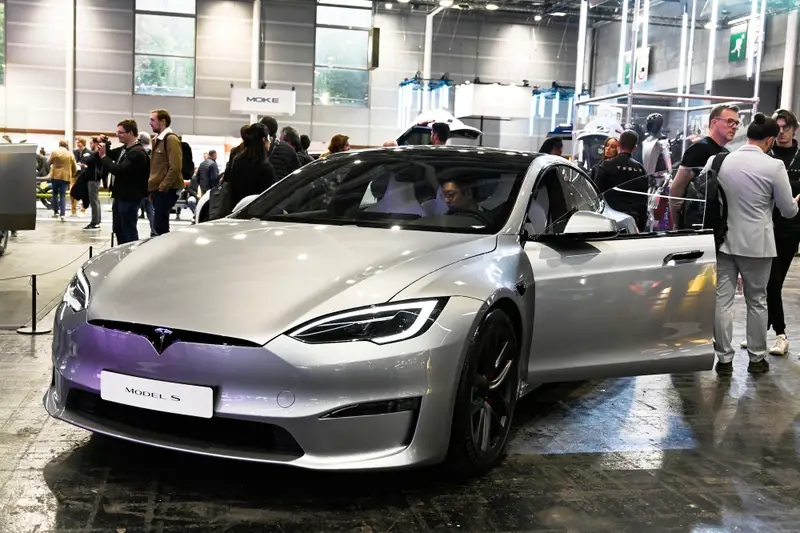
1. The Data Behind the Shift: What the Numbers Actually Say
Volkswagen’s Rise vs. Tesla’s Plateau
By the end of 2025, Volkswagen Group—which includes Volkswagen, Audi, Škoda, Cupra, and Porsche—had surpassed Tesla in total battery electric vehicle registrations across Europe. Importantly, this leadership came not from a single breakout model but from portfolio depth.
Tesla still sold very large volumes of Model Y and Model 3, but Volkswagen’s cumulative strength across multiple segments proved decisive.
Key data trends observed across Europe:
-
Tesla registrations declined year-over-year in several major markets
-
Volkswagen Group EV registrations increased steadily
-
Market share shifted even as total EV adoption continued growing
This distinction is critical: Europe did not stop buying EVs—it simply diversified away from a single dominant brand.
Regional Variations Tell the Real Story
Tesla remained strong in certain regions, especially:
-
Norway and parts of Scandinavia
-
Fleet-heavy urban markets
However, declines were pronounced in:
-
Germany
-
France
-
The UK
-
Southern Europe
These are price-sensitive, policy-driven markets where purchasing behavior is heavily influenced by incentives, leasing structures, and local manufacturing presence.
2. Why Tesla Lost Market Share Without “Failing.”
Tesla’s European slowdown was not caused by one fatal mistake. Instead, it was the cumulative effect of several overlapping pressures.
2.1 Aging Product Cycles
By European standards, Tesla’s core lineup began to feel familiar:
-
Model 3 was first launched in Europe in 2019
-
Model Y arrived in 2021
While software updates kept vehicles feeling modern, European buyers place a high value on visible refresh cycles, interior redesigns, and trim differentiation—areas where Tesla historically moves more slowly.
Volkswagen, by contrast, refreshed:
-
Interior materials
-
Infotainment layouts
-
Trim levels
-
Battery configurations
Even small changes helped maintain consumer interest.
2.2 Incentive Policy Shifts Hit Tesla Harder
Several European countries revised or reduced EV subsidies in 2024–2025. Tesla, positioned as a premium-leaning brand, was disproportionately affected.
In Germany and France:
-
Incentives favored locally manufactured vehicles
-
Price caps excluded higher-trim Teslas
-
Fleet incentives shifted toward multi-brand OEMs
Volkswagen benefited from local production and government alignment, particularly in Germany.
2.3 European Consumer Psychology Is Different
Unlike U.S. buyers, European consumers often prioritize:
-
Brand heritage
-
Interior quality
-
Physical controls
-
Dealer and service proximity
Tesla’s minimalist design philosophy—celebrated in the U.S.—has always been polarizing in Europe.
Volkswagen didn’t need to “out-Tesla Tesla” on software. It only needed to be:
-
Good enough on range
-
Familiar in feel
-
Easy to service
3. Volkswagen’s Strategy: Why It Worked in Europe
3.1 Portfolio Breadth Beats a Single Bestseller
Volkswagen didn’t rely on one hit model. Instead, it spread volume across:
-
Compact EVs
-
Family SUVs
-
Performance trims
-
Premium brands (Audi, Porsche)
This allowed VW to absorb demand fluctuations without losing total volume.
Tesla, by contrast, still relies heavily on:
-
Model Y
-
Model 3
Any slowdown in those two models has an outsized impact.
3.2 Manufacturing Close to the Customer
European buyers are increasingly sensitive to:
-
Supply chain localization
-
Political stability
-
Regional employment impact
Volkswagen’s European factories became a selling point—especially in Germany.
Tesla’s Berlin Gigafactory helped, but production scale and trim availability lagged behind expectations during critical periods.
3.3 Pricing and Leasing Flexibility
Volkswagen excelled at:
-
Aggressive leasing deals
-
Fleet-focused pricing
-
Corporate sales channels
Tesla’s direct-to-consumer model, while efficient, remains less flexible in markets where leasing dominates private ownership.
4. The Competitive Landscape Tesla Now Faces in Europe
Legacy OEMs Are No Longer “Catching Up”
By 2025, the narrative of legacy automakers trailing Tesla became outdated. In Europe:
-
Software gaps narrowed
-
Charging networks diversified
-
Reliability concerns diminished
Volkswagen doesn’t need to innovate faster than Tesla—only to innovate consistently.
The Chinese Factor
Chinese EV brands accelerated their European entry:
-
Aggressive pricing
-
High feature density
-
Rapid refresh cycles
While not yet dominant, they apply downward pressure on pricing, making Tesla’s margins harder to defend.
Regulatory Complexity Is Increasing
Upcoming EU regulations on:
-
Battery sourcing
-
Software compliance
-
Data sovereignty
These disproportionately affect global brands like Tesla, while local OEMs benefit from regulatory familiarity.
5. What This Means for Tesla Owners and Buyers
For Current Tesla Owners
-
Tesla vehicles remain technologically competitive
-
Supercharger access continues to be a major advantage
-
Software updates still differentiate Tesla from most rivals
However:
-
Resale values may normalize
-
Exclusivity perception is fading
-
Competition in service quality is increasing
For Prospective Buyers
European buyers now have:
-
More credible alternatives
-
Better price segmentation
-
Comparable charging convenience
Tesla must increasingly win on value, not novelty.
Implications for the U.S. Market
While Europe differs from the U.S., the lesson is transferable:
-
Market leadership is not permanent
-
Portfolio depth matters
-
Refresh cadence matters
What happens in Europe often foreshadows competitive dynamics elsewhere.
Conclusion: Tesla Isn’t Losing—The Market Is Maturing
Volkswagen overtaking Tesla in Europe does not signal Tesla’s decline. It signals the end of Tesla’s uncontested dominance.
Tesla remains:
-
A technology leader
-
A software benchmark
-
A charging infrastructure pioneer
But Europe has entered a phase where:
-
Choice matters more than disruption
-
Familiarity matters alongside innovation
-
Price, policy, and practicality outweigh hype
For Tesla to regain momentum in Europe, the path forward likely includes:
-
Faster refresh cycles
-
Greater trim diversity
-
More region-specific strategy
The EV revolution didn’t slow down—it simply grew up.
FAQ
Why did Tesla lose market share in Europe without collapsing in sales?
Because overall EV demand grew while competitors captured incremental buyers, Tesla once dominated.
Is Tesla still competitive in Europe in 2026?
Yes, but competition is now structural rather than transitional.
Does this affect Tesla’s long-term future?
Only if Tesla fails to adapt, the brand still holds strong technological and infrastructure advantages.
Will Tesla regain the top spot in Europe?
Possible—but it will require strategic changes rather than relying on past strengths alone.