
Chapter 1: The Blueprint in the Zoning Office
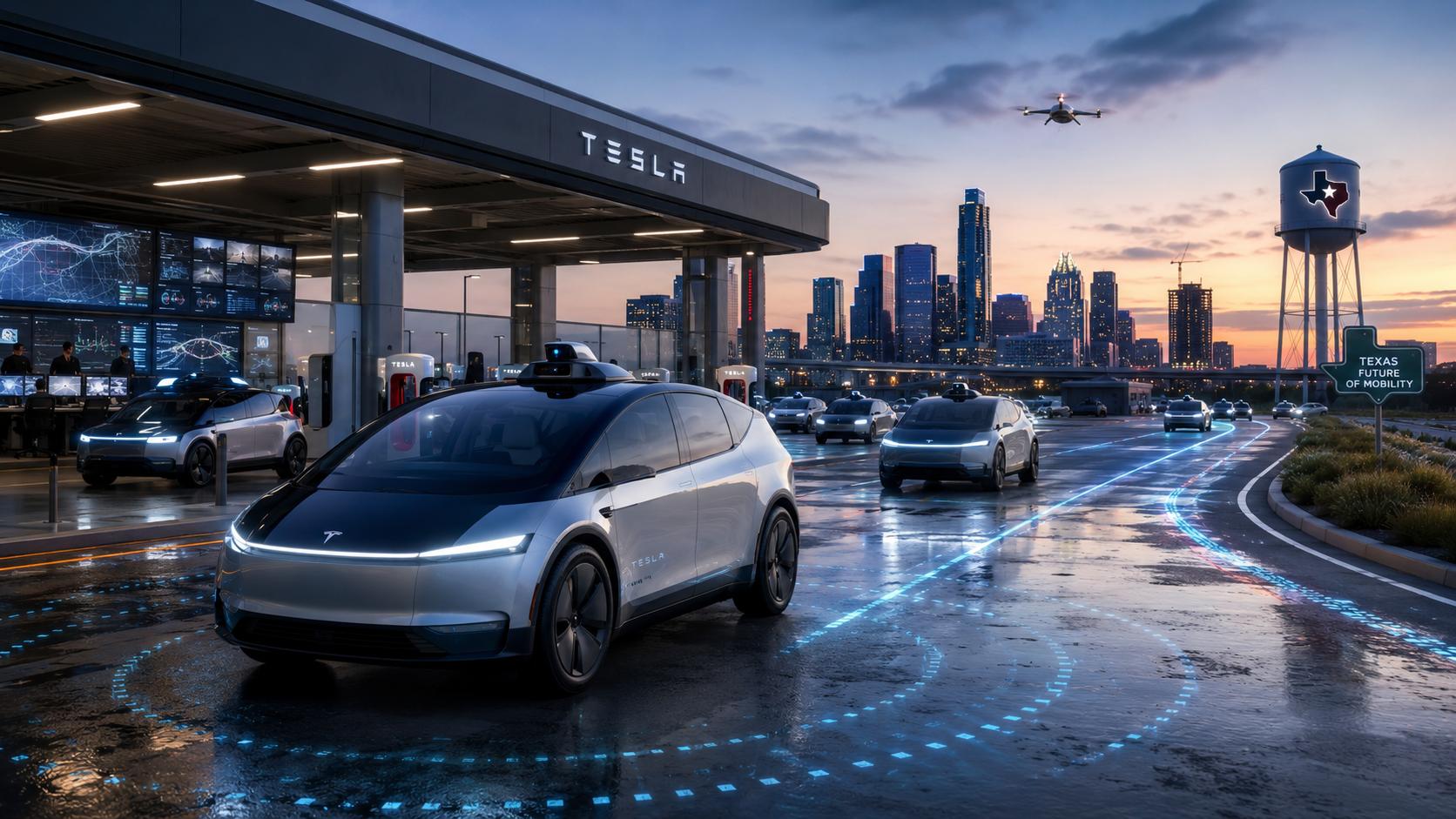
In mid-May 2026, Tesla infrastructure tracker MarcoRP uncovered a set of planning documents filed with the City of Irving, Texas. The documents describe a 24-acre property being converted into what appears to be Tesla’s first purpose-built robotaxi fleet center. The plans call for a 35,049-square-foot warehouse repurposed to handle fleet dispatch, vehicle servicing and repairs, and cleaning and detailing operations. The site includes 212 parking spaces dedicated to autonomous vehicles, along with an additional 64 spaces for staff parking, 17 of which are equipped with EV chargers.
Separate documents reveal a parallel facility being developed in Nevada, suggesting that Irving is not a one-off but the template for a national network. The Irving site, located on West Royal Lane in the Dallas-Fort Worth metroplex, positions Tesla’s physical infrastructure at the heart of its Texas robotaxi operations, which currently span Austin, Dallas, and Houston.
The significance of this development extends far beyond a single warehouse. Since launching its robotaxi service in Austin in June 2025, Tesla has relied on ad hoc infrastructure: vehicles parked in general lots, serviced at existing Tesla centers, and dispatched without a dedicated hub. The Irving facility represents the transition from a pilot program to an operational business—one that requires 24/7 fleet management, rapid turnaround maintenance, and the kind of logistics infrastructure that companies like Amazon and UPS have spent decades perfecting.
Chapter 2: The State of the Fleet: Small Numbers, Big Ambitions
As impressive as the Irving plans may be, the current reality of Tesla‘s robotaxi fleet is notably modest. According to data from the independent Robotaxi Tracker platform, Tesla’s unsupervised fleet across all three Texas cities totaled just 25 vehicles as of late April 2026: 19 in Austin, 3 in Dallas, and 3 in Houston.
To put those numbers in perspective: Alphabet‘s Waymo now operates well over 3,000 robotaxis across ten US cities, completes more than 500,000 paid rides per week, and recently raised $16 billion to fund overseas expansion into London and Tokyo. Tesla’s entire unsupervised fleet would fit in a single parking lot at a Waymo depot.
However, the total fleet is larger when supervised vehicles are included. In Austin alone, estimates place the full robotaxi fleet, including those with safety drivers present, at approximately 45 to 50 vehicles. The Dallas and Houston services, both launched on April 18, 2026, each began with a single vehicle and expanded to three by the end of the month.
Elon Musk has acknowledged the slow pace. During Tesla‘s Q1 2026 earnings call, he stated that large-scale unsupervised deployment will not proceed until the release of FSD Version 15, which will involve an architectural overhaul of the software system. The timeline for V15 is late 2026 at the earliest and early 2027 at the latest. This effectively means that significant fleet scaling, the kind that would fill the 212 parking spaces planned for Irving, is still at least a year away.
Chapter 3: The Safety Question: Crashes, Teleoperators, and Redacted Reports
No discussion of Tesla’s robotaxi ambitions is complete without a sober examination of the safety record to date. Between the Austin launch in June 2025 and mid-January 2026, Tesla’s robotaxis logged 14 crashes over an estimated 800,000 cumulative paid miles. This translates to a rate of approximately one incident every 57,000 miles.
For context, Tesla‘s own Vehicle Safety Report benchmarks the average US human driver at one minor collision per 229,000 miles. The robotaxi fleet’s rate is therefore roughly four times worse than a typical human driver by Tesla‘s own metric. Independent estimates using police data place the gap closer to nine times.
All 14 of those crashes occurred with trained safety monitors physically present in the vehicles. The injuries were generally minor. But the circumstances revealed by newly unredacted NHTSA filings in mid-May 2026 raise troubling operational questions.
At least two incidents involved a teleoperator remotely controlling the vehicle when it encountered a situation it could not resolve. In one case from January 2026, the automated system stopped on a street and a remote operator assumed control after the safety monitor requested navigation support. The remote driver then collided with a temporary construction barricade at 9 miles per hour. Another incident involved a robotaxi making an unprotected left turn into a parking lot and colliding with a metal chain.
Critically, Tesla breaks with every other autonomous vehicle operator in the United States by redacting the narrative sections of its NHTSA crash reports, citing business confidentiality. This practice makes independent assessment of fault or preventability effectively impossible, and it has drawn sharp criticism from safety advocates and industry analysts alike.
Chapter 4: The Cybercab Factor: Purpose-Built for a Driverless World
The Irving facility is not designed for Tesla‘s current fleet of modified Model Y vehicles. It is designed for the Cybercab: a purpose-built, two-seat autonomous vehicle with no steering wheel, no pedals, and no manual controls of any kind.
The first production Cybercab rolled off the line at Gigafactory Texas on February 17, 2026, and continuous production officially began in April. Elon Musk has described an ambitious ramp-up, with production following an elongated S-curve that should reach exponential growth by late 2026. Tesla’s ultimate production target for the Cybercab is an annual output of two million units, positioning it as the highest-volume vehicle in the company‘s history.
The Cybercab is also a landmark in regulatory innovation. Tesla is pursuing a self-certification pathway to bypass the United States’ annual cap of 2,500 vehicles that can be sold without meeting certain Federal Motor Vehicle Safety Standards that assume the presence of a human driver. This regulatory maneuver, if successful, could give Tesla a significant advantage over competitors who must navigate more traditional approval processes.
The economics of a purpose-built robotaxi are compelling. With no steering wheel, no pedals, no driver display, and a minimalist two-seat design, the Cybercab‘s manufacturing cost is expected to be dramatically lower than any vehicle Tesla currently produces. Analyst firm ARK Invest has estimated that the Cybercab could be approximately 50 percent less expensive per mile than Waymo’s sixth-generation robotaxi, which is built on a modified Jaguar I-Pace platform. This cost advantage could be decisive in the price-sensitive ride-hailing market.
Chapter 5: The Competitive Landscape and the $25 Billion Bet
Tesla‘s pivot to robotaxis comes with a staggering price tag. The company’s 2026 capital expenditure plan has ballooned to over $25 billion, roughly three times what it spent in 2025. The vast majority of this spending is directed toward AI computing infrastructure, the Cybercab production line, and the Optimus humanoid robot program.
Meanwhile, Tesla‘s Q1 2026 financial results provide a mixed picture. Revenue rose 16 percent year-over-year to 22.4billion, with adjusted earnings per share of 0.41 beating analyst estimates. Gross margin reached 21.1 percent, the strongest reading in several quarters. However, vehicle deliveries of 358,023 units missed Wall Street expectations of 365,600, and production exceeded deliveries by roughly 50,000 units—indicating potential demand softness in Tesla’s core automotive business.
The competitive pressure is intensifying. Waymo‘s market lead is substantial: over 3,000 vehicles, 10 cities, and a weekly ride volume that dwarfs Tesla’s cumulative figures. In February 2026, Waymo raised $16 billion to fund its own expansion, including a partnership with Avis Budget Group to deploy robotaxis in Dallas. Former Uber CEO Travis Kalanick has stated that Waymo is "obviously" ahead of Tesla in the robotaxi race.
But Tesla holds one potentially decisive advantage: vertical integration. Waymo must purchase vehicles from Jaguar or Geely and outfit them with its proprietary sensor and software suite. Tesla builds its own vehicles, its own AI chips, its own training infrastructure, and soon its own fleet operations centers. If Tesla can execute on its vision, the cost structure advantage could be overwhelming. A single receipt from Tesla‘s Dallas robotaxi service showed a 2.25-mile trip costing 6.15, 13.93 that Waymo quoted for the identical route
Chapter 6: The Texas Regulatory Environment: A Double-Edged Sword
Texas has been the friendliest jurisdiction for Tesla’s robotaxi ambitions, but even that welcome is becoming more structured. Governor Greg Abbott signed Senate Bill 2807 into law, and it takes effect on May 28, 2026. The law requires all commercial autonomous vehicle operators to obtain state authorization through the Texas Motor Carrier Credentialing System, meet specified safety standards, and face permit revocation if public safety is at risk.
Tesla has been operating under a Transportation Network Company license granted by the Texas Department of Licensing and Regulation in August 2025, valid until August 6, 2026. The company will need to demonstrate compliance with the new law‘s requirements when that license comes up for renewal.
The new law also explicitly accommodates vehicles like the Cybercab. It approves the removal of traditional controls such as steering wheels and brake pedals for autonomous vehicles designed to operate entirely without a human driver. This provision, quietly included in the legislation, represents a significant regulatory milestone for Tesla’s purpose-built robotaxi strategy.
Chapter 7: The Expansion Roadmap: Promises and Reality
Tesla‘s official robotaxi expansion roadmap targets seven additional cities by mid-2026: Phoenix, Miami, Orlando, Tampa, Las Vegas, and two as-yet-unnamed locations. However, Electrek reported in late April that Tesla has already pushed back the timeline for at least five of these cities. As of late May, only the three Texas cities—Austin, Dallas, and Houston—are operational.
Musk’s public statements on expansion have been characteristically ambitious. Speaking at a summit in Israel on May 18, he claimed Tesla’s robotaxi service would be "widespread in the U.S. by the end of the year". This follows earlier predictions that robotaxis would cover half the US mainland by the end of 2025—a prediction that did not materialize.
Yet, for all the delays and overpromises, there are genuine signs of progress. On May 4, 2026, Tesla’s Austin robotaxi fleet began operating unsupervised during evening hours for the first time, moving beyond the daylight-only restrictions that had previously been in place. This is a technically significant milestone: nighttime driving presents unique challenges including diminished visibility, headlight glare, reduced contrast for identifying pedestrians and lane markings, and greater variability in camera sensor exposure.
The successful expansion into nighttime operations validates the robustness of Tesla‘s pure vision approach and its end-to-end neural network architecture in handling low-light conditions. It also carries important economic implications: evening hours often coincide with peak urban demand for rides, including dinner commutes and entertainment outings. Each additional operational hour increases daily vehicle utilization, generating more revenue and more high-value training data.
Conclusion: The Warehouse That Points to the Future
The Irving Robotaxi hub is not glamorous. It is a 35,000-square-foot warehouse on an industrial lot in suburban Texas. But in the story of autonomous mobility, it may prove more significant than any concept car, software demo, or earnings call proclamation.
Physical infrastructure is the "tell" of genuine commitment. When a company starts pouring concrete, leasing 24-acre properties, and submitting zoning applications for fleet dispatch centers, it is signaling—more credibly than any press release—that it expects a significant volume of real-world operations. The 212 vehicle parking spaces planned for Irving are not aspirational; they are a capacity forecast.
Yet the gap between today’s fleet of 25 unsupervised vehicles and the infrastructure being built for hundreds remains vast. Tesla’s robotaxi program is caught between two timelines: the slow, careful timeline of safety validation, regulatory approval, and software maturity; and the urgent timeline of a company that has bet $25 billion on an AI-powered future. The Irving warehouse is ready. The question is when the fleet will be.
For Tesla owners, investors, and competitors, the message is clear. The robotaxi era is no longer a distant promise. It is a physical construction project, with real permits, real square footage, and real parking spaces. Whether Tesla can fill those spaces with safe, reliable, profitable autonomous vehicles is the defining question of the company’s next chapter.
FAQ: Tesla‘s Robotaxi Operations and the Irving Hub
Q1: When will Tesla’s robotaxi service be available outside of Texas?
Tesla has announced plans to expand to Phoenix, Miami, Orlando, Tampa, and Las Vegas during the first half of 2026, but timelines for at least five cities have already been pushed back. The current operational cities are Austin, Dallas, and Houston.
Q2: What is a Robotaxi operations hub, and why does it matter?
A robotaxi hub is a dedicated facility for fleet dispatch, vehicle maintenance, cleaning, charging, and storage. It enables 24/7 fleet operations and represents the transition from a pilot program to a scalable business. The Irving facility is Tesla’s first of its kind.
Q3: How does Tesla’s robotaxi fleet compare to Waymo’s?
Waymo operates over 3,000 vehicles across 10 US cities and completes more than 500,000 paid rides per week. Tesla‘s unsupervised fleet currently consists of approximately 25 vehicles across three Texas cities.
Q4: Is Tesla’s robotaxi service safe?
The fleet‘s crash rate is approximately one incident per 57,000 miles—roughly four times worse than the average human driver by Tesla’s own benchmarks. All crashes have occurred with safety monitors present, and injuries have been minor.
Q5: What is the Cybercab, and when will it be deployed?
The Cybercab is Tesla‘s purpose-built robotaxi: a two-seat vehicle with no steering wheel, no pedals, and no manual controls. Production began in April 2026 at Gigafactory Texas, and large-scale deployment depends on the release of FSD Version 15.