
Introduction
1.1 The Announcement of the JUNI x Tesla Battery Cell Giga Challenge
On July 6, 2026, Tesla Inc. sent shockwaves through the global clean energy and industrial manufacturing sectors by officially launching the JUNI x Tesla Battery Cell Giga Challenge. This unprecedented, open-source industrial competition marks a radical departure from Tesla's traditionally insular, highly secretive internal engineering paradigm. Organized in close collaboration with JUNI, Europe's premier industrial acceleration consortium, the challenge represents a structured global call to arms targeting advanced technology startups, university research laboratories, and specialized robotics firms worldwide.
The primary objective of this initiative is to crowd-source immediate, scalable solutions to the lingering mechanical and chemical bottlenecks that continue to limit high-yield throughput of Tesla’s large-format structural battery cells. The incentive structure is immensely lucrative: top-performing entities will secure immediate deployment access within paid production pilots, with the direct backing of a massive $250 million corporate investment fund specifically earmarked to scale the battery manufacturing infrastructure at Gigafactory Berlin-Brandenburg.
1.2 Capital Allocation: Target Metrics for Grünheide
The $250 million capital allocation announced under this challenge is explicitly targeted at transforming Giga Berlin’s localized battery cell manufacturing wing into the most advanced, highly efficient energy production facility on the European continent. Currently, while the vehicle assembly lines at the Grünheide site operate at highly optimized velocities, the internal battery cell production lines have struggled to maintain a matching pace, frequently requiring the importation of cell components or sub-assemblies from Tesla’s domestic facilities in Austin and Sparks.
Tesla’s explicit engineering mandate for this $250 million injection is to rapidly scale Giga Berlin's localized output to a stable, continuous run-rate of 18 GWh of annual 4680 cell production. Achieving an 18 GWh structural cell run-rate will provide Giga Berlin with complete regional cell independence, allowing the facility to manufacture over 200,000 long-range vehicles annually without relying on vulnerable trans-oceanic raw material links or third-party cell suppliers.
1.3 Strategic Goal: Transatlantic Autonomy
This massive financial bet is not merely an exercise in manufacturing scaling; it is a calculated geopolitical move. By completely localizing the entire battery manufacturing lifecycle—from raw material processing to final cell assembly—within the borders of Germany, Tesla is effectively insulating its European operations from escalating global trade disputes, maritime shipping vulnerabilities, and unpredictable supply chain disruptions.
2. Deconstructing the 4680 Structural Cell: Why Scale Remains Elusive
2.1 The Chemistry and Mechanics of Dry Battery Electrode (DBE) Processing
To understand why Tesla is willing to deploy a quarter of a billion dollars to acquire external startup expertise, one must confront the extreme physics governing the manufacture of the 4680 cell format. Introduced as a revolutionary cornerstone of Tesla's long-term cost-reduction roadmap, the 4680 cell (measuring 46mm in diameter by 80mm in height) relies fundamentally on a breakthrough manufacturing technique known as Dry Battery Electrode (DBE) processing.
In traditional lithium-ion battery manufacturing, the active chemical materials (the cathode and anode formulations) are mixed into a wet, liquid slurry utilizing toxic chemical solvents like N-Methyl-2-pyrrolidone (NMP). This wet mixture is then coated onto long sheets of current collector foil and fed into massive, energy-intensive drying ovens that stretch hundreds of feet across the factory floor. These ovens evaporate the solvent, leaving behind a dry chemical coating. This legacy process is incredibly slow, consumes immense amounts of electrical energy, and requires massive physical factory real estate.
Tesla’s DBE process completely eliminates liquid solvents. Instead, the active chemical powders are mixed directly with a binding polymer (such as PTFE) in a dry state. High-shear industrial machinery presses this dry powder mixture into a continuous, self-supporting film sheet. This dry chemical film is then laminated directly onto the current collector foil in a single, high-speed continuous motion. By bypassing the slurry mixing and oven drying phases completely, DBE reduces battery manufacturing energy consumption by up to 85%, shrinks the required factory floor footprint by 70%, and dramatically lowers the baseline cost per kilowatt-hour.
2.2 The Yield Problem: Deconstructing Mechanical Defects
While the theoretical advantages of DBE processing are revolutionary, the real-world execution introduces immense mechanical complexity. The primary obstacle preventing Giga Berlin from reaching its 18 GWh output target is the high rate of mechanical defects during high-speed continuous production, leading to low manufacturing yields.
During the dry powder calendering process—where high-pressure rollers compress the dry powder mixture into a hyper-thin film—the mechanical forces involved are extreme. If the density of the dry powder mixture varies by even a fraction of a percent across the width of the roller, the resulting film will suffer from structural inconsistencies, leading to localized micro-cracks, tearing, or uneven thickness profiles. Furthermore, because the dry film is incredibly brittle before lamination, managing web tension as the film travels through high-speed automation machinery at meters per second requires an unmatchable level of precision. Any sudden micro-jerk in the mechanical transport system causes the film to snap, instantly halting the entire production line and requiring manual intervention to re-thread the machinery.
2.3 The European Regulatory and Tariff Imperative
The urgency to solve these yield issues at Giga Berlin is magnified by the rapidly changing trade policies of the European Union. Throughout 2025 and into mid-2026, European regulatory bodies have systematically implemented aggressive tariff structures targeting imported battery cells and electric vehicles manufactured outside the bloc.
Furthermore, the EU's strict Battery Passport regulations mandate comprehensive, traceable verification of a cell's carbon footprint across its entire production lifecycle. Vehicles featuring battery cells manufactured using energy-intensive, fossil-fuel-backed wet processes in foreign markets face severe financial penalties when sold within the EU. By scaling local Giga Berlin 4680 cell production utilizing the ultra-clean, solvent-free DBE process backed by Germany’s regional renewable energy grid, Tesla can fully comply with European environmental laws, escape all import tariff penalties, and maintain a highly competitive retail pricing edge over foreign automakers.
3. The Open Innovation Strategy: Startups and the JUNI Partnership
3.1 The Paradigm Shift in Tesla's Corporate Culture
For over a decade, Tesla’s corporate identity was anchored in absolute vertical integration. The company famously preferred to design its own robotics, write its own manufacturing software, and engineer its own factory automation tools from scratch, viewing external industrial suppliers as slow and technologically conservative.
However, the persistent scaling challenges of the dry electrode manufacturing process have forced an important evolution in this corporate culture. The launch of the JUNI x Tesla Battery Cell Giga Challenge signifies that Tesla’s leadership now recognizes that specialized breakthroughs in material science, microscopic computer vision, and niche AI optimization often occur faster within agile, hyper-focused technology startups and academic labs. By partnering with JUNI, Tesla gains immediate access to a pre-vetted network of European deep-tech innovators, creating an open-innovation pipeline that allows the company to rapidly absorb external breakthroughs and apply them directly to its active production lines.
3.2 Core Operational Categories of the Challenge
The JUNI Giga Challenge is meticulously structured into four critical operational vectors, each targeting a specific bottleneck within the Grünheide cell manufacturing wing:
-
Category 1: Advanced Material Formulation & Synthesis – Seeking novel dry binding polymers and optimized active material particle geometries that enhance the tensile strength and flexibility of the dry film before lamination.
-
Category 2: High-Speed Precision Automation & Web Handling – Developing next-generation mechanical transport systems, air-bearing rollers, and ultra-low-inertia motors capable of handling highly brittle dry films without causing tension-induced fractures.
-
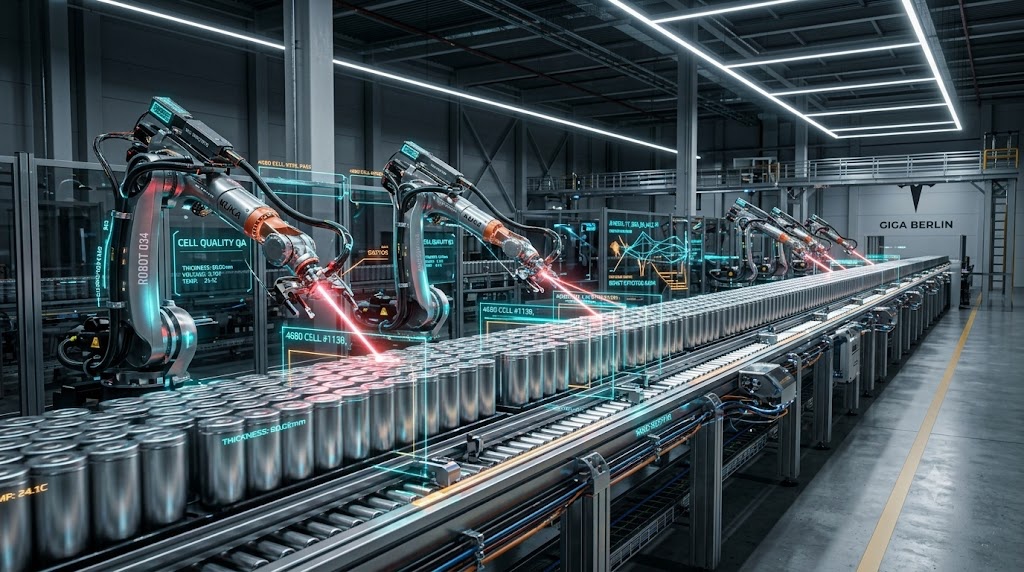
Category 3: Real-Time Computer Vision & Quality Assurance – Implementing hyper-spectral imaging arrays and deep-learning visual inspection models to detect microscopic surface micro-cracks and density variations at production speeds exceeding 2 meters per second.
-
Category 4: Operational AI & Closed-Loop Control Systems – Designing predictive neural networks capable of analyzing upstream powder characteristics and instantaneously adjusting downstream roller pressures to maintain uniform film thickness.
3.3 Timeline, Incentives, and Paid Pilot Mechanics
The timeline for the JUNI x Tesla Giga Challenge is aggressively compressed, reflecting the high-stakes nature of the 18 GWh scaling initiative. The global application portal closes definitively on July 24, 2026. Following a rapid, multi-stage vetting process conducted by a joint panel of Tesla battery manufacturing specialists and JUNI technical directors, selected finalists will be flown directly to Giga Berlin in August for active physical validation trials.
The incentives are uniquely structured to attract high-tier commercial entities. Rather than offering trivial prize money, Tesla is granting winning startups direct access to paid integration pilots on Giga Berlin's operational lines. Startups will have their technologies validated using real production equipment, with direct engineering support from Tesla's core automation teams. Furthermore, companies that successfully prove their scaling viability will unlock direct equity investments and long-term procurement contracts backed by the $250 million corporate fund, effectively integrating them into Tesla's permanent global supply chain architecture.
4. AI and Machine Learning in Battery Manufacturing Automation
4.1 Real-Time Anomaly Detection via Hyper-Spectral Vision
One of the most immediate use cases for advanced AI within the Giga Berlin cell facility is the deployment of high-speed, multi-spectrum computer vision systems for real-time anomaly detection. Traditional manual inspection or basic optical cameras are fundamentally incapable of identifying the subtle sub-surface density variations and micro-voids that can destabilize a dry electrode film.
By installing hyper-spectral camera arrays directly over the active lamination lines, the system can continuously scan the moving film across multiple wavelengths of light. The massive influx of pixel data is processed at the edge using custom-trained convolutional neural networks (CNNs). These AI models are trained on millions of historical manufacturing frames to instantly recognize the exact visual signatures that precede a structural film tear or indicate a localized chemical clustering defect. The moment a defect signature is detected, the AI flags the exact millimeter coordinate, allowing the automated system to cleanly excise the compromised segment or alert operators before the defective film is wound into a completed cell casing.
4.2 Predictive Maintenance of Calendering Rollers via Edge Sensor Fusion
The industrial rollers used in dry battery processing are subjected to continuous mechanical pressures measured in tens of thousands of Newtons, paired with precise thermal activation cycles. Over time, microscopic wear on the roller surfaces or minor bearing misalignments can introduce catastrophic variations into the dry film thickness profile.
To prevent unscheduled downtime, the upgraded Giga Berlin lines are integrating advanced edge-computing sensor fusion nodes directly onto the rolling mills. These nodes collect high-frequency acoustic emission data, localized vibration vectors, and spatial thermal maps simultaneously. A localized machine learning algorithm analyzes this combined telemetry stream in real time. By identifying subtle patterns of harmonic distortion or localized thermal friction spikes that human operators cannot perceive, the AI can accurately predict mechanical component degradation weeks before an actual failure occurs, automatically scheduling maintenance windows during natural factory shifts.
4.3 Closed-Loop Optimization Networks
The ultimate evolution of AI within the cell manufacturing wing is the implementation of fully autonomous, closed-loop optimization networks. In a traditional factory setup, if an inspection system detects that the completed battery film is tracking slightly outside of thickness tolerances, a human engineer must manually adjust the machine settings, a process that introduces significant delays and material waste.
Under the closed-loop paradigm, a central deep reinforcement learning (DRL) network acts as the master operational controller. The AI continuously receives real-time thickness metrics from the downstream laser gauges while simultaneously tracking upstream powder flow rates and environmental humidity levels. Utilizing a sophisticated mathematical model of the calendering physics, the DRL network makes continuous, micro-adjustments to the roller hydraulic pressures, actuator positions, and thermal heaters hundreds of times per minute. This instantaneous feedback loop ensures that the production process remains locked inside optimal performance boundaries regardless of minor variations in raw material inputs, maximizing manufacturing yields and accelerating progress toward the 18 GWh goal.
5. Global Battery Politics & Environmental Impacts
5.1 Eliminating Toxic Solvents via Dry Processing
The transition to wide-scale 4680 cell manufacturing via dry processing carries massive positive implications for the regional environment surrounding the Grünheide complex. For years, environmental activists throughout Germany raised concerns regarding Gigafactory Berlin’s potential impact on the local water table and regional ecosystems, leading to prolonged legal disputes and public relations friction.
Traditional battery manufacturing plants represent a severe environmental footprint due to their heavy reliance on toxic NMP solvents, which require strict industrial capture systems to prevent hazardous atmospheric release or groundwater contamination. By deploying a completely solvent-free dry electrode production pipeline, Giga Berlin eliminates NMP from its facility entirely. The environmental hazard profile drops to near zero, allowing Tesla to present the Grünheide facility as a true model of clean, sustainable industrial manufacturing that aligns perfectly with the highest standards of European environmental protection.
5.2 Supply Chain Resilience Against Global Geopolitical Chokepoints
On a global macroeconomic scale, battery manufacturing remains heavily concentrated within highly centralized geographic corridors, primarily across East Asia. This concentration introduces severe geopolitical risks for Western automakers, who remain vulnerable to sudden raw material export restrictions, graphite sorting controls, and mineral processing blockades.
Tesla's aggressive scaling of its independent 4680 cell infrastructure at Giga Berlin represents a major structural insulation strategy. By acquiring the technical capability to process raw lithium, nickel, and cathode powders into high-performance structural cells entirely within Germany, Tesla effectively decouples its European vehicle production machine from foreign geopolitical choke points. Even if global transport links face prolonged disruptions, Giga Berlin can maintain its vehicle delivery commitments by relying on localized European mineral sourcing partnerships, securing long-term operational survival in an increasingly volatile global trade environment.
Conclusion
6.1 Giga Berlin as an Independent Industrial Microcosm
The launch of the JUNI x Tesla Battery Cell Giga Challenge, backed by an immediate $250 million investment allocation, marks a critical inflection point for Tesla's European operations. Grünheide is rapidly evolving from a pure vehicle assembly outpost into an independent, highly resilient industrial microcosm capable of pioneering the world's most advanced, AI-driven energy storage manufacturing techniques.
6.2 The Strategic Horizon of the Giga Challenge
By welcoming external startup innovators and leveraging cutting-edge machine learning optimization models, Tesla is systematically dismantling the complex mechanical barriers that have slow-walked the scaling of the 4680 cell platform. If the JUNI partnership achieves its targeted 18 GWh annual production run-rate over the coming quarters, it will secure complete regional independence for Giga Berlin, insulate Tesla from punitive European import tariffs, and establish a highly optimized, environmentally pristine manufacturing template that will define the future of global automotive mass production.
Frequently Asked Questions (FAQ)
Q1: What exactly is the Dry Battery Electrode (DBE) process, and why is it difficult to scale?
The DBE process completely eliminates the liquid toxic solvents used in traditional battery manufacturing, mixing active chemical powders with a binding polymer to create an electrode film sheet through pure mechanical pressure. It is exceptionally difficult to scale because handling this highly brittle dry film at high production speeds requires an unmatchable level of tension control and precision pressure management, failing which the film fractures and halts production.
Q2: What do startups gain from participating in the JUNI x Tesla Battery Cell Giga Challenge?
Selected startups gain immediate, high-value access to real production equipment inside Gigafactory Berlin to validate their technologies in real-world scenarios. Additionally, successful pilots unlock direct access to paid procurement contracts and venture investments backed by Tesla's specialized $250 million corporate fund, integrating them directly into Tesla's global supply chain.
Q3: How does achieving an 18 GWh capacity impact the pricing of European-made Tesla vehicles?
Reaching an 18 GWh localized cell production run-rate allows Giga Berlin to fully insulate over 200,000 long-range vehicles per year from costly maritime shipping fees and changing European import tariffs. The massive cost reductions achieved through localized dry processing can be passed directly to consumers, allowing Tesla to defend its competitive pricing edge against foreign EV entries.