
Introduction: Two Visions for Giga Texas
The land surrounding Tesla’s Gigafactory in southeastern Austin tells two stories. The first is visible from the highway: a massive industrial complex where Cybertrucks and Model Ys roll off assembly lines, where battery cells are produced, and where thousands of workers clock in each day. The second story is harder to see—etched in site plans, environmental reports, and six-year-old promises.
On March 24, 2026, Tesla filed new site plans with Travis County that attempt to reconcile these two narratives. The documents detail two major initiatives that will shape the future of the Giga Texas campus:
-
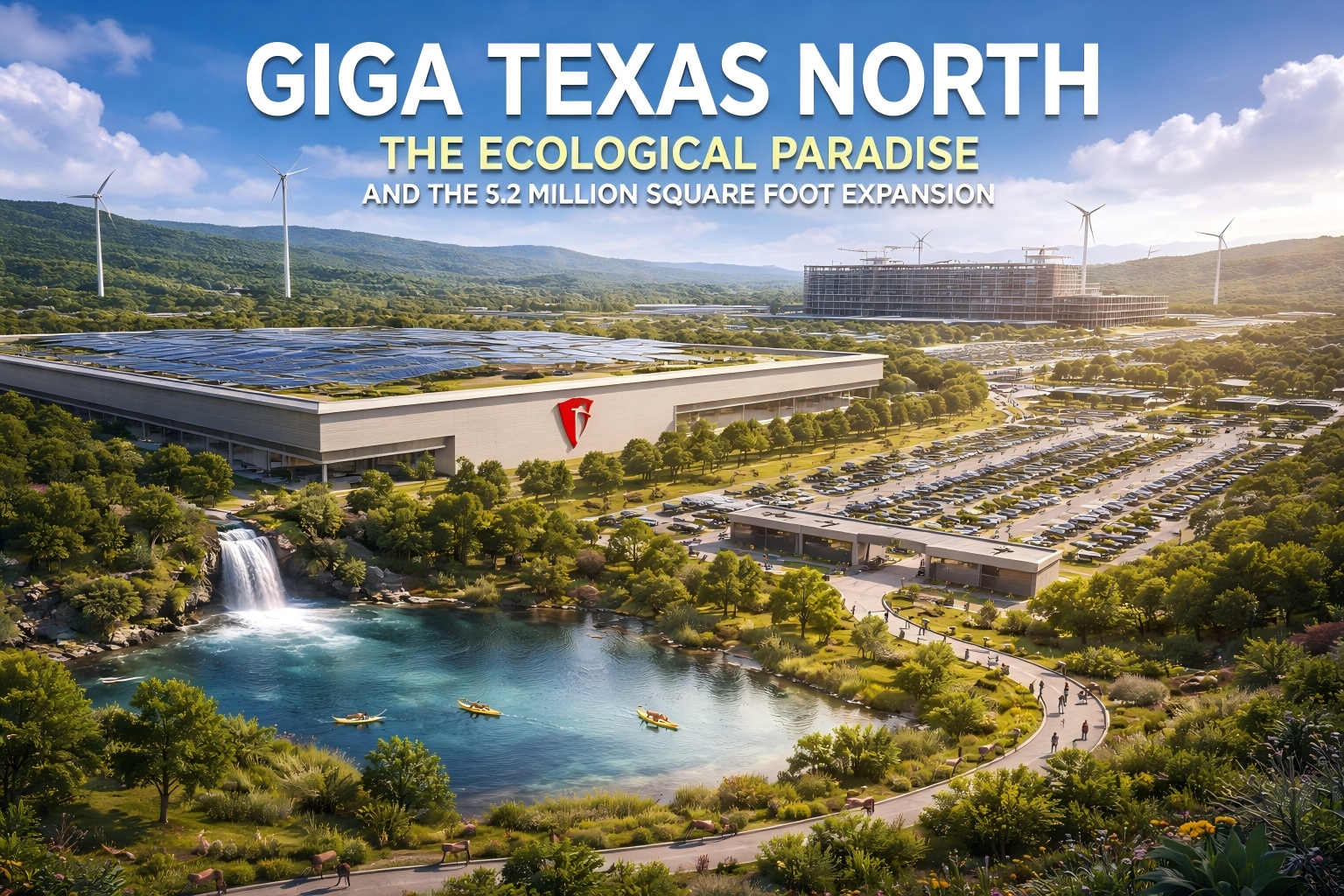
The GFTX Riverfront Eco-Park: A 290-acre public green space along the Colorado River, complete with trails, sports facilities, wetlands, and wildlife corridors—a project Elon Musk first promised in July 2020 would transform the area into an “ecological paradise” with “birds in the trees, butterflies, fish in the stream”.
-
The Terafab North Campus: A 5.2-million-square-foot expansion north of the existing factory, housing the semiconductor fabrication facility announced by Musk on March 21, 2026—a joint venture between Tesla, SpaceX, and xAI targeting 2-nanometer chip production.
These two projects represent competing impulses within Tesla’s growth strategy. One is outward-facing, promising public amenities, environmental restoration, and integration with the surrounding community. The other is purely industrial, expanding manufacturing capacity for the company’s most ambitious technological bets. Whether Tesla can deliver on both—and whether the eco-park finally moves from rendering to reality—will define Giga Texas’s evolution over the next decade.
Chapter 1: The Ecological Paradise – Six Years and Counting
The 2020 Promise
Elon Musk first used the phrase “ecological paradise” during Tesla’s July 2020 earnings call. Describing the area around the then-under-construction Giga Texas, Musk painted a picture of a factory seamlessly integrated with nature: “birds in the trees, butterflies, fish in the stream”. The vision was characteristically Muskian: industrial scale combined with environmental ambition, a manufacturing facility that would also serve as a public amenity.
Six years later, that vision remains largely on paper.
What the 2026 Site Plans Actually Show
According to Tesla’s 2024 annual report to Travis County—filed as a requirement of the company’s Chapter 381 Economic Development Performance Agreement—the eco-park plans include:
Trails and Access:
-
25 miles of walking trails
-
18 miles of biking paths
-
3.78 miles of direct Colorado River access
-
A riverfront boardwalk extending along the property’s waterfront
Green Space and Environmental Features:
-
290 acres of preserved waterfront green space
-
53 areas of expanded wetland for flood mitigation
-
8 wildlife corridors connecting habitat areas
-
A 14.5-mile onsite bioswale for stormwater management
-
3,000 trees planted annually
Recreation Facilities:
-
A sports complex with soccer, baseball, basketball, and tennis facilities
-
Fishing zones along the river
-
A children’s playground
-
A community orchard
Community Impact:
Tesla estimates that 20,000 households will benefit from the park once completed.
The Progress Problem
The numbers are impressive. The execution is not.
When Tesla first presented the eco-park concept to the Travis County Commissioners Court in October 2023, the company claimed it had seeded 46 acres—approximately 16% of the 290-acre vision. Since then, there has been no public evidence of significant construction activity on the eco-park.
This pattern is not new. In 2020, when Electrek first covered Musk’s ecological paradise promise, “the language was identical: grand vision, no timeline”. The gap between Tesla’s site plan renderings and actual delivery has become a recurring theme—on the eco-park, on 4680 battery cell production, and now on the proposed Terafab.
The Environmental Regulation Controversy
In 2024, Tesla used a new Texas law to exempt itself from Austin’s environmental regulations—the same water quality and flood mitigation rules that would apply to a project like the eco-park. Critics argue that this move is inconsistent with Tesla’s stated commitment to building “the region’s largest public ecological park along the Colorado River.”
Electrek’s Fred Lambert, who has covered Tesla for over a decade, expressed frustration with the situation: “Travis County officials should be pressing Tesla for binding milestones, not just accepting another round of beautiful plans with no deadlines. But I don’t see that happening. Like Tesla shareholders, they are focused on the Terafab dream”
Chapter 2: The Terafab North Campus – 5.2 Million Square Feet of New Industry
The Permit Filings
The March 13, 2026, permit application for “Tesla North Campus,” submitted to the Travis County Fire Marshal, reveals the scale of Tesla’s expansion ambitions. Key details include:
-
Total new building space: Over 5.2 million square feet
-
Initial phase: A 2-million-square-foot research-and-development facility adjacent to the existing Gigafactory
-
Long-term development: The full-scale expansion will eventually require “thousands of acres”
Construction Status
Ground clearing, soil reclamation, and infill operations are already visible north of the existing facility, consistent with the early stages of major foundation work. Drone footage captured over recent months shows earth-moving activity on a scale comparable to the original Giga Texas construction.
Tesla has posted multiple Terafab job listings with Austin as the primary location, indicating that hiring is already underway for the skilled positions the facility will require.
Technical Specifications
The Terafab facility will target 2-nanometer chip production starting in 2027, with an initial capacity of 100,000 wafer starts per month and ambitions to scale to 1 million wafer starts per month at full capacity.
Critical challenges include:
-
EUV Equipment: The extreme ultraviolet lithography machines required for 2nm production are manufactured exclusively by ASML and are back-ordered through 2027.
-
Tesla’s Experience: Tesla has zero semiconductor manufacturing experience, and the company’s history of overpromising on manufacturing timelines warrants skepticism.
-
Scale: A 2nm fab with 1 million wafer starts per month would be the largest ever constructed—by a significant margin.
Chapter 3: The Gap Between Renderings and Reality
A Pattern of Overpromise
The gap between Tesla’s site plan renderings and actual delivery extends beyond the eco-park. Industry observers point to several examples where Tesla’s ambitious plans have encountered reality:
4680 Battery Cells: Promised as a breakthrough in battery manufacturing that would dramatically reduce costs, the 4680 cell has faced persistent production challenges. Years after the initial announcement, Tesla continues to rely on suppliers for a significant portion of its battery needs.
Cybertruck Production: The Cybertruck’s production ramp has been slower than initial projections, with Tesla navigating the complexities of stainless steel exoskeleton manufacturing and 4680 cell supply constraints.
Full Self-Driving: FSD’s timeline has been consistently overpromised, with Musk’s annual predictions of “feature complete” autonomy repeatedly pushed back.
The eco-park follows this pattern. The vision is compelling. The execution has lagged.
The Exemption Question
Tesla’s decision to use a 2024 Texas law to exempt itself from Austin’s environmental oversight raises fundamental questions about the company’s commitment to the eco-park. If Tesla truly intended to build “the region’s largest public ecological park,” why would it seek exemptions from the very regulations designed to protect water quality and manage flood risk?
The answer may lie in prioritization. Giga Texas’s primary function is manufacturing. The eco-park, while a nice amenity, is not essential to Tesla’s core business. When construction resources are constrained—as they inevitably are during periods of rapid expansion—industrial capacity takes precedence over public green space.
What Would Binding Milestones Look Like?
If Travis County officials were to press for binding milestones, they might require:
-
A specific completion date for each phase of the eco-park
-
Quarterly progress reports with photographic evidence
-
Financial penalties for missed deadlines
-
Independent environmental monitoring to ensure compliance
None of these appear to be in place. As Electrek noted, “Travis County officials should be pressing Tesla for binding milestones, not just accepting another round of beautiful plans with no deadlines”.
Chapter 4: The North Campus in Context – Giga Texas’s Evolution
From Vehicle Assembly to Industrial Campus
Giga Texas opened in 2022 as a vehicle assembly plant focused on Model Y production. Since then, the facility has evolved into something far more complex:
-
Cybertruck Production: The factory now produces the Cybertruck, with its unique stainless steel exoskeleton requiring entirely new manufacturing processes.
-
Battery Cell Manufacturing: 4680 cell production occurs on-site, though scaling has been slower than anticipated.
-
Optimus Production: In November 2025, Tesla broke ground on a dedicated Optimus humanoid robot production facility on the east side of the Giga Texas campus. That facility is designed to produce up to 10 million humanoid robots per year once fully ramped.
-
Terafab North Campus: The new semiconductor facility will add chip manufacturing to Giga Texas’s capabilities.
The cumulative effect is transformation. Giga Texas is no longer merely a car factory. It is becoming an integrated industrial campus where vehicles, batteries, robots, and chips are all produced under one roof—or at least within the same sprawling complex.
The Optimus Connection
The timing of Terafab’s announcement relative to the Optimus factory is significant. The Optimus production facility, which began construction in late 2025, is expected to begin initial production in 2027—the same year Terafab’s initial chip production is targeted.
This alignment is not coincidental. The chips produced at Terafab will power Optimus robots. The robot factory will assemble those chips into humanoid machines. Both facilities will share infrastructure, workforce, and management attention. The integration creates the potential for efficiencies—but also multiplies the consequences of any delays.
The xAI Integration
SpaceX’s recent acquisition of xAI and the integration of that entity into the Terafab joint venture adds another dimension. xAI will consume a significant portion of Terafab’s output for AI model training and inference—some of it on Earth, some of it in orbit. Giga Texas becomes not just a manufacturing hub for physical products but a node in Musk’s broader AI infrastructure.
Chapter 5: Community Impact – What the Expansion Means for Austin
Economic Benefits
Tesla’s expansion brings undeniable economic benefits to the Austin region:
-
Employment: The North Campus expansion will create thousands of construction jobs during buildout and hundreds of permanent positions once operational. The semiconductor industry offers high-wage employment that can anchor a regional economy.
-
Tax Base: Giga Texas already contributes significantly to Travis County’s property tax base. The North Campus expansion will increase that contribution.
-
Supplier Ecosystem: As Tesla’s manufacturing footprint grows, suppliers locate nearby, creating a virtuous cycle of economic development.
Infrastructure Strain
The expansion also strains local infrastructure. Giga Texas already generates significant traffic on surrounding roads. The addition of 5.2 million square feet of new building space—plus the workers who will occupy it—will require road improvements, utility upgrades, and potentially new schools and housing.
Tesla’s eco-park plans could mitigate some of this strain by providing recreational amenities that offset the industrial character of the campus. But only if those plans are actually built.
The Riverfront Opportunity
The Colorado River frontage that forms the heart of the eco-park is a remarkable natural asset. Public access to this waterfront—currently restricted—would be a significant benefit to the surrounding community. The planned fishing zones, riverfront boardwalk, and wildlife corridors would transform what is now essentially an industrial buffer zone into a genuine public amenity.
The question is whether Tesla will prioritize this transformation or treat it as a perpetual future project.
Chapter 6: The Industry Context – Why the Expansion Matters Beyond Tesla
The Semiconductor Race
The Terafab North Campus is not being built in a vacuum. The United States is in the midst of a multi-billion-dollar push to reshore semiconductor manufacturing, driven by the CHIPS Act and growing concerns about supply chain security.
TSMC’s Arizona facility, Intel’s Ohio complex, and Samsung’s Texas expansion represent billions in investment. Terafab joins this list, but with a crucial difference: unlike the others, Terafab is integrated with a customer that plans to consume most of its output internally.
Vertical Integration as Strategy
Terafab represents the most aggressive vertical integration in semiconductor history. Traditional semiconductor companies design chips, manufacture them, or both—but rarely does a single company attempt to produce the entire stack from raw materials to finished systems.
Musk’s approach is different. Terafab will produce chips for Tesla vehicles, Optimus robots, and SpaceX’s orbital infrastructure. The customer is the factory’s owner. This vertical integration could create advantages in iteration speed, supply chain security, and cost control—if it works.
The Environmental Dimension
The eco-park, despite its delays, represents something important: an acknowledgment that industrial growth and environmental quality need not be opposed. If Tesla can deliver on its 290-acre vision, it will demonstrate that even a massive manufacturing campus can coexist with—and even enhance—natural spaces.
The use of the 2024 Texas law to exempt itself from environmental oversight complicates this narrative. Skeptics will argue that Tesla wants credit for environmental ambition without accepting the constraints that normally accompany it.
Conclusion: The Promise and the Performance Gap
Giga Texas is one of the most impressive manufacturing facilities ever built. Its scale, its integration of multiple production lines, and its ambition are unmatched in the automotive industry. The North Campus expansion and Terafab project continue this trajectory, adding semiconductor manufacturing to Tesla’s in-house capabilities.
But the eco-park tells a different story—one of promises deferred, deadlines missed, and renderings that have yet to become reality. Six years after Musk first described an “ecological paradise,” the site remains largely undeveloped. Tesla’s use of a 2024 law to exempt itself from environmental oversight raises questions about its commitment to the project.
For Travis County officials, the challenge is balancing enthusiasm for economic growth with accountability for public commitments. For Tesla owners and investors, the question is whether the pattern of overpromise and delayed delivery will extend to Terafab—or whether the company’s semiconductor ambitions will prove more durable than its environmental ones.
What is clear is that Giga Texas is entering a new phase. The original factory, completed in 2022, was a vehicle assembly plant. The expanded campus will be an industrial city—producing vehicles, batteries, robots, and chips under one sprawling roof. Whether that city includes the “birds in the trees, butterflies, fish in the stream” that Musk promised in 2020 remains to be seen.
Frequently Asked Questions
Q: When will the ecological paradise be completed?
A: Tesla has not provided a completion timeline. The company seeded 46 acres in 2023, but there has been no public evidence of significant construction since. The latest Travis County filing still includes no completion date.
Q: Why did Tesla exempt itself from Austin’s environmental regulations?
A: In 2024, Tesla used a new Texas law to exempt itself from Austin’s water quality and flood mitigation rules. Critics argue this is inconsistent with the company’s eco-park promises. Tesla has not publicly explained its rationale.
Q: How much new building space is being added?
A: The North Campus expansion includes over 5.2 million square feet of new building space. The initial phase is a 2-million-square-foot R&D facility adjacent to the existing Gigafactory.
Q: Will the public be able to use the eco-park?
A: Yes. The plans show public amenities including walking and biking trails, a riverfront boardwalk, fishing zones, a sports complex, and a children’s playground. Tesla estimates 20,000 households will benefit.
Q: What is the relationship between the North Campus and Terafab?
A: The North Campus expansion is the physical infrastructure for Terafab—the semiconductor fabrication facility announced by Musk on March 21, 2026. Terafab will be housed in the new buildings.
Q: Is construction actually happening?
A: Yes. Ground clearing, soil reclamation, and infill operations are visible north of the existing facility. However, the eco-park portion has seen little visible progress since 2023.
Q: What happens to the eco-park if Terafab takes priority?
A: This is a concern. Construction resources are finite, and industrial capacity typically takes precedence over public amenities. Without binding milestones, the eco-park could remain in the rendering phase indefinitely.