
Introduction
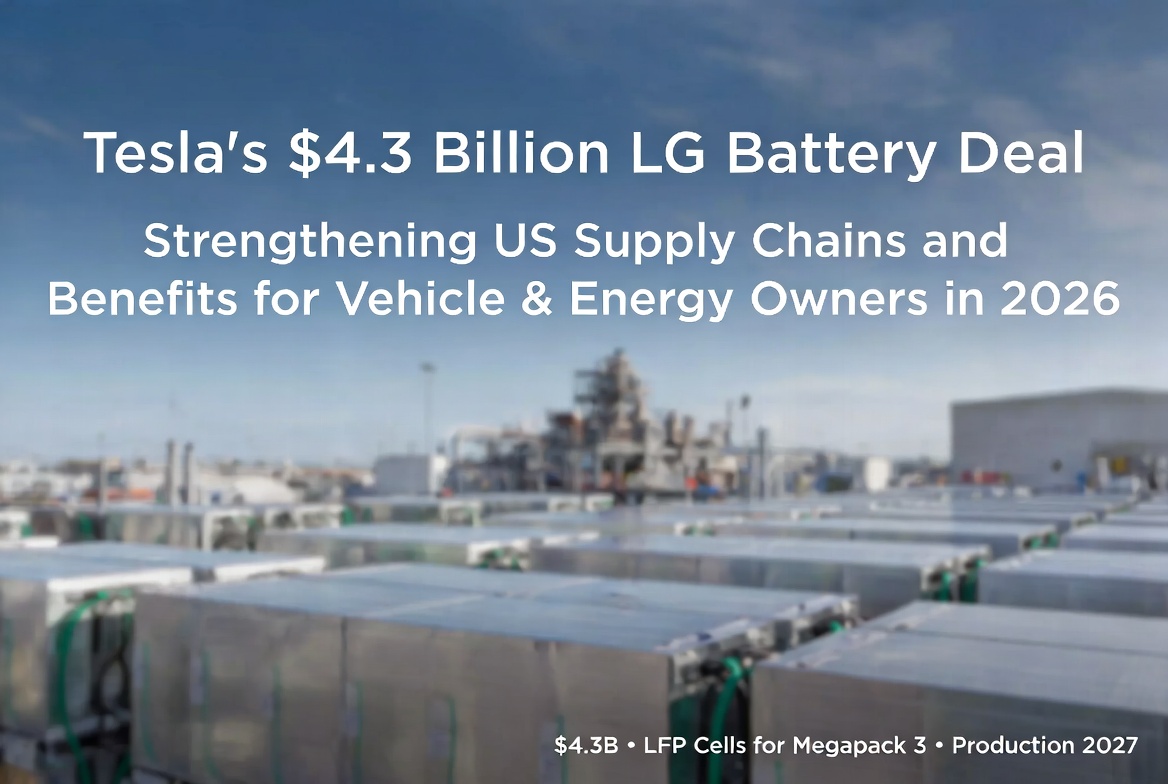
In mid-March 2026, the U.S. government officially confirmed that Tesla is the buyer behind a landmark $4.3 billion battery supply agreement with South Korea’s LG Energy Solution. This deal involves the production of lithium iron phosphate (LFP) prismatic battery cells at a dedicated facility in Lansing, Michigan, with production scheduled to begin in 2027. These American-made cells will directly power Tesla’s next-generation Megapack 3 energy storage systems assembled at the company’s Houston Megafactory in Texas.
For Tesla owners in the United States and Europe, this announcement represents far more than a corporate supply chain move. It signals Tesla’s deepening commitment to vertical integration in its energy business, reduced reliance on overseas suppliers, and long-term stability that can translate into tangible benefits for vehicle owners and those with home or commercial energy products like Powerwall.
As Tesla’s vehicle delivery growth moderates in 2026—with analyst consensus pointing to around 365,000 deliveries in Q1—the energy storage segment is emerging as a critical growth engine and margin stabilizer. Analyst forecasts suggest Tesla could deploy a record 14.4 GWh of energy storage in Q1 2026 alone, building on the strong 46.7 GWh achieved in full-year 2025. This $4.3 billion deal secures a domestic LFP cell supply specifically tailored for the Megapack 3, helping Tesla mitigate tariff risks, geopolitical uncertainties, and potential supply disruptions from Asian sources that have historically dominated LFP production.
LFP chemistry is particularly well-suited for stationary storage applications. It offers excellent safety characteristics (lower risk of thermal runaway compared to nickel-based chemistries), longer cycle life, and lower cost per kWh, even if it provides slightly lower energy density than NMC or NCA cells used in many vehicles. By securing a dedicated U.S. supply of LFP prismatic cells, Tesla ensures that its utility-scale Megapack 3 systems can scale efficiently while maintaining high safety and performance standards.
This article explores the deal in depth: its technical specifications, strategic importance for Tesla’s energy business, implications for the broader U.S. and European markets, and—most importantly—what it means for you as a Tesla vehicle or energy product owner. Whether you drive a Model Y in California, own a Powerwall in Germany, or are considering adding Megapack-scale storage to a commercial site, the strengthening of Tesla’s battery ecosystem directly impacts long-term ownership value, software updates, resale potential, and total cost of energy ownership.
We will examine the deal’s timeline, LFP chemistry advantages, synergies between energy storage and vehicle technology, regional differences between the U.S. and Europe, and practical advice for owners navigating 2026 and beyond. The goal is to provide a comprehensive, forward-looking analysis grounded in the latest developments as of March 31, 2026.
Section 1: Deal Breakdown and Technical Specs
The $4.3 billion agreement marks a significant milestone in Tesla’s effort to build a robust domestic battery supply chain. LG Energy Solution will repurpose and expand production lines at its existing Lansing, Michigan facility—originally developed in partnership with General Motors—to manufacture LFP prismatic cells dedicated to Tesla’s energy storage needs. Production is slated to ramp in 2027, with cells feeding directly into Megapack 3 assembly at Tesla’s Houston Megafactory.
Key Technical Details of the LFP Cells:
-
Chemistry: Lithium Iron Phosphate (LiFePO4) – known for thermal stability, with decomposition temperatures significantly higher than NMC chemistries, reducing fire risk in large-scale installations.
-
Form Factor: Prismatic cells, which offer better packing efficiency and easier thermal management in Megapack modules compared to cylindrical cells.
-
Performance Characteristics: Typical LFP cells deliver 3,000–6,000+ cycles at 80% depth of discharge, with excellent calendar life. Energy density is around 160–180 Wh/kg, lower than vehicle-optimized NCA cells (~250+ Wh/kg), but ideal for stationary applications where weight is less critical than cost and longevity.
-
Safety and Compliance: LFP’s inherent stability aligns with stringent U.S. grid interconnection standards and fire safety codes, making it preferable for utility-scale projects in populated or sensitive areas.
The Michigan facility will create dedicated production lines for this Tesla-specific supply. While exact annual cell capacity figures have not been publicly disclosed, the multi-year agreement (initially three years with potential extensions) is sized to support Tesla’s aggressive Megapack 3 ramp at Houston, which targets an initial annual capacity of around 50 GWh once fully operational.
Megapack 3 Context: Tesla unveiled the Megapack 3 alongside the integrated Megablock solution (a pre-engineered 20 MWh system combining four Megapack 3 units with transformers and switchgear). These systems are designed for rapid deployment in utility-scale and large commercial projects, offering higher efficiency, improved thermal management, and lower installation costs per MWh compared to previous generations.
Supply Chain Integration: Cells produced in Michigan will ship to Houston for final Megapack assembly. This closed-loop domestic flow reduces logistics costs, lead times, and exposure to international shipping disruptions or tariffs on Chinese-made LFP cells, which have historically supplied much of the global energy storage market.
For Tesla vehicle owners, the technical crossover is noteworthy. While Megapack 3 uses LFP and many vehicles use higher-density chemistries, Tesla’s vertical integration means advancements in cell manufacturing, battery management systems (BMS), and thermal controls often flow across divisions. Lessons learned from scaling safe, long-life LFP packs in storage can eventually improve vehicle battery durability, especially in harsher climates common in parts of the U.S. and Northern Europe.
The deal also reflects Tesla’s strategy to diversify suppliers while maintaining control over core technology. By partnering with LG—a company with deep expertise in prismatic cell production—Tesla gains access to proven manufacturing processes without bearing the full capital burden of building yet another cell gigafactory from scratch.
This section highlights how a seemingly “behind-the-scenes” supply agreement is actually foundational to Tesla’s ability to scale energy storage reliably and cost-effectively.
Section 2: US Energy Storage Momentum
Tesla’s energy storage business has become one of the company’s brightest spots amid more modest vehicle growth. In 2025, Tesla deployed a record 46.7 GWh of energy storage products, representing nearly 50% year-over-year growth. Q4 2025 alone saw 14.2 GWh deployed, and analysts expect Q1 2026 to reach or exceed 14.4 GWh—a potential new quarterly record.
The $4.3 billion LG deal directly supports this momentum by securing cells for Megapack 3 production starting in late 2026/early 2027. Tesla’s Houston Megafactory is positioned as a major hub, with plans for significant capacity expansion. The Megablock product further accelerates deployment by offering plug-and-play utility-scale solutions that utilities and developers can install faster and with lower labor costs.
Key Drivers in the U.S. Market:
-
Grid Modernization and Renewables Integration: As solar and wind penetration increases, especially in states like California, Texas, and the Southwest, grid operators need flexible storage to balance intermittent generation, reduce curtailment, and provide ancillary services (frequency regulation, peak shaving).
-
Policy and Incentives: Domestic content requirements, Inflation Reduction Act-style manufacturing credits (even with policy evolution), and state-level procurement mandates favor U.S.-made batteries. The LG-Tesla deal helps Tesla qualify for such preferences.
-
AI and Data Center Demand: Explosive growth in hyperscale data centers and AI training facilities creates massive, steady baseload-plus-flexibility power needs. Megapacks are increasingly paired with solar or gas peakers to provide reliable, low-carbon power.
-
Virtual Power Plants (VPPs): Tesla’s Powerwall fleet (over 1 million units globally) already participates in VPP events, delivering billions in customer savings. Megapack-scale projects extend this concept to commercial and utility levels.
Real-World Impact: Projects using Megapacks have helped stabilize grids during extreme weather events and reduced reliance on peaker plants, lowering overall electricity costs for ratepayers. For Tesla vehicle owners in the U.S., stronger energy storage deployment indirectly supports the Supercharger network (many sites now include on-site storage for demand management) and enhances the value proposition of owning a Tesla ecosystem (vehicle + solar + Powerwall + potential VPP participation).
The domestic supply chain created by the Michigan plant shields Tesla from potential Section 301 tariff increases on Chinese battery components, which have been a concern for energy storage importers. This stability can lead to more predictable Megapack pricing and availability, benefiting large-scale adopters and, over time, flowing down to smaller commercial and residential customers.
Challenges remain, including potential margin compression in 2026 due to increased competition and policy uncertainty. However, Tesla’s integrated approach—cells, packs, software, and deployment—gives it a structural advantage.
Section 3: Broader Supply Chain and European Context
While the LG deal is U.S.-centric, its ripple effects extend to Europe, where Tesla operates Giga Berlin and serves a large base of Model Y and Model 3 owners. Europe has ambitious renewable energy targets under the EU Green Deal and REPowerEU plan, driving strong demand for grid storage to integrate high levels of wind and solar, particularly in Germany, the UK, Spain, and the Nordics.
European Energy Storage Landscape:
-
Many European projects currently rely on imported batteries, including LFP from Asia. Tesla’s Megapacks are deployed across the continent for utility and commercial use.
-
Regulatory push for “strategic autonomy” and domestic manufacturing (similar to the U.S. IRA) could favor companies with resilient supply chains. Although the Michigan cells are for U.S. Megapack 3 production, Tesla’s overall battery expertise and software platform benefit European deployments.
-
Competition from Chinese suppliers and local European players exists, but Tesla differentiates through its integrated ecosystem, advanced BMS, and proven reliability in real-world cycling.
Cross-Regional Implications:
-
Supply Chain Resilience: A stronger U.S. base reduces global pressure on Asian cell supplies, potentially stabilizing prices and availability for European projects that may source from Tesla’s Shanghai or other facilities in the interim.
-
Technology Transfer: Advances in LFP module design, thermal management, and software optimization developed for Megapack 3 can accelerate improvements in Powerwall and even vehicle battery management for European owners.
-
Vehicle-Energy Synergies: European Tesla owners with home solar + Powerwall setups benefit from bidirectional charging capabilities (where enabled) and VPP participation. As Megapack deployments grow globally, the data and learnings improve the entire Tesla energy platform.
For U.S. owners, the deal directly supports faster Megapack rollout in domestic projects, which can stabilize electricity rates and enhance grid reliability—indirectly benefiting home charging costs. In Europe, owners may see more consistent Powerwall availability and potential for expanded virtual power plant programs as Tesla scales its energy software globally.
Geopolitical risk mitigation is a shared benefit. Both regions face potential supply disruptions; a diversified, multi-continent approach (U.S. LFP for Megapack 3, existing Asian sources for other needs) strengthens Tesla’s position.
Section 4: Practical Benefits for Tesla Owners
The $4.3 billion LG deal ultimately aims to deliver value to Tesla’s core customers—vehicle and energy product owners.
For Vehicle Owners (US & Europe):
-
Long-Term Company Stability: Diversified revenue from high-margin energy storage reduces reliance on automotive cyclicality, supporting sustained investment in OTA software updates, FSD improvements, and service networks.
-
Battery Technology Spillover: Scaling LFP production hones Tesla’s expertise in cell manufacturing, quality control, and BMS. This can lead to incremental improvements in vehicle range retention, faster charging protocols, and better cold-weather performance over time.
-
Ecosystem Value: Owners with solar + Powerwall can participate in more sophisticated energy management. In the U.S., stronger grid storage helps moderate peak electricity prices, lowering home charging costs. In Europe, similar dynamics apply amid volatile energy markets.
-
Resale and Residual Value: A financially robust Tesla with growing energy contributions supports stronger resale values for vehicles, as buyers perceive the brand as forward-looking beyond just EVs.
For Energy Product Owners (Powerwall, Potential Megapack):
-
Improved Availability and Pricing Stability: Domestic U.S. cell supply for Megapack 3 can accelerate production ramps and reduce exposure to import tariffs or shortages, potentially shortening wait times and moderating price increases.
-
Enhanced Performance: Megapack 3 and future iterations will incorporate lessons from dedicated LFP production, offering higher efficiency, longer warranties, and better integration with Tesla’s Virtual Power Plant software.
-
Cost Savings: Widespread storage deployment helps utilities avoid expensive peaker plants and transmission upgrades, which can translate to lower electricity rates or better incentives for behind-the-meter storage like Powerwall.
-
VPP Revenue Opportunities: As the fleet of connected Tesla batteries grows, owners in supported regions can earn from grid services, with Tesla handling optimization via the app.
Actionable Advice for 2026:
-
Monitor your Tesla app for energy features and VPP invitations.
-
Consider adding Powerwall if you have solar—pairing it with your vehicle maximizes self-consumption and resilience.
-
For commercial or fleet operators in the U.S., evaluate Megapack/Megablock for site energy management.
-
Track Q1 2026 energy deployment numbers (expected early April) for signals on ramp speed and pricing trends.
Overall, this deal reinforces that owning a Tesla increasingly means owning part of an integrated energy platform, not just a vehicle.
Conclusion
Tesla’s $4.3 billion partnership with LG Energy Solution to produce LFP cells in Michigan for Megapack 3 represents a strategic masterstroke in building a resilient, domestic-first energy supply chain. As vehicle growth moderates, the energy business—bolstered by record deployments and this secure cell supply—provides critical diversification, higher margins, and technological synergies that benefit all Tesla owners.
For US and European owners, the implications are clear: greater long-term stability, potential improvements in battery technology and software, more reliable energy products, and participation in a cleaner, smarter grid. While full benefits from 2027 production will take time to materialize, the direction is unmistakable—Tesla is investing heavily in the infrastructure that will power not only its vehicles but the broader energy transition.
As we move through 2026, watch for updates on Houston Megafactory ramp-up, Megapack 3 deployments, and Powerwall/VPP expansions. Tesla owners are uniquely positioned at the intersection of transportation and energy innovation, and deals like this ensure that position remains strong for years to come.
FAQ
1. How does the LG deal affect Megapack availability and pricing in the US? It supports faster scaling of Megapack 3 production starting late 2026/2027 by securing domestic cells, potentially improving availability and helping mitigate tariff-driven price increases.
2. Will this LFP technology eventually appear in Tesla vehicles? While Megapack 3 uses LFP for stationary needs, Tesla may apply manufacturing and BMS learnings to future vehicle packs, especially for standard-range or cost-optimized models, though high-density chemistries will likely remain primary for vehicles.
3. What does this mean for European Tesla owners with Powerwall? Indirect benefits through global technology improvements, more stable supply chains, and potential expansion of energy software features and VPP programs in supported EU countries.
4. How does stronger energy storage help my daily Tesla charging costs? Grid-scale storage reduces peak pricing and grid strain, which can lower overall electricity rates. Combined with Powerwall and solar, it maximizes self-consumption and minimizes grid draw during expensive periods.
5. When will Megapack 3 with Michigan cells be available? Houston production of Megapack 3 is targeted for late 2026; LG cells from Michigan are expected to feed the line starting 2027, with initial units possibly using existing inventory.
6. Is Tesla shifting focus away from vehicles toward energy? No—the energy business complements vehicles. High-margin storage revenue helps fund vehicle R&D, autonomy, and manufacturing improvements while providing owners with a more complete ecosystem.
7. How safe are LFP-based Megapacks compared to other batteries? LFP chemistry is among the safest for large-scale storage due to its high thermal stability and resistance to thermal runaway, making it ideal for grid applications near communities.
8. Can individual owners benefit financially from Tesla’s energy growth? Yes—through VPP participation with Powerwall (earning from grid services), potential lower electricity bills, and enhanced vehicle resale value tied to Tesla’s overall strength.
9. What should I watch for in coming months regarding this deal? Progress on the Michigan facility construction, Houston Megafactory updates, Q1 2026 energy deployment figures, and any announcements on Megablock deployments.
10. Does this deal reduce Tesla’s dependence on Chinese battery suppliers? Yes, specifically for LFP cells destined for U.S. Megapack 3 production. Tesla will continue using a mix of global suppliers, but this adds important North American capacity and resilience.