
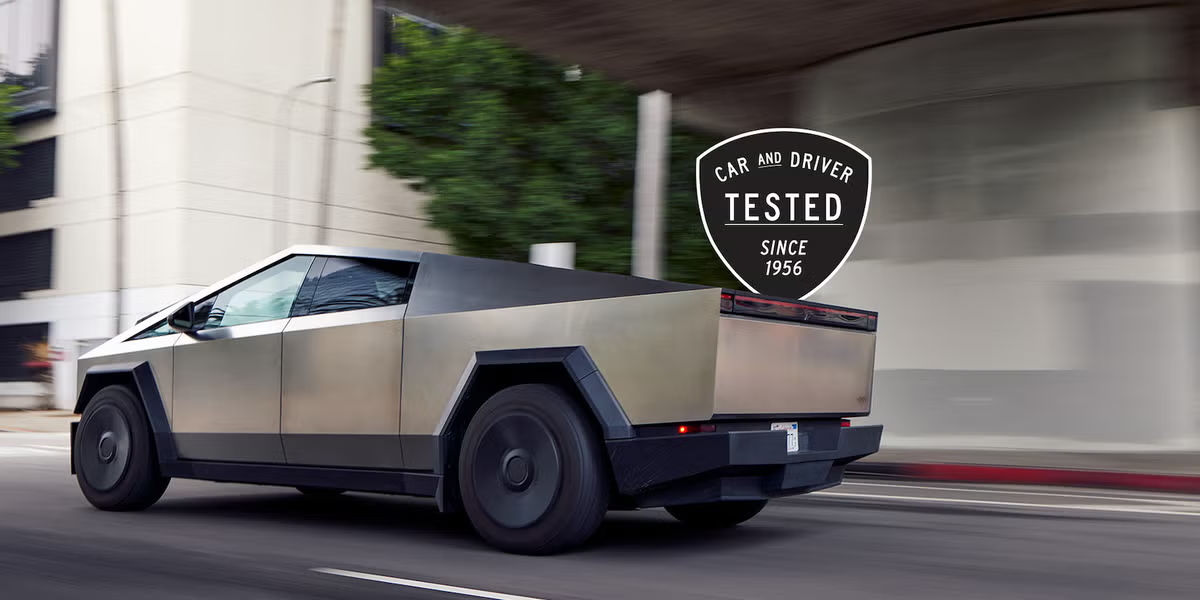
It has been one full year since the Tesla Cybertruck, arguably the most polarizing and audacious vehicle of the modern era, began rolling out to a wider customer base in the United States. Arriving on a wave of unprecedented hype, skepticism, and meme-fueled curiosity, the Cybertruck promised to shatter the conventions of the traditional pickup truck market. With its sharp-edged stainless steel exoskeleton, advanced technologies like steer-by-wire, and ambitious performance claims, it was less a vehicle and more a statement on wheels.
Now that the dust of the initial launch has settled, it's time to move beyond the hype and assess the reality. This article serves as a one-year, real-world report card for the Cybertruck, compiled from owner experiences, performance data, and practical use cases. We will also cast our eyes across the Atlantic to examine the formidable challenges and uncertain prospects for the Cybertruck's eventual debut on European shores. The verdict after twelve months is becoming clear: the Cybertruck has proven itself to be a uniquely capable and endlessly fascinating vehicle, but one that comes with a very specific set of compromises and an imposing question mark over its future in Europe.
Chapter 1: The Good, The Bad, and The Stainless: Owner Experiences
Living with a Cybertruck is an experience unlike owning any other vehicle. It blends incredible capability with daily quirks that owners have been diligently documenting over the past year.
Performance and Handling: The Steer-by-Wire Marvel
The single most praised feature by owners is the revolutionary steer-by-wire system, combined with rear-wheel steering. Despite its considerable size and weight, the Cybertruck handles with the agility of a much smaller vehicle. The turning radius is famously tighter than a Model S, making U-turns and navigating tight parking lots surprisingly stress-free. At low speeds, the steering is light and requires minimal input, while at high speeds, it firms up to provide stability and confidence. The learning curve is short, and most owners report that going back to a car with a traditional steering rack feels archaic. The raw acceleration, especially from the dual-motor "Cyberbeast" model, remains a thrilling party trick that defies the vehicle's utilitarian form.
The Stainless Steel Exoskeleton: Beauty and the Beast
The choice of an unpainted, cold-rolled stainless steel body is the Cybertruck's defining feature, and it has proven to be both a blessing and a curse.
-
The Good: The resistance to door dings and minor scratches from shopping carts or trail branches is a genuine benefit. Owners report a sense of rugged invincibility that is liberating. The truck doesn't require the same level of pampering as a painted vehicle.
-
The Bad: The biggest complaint is fingerprints. The flat, matte surface shows every single touch, requiring owners to either become obsessive about cleaning (many carry a spray bottle of Windex and a microfiber cloth) or simply embrace a "patina" of smudges. While resistant to dings, the steel can be scratched by sharp objects, and repairing such scratches is not a simple matter of touch-up paint.
-
The Ugly: Early production models were plagued by inconsistent panel gaps and fit-and-finish issues, a common critique of new Tesla models. Reports indicate that as production has scaled, these issues have become less pronounced, but consistency still lags behind traditional truck manufacturers.
Utility and The "Vault": A Mixed Bag
The Cybertruck's utility is a story of brilliant innovation and some practical oversights.
-
The "Vault": The 6-foot composite bed with its integrated, powered tonneau cover is a highlight. The ability to have a secure, weatherproof, and lockable storage area is a game-changer for many. It effectively turns the truck bed into a massive trunk.
-
Payload and Towing: Real-world towing tests have confirmed the Cybertruck's immense power. It can tow heavy loads with ease, though, like all EVs, this comes at a significant cost to range (often a 40-50% reduction). The onboard software does an excellent job of recalculating range and suggesting charging stops when a trailer is attached.
-
Practical Quirks: The high bed walls, while great for containment, can make it difficult to reach items in the bed from the side. The sail panels, while iconic, create significant blind spots that drivers must learn to mitigate using the cameras. The single, massive "giga-wiper" has also received mixed reviews for its coverage and effectiveness in certain weather conditions.
The "Wow" Factor vs. Daily Livability
Owning a Cybertruck means being the center of attention everywhere you go. For the first few months, owners report being constantly stopped for photos and questions. While initially exciting, many find this constant celebrity status can become tiresome during routine errands. Its sheer size makes it a challenge for narrow city streets and, most notably, for standard parking garages, many of which it is simply too tall to enter. It is a vehicle that demands you adapt your life to it, not the other way around.
Chapter 2: By the Numbers: Range, Charging, and Efficiency
Performance on paper is one thing; real-world data from thousands of owners provides a much clearer picture of the Cybertruck's operational realities.
Real-World Range vs. EPA Estimates
As with most EVs, the Cybertruck's real-world range falls short of its official EPA-estimated figures.
-
All-Wheel Drive (Dual Motor): This model has an EPA estimate of around 340 miles (547 km). Owners are consistently reporting real-world range of approximately 280-300 miles (450-480 km) with the standard all-season tires in mixed driving.
-
Cyberbeast (Tri-Motor): With an EPA estimate of 320 miles (515 km), real-world figures are closer to 260-280 miles (420-450 km).
-
Tire Impact: The optional 35-inch all-terrain tires, while adding to the rugged look and off-road capability, create a significant range penalty, often reducing the above figures by another 10-15%.
-
Cold Weather: Like all EVs, the Cybertruck sees a range reduction in cold weather, with owners in northern climates reporting a 20-30% drop in winter months.
Charging on the 800-Volt Architecture
The Cybertruck is Tesla's first vehicle built on an 800-volt architecture, a feature designed to enable ultra-fast charging. The reality has been more complex. While it can theoretically charge at much higher speeds, the existing V3 Supercharger network is based on a 400-volt system. This means the truck must internally boost the voltage, which limits the peak charging speed.
Owners report peak charging rates of around 150-200kW on V3 Superchargers. The true potential is only now being unlocked as Tesla's new V4 Superchargers, which are 800-volt native, become more common. At a V4 station, the Cybertruck can sustain much higher speeds for longer, with reports of adding around 130 miles of range in as little as 15 minutes. A typical 10-80% charge on a V4 stall takes just under 30 minutes.
Efficiency Analysis
The Cybertruck is a heavy, aerodynamically-compromised vehicle, and its efficiency numbers reflect this. It typically consumes between 450-550 Watt-hours per mile (Wh/mi), or around 280-340 Wh/km. This is significantly less efficient than a Tesla Model Y (around 250 Wh/mi) but is broadly competitive with other large electric trucks like the Ford F-150 Lightning and Rivian R1T.
Cost of "Fueling"
Despite its lower efficiency, the cost-per-mile to "fuel" the Cybertruck with electricity remains a significant advantage. Based on average US electricity prices of around $0.17/kWh, driving a Cybertruck costs approximately 9 cents per mile. This is in stark contrast to a comparable gasoline-powered truck like a Ford F-150, which at $3.50/gallon and 20 mpg, costs around 17.5 cents per mile—nearly double.
Chapter 3: The European Conundrum: Will the Cybertruck Cross the Pond?
While the Cybertruck has carved out a niche in the US, its path to the European market is fraught with regulatory, practical, and cultural obstacles. It is not an exaggeration to say that the truck, in its current form, may never be officially sold in Europe.
The Regulatory Hurdles: A Bureaucratic Nightmare
The EU's vehicle homologation standards are far stricter than those in the US, and the Cybertruck appears to violate several key tenets:
-
Pedestrian Safety: This is the biggest hurdle. EU regulations (specifically UN-GTR 9) require vehicle front-ends to have a certain degree of deformability and rounded edges to mitigate injuries to pedestrians and cyclists in a collision. The Cybertruck's rigid, sharp-edged stainless steel exoskeleton appears to be fundamentally incompatible with these rules.
-
Weight and Licensing: The Cybertruck's gross vehicle weight rating (GVWR) is over 3,500 kg. In many European countries, this classifies it as a commercial vehicle, meaning a standard "B" category car driver's license would not be sufficient to operate it. Drivers would need a "C1" category license, a significant barrier for the average consumer.
-
Lighting and Mirror Regulations: The Cybertruck's unique lighting configuration, including its full-width light bar, and its reliance on cameras in lieu of traditional mirrors may not comply with specific EU regulations (UNECE regulations).
The Size Problem: A Giant in a Land of Minis
Beyond the regulations, there's the simple, unavoidable issue of size. The Cybertruck is nearly 19 feet long and over 6.5 feet wide. It would be a nightmare to navigate through the narrow, winding streets of a historic European city, park in a typical multi-story car park (most of which have a height clearance of 1.9 or 2.0 meters), or maneuver down a rural English country lane. It is fundamentally out of scale with the European environment.
Market Demand and Cultural Fit
The American-style full-size pickup truck has always been an extremely niche product in Europe. The market is dominated by compact hatchbacks, wagons, and, more recently, compact SUVs. The Cybertruck's aggressive, almost brutalist design language is also a stark contrast to the generally more understated European automotive aesthetic. While it would certainly have a small cult following, the potential for mass-market appeal is highly questionable.
Potential Modifications for a European Version
For Tesla to launch a Cybertruck in Europe, it would likely require a complete re-engineering of the vehicle. This could involve using different, more deformable materials for the body panels, redesigning the entire front-end, and potentially even creating a smaller, scaled-down version of the truck. Given the immense cost and complexity of such a project, and the limited market size, it remains an open question whether Tesla will ever deem it a worthwhile investment.
Conclusion
One year on, the Tesla Cybertruck has firmly established its identity. It is not a pickup truck for everyone; in fact, it's not for most people. It is a vehicle of extremes: extremely fast, extremely capable in its utility, and extremely unconventional in its design and ownership experience. For its target audience of tech enthusiasts, early adopters, and those who value its radical departure from the norm, it is an unparalleled success. It delivers on its core promises of performance and innovation, even if it comes with a list of daily-life quirks.
However, its future remains largely confined to the wide-open spaces of North America. The regulatory, practical, and cultural barriers to a European launch are immense, perhaps insurmountable for the vehicle in its current form. The Cybertruck will likely remain a rare and exotic import on European roads, a symbol of American automotive extremism. Its ultimate legacy may not be in its global sales numbers, but in its role as a "halo" product—a bold, uncompromising experiment that has pushed the boundaries of automotive engineering and forced the entire industry to question what a truck is supposed to be.
FAQ Section
-
How do you wash a Cybertruck? Can it go through a normal car wash? Tesla advises against automatic car washes with brushes, as they can potentially cause fine scratches on the stainless steel. Touchless car washes are generally considered safe. Most owners prefer to hand wash it, and many use stainless steel cleaners (like those for kitchen appliances) to remove fingerprints and water spots.
-
What are the most popular aftermarket accessories for the Cybertruck? The most popular accessories are vinyl wraps (to add color and protect the steel), bed-mounted rack systems for bikes and gear, and interior storage solutions. A whole ecosystem of third-party accessories has sprung up to enhance its utility.
-
Does the steer-by-wire system feel safe and reliable? Yes. The system has multiple redundancies built in. After a very brief adjustment period, owners report that it feels completely natural and safe. The variable steering ratio is a key feature, making it highly responsive and intuitive at all speeds.
-
How much does it cost to insure a Cybertruck? Insurance costs are higher than for a typical pickup truck. This is due to its high purchase price, the unique nature of its stainless steel body (which can be expensive to repair), and its powerful performance capabilities. Rates vary significantly based on location and driver history.