
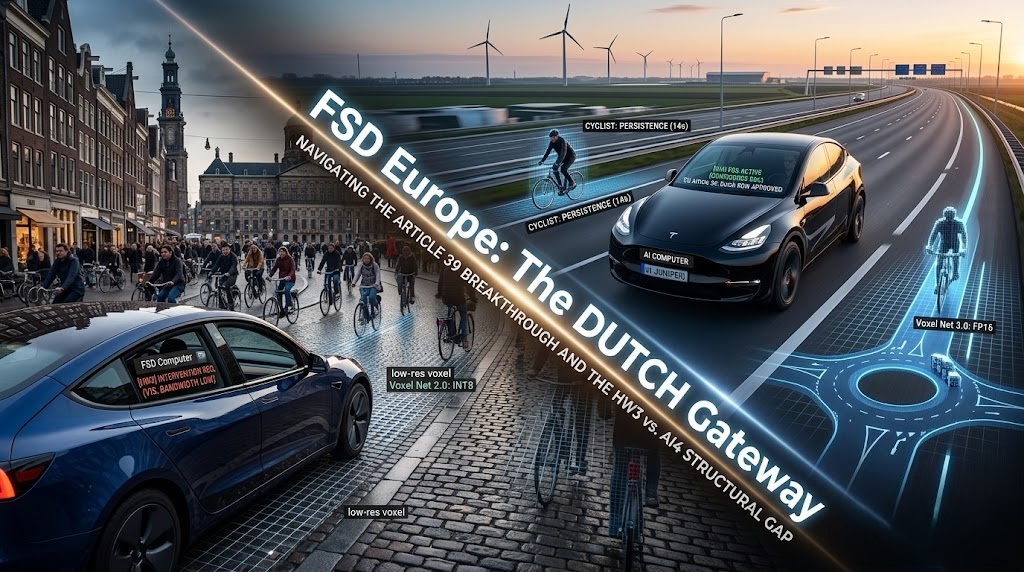
1. Introduction: A New Chapter for European Autonomy
Today, March 20, 2026, marks a historic pivot in the timeline of sustainable transport. For nearly a decade, European Tesla owners have watched from the sidelines as their North American counterparts experienced the iterative evolution of Full Self-Driving (FSD). Due to a complex web of UNECE regulations and conservative type-approval frameworks, the European "Autopilot" experience remained frozen in a state of limited functionality.
That era officially ends today. Tesla has begun the wide-scale over-the-air (OTA) rollout of FSD (Supervised) to eligible vehicles across the Netherlands. This launch, powered by the 2026.2.9 firmware branch (and newer), represents the first time a neural-network-based, end-to-end autonomous driving system has been legally sanctioned for public roads in the European Union. By selecting the Netherlands as the launchpad, Tesla is not just releasing a software feature; it is executing a masterclass in regulatory strategy.
2. The Regulatory Masterstroke: Article 39 and the RDW Pathway
The primary barrier to FSD in Europe has always been UN Regulation No. 157 (and its successor UN-R-157), which was written for simple lane-keeping systems, not AI-driven "Cognitive Units." Tesla’s breakthrough today was made possible by bypassing the slow-moving UN committees in favor of a specialized EU legal mechanism.
2.1 The Article 39 Exemption
In February 2026, the RDW (Rijksdienst voor het Wegverkeer)—the Dutch vehicle authority—granted Tesla a national type approval under Article 39 of EU Regulation 2018/858.
-
The "Innovative Technology" Clause: Article 39 allows individual member states to grant temporary exemptions for advanced technologies that do not yet fit into existing regulatory buckets, provided the manufacturer can prove the system is safer than a human driver.
-
The RDW Dossier: To secure this, Tesla provided the RDW with a comprehensive "Safety Dossier" featuring data from over 8.4 billion miles driven on FSD globally. The most compelling figure: vehicles with FSD (Supervised) engaged record one major collision every 5.3 million miles, compared to just one every 855,000 miles for manual driving without active safety.
2.2 The Mutual Recognition "Domino Effect"
The significance of the Netherlands goes beyond its borders. Under EU law, once one member state approves a technology via the Article 39 pathway, other member states can choose to "recognize" that approval through a fast-track process. Already, authorities in Belgium and Ireland have indicated they will honor the RDW’s findings, potentially opening 80% of the EU market by mid-2026.
3. Technical Adaptation: Teaching AI the "European Way"
The FSD v14.1.7 build rolling out in the Netherlands today is not a simple port of the U.S. version. It has been specifically trained on European road geometry, signage, and social norms.
3.1 Roundabout Mastery and "Proactive Nudging"
While U.S. roundabouts are often simple, European "rotaries" are complex, multi-lane gauntlets.
-
Voxel-based Occupancy 3.0: The system now uses high-resolution volumetric pixels to identify the subtle "lean" of a motorcyclist or the hand signals of a traffic officer.
-
Assertive Logic: In dense Dutch traffic, the car has been trained to "nudge" forward to communicate intent, mimicking the assertive driving style required in European city centers, rather than waiting for a wide gap that may never come.
3.2 The "Dutch Reach" and Cyclist Persistence
The Netherlands is the ultimate "stress test" for AI due to its high density of cyclists.
-
Temporal Transformers: Unlike previous versions that "forgot" an object if it was briefly obscured, the new Temporal Transformer architecture allows the car to maintain a "memory" of a cyclist even when they disappear behind a delivery van or a parked car for up to 15 seconds.
-
Bicycle Lane Awareness: The system now treats bicycle lanes as a distinct, high-priority "avoidance zone," maintaining a wider safety buffer than it does for standard lane lines.
4. Hardware Realities: HW3 vs. AI4 Performance
As the rollout begins, a performance gap is appearing between older and newer Tesla hardware.
4.1 The AI4 (Hardware 4) Advantage
Vehicles like the Model 3 Highland and Model Y Juniper benefit from 5-megapixel cameras and native FP16 processing. In the narrow, often rain-slicked streets of Amsterdam and Rotterdam, AI4 vehicles show significantly better object resolution at a distance, allowing the car to "see" a red light or a pedestrian two seconds earlier than HW3.
4.2 The HW3 "Quantization" Challenge
Owners of legacy HW3 vehicles (2019–2023) are still included in today's rollout. However, the software for these cars is "quantized"—essentially compressed—to fit the older processor's memory bandwidth. While still remarkably safe, initial data suggests HW3 vehicles may be slightly more "hesitant" in complex Dutch weather conditions compared to the fluid performance of AI4.
5. Conclusion: The Foundation for the Cybercab
The launch of FSD in the Netherlands is the first step toward the Tesla Cybercab arriving on the continent. By proving the software in the "Supervised" category first, Tesla is building the actuarial evidence needed to demand "Unsupervised" Level 4 approval by late 2027.
For Dutch owners, today is the day their cars finally became "living" AI. For the rest of Europe, it is the signal that the wait is almost over.
FAQ: Everything Dutch Owners Need to Know Today
Q: How do I check if my car is eligible for the update today?
-
A: Go to Controls → Software. You must be on software branch 2026.2.9 or newer and have the "Full Self-Driving Computer" (HW3 or AI4) listed in your hardware details.
Q: Does this update allow me to drive "Hands-Free"?
-
A: No. This is still a Level 2 "Supervised" system. You must remain attentive and ready to intervene. However, the system is significantly less "naggy" than Autopilot, using the cabin camera to monitor your gaze instead of requiring constant steering wheel torque.
Q: What is the cost for the FSD subscription in the Netherlands?
-
A: While final pricing is populating in the app today, source code leaks suggest a monthly price of approximately €99/month, consistent with the recent North American price adjustment.