
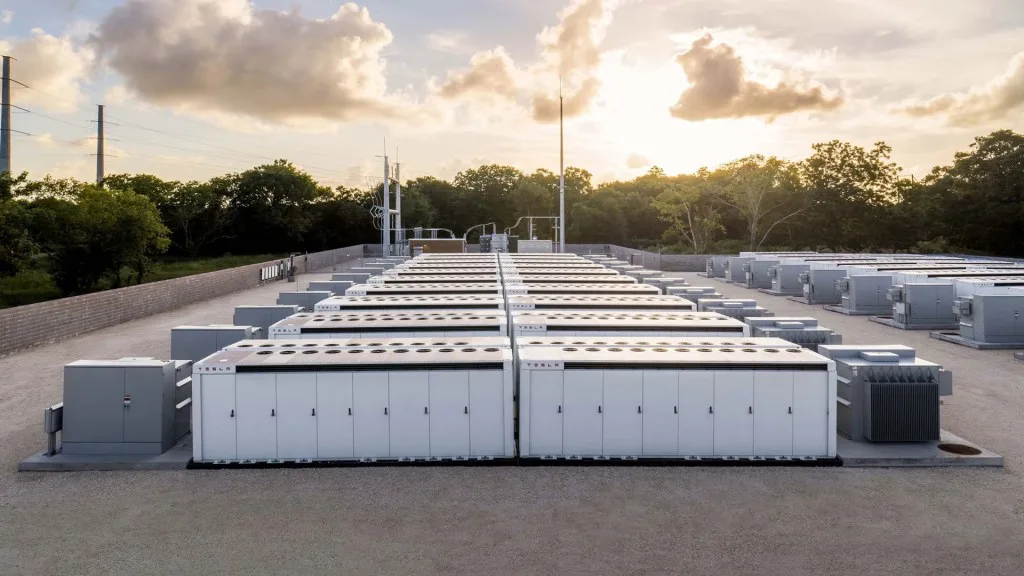
Tesla’s new Megablock (announced alongside the Megapack 3) is a prefabricated, medium-voltage, utility-scale energy-storage assembly designed to speed deployment and lower construction costs for large battery projects. Tesla claims faster installation (factory-built, plug-and-play elements), higher site energy density, long cycle life, and improved round-trip efficiency. For utilities, commercial site operators and fast-charging networks the promise is straightforward: lower project timelines and potentially cheaper storage that can smooth the grid, enable more renewable integration, and support fast EV charging without expensive grid upgrades. For individual Tesla owners the Megablock’s practical effects include better charging reliability along busy corridors, more resilient local grids, and the potential for new “green charging” products — but the benefits are contingent on cell supply, permitting processes, cost competitiveness and responsible deployment.
Key claims
Below are five load-bearing claims from today’s announcements and reporting that anchor the analysis in this article. I cite the primary reporting sources for those claims here so you can quickly check them; a fuller list of sources appears at the end of the article.
-
Tesla introduced the Megablock at this week’s energy conference (RE+), presenting it as a factory-prefabricated block that integrates multiple Megapack 3 units, transformers and switchgear to speed installation and reduce on-site construction.
-
Tesla claims the Megablock enables roughly 23% faster installation and up to ~40% lower site construction costs versus prior approaches.
-
Technical claimed specs: the Megablock is presented as a ~20 MWh AC solution (per block), with 25-year design life, >10,000 cycles, and an estimated ~91% round-trip efficiency at medium voltage (inclusive of auxiliary loads).
-
Megablock is paired with the new Megapack 3; Tesla said Megapack 3 simplifies thermal systems and reduces internal connections — changes intended to increase reliability and reduce failure points.
-
Tesla’s public messaging positions Megablock as a tool to accelerate renewable buildout and reduce the time and cost of adding utility-scale batteries — a capability the company argues will also speed Supercharger and commercial fast-charging deployments in constrained grid locations.
Why this announcement matters
Utilities, independent power producers (IPPs), commercial developers and EV charging networks are currently wrestling with three related problems:
-
Interconnection and permitting timelines — connecting any sizeable storage project to the grid is a slow, expensive legal/engineering process.
-
Construction complexity & onsite labor — bespoke site builds require a lot of engineering and fieldwork.
-
Cell and balance-of-plant (BOP) cost pressures — battery cells, transformers, switchgear and installation labor add up.
Tesla’s pitch with Megablock is to turn more of the project into a factory assembly (modular, pre-integrated units) so that field work is a simpler “plug-and-play” process. In principle, that reduces on-site labor, shortens schedule risk, and lowers soft costs — the part of a project budget that’s not raw materials: civil works, permits, interconnection engineering, labor scheduling, and testing.
The direct economic stakes: if Tesla’s claims are realized at scale, utilities will be able to add large-capacity storage faster and for less money — which can accelerate renewables integration, reduce peak grid stress, and enable more fast chargers without upgrades to local distribution infrastructure.
Technical anatomy: what is a Megablock and how does it differ from a Megapack?
What Tesla described (product architecture)
-
Megapack 3 is Tesla’s next-generation utility battery rack/module. Tesla emphasized a simplified thermal bay with far fewer connections and components that commonly fail. The company presented Megapack 3 as the cell-to-pack evolution feeding the Megablock.
-
Megablock is a site-scale assembly that groups several Megapack 3 units together with medium-voltage switchgear, transformer(s), and protective equipment into a single pre-engineered block that can be shipped and installed as a unit. Reports describe each Megablock as around 20 MWh (AC) capacity and engineered for high energy density per acre.
Key engineering approaches
-
Prefabrication & factory integration: Doing more assembly in controlled factory conditions reduces variability, speeds QA/QC, and reduces field labor hours.
-
Medium-voltage integration: Integrating medium-voltage components into the block minimizes field wiring and reduces the need for complicated on-site transformer installations.
-
Thermal simplification: Megapack 3’s reduced thermal complexity (fewer hoses/pipes/connections) lowers potential leak/failure points and simplifies servicing.
Why modular site blocks help
-
Faster commissioning (fewer on-site tests and fewer interfaces).
-
Simplified mechanical and electrical footprints — easier to site in constrained or urban locations.
-
Pre-tested blocks can be rolled out more predictably, helping project finance and schedule certainty.
Claimed performance & lifecycle metrics
The announcement included technical claims that, if validated in real deployments, are meaningful:
-
Installed capacity per block: ~20 MWh AC.
-
Design life & cycles: Tesla cited ~25-year design life and more than 10,000 cycles — implying durability suitable for daily cycling applications as well as long-duration seasonal roles.
-
Round-trip efficiency: Tesla claimed roughly 91% round-trip efficiency at medium voltage (this number is inclusive of auxiliary loads, according to reporting).
-
Installation speed & cost: Tesla claimed a ~23% faster installation timeline and up to ~40% lower construction costs for certain project elements versus previous approaches.
Reader note: product launch claims are the manufacturer’s baseline; independent field data and third-party deployments are needed to verify realized efficiency, life, and delivered cost savings.
Economics — how Megablock could change project math
Energy storage project economics are dominated by four levers:
-
Cell cost (per kWh) — the raw chemistry cost.
-
Balance of system (BOS) and BOP — transformers, inverters, switchgear, cable trenches, site work.
-
Soft costs & permitting — interconnection engineering, legal, labor and testing.
-
Operating profile — how frequently the battery cycles, degradation and maintenance.
Where Megablock targets savings
-
Soft costs & BOS labor: By prefabricating and pretesting a large portion of the balance-of-plant in factory conditions, Megablock reduces field engineering hours and complexity — the area where Tesla claims 23% faster installation and up to ~40% lower site construction costs. These are exactly the categories that have ballooned project budgets in high-labor markets.
-
Interconnection readiness: Standardized block configurations may make interconnection submissions more predictable and faster if regulators accept factory-standardized technical packages. That can shorten scheduling uncertainty (which has a heavy financing cost).
-
Operational economy: If the Megapack 3 and Megablock deliver higher round-trip efficiency (reported ~91%), fewer kWh are lost to round trips — improving revenue for frequency regulation, peak shaving, or arbitrage strategies.
How much can owners/utility operators save?
Exact numbers depend on local labor costs, permitting regimes and cell costs. In regions with high soft costs (much of Europe, parts of the U.S.), shaving 20–40% off construction-related budgets is meaningful. However, cell supply costs remain the largest variable — if cell prices are high or constrained, per-kWh economics may still be challenged.
Manufacturing, supply chain & timelines
Manufacturing notes
-
Tesla said production of new units (Megapack 3 and associated assemblies) will be ramped in lines where Tesla makes large energy products (Tesla’s Houston energy factory has been mentioned in reporting as a production site). Some reports indicate deliveries targeted for 2026 timelines.
Cell sourcing & dependency
-
Multiple outlets reported Tesla will continue to depend on large battery cell suppliers (reporting names include BYD and CATL among potential suppliers in the current industry landscape), and that cell availability remains a gating constraint. Large grid projects require a lot of cells; how quickly Tesla can secure long-term supply contracts materially affects rollout speed.
Critical path items
-
Cell supply: Large-scale storage projects require steady cell supply; auctions or spot shortages drive up project costs.
-
Substation and interconnection upgrades: Even with a prefab block, ultimate grid connection still depends on local DSO/TSO approvals and sometimes transformer/substation work external to the block.
-
Permitting & environmental approvals: Urban or protected sites may still need lengthy approvals.
Timeline outlook
Tesla’s public statements project production and deliveries beginning on a staged timeline (announcements indicated production ramp targeting late next year or into 2026 for larger volumes). Early deployments will test claims and generate the operational data that utilities use to underwrite larger programs.
Use cases: where Megablock offers the most value
Megablock’s modular, high-density and factory-built approach maps to several attractive use cases:
-
Utility-scale renewables smoothing & capacity firming
-
Large renewables projects need co-located storage for dispatchable generation. Faster deployment reduces the time it takes to monetize the battery through capacity and ancillary markets.
-
-
Commercial & industrial (C&I) sites, data centers, and microgrids
-
C&I customers value predictable project timelines. A prefab block reduces business disruption and shortens the payback horizon when energy managers need guaranteed projects.
-
-
Fast-charging hubs & Supercharger corridors
-
Fast chargers draw large peak power. Adding on-site storage can avoid expensive distribution upgrades by shifting peak EV charging to stored off-peak energy. Prefab Megablocks can be sited adjacent to charging stations to provide high-power bursts without long lead times for grid upgrades.
-
-
Grid resilience & black-start support
-
In areas prone to outages, a factory-tested block with integrated medium-voltage gear can be commissioned quickly to provide backup capacity for critical services.
-
Which sites get the highest ROI?
-
Projects with high local labor costs, slow permitting and urgent capacity needs see the fastest ROI improvement from prefab assemblies. Urban fast-charging corridors and congested distribution networks are prime candidates.
Implications for EV charging networks
Direct benefits for Tesla Superchargers
-
Faster station rollouts: Megablocks could reduce the time needed to build high-power Supercharger hubs in corridors where local upgrades were previously a showstopper. Project developers could drop a block and commission a site quicker than a fully custom build. That reduces the “time to revenue” for new high-power locations.
Indirect benefits for the EV ecosystem
-
Less local grid stress: If widespread, blocks placed near hubs can smooth load and reduce the need for DSO upgrades, which often create permitting delays.
-
Green charging products: Operators could offer “charge from renewables” by using stored solar/wind that’s collected during off-peak hours; premium pricing or commuter programs could emerge.
-
Interoperability: Prefab blocks could be paired with modular chargers of various OEMs — enabling multi-brand fast-charging hubs in high-traffic corridors.
Limitations & caveats
-
Fast charging still requires robust local infrastructure (nascent secondary distribution or substation work may still be necessary for full throughput). Megablock reduces but does not remove grid connection complexity in many cases.
Policy, permitting and grid interconnection realities (US & Europe)
A standardized block doesn’t erase regulatory friction. Key areas to consider:
-
Interconnection studies & queue management
-
DSOs/TSOs require studies showing the block’s effects on voltage, protection, and fault current. Standardized technical packages may speed study reviews if regulators accept them, but each grid operator still requires local analysis.
-
-
Permitting & land use
-
Building permits, environmental reviews, and local zoning rules remain a factor — especially in Europe where protected lands and stricter local rules can slow builds.
-
-
Safety & codes
-
Prefab blocks must meet regional electrical safety codes; convergence between factory standards and local code enforcement is necessary for rapid acceptance.
-
-
Market rules & revenue stacking (US context)
-
Revenue from capacity, flexibility and ancillary services relies on market rules and program access; project viability depends on regulatory frameworks that allow storage to participate across revenue streams.
-
European specifics
-
EU member states have varied interconnection rules and stricter environmental procurement; however, the EU also offers strong incentives for grid modernization and renewables integration — potential funding routes to accelerate block deployments if standardized packages lower developer risk.
Environmental lifecycle & recycling
As energy-storage deployment accelerates, lifecycle management becomes critical.
-
Recyclability: Battery recycling infrastructure must scale to match deployments; Europe has progressive policies pushing circularity and battery passports that make end-of-life handling a commercial and regulatory consideration.
-
Materials transparency: Buyers increasingly require clarity on cell chemistries and provenance — important for corporate procurement and public tenders.
-
Operations & degradation: High cycle life (>10,000 cycles as claimed) suggests packs designed for frequent cycling, but real degradation depends on duty cycle, temperature management and system software.
Deployments at scale mean policy frameworks and recycling infrastructure must keep pace to avoid downstream environmental costs.
Risks and constraints (what could prevent Megablock from delivering)
-
Cell supply constraints and commodity prices — even a perfect prefab product needs abundant, cost-effective cells. Tight global markets (or competing demands from vehicle OEMs) could limit rapid scaling.
-
Interconnection & permitting delays that factory standardization can’t fully remove — local electrical upgrades or TSO requirements remain gating factors.
-
Realized vs claimed performance — round-trip efficiency, cycle life and delivered cost savings need independent verification. Early field data will determine market acceptance.
-
Safety incidents & public perception — any prominent event involving energy storage (fire, explosion, thermal runaway) can slow adoption and increase insurance costs. Robust testing, transparent incident reporting and third-party validation mitigate this risk.
-
Financing & contract structures — utilities and IPPs often require bankable performance guarantees. Tesla will need to structure contracts that lenders accept to scale deployment.
Strategic implications for Tesla
Short-term: Megablock positions Tesla Energy to capture larger project volumes and diversify revenue beyond vehicles. Shorter project timelines and predictable economics make Tesla a stronger contender for large IPP deals and corporate procurements.
Medium/long term: If installed at scale, Megablocks could transform how fast-charging networks are rolled out, lowering regional charging deserts and supporting higher EV adoption rates. For Tesla as both a vehicle and energy company, that harmonizes incentives: more reliable charging encourages vehicle sales, and more vehicles expand demand for energy services.
Competitive dynamics: Other ESS vendors (LG Energy, Fluence, Wärtsilä, etc.) are also pursuing modular and prefabricated solutions. Tesla’s advantage is brand recognition and vertical integration, but competitors will press on cost, local manufacturing and contract flexibility.
Practical guidance for Tesla owners & charging operators
For owners (what to expect locally)
-
Over time you may see faster deployment of high-power chargers in corridors where grid upgrades previously blocked stations. That can cut “range anxiety” on long trips.
-
Availability and pricing: operators can use on-site storage to reduce demand charges and potentially keep charging cheaper during peak periods — but this depends on operator pricing strategies.
For fleet & charging operators
-
Evaluate whether a prefab block reduces lead time for critical hubs. In high-labor markets the time and cost savings are likely larger.
-
Factor in lifecycle and recycling costs; insist on transparent cell chemistry and end-of-life obligations in supplier contracts.
For policy makers and utilities
-
Consider standard technical acceptance frameworks for factory-prefab storage packages to accelerate deployment while preserving safety review integrity.
-
Align incentive programs to reward resilience and renewable integration value, not just capacity numbers.
Conclusion — cautious optimism, with a data-driven watchlist
The Megablock announcement is an important incremental step in the evolution of utility-scale storage. Its value proposition — speeding up build schedules, lowering on-site costs, and delivering site-scale modules — directly addresses some of the biggest barriers to rapid storage deployment. For EV charging and Supercharger networks, the potential to fast-track high-power stations is meaningful.
But the real test is in field validation. Will the blocks deliver the claimed installation speed and cost savings in real projects, across regions with different labor and permitting regimes? Will cell supply and financing scale to match? The first wave of Megablock deployments and the performance data they yield will either validate Tesla’s claims or expose gaps that competitors and buyers will exploit.
If you’re a Tesla owner in the U.S. or Europe, the practical takeaway is positive: faster expansion of charging infrastructure and improved grid resilience are plausible outcomes that should improve the ownership experience over the next few years — but don’t expect overnight miracles. Monitor local project announcements, charging hub plans, and early operational reports for the first independent performance data.
FAQ
Q: Is Megablock the same as Megapack?
A: No. Megapack 3 is the next-generation battery module; Megablock is a prefabricated site assembly that integrates several Megapack 3 units with transformers and medium-voltage switchgear into a plug-and-play block.
Q: When will Megablocks be available near me?
A: Tesla outlined production ramp intentions with deliveries expected as volumes scale into 2026. Actual local availability depends on project contracts, permitting and cell supply.
Q: Will Megablock reduce the cost of Supercharger stations?
A: It can reduce some construction and interconnection costs by lowering onsite engineering needs, but total station cost still depends on grid upgrades, chargers, and permitting.
Q: Does Megablock make grid outages less likely?
A: Megablocks provide local capacity that can improve resilience for connected loads (fast chargers, critical facilities), but they don’t replace network upgrades where those are required for system-level reliability.
Q: Are there environmental concerns with more battery deployments?
A: Yes — more deployments increase the need for responsible recycling, material sourcing transparency, and lifecycle planning. Europe’s regulatory direction already emphasizes circularity.