
I. Introduction: The Industrial Inevitability of the Affordable Tesla
For nearly a decade, the "$25,000 Tesla" (often dubbed the Model 2) has been the "Holy Grail" of the electric vehicle industry—a promise that seemed to dance just out of reach as global supply chains buckled and battery costs fluctuated. However, as of February 2026, the phantom has gained physical form. Internally codenamed "Project Redwood," this vehicle represents more than just a cheaper entry point into the ecosystem; it is Tesla’s strategic response to the aggressive global expansion of budget-friendly Chinese EVs and the slowing growth of the premium sedan market.
The urgency for Redwood in 2026 is rooted in market saturation. While the Model 3 and Model Y have dominated sales charts, they remain out of reach for a vast demographic of urban commuters in Europe and North America. To conquer the next 20 million units in annual sales, Tesla cannot simply "discount" its way to the top. It must reinvent the very physics of manufacturing. Redwood is not a stripped-down Model 3; it is a radically re-engineered compact crossover that leverages the "Unboxed Process" to halve production costs while maintaining the high-tech DNA that defines the brand.
II. Engineering Breakthroughs: The "Unboxed" Method and Parallelism
The traditional automotive assembly line, pioneered by Henry Ford, is a linear process: a stamped metal shell moves down a mile-long track while parts are painstakingly stuffed into it. Tesla’s "Unboxed" process, debuting in high-volume at Giga Texas and now being integrated into Giga Berlin, throws this rulebook away.
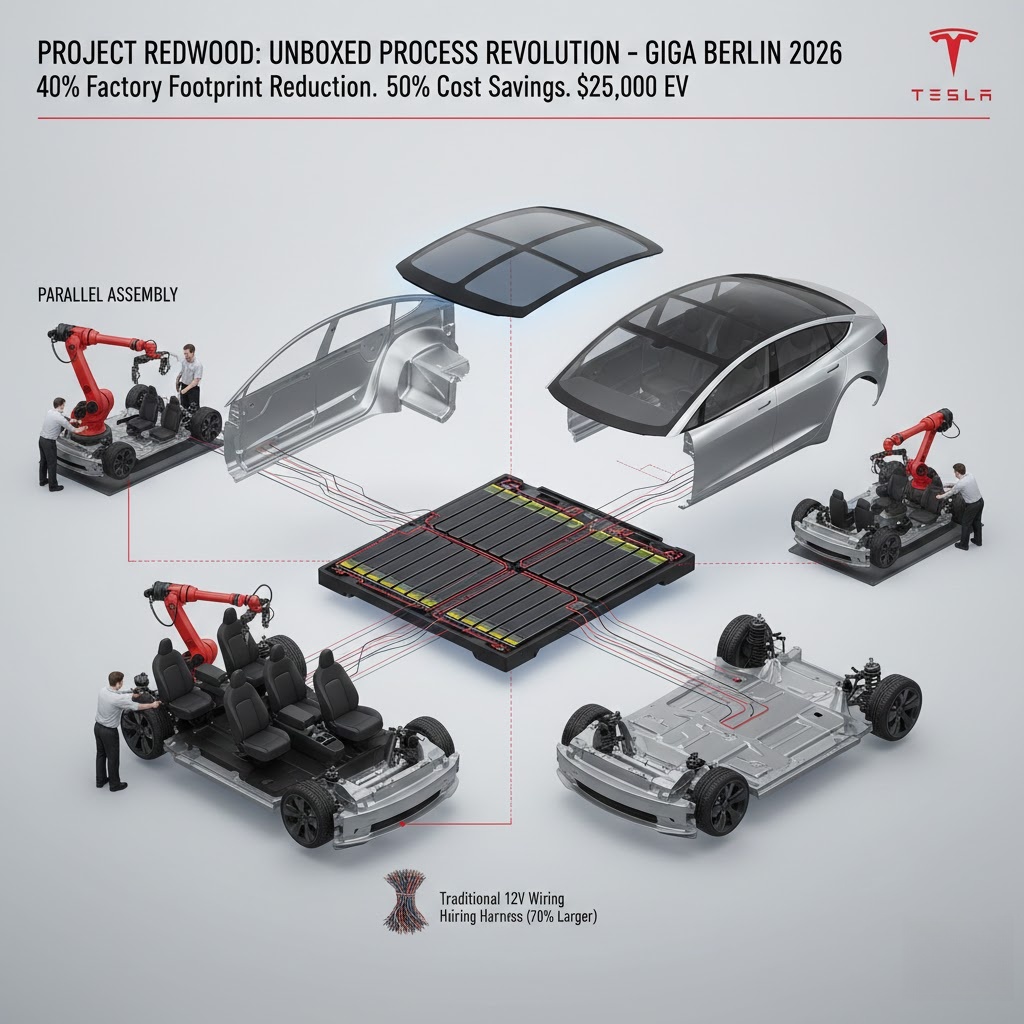
Instead of a single line, the car is broken down into six distinct modules that are assembled in parallel.
-
The Interior Module: Seats, center console, and dashboard are bolted directly to the structural battery pack before any "body" exists around them. This "outside-in" approach means that robots and workers have 360-degree access to the modules.
-
Parallel Assembly: Because the front, rear, and underbody sections are built simultaneously in different parts of the factory, the "bottleneck" of the paint shop is minimized. Only the necessary panels are painted, reducing paint shop footprint by 40%.
-
The 48V Architecture: Following the lead of the Cybertruck, Redwood utilizes a full 48-volt architecture. This reduces the weight and complexity of the wiring harness by over 70%, allowing for more automated robotic assembly and contributing significantly to the $25,000 price target.
III. Giga Berlin: The Gateway to Europe’s Compact Dominance
As of early 2026, Giga Berlin-Brandenburg has become the primary hub for Redwood’s European rollout. The factory has avoided the layoffs seen in other German industrial sectors, instead ramping up to accommodate the new platform. Plant manager André Thierig confirmed in early 2026 that the facility is preparing for a "second partial approval" for capacity growth, aimed specifically at the next-gen platform.
For European owners, a Berlin-made Redwood is crucial. It bypasses the 10% EU import tariff on Chinese-made vehicles and benefits from local logistics. Furthermore, Tesla’s push for 4680 cell production in Germany (targeted for 8 GWh annually by 2027) ensures that the Redwood’s heart—the battery—is locally sourced, further insulating the price from global trade volatility.
IV. Anticipated Specs: The "Mini-Y" Crossover Aesthetic
Leaked data and supplier requests from early 2026 describe Redwood as a "compact crossover" rather than a traditional hatchback.
-
Design: It features a "Kamm-back" rear for aerodynamic efficiency and a "Baby Cybertruck" influence in its lighting signatures.
-
Battery & Range: The vehicle is expected to utilize a 53 kWh Lithium Iron Phosphate (LFP) battery pack. Thanks to its lightweight chassis and a drag coefficient aiming below 0.21 Cd, it is projected to achieve a range of 250 miles (400 km) EPA, which is more than sufficient for its target demographic of urban professionals.
-
Hardware: Every Redwood comes standard with Hardware 5 (AI 5), ensuring it is fully compatible with the FSD v14.x software suite, although FSD remains a subscription-based add-on.
V. Conclusion: The Foundation for a 20 Million Vehicle Future
Project Redwood is the linchpin of Tesla’s 2026 strategy. By shifting the focus from "selling luxury" to "manufacturing efficiency," Tesla is positioning itself to reclaim volume leadership from competitors like BYD. The vehicle serves a dual purpose: it is the affordable personal car the masses have waited for, and its architecture provides the skeleton for the upcoming Cybercab.
If 2025 was a year of stabilization, 2026 is the year Tesla proves it can dominate the low-end market without sacrificing its industry-leading margins. Redwood isn't just a new car; it's a new way of thinking about what an automobile can be.
VI. FAQ
-
Q: Will the $25,000 price include Full Self-Driving (FSD)?
-
A: No. The price covers the AI 5 hardware, but FSD will remain a $99/month subscription or a one-time software purchase. In 2026, Tesla is expected to offer an "FSD Lite" specifically for Redwood.
-
-
Q: Is the Redwood a replacement for the Model 3?
-
A: No. It sits below the Model 3 in size and price, targeting the Honda Civic and VW Golf segments, but with the utility of a small SUV.
-
-
Q: When can I take delivery in Europe?
-
A: While production is starting in late 2026, the first major European delivery waves from Giga Berlin are slated for Q1 2027.
-