
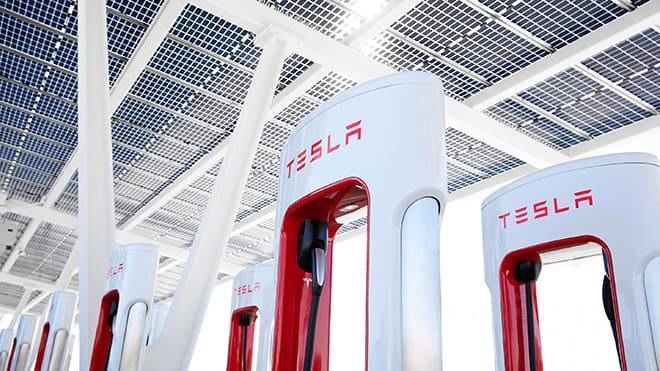
Tesla’s Supercharger strategy in 2025 is shifting from closed proprietary fast chargers to an expansive, more interoperable network across Europe. Key moves: rolling out V4 Supercharger cabinets (higher peak power, more stalls, payment terminals and CCS connectors at some sites), selectively opening Superchargers to NACS-equipped non-Tesla cars (and compatible adapters), and automakers (Porsche, BMW, VW group and others) moving to adopt Tesla’s NACS plug or provide adapters. For European Tesla owners and non-Tesla EV drivers this means more fast-charging options on major routes, evolving payment and subscription flows, and a transition period of mixed connector types and regional permitting that will last through 2026. Practical takeaways: check the Tesla app for “Open to NACS” stations, plan for adapter logistics for now, watch for V4 sites on major corridors, and expect regional differences in availability and pricing.
1. Why this matters now
Charging convenience is the single most visible part of the EV ownership experience. For years, Tesla’s Supercharger network was the fastest, most reliable long-distance charging option in Europe — but it was largely limited to Tesla cars. That closed approach created friction for non-Tesla EVs and made inter-network interoperability a major policy and customer pain point. In 2024–2025 a strategic shift became clear: Tesla is both deploying a new hardware generation (V4) that supports more power and more stalls per cabinet, and opening parts of its network to cars from other makers via the North American Charging Standard (NACS) or NACS adapters.
This is important because it changes the economics and logistics of long-distance EV travel in Europe: a broader Supercharger network means more practical routes, reduces range anxiety for non-Tesla owners, increases competition between charging operators, and forces governments and grid operators to rethink permitting and distribution. For Tesla owners, it increases station availability and may change charging costs and queuing behavior. For policymakers and fleet planners in Europe, the shift raises questions about grid capacity, site permitting, cross-network roaming, and fair access.
2. Snapshot: where we are today (September 2025)
-
Tesla continues to expand its Supercharger footprint across Europe, targeting highway corridors and high-demand destinations.
-
V4 Supercharger cabinets are being deployed in phased stages: early sites use partial V4 hardware with limits; fully realized V4 cabinets — designed for up to ~500 kW peak for cars and far higher power for trucks — are in permitting and scheduled for broader rollout in 2025–2026.
-
Select Superchargers are marked “Open to NACS” in the Tesla app and on Tesla’s website; these sites accept non-Tesla cars that either have native NACS ports or use certified NACS DC adapters.
-
Automakers are moving quickly to adopt NACS (or provide adapters) so their customers can use Tesla’s network more seamlessly; Porsche, BMW, VW Group and others have publicly committed to NACS transitions or adapter programs for 2025–2026 model years.
-
Despite widescale opening plans, access will be gradual and regionally staggered — not all Superchargers are open to non-Tesla cars, and the rollout involves permits, electrical upgrades, and commercial agreements per country and site.
That summary explains why ‘open network’ is not an overnight flip: it’s a multi-year transition combining hardware upgrades, commercial deals, and regulatory permitting.
3. What V4 Superchargers bring (technical & user-facing differences)
Tesla’s V4 is more than a marketing label — it represents a hardware and site-engineering upgrade with practical user impacts.
Key hardware and site improvements (what V4 offers):
-
Higher peak power capability: V4 cabinets are designed to support much higher peak power per stall (Tesla’s long-term goal—up to ~500 kW for passenger vehicles in some configurations), which shortens fast-charge sessions for high-voltage architecture EVs.
-
More stalls per cabinet and modular deployment: A single V4 cabinet can support more stalls (e.g., eight) compared with V3’s fewer stalls, reducing per-stall hardware costs and improving site throughput.
-
Longer, more flexible cables & mounting: Designed to physically reach more vehicle ports without blocking adjacent spaces.
-
Payment terminals and improved UX for non-Tesla drivers: V4 rollouts include physical payment options (to allow walk-up payments) and software flow improvements for plug-and-charge on non-Tesla apps where supported.
-
Support for CCS/NACS interoperability: Some V4 sites are being configured to accommodate CCS connectors or NACS adapters to ease access for non-Tesla EVs.
-
Truck/Commercial support (futureproofing): Higher power headroom accommodates future heavy-duty charging needs (e.g., Tesla Semi).
User experience changes you’ll notice:
-
Faster max charging sessions if your EV supports high-voltage fast charging.
-
Less queuing at busy nodes (once V4 stalls are operating at scale).
-
Mixed connector experiences — some sites will still require an adapter or app flow to start a session.
Bottom line: V4 is built to make long-distance charging faster and friendlier to a wider range of EVs — but full benefits arrive as hardware, grid upgrades, and software integrations complete.
4. Interoperability: NACS adoption, adapters, and how non-Tesla cars get access
Two parallel paths enable non-Tesla EVs to use Superchargers:
-
Native NACS adoption by automakers — some manufacturers are switching from CCS2 to NACS for new models or offering NACS-equipped ports as standard on 2025/2026 models. That removes adapter friction entirely and enables true plug-and-charge experiences at many Tesla sites.
-
Certified NACS adapters and selective Supercharger opening — for existing models with CCS, manufacturers or third parties provide certified NACS DC adapters that allow drivers to plug into NACS outlets (or to use Tesla locations labeled “Open to NACS”). In the meantime Tesla flags which chargers are open to non-Tesla cars via its app.
What this means practically today:
-
If your EV will ship with a native NACS port (or a factory-supplied adapter), you’ll get the smoothest experience. Several premium automakers have confirmed plans for NACS adoption or to supply adapters in 2025–2026.
-
For many current EVs, adapters are available or will be offered; but adapters come with caveats: they must be certified for DC fast-charging, they can be bulky, and using them introduces an extra step into the charging flow.
-
Tesla’s app and site filters are the best source to find NACS-open Superchargers while the transition unfolds.
Interoperability is therefore a hybrid model: long-term native ports + a short-to-medium term adapter ecosystem.
5. Country-by-country realities: permitting, grid upgrades, and rollout cadence
Europe is not a single homogeneous market — permitting regimes, grid capacities, and public incentives vary by country, which shapes rollout speed.
Permitting and local approvals
-
In many EU countries, building a high-power highway Supercharger requires multiple permits: land use, electrical grid connection approval, environmental checks, and local municipal sign-off. These processes can take months, sometimes longer in historic or dense urban corridors.
-
Some governments fast-track high-priority corridor electrification under EV infrastructure programs, which speeds permitting for major nodes.
Grid connections and cabling
-
High-power V4 sites draw significant peak power; some locations require substation upgrades or on-site megawatt-scale connections. Where grid upgrades are slow or expensive, there’s a practical cap on how many V4 stalls a single site can support.
-
In some cases, Tesla uses battery buffering or load management to smooth peak draw and reduce immediate grid upgrade needs — but battery buffers increase site CAPEX.
Regional priorities
-
Major cross-border corridors (e.g., Germany–France, Spain–France, Benelux routes) are priorities for early V4 deployment to enable pan-European long trips.
-
Urban and destination charging sites may see fewer V4 cabinets due to limited grid headroom, with operators favoring V3 or high-capacity public CCS installations instead.
Timeline implication: Expect V4 density to increase first on major highways and high-traffic tourist routes, then to spread into secondary networks as permits and grid upgrades are completed.
6. Economics and business model: how opening affects operators, governments, and Tesla
Opening Tesla’s Supercharger network to more manufacturers reshapes the charging market’s economics.
For Tesla:
-
Utilization & revenue upside: Allowing non-Tesla cars increases utilization of high-capacity stalls (more sessions per day), raising revenue per site.
-
Commercial agreements: Tesla may strike wholesale/roaming deals with OEMs or aggregator services to receive payments per session or per-user fees.
-
Opex and maintenance: Higher utilization raises wear and maintenance needs; Tesla must balance pricing and capacity to preserve uptime.
For other charging operators & incumbents (Ionity, Fastned, Electrify Europe):
-
Increased Supercharger availability intensifies competition on key corridors, potentially pressuring price points and service levels.
-
Incumbent networks may respond by upgrading sites, improving payment UX, and forming commercial alliances.
For governments & regulators:
-
Opening can accelerate EV adoption (reducing range anxiety), but it also demands public investment in grid reinforcement, permitting streamlining, and fair-access rules to prevent anti-competitive bottlenecks.
Overall: better customer experience but a complex commercial shift as legacy CCS networks adapt.
7. What this means for Tesla owners in Europe
If you own a Tesla in Europe, the evolving Supercharger strategy brings both improvements and short-term complexity:
Benefits:
-
More chargers per corridor means fewer detours and less queuing overall; V4 reduces peak session time for compatible high-voltage vehicles.
-
Improved public goodwill and reduced congestion at Tesla-only sites as more drivers can use chargers, smoothing demand patterns over time.
Potential downsides / friction in transition:
-
Mixed pricing models: Tesla may trial different pricing for non-Tesla users (higher per-kWh or per-minute fees) or subscription options; your historical charging cost patterns could change.
-
Queue dynamics: More available users at each site can still create new bottlenecks, especially at popular tourist destinations during peak season. Tesla’s software-based queuing and expected parking enforcement will be important.
-
Adapter misuse & blocking: Non-Tesla vehicles using adapters with poor fit or parked badly can cause operational headaches; local enforcement and driver education will be needed.
Practical tip: keep the Tesla app updated, use the “Open to NACS” filter, and consider subscribing to any loyalty/subscription product if it offers materially lower per-session costs for your usage pattern.
8. What non-Tesla European EV owners should know today
If you drive a non-Tesla EV in Europe, here’s how to navigate the transition:
-
Check if your next/ current EV will have a NACS port or a supplied adapter — many 2025/2026 models from premium brands are moving to NACS or supply adapters. If you buy a 2026 model, check factory specs.
-
Use Tesla’s app or website to find NACS-open sites; the “open to NACS” filter is the best guide while the network transitions.
-
Adapters are a stopgap — read instructions carefully: certified NACS adapters are required for DC fast charging and must be rated for the power levels you use; they are not universal and may void warranty if used incorrectly.
-
Plan for mixed connector trips: some sites will be CCS, some NACS, some support both. Bring a CCS cable where practical, and know local adapter availability.
-
Expect new payment flows: some Superchargers will accept plug-and-charge via OEM apps eventually, but in the interim you may need to use the Tesla app or a one-time walk-up payment where available.
In short: the user experience is improving but still requires planning.
9. Grid & environmental considerations: power demand, buffering, and renewables
High-power charging at scale has grid and environmental implications that deserve attention.
Peak load & grid upgrades
-
V4 sites with many high-power stalls can create large peak loads; utilities may need to upgrade feeders or substations. That has permitting and cost consequences, which may slow some deployments.
-
In some sites, onsite battery energy storage is used to shave peaks, reducing immediate grid upgrades but adding CAPEX and maintenance.
Renewables integration
-
Ideally, higher power sites will be paired with renewable energy contracts or local solar/ storage to reduce lifecycle emissions and manage energy costs. Policy incentives and green tariffs accelerate these pairings.
Local impacts
-
Rural or remote highways may lack the immediate grid capacity for V4; those locations will require significant investment or creative engineering (microgrids, hydrogen), slowing uniform coverage.
Policy takeaway: governments should coordinate grid reinforcement funding and streamline permitting for high-priority EV corridors to realize the full benefits of faster charging.
10. Case studies — early V4 & “Open to NACS” sites to watch
Harderwijk (Netherlands) & early European V4 pilots
Tesla’s early V4 deployments in parts of Europe provided testbeds for cable length, site layout, and initial interoperability experiments. Early learnings: cable ergonomics matter; payment terminals reduce friction for non-Tesla drivers; site power management is critical.
Highway corridors (e.g., major north–south European routes)
Corridor-focused deployments illustrate how V4 enables longer continuous travel with fewer stops if charging speeds are high and gaps between sites are optimized.
OEM rollouts (Porsche/BMW/VW):
As Porsche and other OEMs roll out NACS adoption for specific models, watch how integration with OEM apps (plug-and-charge) changes the UX. OEM-native plug-and-charge will be the best long-term rider experience.
These early sites show both technical feasibility and the operational headaches to solve before full scale.
11. Practical trip-planning checklist for European drivers
If you’re planning a long trip this year or next, use this checklist:
-
Check the Tesla app for “Open to NACS” stations and create a route that alternates Tesla and CCS nodes where needed.
-
Confirm adapter availability for your vehicle (factory-supplied or aftermarket certified adapter) and carry it in your car if you rely on Tesla sites.
-
Factor in payment flows: have the Tesla app installed and an account set up; carry a credit card for walk-up payments at sites that support them.
-
Allow buffer time in tourist seasons — early mornings or late evenings tend to have lower queues.
-
Monitor local rules — some countries restrict charging stall use for non-charging vehicles or impose fines for overstaying. Observe posted rules and local etiquette.
-
Stay flexible — the network is in transition; a favorite site today may change operational policies tomorrow.
This hands-on approach reduces stress and avoids surprises while the network matures.
12. What to watch next (indicators and dates)
To keep track of the transition, follow these signals:
-
OEM NACS announcements & factory port changes — watch for model-year announcements from major manufacturers about native NACS ports or supplied adapters.
-
Tesla V4 site openings & permit filings — Tesla’s site openings and local permitting filings are public records in many jurisdictions; they show where capacity is being added.
-
Tesla app map updates — Tesla’s app labeling of “Open to NACS” stations is the best real-time indicator for drivers.
-
Grid upgrade projects — public utility filings for substation or feeder upgrades often presage large V4 sites.
-
Commercial roaming agreements — announcements between Tesla and OEMs or charging roaming platforms indicate broader interoperability rollouts.
Expect meaningful progress through late 2025 into 2026, with visible improvements on main corridors first.
13. Risks and failure modes
The Supercharger transition is promising but not risk-free:
-
Permitting delays and grid bottlenecks can stall planned deployments.
-
Adapter supply or certification issues (safety recalls, warranty disputes) could create negative headlines.
-
Pricing fragmentation could cause user confusion and perceived unfairness between Tesla and non-Tesla drivers.
-
Maintenance & uptime pressure as utilization rises; higher demand can expose weak points in service levels if maintenance doesn’t scale.
-
Competition & regulatory pushback from incumbent operators if governments view preferential access as anti-competitive.
Most of these risks are manageable with clear regulations, robust commercial contracts, and transparent pricing/policy.
14. Conclusion — practical takeaways for owners, fleet managers, and policymakers
Tesla’s Supercharger strategy in Europe is transitioning to a more open, higher-capacity, and commercially integrated network. The combined effect of V4 deployment and NACS interoperability will materially improve long-distance EV travel reliability — but the change will be gradual and regionally uneven. For users: plan trips with the Tesla app, consider adapters as a temporary tool, and expect better corridor coverage by 2026. For fleet and fleet-ops: model charging wait times pre/post V4 and plan for higher utilization. For policymakers: prioritize grid upgrades and clear permitting to realize the network’s full benefit.
In short: more chargers and faster charging are coming — but the transition requires coordination, user education, and patient infrastructure investment.
FAQ
Q1: Can any EV use a Tesla Supercharger today in Europe?
A: Not every Supercharger is open to non-Tesla EVs. Tesla marks specific stations as “Open to NACS” in its app and website; non-Tesla cars with NACS ports or certified NACS adapters can use those stations. The network is gradually opening but remains partial.
Q2: Do I need a special adapter to use Tesla Superchargers with a non-Tesla car?
A: If your car does not have a native NACS port, you’ll need a certified NACS DC adapter for many Tesla stations that accept non-Tesla cars. Some OEMs provide adapters; check compatibility and safety ratings before use.
Q3: Will Supercharging become cheaper for European drivers?
A: Pricing will vary by site and operator deals. Greater competition and higher utilization could pressure prices down on some corridors, but operational costs (grid upgrades, maintenance) also matter. Watch for pricing experiments and subscriptions.
Q4: When will V4 be widely available in Europe?
A: V4 deployment is phased. Major highway corridors will see earlier rollouts in 2025–2026; full-density coverage across secondary routes will take longer and depends on permitting and grid upgrades.
Q5: How will this affect CCS-based public chargers?
A: Greater Supercharger access intensifies competition. CCS network operators may upgrade sites or improve UX. Consumers benefit from improved options — but local outcomes will vary.