
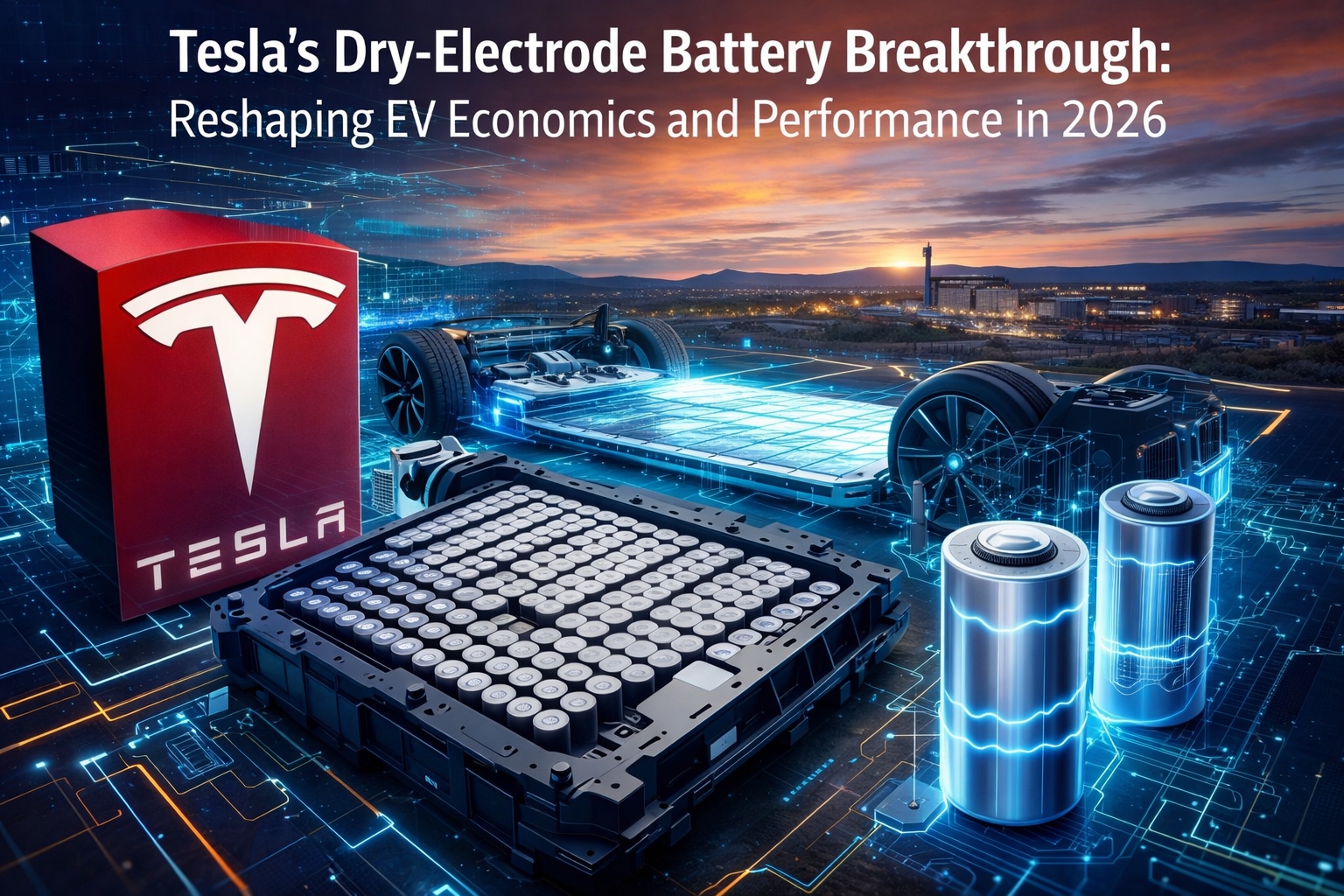
Section 1: The Five-Year Journey to Dry-Electrode Production
1.1 From Maxwell Acquisition to Battery Day Promise
Tesla's pursuit of dry-electrode technology began in earnest with the 2019 acquisition of Maxwell Technologies, a San Diego-based company specializing in energy storage and dry-electrode coating processes . At the time, the acquisition was viewed as a strategic move to gain control over battery manufacturing intellectual property, but few appreciated just how challenging the technology would be to commercialize.
At Tesla's much-anticipated Battery Day event in September 2020, Elon Musk unveiled ambitious plans for the 4680 battery cell format, named for its 46mm diameter and 80mm height. The 4680 cell was presented as a comprehensive system incorporating three key innovations: the larger cylindrical format, tabless electrode design, and dry-electrode manufacturing . The dry-electrode process was positioned as the foundation for dramatic cost reductions, with promises of smaller factories, lower energy consumption, and reduced capital expenditure.
However, the path from Battery Day promises to production reality proved far more difficult than Tesla's optimistic presentations suggested. The company soon discovered that scaling dry-electrode technology from laboratory demonstrations to industrial production was, in Musk's own words, an "extremely difficult" challenge .
1.2 The Industry Skepticism
Throughout the early 2020s, battery industry experts openly questioned whether dry-electrode technology could ever be mass-produced. Traditional lithium-ion battery manufacturing relies on a "wet" process that has been refined over decades. Active materials are mixed with toxic solvents such as N-Methyl-2-pyrrolidone (NMP) to create a slurry, which is then coated onto metal foils and passed through enormous drying ovens that can stretch hundreds of feet in length .
This conventional approach, while proven and reliable, carries significant drawbacks. The drying ovens consume enormous amounts of energy. The solvent recovery systems required to handle toxic NMP add complexity and cost. The factory footprint is dominated by coating and drying equipment. Industry insiders described scaling dry-electrode technology as a "laboratory trick" that would never work in high-volume production .
Tesla's early struggles seemed to validate this skepticism. While the company managed to apply dry coating to anodes relatively early, the cathode process proved persistently problematic at industrial speeds . Engineers grappled with adhesion issues, uneven layer thickness, and delamination problems that caused production delays and forced repeated line redesigns .
1.3 The Confirmation: "Both Electrodes Use Our Dry Process"
The breakthrough finally arrived in late 2025 and early 2026. In Tesla's Q4 and FY 2025 update letter to investors, the company quietly disclosed that it was now producing 4680 cells whose anode and cathode were both manufactured using the dry-electrode process .
Bonne Eggleston, Tesla's Vice President of 4680 batteries, reinforced the announcement with a direct post on X: "both electrodes use our dry process" . This brief confirmation from the executive directly responsible for the program carried enormous weight, signaling that the technical hurdles had finally been overcome.
Elon Musk added his own congratulations, posting on X to celebrate the Tesla engineering, production, and supply chain teams for solving what he termed a "major breakthrough" in lithium battery technology . The personal acknowledgment from Tesla's CEO underscored the significance of the achievement.
Section 2: How Dry-Electrode Technology Works
2.1 The Traditional Wet Process Explained
To understand why Tesla's dry-electrode breakthrough matters, one must first understand the conventional manufacturing process it replaces. Traditional lithium-ion electrode production begins by mixing active materials—lithium, nickel, cobalt, manganese, or iron phosphate compounds—with conductive additives and polymer binders. This mixture is dissolved in toxic solvents, primarily NMP, to create a liquid slurry .
This slurry is then coated onto thin metal foils—aluminum for the cathode, copper for the anode—and passed through enormous drying ovens that can exceed 100 meters in length. These ovens evaporate the solvent, leaving the active material bonded to the foil. The evaporated solvent must be captured, condensed, and recycled or disposed of, requiring complex ventilation and recovery systems .
The energy consumption of this process is substantial. The drying ovens operate at high temperatures continuously. The solvent recovery systems consume additional power. The factory footprint is dominated by this equipment, driving capital costs higher.
2.2 Tesla's Dry Process Innovation
Tesla's dry-electrode process takes a fundamentally different approach. Rather than dissolving materials in liquid solvents, the dry process mixes active materials with specialized binders in powder form. This mixture is then compressed under heat and pressure to form a thin, self-supporting film that is bonded directly to the current collector foil .
The elimination of liquid solvents brings multiple advantages. The massive drying ovens disappear entirely from the factory floor. The solvent recovery systems are no longer needed. The energy consumption of electrode production drops dramatically. The entire process can be completed in minutes rather than the hours required for wet coating and drying .
Tesla's patent filings reveal the specific innovations that made this possible. A recently published patent (US 2025/0364562) describes a composite binder system combining polytetrafluoroethylene (PTFE) with high-stability polymers such as PVDF or polyethylene . This binder system, when processed through high-shear jet milling, forms a unique "spider web" microscopic structure that gives the electrode film mechanical toughness while maintaining electrochemical performance.
2.3 Solving the Cathode Challenge
The cathode side of the battery presented the greatest difficulty. Cathode materials are more chemically reactive and mechanically fragile than anode materials. Previous attempts at dry cathode coating resulted in films that cracked, delaminated, or failed to achieve sufficient density.
Tesla's breakthrough solution involves reducing the number of roll-press passes required to achieve target density. Traditional approaches might require ten or more passes through compression rollers. Tesla's new process, enabled by the improved binder system and material formulation, achieves target density in just three passes . This threefold increase in throughput was essential for economic viability.
Additionally, the new binder system forms an effective electron barrier at the particle surface, reducing irreversible capacity loss (ICL) to just 30-50 mAh/g—comparable to mature wet-process electrodes . This means the dry electrodes do not sacrifice performance for manufacturability.
Section 3: Performance and Economic Benefits
3.1 Cost Reduction: The 50% Opportunity
The most significant benefit of dry-electrode technology is cost reduction. By eliminating solvents, drying ovens, and recovery systems, Tesla can dramatically reduce both capital expenditure and operating costs for battery production .
Studies of dry coating technology suggest potential cost reductions approaching 50% for electrode production lines once fully scaled . For Tesla, which produces batteries at gigawatt-hour scale, this translates to billions of dollars in annual savings. Lower battery costs mean lower vehicle prices, higher margins, or some combination of both.
The capital expenditure implications are equally important. Factories without drying ovens and solvent recovery systems are smaller, cheaper to build, and faster to deploy. This accelerates Tesla's ability to expand production capacity in response to growing demand.
3.2 Energy Density Improvements
Dry-electrode processing enables thicker, denser electrode coatings than wet processing . In wet processing, thick coatings are difficult to dry completely and may crack as solvent evaporates. Dry processing avoids these limitations entirely.
Thicker, denser electrodes mean more active material in the same physical volume. For a given cell size, this translates directly to higher energy density. For a given energy capacity, it means smaller, lighter cells.
Tesla's patent documentation indicates that the dry electrodes can achieve maximum energy output with minimal binder content—as low as 1.25% binder by weight . This compares favorably to wet-process electrodes, which typically require higher binder loadings to maintain cohesion through the drying process.
3.3 Extended Cycle Life
Beyond cost and energy density, dry-electrode technology appears to deliver extended battery life. The improved particle bonding achieved through dry processing reduces cracking and degradation over many charge cycles .
Tesla's patent indicates that cells manufactured with the dry process can maintain approximately 90% of initial capacity after 2,000 charge-discharge cycles . For a typical electric vehicle with 300 miles of range, 2,000 cycles represents 600,000 miles of driving before reaching 90% capacity. Most owners will never approach this level of battery degradation.
The extended cycle life has particular relevance for Tesla's energy storage products and robotaxi ambitions. Stationary storage applications cycle daily, making cycle life a critical economic parameter. Robotaxis, which may operate continuously and charge frequently, similarly benefit from batteries that can withstand heavy use.
3.4 Environmental Benefits
The elimination of NMP and other toxic solvents represents a significant environmental improvement . NMP is classified as a reproductive toxicant in Europe and requires careful handling, worker protection, and emission controls. By removing this material entirely from the manufacturing process, Tesla eliminates both the environmental risks and the compliance costs associated with solvent management.
The energy reduction also carries environmental benefits. Battery production has historically been energy-intensive, contributing to the lifecycle carbon footprint of electric vehicles. By reducing manufacturing energy consumption, dry-electrode technology makes already-clean electric vehicles even cleaner.
Section 4: Production Status and Vehicle Integration
4.1 Current Production at Gigafactory Texas
Tesla has already begun producing 4680 battery packs using the full dry-electrode process at Gigafactory Texas . These packs are being installed in "certain Model Y vehicles" produced at the Austin facility .
The qualification "certain Model Y vehicles" is important. Tesla appears to be taking a measured approach to deployment, likely starting with a subset of production to validate the new cells in real-world conditions before expanding to full production. This cautious approach allows Tesla to monitor performance, identify any issues, and refine processes before committing the entire Model Y fleet to the new cells.
4.2 Supply Chain Resilience and Tariff Mitigation
The timing of the dry-electrode breakthrough is not coincidental. Tesla's Q4 2025 update letter explicitly frames the 4680 production expansion as a response to "increasingly complex supply chain challenges caused by trade barriers and tariff risks" .
By producing cells domestically in Texas, using materials processed in the United States, Tesla gains insulation from trade disputes that could disrupt imported battery supplies. This supply chain resilience has become increasingly valuable as geopolitical tensions affect global trade.
The company plans to further deepen this vertical integration with domestic cathode material production in Texas and LFP (lithium iron phosphate) production lines in Nevada planned for 2026 . Each step reduces exposure to supply chain disruptions and trade policy uncertainty.
4.3 Implications as Model S and X Production Winds Down
Tesla's announcement that it is winding down Model S and Model X production makes the dry-electrode breakthrough even more timely . With the flagship models sunsetting, the Model Y and Model 3 will account for an even larger share of Tesla's global vehicle output.
Ensuring that the Model Y can be equipped with domestically produced 4680 battery packs gives Tesla flexibility to maintain production volumes in the United States even as global battery supply chains face complexity . For European Tesla owners, the analogous benefit would come from 4680 production at Gigafactory Berlin-Brandenburg, should Tesla extend dry-electrode manufacturing to Europe.
4.4 Cybertruck Applications
The Cybertruck has been the primary beneficiary of 4680 production to date . The truck's large battery pack and high power requirements make it well-suited to the 4680 format. With dry-electrode technology now proven, Cybertruck production can accelerate without being constrained by battery cell availability.
For Cybertruck owners and reservation holders, this means reduced uncertainty about production timelines and potential for improved vehicle performance as the new cells enter production.
Section 5: Strategic Implications for European and American Markets
5.1 European Context: Sales Trends and Competitive Pressure
The dry-electrode breakthrough arrives at a critical moment for Tesla in Europe. Data from December 2025 shows Tesla European sales of 35,280 vehicles, representing a 20.2% decline from the 44,190 vehicles sold in December 2024 . This decline occurred despite growing overall EV adoption in key markets.
Several factors contribute to this trend. Increased competition from established European automakers has eroded Tesla's market share. Volkswagen Group, Stellantis, and Renault have all expanded their EV offerings. Chinese manufacturers like BYD are also gaining presence in European markets.
Against this backdrop, cost reduction through dry-electrode technology becomes strategically crucial. Lower battery costs allow Tesla to adjust pricing, maintain margins while competitors discount, or invest more heavily in features and marketing. The technology provides a competitive advantage precisely when Tesla needs it most.
5.2 American Market: Model Y Dominance and California Trends
In the American market, particularly California—Tesla's largest domestic market—the Model Y continues to dominate despite challenges. The Model Y recorded 110,120 registrations in California in 2025, maintaining its position as the state's best-selling vehicle for the fourth consecutive year .
However, the trend line shows concerning declines. Model Y registrations fell from 132,636 in 2023 to 128,923 in 2024, and further to 110,120 in 2025 . Overall Tesla sales in California dropped from 238,589 in 2023 to 179,656 in 2025.
These declines reflect multiple factors: the expiration of the federal $7,500 EV tax credit, increased competition, and political controversies affecting brand perception. Against this headwind, the cost advantages of dry-electrode technology provide a tool for Tesla to maintain competitiveness through pricing flexibility.
5.3 Energy Storage Growth Trajectory
Beyond vehicles, dry-electrode technology carries enormous implications for Tesla's energy storage business. The company's energy storage deployments reached 46.7 GWh in 2024, representing substantial year-over-year growth . Energy storage revenue surged 44% year-over-year in Q3 2025, reaching $3.4 billion .
Energy storage applications are even more cost-sensitive than automotive applications. Megapack and Powerwall customers compare Tesla's offerings against alternatives on a dollar-per-kilowatt-hour basis. Any reduction in battery cell costs translates directly to improved competitiveness or higher margins.
The extended cycle life offered by dry-electrode technology is particularly valuable for stationary storage, where daily cycling accumulates rapidly. A 90% capacity retention after 2,000 cycles translates to approximately 5.5 years of daily cycling before reaching 90% capacity—well within the expected service life of a grid storage installation.
5.4 Robotaxi Economics
Tesla's robotaxi ambitions depend critically on battery economics. Robotaxis will operate continuously, accumulating mileage far faster than personally owned vehicles. They will charge frequently, potentially multiple times daily. Battery degradation directly impacts robotaxi profitability.
Dry-electrode technology's extended cycle life directly supports robotaxi economics. A battery that maintains 90% capacity after 2,000 cycles can support years of commercial operation before degradation affects range or requires replacement. Lower initial cell costs also improve the capital efficiency of robotaxi fleets.
Section 6: What This Means for Tesla Owners
6.1 Future Vehicle Pricing
For Tesla owners and prospective buyers, the most immediate question is whether dry-electrode technology will lead to lower prices. The answer is nuanced but ultimately positive.
Battery cells represent the single largest cost component in electric vehicle manufacturing. Reducing cell costs by 20-30%—a realistic expectation for dry-electrode technology—creates substantial room for price adjustments. Tesla could choose to pass these savings to consumers through lower vehicle prices, maintain current prices while improving margins, or invest the savings in enhanced features and performance.
Historical patterns suggest Tesla will pursue a combination approach. The company has consistently worked to reduce vehicle prices as costs decline, while also funding research, development, and expansion. Owners should expect continued price improvements over time, though not necessarily an immediate across-the-board reduction.
6.2 Range and Performance Improvements
Beyond pricing, dry-electrode technology enables range and performance improvements. Higher energy density means more range from the same physical battery pack, or the same range from a smaller, lighter pack .
For performance-oriented vehicles, the improved power delivery enabled by dry electrodes may translate to faster acceleration. For long-range variants, the range extension could push beyond current benchmarks. Future Model Y and Cybertruck variants may offer range figures that seem impressive by today's standards.
6.3 Battery Longevity
Current Tesla owners already benefit from excellent battery longevity. The addition of dry-electrode technology should extend battery life further . For owners planning to keep their vehicles for many years, this translates to reduced long-term cost of ownership and less concern about battery replacement.
The 90% capacity retention after 2,000 cycles cited in Tesla's patent compares favorably to current industry benchmarks. For context, Tesla's current vehicles typically achieve approximately 90% capacity retention after 200,000 miles. The new cells should maintain capacity to even higher mileage.
6.4 Charging Speed Implications
Dry-electrode technology may also enable faster charging. The improved particle bonding and reduced internal resistance can support higher charge rates without accelerating degradation . Combined with Tesla's V4 Supercharger technology, future vehicles may charge even faster than today's models.
For owners who frequently take long road trips, faster charging translates to shorter stops and more efficient travel. The combination of improved battery technology and enhanced charging infrastructure creates a virtuous cycle of convenience.
Conclusion
Tesla's successful commercialization of dry-electrode battery technology represents one of the most significant manufacturing breakthroughs in the electric vehicle industry's history. After years of development, skepticism, and technical challenges, Tesla has proven that dry-electrode production can work at scale, delivering cells for the Model Y and Cybertruck that are cheaper, more energy-dense, and longer-lived than conventionally manufactured alternatives.
The implications extend far beyond Tesla's immediate product lineup. Lower battery costs accelerate the entire transition to sustainable transportation by making electric vehicles more affordable. Improved energy density enables longer range and better performance. Extended cycle life supports commercial applications like robotaxis and grid storage that require durable, long-lasting batteries.
For Tesla owners in the United States and Europe, the dry-electrode breakthrough promises better vehicles at better prices. While the benefits will roll out gradually as production scales and new vehicle variants are introduced, the direction of travel is clear: Tesla's battery technology advantage is widening, not narrowing.
As legacy automakers struggle with battery supply chains and production costs, Tesla is mastering the fundamental chemistry and manufacturing processes that determine electric vehicle economics. The dry-electrode breakthrough, combined with Tesla's investments in vertically integrated production, positions the company to maintain its leadership position for years to come.
The five-year journey from Maxwell acquisition to production reality demonstrates both the difficulty of fundamental innovation and the rewards of persistence. Tesla has transformed a "laboratory trick" into industrial reality, and the entire electric vehicle ecosystem will benefit as a result.
Frequently Asked Questions
Q: Will my existing Tesla receive a battery upgrade?
A: No. The dry-electrode technology applies to new battery production and will be incorporated into vehicles as they are manufactured. Retrofitting existing vehicles with new battery packs is not feasible or economically practical.
Q: When will I be able to buy a Tesla with dry-electrode batteries?
A: Tesla has already begun producing Model Y vehicles at Gigafactory Texas with 4680 packs using the full dry-electrode process . However, production is initially limited to "certain" vehicles. Broader availability will increase throughout 2026 as production scales.
Q: Does this breakthrough affect the 4680 cell or other formats?
A: The dry-electrode process is currently applied to 4680 cell production. However, the fundamental technology could theoretically be adapted to other cell formats if Tesla chooses to do so .
Q: How much will dry-electrode technology reduce vehicle prices?
A: Tesla has not announced specific price adjustments. Industry estimates suggest battery cost reductions of 20-30% are achievable, which could translate to thousands of dollars in vehicle cost savings. How much of this reaches consumers versus being retained as margin remains to be seen .
Q: Will European Teslas get dry-electrode batteries from Gigafactory Berlin?
A: Tesla has not announced plans for dry-electrode production in Europe. However, given the strategic importance of the European market and the benefits of local production, it would be logical for Tesla to eventually extend the technology to Berlin.
Q: Is this technology only for Tesla, or will it be shared with other automakers?
A: Tesla has historically kept its battery technology proprietary. While Tesla supplies powertrain components to some automakers and has opened its Supercharger network, battery cell technology remains a core competitive advantage that Tesla is likely to protect.
Q: How does this affect Tesla's 2026 sales outlook in Europe?
A: The cost advantages from dry-electrode technology could help Tesla respond to competitive pressure and declining sales in Europe by enabling more aggressive pricing or higher investment in marketing and features. However, other factors such as model lineup, regulatory environment, and brand perception will also influence sales .
Q: What is the environmental benefit of eliminating NMP solvent?
A: NMP is classified as a reproductive toxicant and requires careful handling and disposal. Eliminating it from the manufacturing process removes environmental risks and reduces the energy and capital required for solvent recovery systems .