
Introduction: A Milestone With Multiple Layers
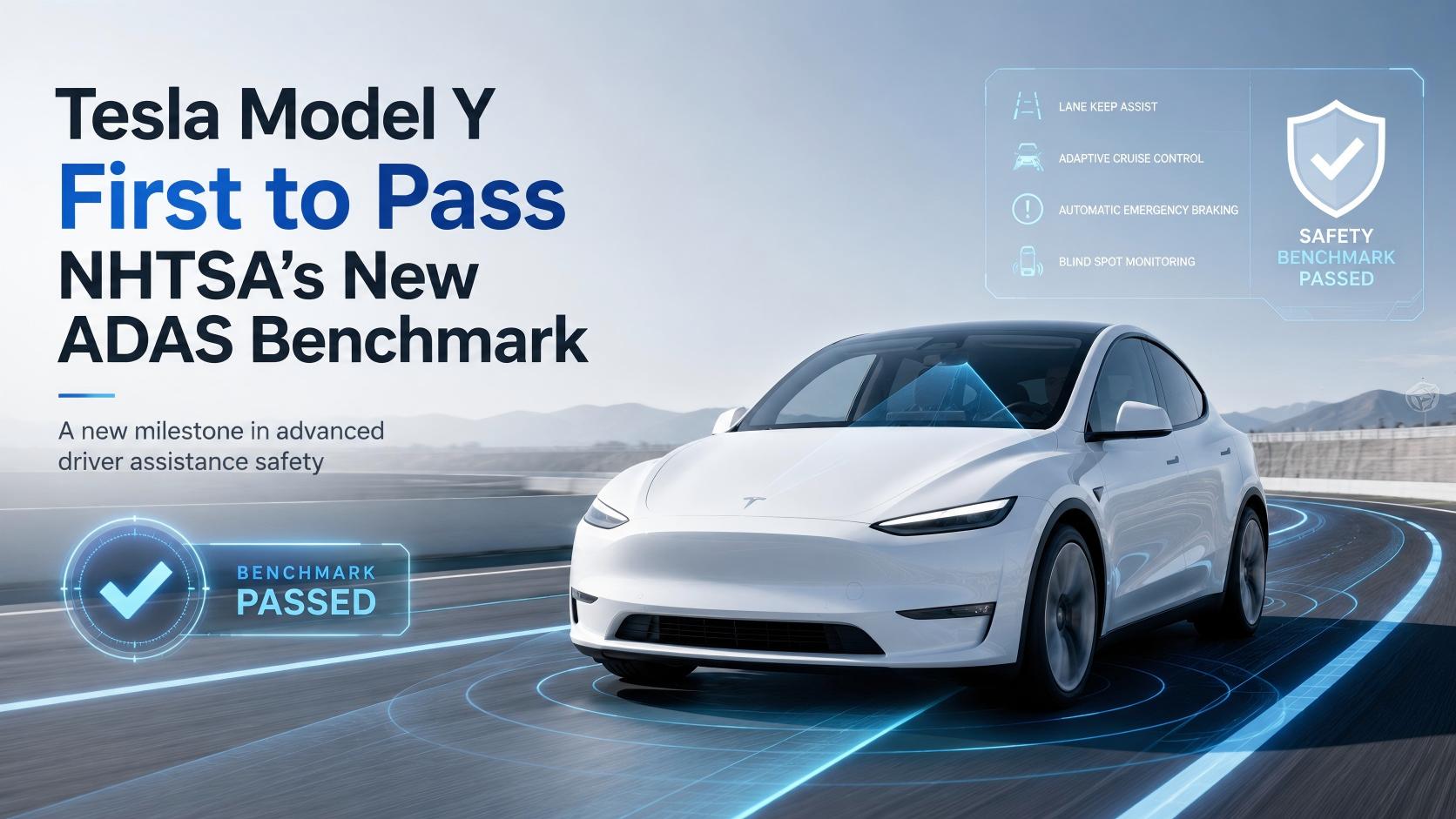
On May 7, 2026, the United States Department of Transportation’s National Highway Traffic Safety Administration (NHTSA) made an announcement that instantly ricocheted across automotive media, investor forums, and Tesla owner communities worldwide. The agency declared that the 2026 Tesla Model Y had become the first vehicle model to pass its newly established benchmark for advanced driver assistance systems (ADAS). The press release, published on NHTSA’s official website, carried a headline that was itself newsworthy: “Trump’s Transportation Department Announces Tesla Model Y Is the First Vehicle to Pass NHTSA’s New ‘Advanced Driver Assistance System’ Tests.”
For Tesla owners in the United States and Europe, this announcement lands at a peculiar moment. The company is simultaneously celebrated for setting a “high bar for the industry” while remaining under active federal investigation for its most ambitious driver-assistance technology, Full Self-Driving (Supervised). The 2026 Model Y’s certification under the updated New Car Assessment Program (NCAP) raises a series of questions that deserve careful exploration. What exactly did Tesla pass? Why was the Model Y the first? How should owners interpret this certification in the broader context of vehicle safety ratings? And what does the political framing of the announcement reveal about the relationship between government regulators and the world’s most valuable automaker?
Chapter 1: Anatomy of the Announcement -What NHTSA Actually Said
The NHTSA press release, dated May 7, 2026, from Washington, D.C., made several specific claims that are worth parsing carefully. The agency stated that the “later release 2026 Tesla Model Y” is the first vehicle model to pass its new ADAS benchmark. The qualifying phrase “later release” is significant — it refers specifically to Model Y vehicles manufactured on or after November 12, 2025.
NHTSA Administrator Jonathan Morrison provided the official framing: “Today’s announcement marks a significant step forward in our efforts to provide consumers with the most comprehensive safety ratings ever. By successfully passing these new tests, the 2026 Tesla Model Y demonstrates the lifesaving potential of driver assistance technologies and sets a high bar for the industry. We hope to see many more manufacturers develop vehicles that can meet these requirements.”
The agency emphasized that ADAS is designed to assist drivers who “must remain fully attentive and in control of their vehicle” — an important caveat that distinguishes these systems from autonomous driving technology. The updated NCAP program, NHTSA explained, introduced enhanced evaluations for existing safety technologies and added four new ADAS performance evaluations “to better protect those both inside and outside the vehicle.”
The press release also referenced NHTSA’s 10-year roadmap for NCAP evolution, signaling that this is merely the beginning of a longer trajectory of expanding safety assessments. Additional improvements are already under consideration, suggesting that the ADAS benchmark represents a floor rather than a ceiling for future regulatory expectations.
For Tesla owners, one critical detail in the announcement is the manufacturing date cutoff. Only 2026 Model Y vehicles produced on or after November 12, 2025, are covered by this certification. Owners of earlier Model Y variants, including those manufactured in late 2025 before the cutoff date, fall outside the scope of this particular NHTSA evaluation.
Chapter 2: The Eight Tests-What the Model Y Had to Pass
Understanding the significance of the NHTSA certification requires a detailed examination of what the Model Y was actually tested on. The updated NCAP program evaluates vehicles against eight distinct ADAS criteria — four that were already part of the original NCAP framework, and four that were newly introduced.
The four original ADAS criteria, which the Model Y also passed, are:
-
Forward Collision Warning (FCW): This system alerts the driver when a potential frontal collision with another vehicle is detected, providing critical seconds to react and avoid or mitigate an impact. FCW uses forward-facing cameras and sensors to monitor the distance and closing speed relative to vehicles ahead.
-
Crash Imminent Braking (CIB): When a frontal collision is determined to be imminent and the driver has not taken sufficient evasive action, CIB automatically applies the brakes to reduce the severity of impact or, in some scenarios, avoid the collision entirely. Unlike standard Automatic Emergency Braking, CIB is designed to activate at the very last moment before an unavoidable crash.
-
Dynamic Brake Support (DBS): This system supplements the driver’s braking input when it senses that the driver is applying the brakes but with insufficient force to avoid a collision. DBS essentially boosts braking power in emergency situations where human reaction alone may not apply adequate pedal pressure.
-
Lane Departure Warning (LDW): LDW monitors lane markings and alerts the driver — typically through visual, audible, or haptic signals — when the vehicle begins to drift out of its lane without a turn signal activated. This addresses one of the most common causes of highway accidents: unintentional lane departures due to driver fatigue or distraction.
The four newly added ADAS criteria represent NHTSA’s first formal integration of more advanced driver-assistance evaluations into the NCAP star-rating framework:
-
Pedestrian Automatic Emergency Braking (Pedestrian AEB): This system detects pedestrians in the vehicle’s path and automatically applies the brakes if the driver fails to respond in time. Pedestrian AEB is particularly challenging because it must distinguish pedestrians from other objects in complex urban environments, operate effectively in low-light conditions, and make split-second decisions at various vehicle speeds.
-
Lane Keeping Assistance (LKA): Unlike LDW, which merely warns the driver, LKA actively intervenes by applying corrective steering torque to keep the vehicle centered within its lane. This requires continuous monitoring of lane markings and the ability to make subtle steering adjustments that feel natural to occupants while preventing unintended lane departures.
-
Blind Spot Warning (BSW): BSW monitors the areas alongside and behind the vehicle that are typically not visible in the side mirrors. When another vehicle enters these blind spot zones, the system provides a visual alert — usually an illuminated icon in the side mirror — to warn the driver against changing lanes.
-
Blind Spot Intervention (BSI): Building on BSW, BSI takes active measures to prevent a lane-change collision. If the driver signals an intention to change lanes while a vehicle is detected in the blind spot, the system can apply steering corrections or differential braking to guide the vehicle back into its original lane and avoid a potential collision.
The distinction between warning-only systems (like LDW and BSW) and intervention-capable systems (like LKA and BSI) is important. Intervention systems are technically more complex because they must not only detect hazards but also take physical control actions that must be executed safely across a wide range of driving scenarios. The Model Y’s ability to pass all four intervention tests suggests its sensor suite and control algorithms meet NHTSA’s threshold for reliable operation.
However, it is essential to note that these eight tests evaluate what the industry generally considers “basic” ADAS features. As Electrek’s coverage observed, “blind spot warning, lane keeping assistance, and pedestrian automatic emergency braking are standard or widely available on dozens of vehicles from Toyota, Hyundai, Honda, BMW, and others.” The Model Y being “first” to pass does not necessarily mean it is uniquely capable among all vehicles on the market; it means it is the first vehicle formally tested and certified under the new NCAP ADAS framework.
Chapter 3: Why Was Tesla First? The Regulatory Timeline
The question of why Tesla rather than Toyota, Honda, or BMW became the first manufacturer to pass the new ADAS benchmark has a straightforward explanation rooted in regulatory timing rather than technological exclusivity.
NHTSA originally finalized the NCAP updates in late 2024, with the intention of applying the new ADAS evaluations to model year 2026 vehicles. The automotive industry had advance notice and was expected to prepare. However, in September 2025, the Trump administration delayed the full implementation of these updates by one full year, pushing applicability to model year 2027 vehicles. The delay came after the Alliance for Automotive Innovation — the industry’s primary lobbying organization representing major automakers — formally requested more time to align their product development cycles with the new testing requirements.
This one-year delay had a cascading effect on the competitive landscape. Most established automakers, following the revised regulatory calendar, had not yet submitted their 2026 model year vehicles for the new ADAS evaluations by May 2026. They were operating under the assumption that formal testing and certification would align with the updated model year 2027 timeline. Tesla, by contrast, chose to submit the Model Y for evaluation under the original schedule despite the delay — an approach consistent with the company’s historical pattern of moving faster than regulatory requirements demand.
This context reframes the “first to pass” narrative in a significant way. The Model Y achieved certification not necessarily because competing vehicles are incapable of passing the same tests, but because competing manufacturers had not yet entered the testing pipeline when the announcement was made. As Electrek noted, “calling it a ‘high bar for the industry’ when the bar is literally blind spot warnings is a stretch.”
None of this diminishes Tesla’s genuine achievement. The Model Y demonstrably met all eight criteria, and submitting a vehicle for testing before it was required shows a proactive stance on safety transparency. But for Tesla owners and prospective buyers, understanding the regulatory timeline provides essential context: more vehicles from other manufacturers are likely to follow, and the “first” designation should not be misinterpreted as evidence that Tesla alone possesses these safety capabilities.
Chapter 4: The Political Framing -An Unusual Government Announcement
Perhaps the most striking aspect of the NHTSA announcement is not what was tested, but how it was communicated. The press release title reads in full: “Trump’s Transportation Department Announces Tesla Model Y Is the First Vehicle to Pass NHTSA’s New ‘Advanced Driver Assistance System’ Tests.”
This phrasing is unusual by the standards of federal safety agency communications. Government safety announcements — whether from NHTSA, the National Transportation Safety Board (NTSB), or the Federal Aviation Administration (FAA) — typically center on the safety program, the technology, or the vehicle, rather than the political administration in power. Leading with “Trump’s Transportation Department” rather than “NHTSA” or “U.S. Department of Transportation” represents a departure from the apolitical tone that has historically characterized vehicle safety communications.
Electrek’s analysis raised pointed questions about this framing: “The framing raises questions about whether this announcement is driven more by safety communication or by a desire to highlight Tesla — a company whose CEO has had a well-documented relationship with the current administration.” Elon Musk’s connections to the Trump administration — including his appointment to lead the Department of Government Efficiency (DOGE) initiative and regular presence in White House advisory circles — have been extensively reported in major media outlets. The political framing of a vehicle safety certification invites scrutiny about whether the lines between objective safety assessment and political signaling have been blurred.
From a consumer’s perspective, the political context does not invalidate the test results. The Model Y either passes the objective criteria or it does not, and the vehicle’s hardware and software performance is what it is regardless of how the press release is written. However, the political framing matters for two reasons. First, it shapes public perception of the certification’s significance, potentially inflating its meaning beyond what the technical evaluation supports. Second, it raises legitimate questions about whether Tesla will receive differential regulatory treatment — either favorable or unfavorable — compared to other manufacturers, which ultimately affects market competition and consumer choice.
Chapter 5: The Irony-NHTSA’s Simultaneous FSD Investigation
The most intellectually striking dimension of this announcement is the dual posture NHTSA maintains toward Tesla’s driver-assistance technology. While one arm of the agency — the NCAP program — was issuing a press release celebrating Tesla’s ADAS capabilities as an industry benchmark, another arm — the Office of Defects Investigation (ODI) — remains actively engaged in an Engineering Analysis investigation into Tesla’s Full Self-Driving (Supervised) system.
This is not a historical footnote or a closed investigation. The Engineering Analysis represents a formal, ongoing federal inquiry into the safety of Tesla’s most advanced driver-assistance system — the same technology that Tesla markets as the pathway to fully autonomous driving. The investigation examines whether FSD (Supervised) poses unreasonable safety risks under real-world operating conditions, including scenarios that go far beyond the controlled test-track evaluations used in the NCAP ADAS assessment.
For NHTSA, this duality creates an awkward but not necessarily contradictory position. The NCAP ADAS tests evaluate specific, well-defined safety functions — pedestrian AEB, blind spot intervention, lane keeping assistance — under standardized conditions that can be replicated in a testing facility. The Engineering Analysis into FSD, by contrast, examines complex real-world performance, edge cases, and the system’s behavior in unpredictable traffic environments that cannot be fully captured by controlled tests. It is entirely possible for a vehicle to pass the NCAP ADAS benchmark while its more advanced autonomous features remain under investigation, because the two assessments target fundamentally different capabilities.
For Tesla owners, this duality carries practical implications. It means that passing the NCAP ADAS tests says nothing definitive about the safety or reliability of FSD (Supervised) — the feature that many owners pay thousands of dollars to access. The NCAP certification is relevant to the baseline safety systems that operate whenever the vehicle is driven, regardless of whether FSD is engaged. The ongoing investigation is relevant to the system that owners activate when they choose to use Tesla’s most advanced autonomy features. Owners should understand these as separate and only partially overlapping safety domains.
Industry observers note that this situation places NHTSA in an inherently contradictory public communication position. The agency is telling consumers, on one hand, that the Model Y “sets a high bar for the industry” in driver-assistance safety, while simultaneously investigating whether the vehicle’s most advanced driver-assistance system creates unreasonable safety hazards on public roads. Reconciling these two messages is challenging for the agency, complicated for media coverage, and potentially confusing for consumers making purchasing decisions.
Chapter 6: Understanding the NCAP Safety Rating System
To fully appreciate what the ADAS certification means — and what it does not mean — Tesla owners and prospective buyers need to understand the architecture of NHTSA’s New Car Assessment Program.
The NCAP is best known for its five-star safety ratings, which appear on window stickers at dealerships and on NHTSA’s consumer-facing website, These star ratings are fundamentally based on crashworthiness: how well a vehicle protects occupants in frontal crashes, side crashes, and rollover scenarios. The tests involve physical vehicles being crashed into barriers and subjected to measured forces, with instrumented dummies recording the likely injuries to human occupants. These crash tests form the core of the star rating system and are what most consumers think of when they see a vehicle’s safety score.
The ADAS evaluations are categorically different. They are pass/fail “checkmarks” — not graduated ratings — that appear alongside but separate from the star rating. A vehicle can earn five stars in crashworthiness while failing one or more ADAS tests, or conversely, a vehicle could pass all ADAS tests while earning a lower star rating in crash protection. The two assessments operate on parallel but independent tracks.
This distinction matters enormously for consumer interpretation. NHTSA’s own website is clear: the ADAS tests provide “useful consumer information” — a supplement to, not a replacement for, the crash-based star ratings. The Model Y has independently earned a five-star overall safety rating from NHTSA based on its crash-test performance, which includes strong results in frontal crash, side crash, and rollover evaluations. The ADAS pass is additional information layered on top of that crash rating.
Why does this matter? Because some media coverage and social media discussion following the NHTSA announcement has conflated the ADAS certification with a claim that the Model Y is “the safest car ever tested” or similar superlatives. In reality, the ADAS pass means that the vehicle’s driver-assistance features meet NHTSA’s minimum performance thresholds for the eight evaluated functions. It does not mean the vehicle offers superior crash protection compared to other five-star-rated vehicles. It does not mean the ADAS features are more capable than those available on other vehicles. It means the vehicle passed these specific tests — a genuine achievement, but one whose boundaries must be clearly understood.
Chapter 7: Practical Implications for Tesla Owners and Buyers
For existing Tesla owners, particularly those driving the world’s best-selling vehicle, the NHTSA announcement carries several practical implications that go beyond the headlines.
First, the manufacturing date cutoff is critical. Only 2026 Model Y vehicles produced on or after November 12, 2025, have been verified against the new NCAP ADAS tests. If you own a Model Y manufactured before that date — even if it is a 2026 model year vehicle — your specific vehicle has not been through this certification process. While your vehicle may well possess the same hardware and software capabilities, and may perform identically in real-world conditions, the NHTSA certification technically applies only to vehicles meeting the production date requirement.
Second, the certification covers the factory-installed ADAS features as configured at the time of NHTSA’s evaluation. Over-the-air (OTA) software updates — one of Tesla’s signature advantages over traditional automakers — can change ADAS performance characteristics over time. A vehicle that passed the tests in May 2026 could theoretically have different ADAS behavior after receiving software updates later in the year. Tesla owners should be aware that NHTSA certification represents a point-in-time assessment, not a permanent guarantee of unchanged performance.
Third, the NCAP ADAS pass/fail checkmarks will appear on NHTSA’s consumer-facing website, allowing prospective buyers to compare the Model Y against future certified vehicles on these specific safety dimensions. As more vehicles are tested — expected when the model year 2027 implementation deadline approaches — consumers will have an increasingly rich dataset for comparison shopping. The Model Y’s early certification means it will anchor the benchmark data that subsequent vehicles are measured against.
Fourth, for owners of other Tesla models — Model 3, Model S, Model X, and Cybertruck — the NHTSA announcement does not directly apply. These vehicles have not yet been tested under the new NCAP ADAS framework, and their specific ADAS performance profiles may differ from the Model Y’s due to differences in sensor configurations, software versions, and vehicle architecture. Owners of non-Model Y Teslas should look for future NHTSA announcements specific to their vehicle models.
Fifth, for prospective buyers considering the Model Y, the ADAS certification adds a useful data point to the purchasing decision — but it should not be the sole or primary factor. The Model Y’s five-star crash rating, its electric range, its charging network access, and its total cost of ownership are all independently important considerations. The ADAS pass is one element in a broader safety and value equation.
Chapter 8: The Broader Industry Context
The NHTSA announcement arrives at a time when the automotive industry is undergoing a fundamental transformation in how safety is defined, measured, and communicated to consumers. For decades, vehicle safety has been primarily about passive protection — airbags, crumple zones, seatbelt pretensioners — designed to protect occupants after a crash has begun. The NCAP star rating system was built around this passive-safety paradigm.
The integration of ADAS evaluations into NCAP represents a paradigm shift toward active safety — technologies designed to prevent crashes from occurring in the first place. This shift has been advocated by safety researchers and consumer groups for years, and it aligns with broader industry trends toward increasingly automated driving functions. NHTSA’s 10-year NCAP roadmap envisions progressively expanding the scope of ADAS evaluations, potentially including more advanced functions like highway pilot systems, automated lane changes, and intersection assistance in future iterations.
For the automotive industry, this regulatory evolution creates both opportunities and challenges. Manufacturers that have invested early in ADAS development — of which Tesla is a prominent example — may find themselves well-positioned as the testing framework expands. Manufacturers that have treated ADAS as a differentiator for higher trim levels may face pressure to standardize these features across their lineups to maintain competitive NCAP profiles.
For consumers, the trend toward standardized ADAS testing is unambiguously positive. It provides comparable, government-verified information about safety technologies that have historically been difficult to evaluate through casual test drives or manufacturer marketing materials. As more vehicles enter the testing pipeline, car buyers will have access to an increasingly comprehensive picture of how different models perform on the safety dimensions that matter most in everyday driving.
Conclusion: A Genuine Step Forward, Properly Understood
The NHTSA certification of the 2026 Tesla Model Y as the first vehicle to pass the new ADAS benchmark is a genuine milestone that deserves recognition. The vehicle demonstrably met all eight evaluated safety criteria — four legacy and four new — confirming that its active safety systems perform to federally established standards. For Tesla owners, this provides independent, government-verified confirmation of safety capabilities that they experience daily on the road.
However, a clear-eyed understanding of this milestone requires holding several truths in tension simultaneously. The Model Y was first to pass because it was first to submit, in a context where most competitors are operating on a delayed regulatory timeline. The ADAS tests are pass/fail checkmarks that supplement but do not alter the five-star crash-based safety rating. The political framing of the announcement raises questions about the relationship between regulatory communication and political signaling. The simultaneous NHTSA investigation into FSD (Supervised) presents a counter-narrative that complicates any simple celebration of Tesla’s safety leadership.
For the thoughtful Tesla owner or prospective buyer, the takeaway is neither uncritical celebration nor dismissive skepticism. It is a nuanced appreciation that vehicle safety certification exists within a complex ecosystem of technical evaluation, regulatory policy, industry competition, and political context. The 2026 Model Y has earned an important safety credential — one that grows in significance as NCAP’s ADAS framework matures and more vehicles enter the testing pool. Understanding both what this credential means and what it does not mean is the mark of an informed consumer.
FAQ
Q: Does this mean the Tesla Model Y is the safest car on the road?
A: The Model Y has earned a five-star overall safety rating from NHTSA based on crash test performance, which places it among the safest vehicles available. The ADAS certification adds verified active safety capabilities to that profile, but it does not, by itself, make the Model Y “the safest” in any absolute sense. Other vehicles also achieve five-star crash ratings and offer comparable ADAS features, even if they have not yet been formally tested under the new NCAP framework.
Q: Do I need to buy a new Model Y to get these ADAS features?
A: The NHTSA certification applies specifically to 2026 Model Y vehicles manufactured on or after November 12, 2025. Earlier Model Y vehicles, as well as other Tesla models, may have many of the same ADAS features but have not been verified under the new NCAP framework. If you own an earlier vehicle and are concerned about ADAS coverage, consult your vehicle’s specifications and consider whether the features you value are present.
Q: Does passing the ADAS tests mean FSD is safe?
A: No. The NCAP ADAS tests evaluate specific basic safety functions — pedestrian AEB, lane keeping, blind spot warning, blind spot intervention, and the four original criteria — that operate independently of FSD (Supervised). NHTSA is simultaneously conducting an Engineering Analysis investigation into FSD safety. The ADAS certification and the FSD investigation are separate regulatory processes addressing different systems.
Q: Will other vehicles be certified soon?
A: With the full NCAP ADAS implementation delayed until model year 2027, most other manufacturers are expected to submit vehicles for testing as the 2027 deadline approaches. Consumers can expect a growing list of certified vehicles over the next 12 to 18 months as the testing pipeline fills.
Q: Does this certification affect my insurance rates?
A: Insurance companies use multiple factors to determine rates, including vehicle safety ratings, claims history for specific models, repair costs, and driver profiles. The NHTSA ADAS certification may be one factor among many that insurers consider, but it does not automatically trigger rate adjustments. Contact your insurance provider for model-specific information.