
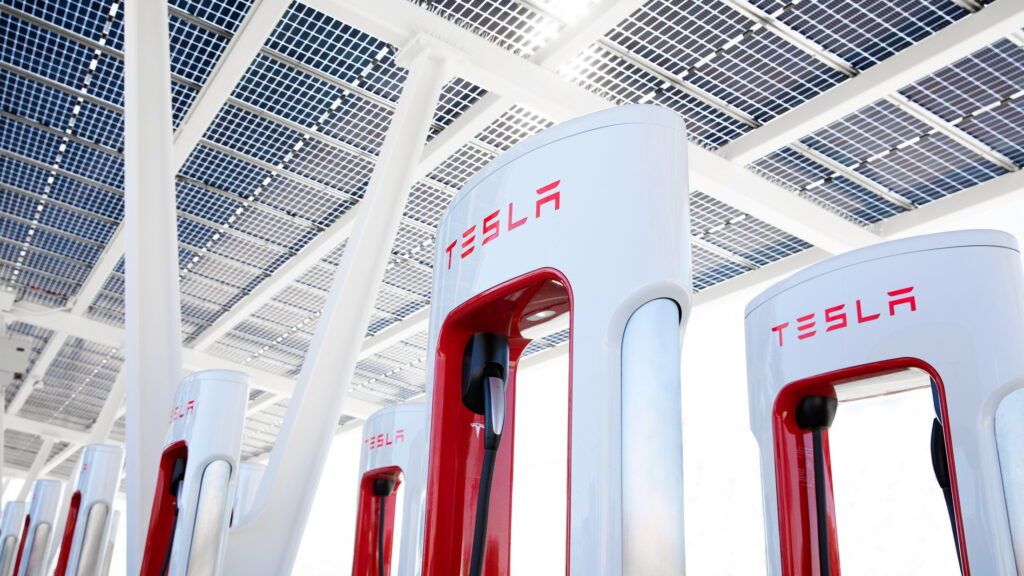
One of Tesla’s greatest customer perks has been its Supercharger fast-charging network. For years, Superchargers were exclusive to Tesla drivers, creating a powerful “walled garden.” But in late 2025, that paradigm is changing. Tesla is opening up its charging infrastructure in significant ways: non-Tesla EVs can now plug in, businesses can host Superchargers, and users can pay with third-party charge cards. These shifts – all unfolding in the US and Europe – have big implications for Tesla owners and the broader EV ecosystem. We examine how Tesla’s Supercharger network is being reshaped.
Opening Superchargers to Other EVs
-
NACS Adoption: In North America, many automakers have switched to Tesla’s North American Charging Standard (NACS) plug. This means cars from Ford, GM, Rivian, and others can physically use Tesla stalls. Since early 2025, Tesla has gradually enabled certain Supercharger locations to service any NACS-equipped EV. For owners, this often requires a simple firmware update and possibly a free adapter (e.g., EVgo or Ford delivered adapters to some owners).
-
Europe’s Approach: Tesla’s European network has used the Combined Charging System (CCS2) connector all along (due to regulation). So in Europe, the question was not a new plug, but Tesla explicitly opening the charging stations. Throughout 2025, Tesla began flipping certain CCS2 Supercharger stalls to allow any eligible electric vehicle to charge, effectively following local law that encourages interoperability. Drivers report seeing signs at some stations “Tesla and other EVs welcome.”
-
Significance: These moves reflect Tesla’s strategy to “turn a proprietary advantage into an ecosystem play” By allowing other EVs onto its network, Tesla can attract more users (potentially monetize them) and support a unified fast-charging standard (which reduces drivers’ anxiety about availability). For Tesla owners, more participating vehicles means maybe crowded stations but also that Tesla is leading the industry forward.
Supercharger for Business: Third-Party Stations
-
Franchise Model Launch: Another big development is the Supercharger for Business program. Instead of Tesla owning every station, the program lets property owners (like malls, parking lots, or charging companies) pay for the hardware and installation, while Tesla handles operations and integration. The first public example opened in Florida: an 8-stall Supercharger owned by Suncoast Charging in Land O’Lakes, FL. Tesla’s charging division tweeted about it on Nov 20, 2025: “First North American Supercharger that’s Tesla managed, third party owned, is now open”
-
How It Works: These stations are essentially identical in user experience to traditional Superchargers: they appear in Tesla’s navigation, charging costs are billed through the Tesla app, and Tesla maintains uptime. The difference is who put up the money. Tesla’s blog explains this lets the network grow faster without Tesla alone shouldering all capital costs. Property owners can even earn fees from charging traffic.
-
Impact: The franchise model is akin to gas stations being owned by franchisees. It could dramatically accelerate station deployment, especially in areas Tesla might not have prioritized. For Tesla owners, it means even more Superchargers spreading quickly – though again, potentially more traffic at each site. Importantly, these third-party Superchargers are usually open to all EVs with NACS (if compatible), so they serve the entire EV community.
Payment and Access Innovations
-
Fleet Card Integration (EU): Tesla has addressed one nagging issue for business drivers: company fuel cards didn’t work at Superchargers. In Nov 2025, Tesla announced that its app now supports 34 major European fleet charge cards (DKV, WEX, UTA, etc.). Drivers can simply add their existing card in the Tesla App and then plug in: the charging session is automatically billed to the company, with no receipt hassles. This small change is huge for corporate EV fleets, making Tesla charging seamless for employees.
-
Tesla Wallet Expansion: At the same time, Tesla effectively “unlocked” its in-app wallet. Tesla drivers (and other EV drivers via Multipass) can pay for almost any European charging network directly through the Tesla app. This means you don’t need separate apps or RFID cards for different chargers – one unified wallet handles them. It mirrors Tesla’s existing U.S. Multipass feature (using Tesla payment for third-party chargers). Combined with fleet cards, Tesla has created an all-in-one payment solution.
-
Adapter Strategy: Tesla is also rolling out more “Magic Dock” adapters at Supercharger sites. These allow vehicles without NACS plugs to charge, easing the transition. For instance, many Korean and Japanese EVs (CCS or CHAdeMO) use these adapter-equipped stalls. Ultimately, Tesla envisions its network as part of a broader “plug-and-charge” standard.
Benefits and Concerns for Owners
-
Benefits: More users on the Supercharger network means Tesla gains revenue (if non-Tesla drivers pay, even via an open-rate). In places where chargers were underutilized, the network can turn idle capacity into income. Additionally, owners benefit from Tesla’s push to standardize charging: more stations might come online because Tesla can recoup costs faster, and grid upgrades for Superchargers will help all EVs.
-
Concerns: A downside is potential congestion. If a Supercharger station has only 8 stalls and suddenly serves double the number of car brands, queues could form at peak times. Tesla will likely manage this with dynamic pricing (higher rates at busy times) or build more stalls. Another worry: Tesla’s charging advantage (brand loyalty) is eroding. If my friend’s non-Tesla EV can use Superchargers seamlessly, Tesla’s unique selling point weakens.
-
Service and Maintenance: Owners should note that Tesla still controls the hardware and software. Charging behavior, pricing, and station reliability remain under Tesla’s oversight. In fact, Tesla calls itself an “energy and service provider for the broader EV market” now.
Strategic Implications
This charging evolution signals a shift in Tesla’s business mindset. The Supercharger network – once a moat – is becoming a shared public utility. Tesla’s CEO hinted at this at the shareholder meeting: the network should “accelerate the world’s transition to sustainable energy” by serving all EVs. It aligns with Tesla’s mission of sustainable transport, albeit at the cost of exclusivity.
For the broader EV ecosystem, Tesla’s moves pressure other networks to improve. For example, Electrify America in the U.S. and Ionity in Europe may lose the unique customer base they had if Tesla’s network is more open and user-friendly. Standardization on NACS also gives Tesla leverage: it defines the charging plug for many future EVs.
Conclusion
The Tesla Supercharger network is undergoing a quiet revolution. By opening its doors (and app) to other vehicles and payment methods, Tesla is shifting from a proprietary EV club to a charging industry leader. For owners, the changes mean more charging options and easier payments, but also more drivers sharing stations. It’s a trade-off: better infrastructure for everyone, but less of a “secret weapon.” In the grand scheme, Tesla is betting that being the standard-bearer for EV charging will strengthen its brand and accelerate EV adoption – even if Tesla owners lose a bit of exclusivity.
FAQ
Q: Can my non-Tesla EV use Superchargers now?
A: In North America, any EV with the NACS plug (now used by many brands like Ford, GM, Polestar) can use Tesla Superchargers, often with just an adapter. In Europe, Tesla’s CCS2 stations are being opened up so that CCS EVs can charge at some sites. Check the Tesla app map – it will indicate which Superchargers are open to all EVs.
Q: How do fleet charging cards work with Tesla?
A: Tesla’s latest update (Nov 2025) lets you add common fleet cards (like DKV, WEX) into the Tesla App under Charging settings. Once added, charging at a Supercharger bills directly to that card. No need to handle receipts. This only applies in European countries where those cards are supported.
Q: Is there any change to pricing for Tesla owners?
A: Not directly due to these changes. Tesla still determines Supercharger pricing. In areas with high demand, expect dynamic pricing as usual (higher prices during busy hours). However, Tesla may adjust rates more often now that it has paying non-Tesla customers. Always check your car’s display for current rates before charging.
Q: Will Tesla continue to expand the Supercharger network?
A: Yes. In fact, by allowing third parties to build and operate stations under Tesla’s management, Tesla can expand much faster. More locations, including rural or urban ones that Tesla hadn’t reached, are likely. The plan is to grow the total stalls exponentially to meet EV growth, since “the network needs to grow exponentially, not linearly”