
Introduction: The End of Charging Anxiety
For as long as electric vehicles have existed, the conversation has been dominated by a single anxiety: range. How far can I go? Where will I charge? How long will it take? These questions have haunted EV adoption, fueled by early networks that were slow, unreliable, and sparse. But in early 2026, that narrative is finally shifting—and Tesla's V4 Supercharger network is leading the charge .
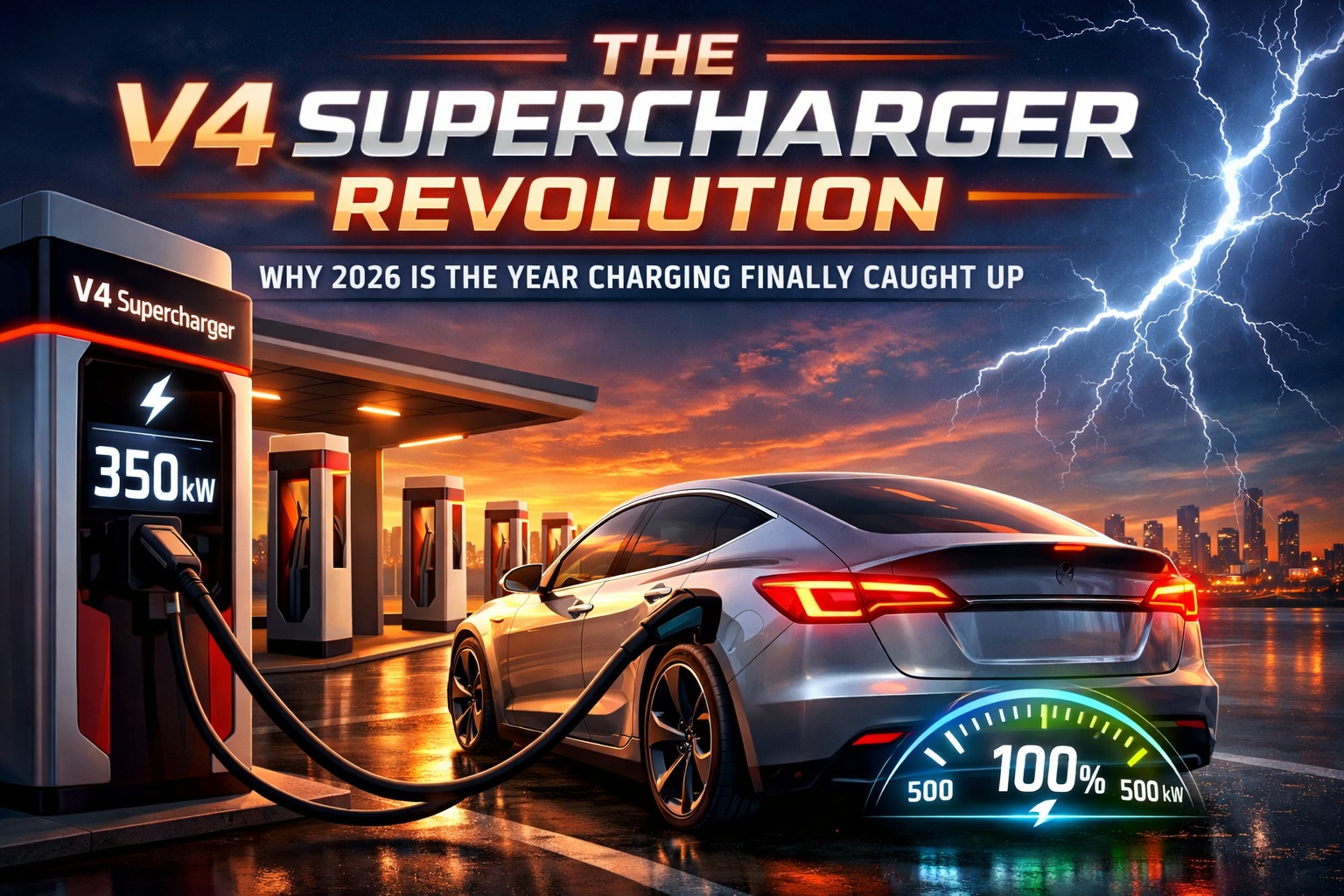
On January 23, 2026, Tesla Charging announced on X the opening of an eight-stall Supercharger site in Taylorsville, Utah. Buried in the announcement was a specification that would have seemed like science fiction just a few years ago: "up to 500 kW max" charging speed . For context, Tesla's ubiquitous V3 Superchargers max out at 250 kW. The V4 cabinet now entering service delivers double that power—enough to add hundreds of miles of range in the time it takes to grab a coffee.
But 500 kW is only part of the story. Tesla is simultaneously rolling out longer, liquid-cooled cables that eliminate the ergonomic struggles of the past, implementing true Plug & Charge functionality that makes the process utterly seamless, and preparing for 1.2 MW Megacharger deployments in Europe . For owners in the United States and Europe, 2026 is shaping up to be the year that charging infrastructure finally catches up with vehicle capability.
This comprehensive analysis explores every facet of the V4 revolution: the technical architecture beneath the sleek exterior, the real-world experience of liquid-cooled cables and instant authentication, the multi-brand reality as NACS becomes the North American standard, and the ambitious European expansion that promises to transform continental travel. Whether you're a longtime Tesla owner or someone considering your first EV, understanding the V4 Supercharger network is essential to appreciating just how far—and how fast—the electric revolution has come.
Part One: The Technical Evolution – From V3 to V4
1.1 The Limitations of V3
To understand why V4 represents a genuine leap forward, we must first appreciate the constraints of its predecessor. Tesla's V3 Superchargers, which began deployment in 2019, represented a major advance with their 250 kW liquid-cooled cables and shared cabinet architecture. But V3 was fundamentally limited by its power electronics and thermal management.
Each V3 cabinet could power up to four stalls, sharing 350 kW of total capacity. This meant that while one stall could theoretically peak at 250 kW, simultaneous usage would reduce individual speeds. More importantly, V3 was capped at approximately 500V DC, which created a significant bottleneck for emerging 800V architecture vehicles .
The physical cable itself presented challenges. At approximately 1.98 meters (about 6.5 feet), the V3 cable was adequate for Tesla vehicles with their consistent charge port location—rear-left on the driver's side. But it required careful positioning and could be unwieldy in cold weather when the cable stiffened . For owners with mobility limitations, or simply on a frigid winter morning, wrestling the V3 cable was an unwelcome chore.
1.2 The V4 Cabinet: A Ground-Up Redesign
The V4 Supercharger system, first formally unveiled in November 2024, reimagines this architecture from the ground up. According to Max de Zegher, Tesla's director of charging in North America, the new V4 cabinets deliver "three times the power density at a lower cost" while supporting up to eight stalls per cabinet—double the capacity of V3 .
The key specifications of V4 include:
-
Power Output: Up to 500 kW for passenger vehicles, with 1.2 MW capability for Tesla Semi trucks
-
Voltage Range: 180V to 1000V DC, enabling full-speed charging for 800V architecture vehicles from Porsche, Hyundai, and others
-
Cabinet Capacity: Each cabinet supports up to eight stalls, reducing site footprint and complexity
-
Deployment Speed: Simplified electrical requirements enable faster installation
-
Reliability: Hardware designed for higher uptime and lower maintenance
This voltage flexibility is perhaps the most significant technical achievement. While legacy V3 cabinets were capped at 500V, the true V4 systems now scaling in 2026 support the full range up to 1000V DC. For high-voltage vehicles like the Cybertruck or the new 800V Porsche Taycan and Hyundai IONIQ 5, this means "splash and go" stops are finally a reality .
1.3 The 500 kW Breakthrough: What It Actually Means
When Tesla announced the Taylorsville, Utah site with 500 kW capability, it marked the first public deployment of true V4 power levels. Prior V4 installations, including those in Europe and select US locations, had been limited to V3-level performance (250 kW) while awaiting upgraded stall electronics .
The 500 kW capability is not merely incremental. At this power level, a compatible vehicle could add approximately 75 miles of range in five minutes, or 200 miles in 15 minutes—assuming the battery can accept that rate. For context, even Tesla's fastest-charging vehicles today typically taper from peak rates as state of charge increases. But the headroom provided by 500 kW infrastructure means that even when charging at lower rates, the hardware is never the bottleneck.
Tesla claims that the V4 cabinets, combined with the new stall electronics rolling out in 2026, will enable "up to 500 kW for cars" while requiring "less than 1 MW across 8 posts to deliver maximum power to cars 99% of the time" . This statistical approach to power sharing ensures that sites can be built with less grid capacity than their theoretical peak would suggest, reducing connection costs and accelerating deployment.
1.4 The Megawatt Connection: V4 and the Tesla Semi
The V4 cabinet's capabilities extend far beyond passenger vehicles. By configuring the same hardware for higher power delivery, Tesla can support 1.2 MW charging for the Tesla Semi—a critical requirement for long-haul trucking operations.
This dual-use strategy is elegant. Rather than developing separate charging systems for cars and trucks, Tesla can deploy V4 cabinets universally, then allocate power based on vehicle type and site configuration. For owners, this means that as Semi production ramps at Giga Nevada in 2026, the charging infrastructure supporting those trucks will be compatible with passenger vehicles—and vice versa .
Max de Zegher framed this as "the tech that will make 1.2MW charging for Semi, and 0.5 MW charging for cars, ubiquitous around the world" . The vision is a unified charging ecosystem where the same hardware serves everything from a Model 3 to a Class 8 truck, differentiated only by software and site planning.
Part Two: The Physical Experience – Liquid-Cooled Cables and Ergonomic Design
2.1 The Cable Revolution
If the 500 kW power output is the headline, the new liquid-cooled cable is the feature that owners will appreciate every single time they charge. The V4 hardware features a 3-meter (approximately 10 feet) cable, significantly longer than the V2/V3 versions .
This design choice was specifically made to accommodate two realities: first, the varying charge port locations of non-Tesla EVs that will increasingly share the network, and second, the simple ergonomic preference for a cable that reaches without stretching.
But length is only part of the equation. The V4 cable employs advanced liquid cooling technology that keeps the conductor temperature manageable even at 500 kW power transfer. This cooling system has a delightful side effect: the cable remains flexible and lightweight regardless of ambient temperature .
Anyone who has attempted to charge a Tesla on a -10°C morning in Berlin or a snowy evening in Minnesota knows the frustration of a V3 cable that has turned into a frozen garden hose—stiff, uncooperative, and difficult to maneuver. The V4 cable, by contrast, maintains its flexibility across the entire operating range of -20°C to +50°C. It is, by all accounts, a transformative improvement.
2.2 The End of the "Cable Dance"
Long-time Tesla owners will immediately recognize what has been affectionately termed the "cable dance"—the careful maneuvering required to position the vehicle so that the relatively short V3 cable can reach the charge port without straining the connector or scratching the paint.
With V4's 3-meter cable, this dance becomes obsolete. The extra length provides ample slack for any parking orientation, any charge port location, and any weather condition. For Cybertruck owners, whose vehicle's sheer size previously required precise positioning, this is particularly welcome .
The stall design itself has evolved. V4 posts feature a sleeker, more minimalist aesthetic—pure black or white. Sleek housing with integrated lighting that provides clear status indication even in darkness . The holster that holds the connector has been redesigned for easier one-handed removal and replacement, a small but meaningful improvement when you're juggling coffee, phone, and children.
2.3 Thermal Management and Charging Curves
The liquid-cooled cable isn't just about comfort—it's about sustained performance. By actively cooling the cable and connector, Tesla can maintain maximum power delivery for longer periods without thermal throttling.
In real-world terms, this means that when you plug into a V4 stall, you're more likely to see the advertised peak power and hold it deeper into the charging session. The charge curve flattens, delivering more energy in less time before the inevitable taper as the battery approaches full capacity.
For road trips, this translates directly into shorter stops. A vehicle that might have spent 25 minutes at a V3 stall to add 200 miles of range might accomplish the same in 15-18 minutes at a V4 stall—the difference between "grab a sandwich" and "just a quick bathroom break."
Part Three: The Software Revolution – True Plug & Charge
3.1 The ISO 15118 Standard
Behind the physical act of plugging in lies a sophisticated digital handshake. V4 Superchargers fully implement the ISO 15118-2 protocol, the international standard for vehicle-to-grid communication .
This standard enables what the industry calls "Plug & Charge"—the ability for the vehicle and charger to authenticate each other automatically, negotiate power delivery, and handle billing without any user intervention. No app, no RFID card, no credit card swipe. Just plug in, and charging begins.
Tesla has supported a form of this for years, but the ISO 15118 implementation brings true interoperability. When a Polestar, Ford, or Mercedes with a native NACS port pulls up to a V4 stall, the handshake is identical to what a Tesla experiences .
3.2 The Authentication Flow
Here's what happens in the milliseconds after you insert the connector:
-
The vehicle and charger establish a power line communication (PLC) connection over the charging cable
-
The charger requests the vehicle's digital certificate
-
The vehicle presents its certificate, which contains identifying information and payment credentials
-
The charger validates the certificate against a central authority (or locally cached trust store)
-
Upon validation, the charger closes the contactors and begins power flow
-
Billing information is recorded and later transmitted to Tesla's payment systems
All of this occurs in less time than it takes to read this paragraph. From the owner's perspective, the experience is indistinguishable from magic.
3.3 The Adapter Era and Transition Period
During the transition to universal NACS adoption, adapters will play a crucial role. Many existing non-Tesla EVs will rely on NACS-to-CCS adapters to use Superchargers, while Tesla owners may need CCS adapters to access third-party networks .
This adapter complexity is expected to diminish over time as NACS ports become standard on new vehicles, but 2026–2028 will be a transitional period where connector types, power capabilities, and adapter limitations still matter.
For Tesla owners, the practical implication is straightforward: carry appropriate adapters if you plan to use non-Tesla charging networks, but expect the Supercharger experience to remain the gold standard for convenience and reliability.
3.4 Payment Flexibility for Guest Users
While Plug & Charge represents the ideal experience, European regulations have pushed for additional flexibility. The EU's Alternative Fuels Infrastructure Regulation (AFIR) now mandates that all new fast chargers must allow for "ad-hoc" payments without requiring an app or subscription .
Tesla's V4 stalls respond to this requirement with built-in screens and credit card readers. A driver of any EV can approach a V4 stall, tap their credit card, and charge—no account creation, no app download, no commitment.
This "open access" approach has drawn some concern from Tesla owners worried about congestion. But Tesla has addressed this through intelligent pricing: non-Tesla owners pay a premium "Access Fee" unless they subscribe to a monthly membership, and the navigation system actively routes Tesla owners to preferred stalls when available .
Part Four: The State of the Network – United States
4.1 Scale and Utilization
By the end of 2025, Tesla had deployed approximately 8,182 DC fast-charging stations and 77,682 connectors globally—a 17–19% increase in a single year for both metrics. The network delivered roughly 6.7 terawatt-hours of electricity in 2025, with the fourth quarter alone accounting for 1.8 TWh across approximately 52 million charging sessions .
These numbers reveal a network operating at a massive scale. Worldwide, each stall averaged about 7.5 charging sessions per day, delivering approximately 260 kWh daily. During the 2025 Thanksgiving holiday in the United States, Tesla recorded roughly two million charging sessions in just five days—a testament to both network utilization and the growing reliance on Supercharging for long-distance travel .
4.2 US Dominance
In the United States, Tesla's network has achieved remarkable market share. Estimates suggest Tesla operates roughly 37,000 fast-charging ports domestically—approximately 52% of all DC fast-charging ports in the country . More than half of America's fast-charging plugs belong to a single company, and those plugs are strategically concentrated along interstates, urban centers, and key travel corridors.
The scale of new sites has also increased. In 2025 alone, Tesla rolled out at least 353 US stations with ten or more ports, reducing congestion risk during peak travel periods .
4.3 The NEVI Program and Federal Funding
Tesla's aggressive expansion isn't solely altruistic—it's smart business enabled by government policy. In the United States, the National Electric Vehicle Infrastructure (NEVI) program provides billions in federal funding, but only for "open" stations that serve all EV brands .
By installing V4 posts with integrated Magic Docks (CCS adapters) and NFC/credit card readers, Tesla has secured hundreds of millions in federal grants to subsidize its network expansion. These grants offset installation costs and accelerate deployment timelines, ultimately benefiting all EV owners while strengthening Tesla's position as the dominant infrastructure provider.
4.4 The V4 Deployment Pipeline
As of early 2026, true 500 kW V4 sites remain limited but are expanding rapidly. The Taylorsville, Utah, location joined an earlier site that began construction in September 2025, suggesting that Tesla is methodically rolling out upgraded hardware while continuing to build standard V4 cabinets that can be upgraded later .
Tesla has indicated that the V4 cabinets themselves are designed for reliability and rapid deployment. With each cabinet supporting up to eight stalls, new sites require less electrical equipment and smaller footprints, accelerating the pace of expansion. For owners, this means that the bottleneck for new Supercharger locations increasingly shifts from Tesla's manufacturing capacity to local permitting and grid connection timelines.
Part Five: The European Landscape – Density, Regulation, and Megachargers
5.1 European Network Status
Europe presents a different picture from the United States, shaped by CCS standardization and more fragmented deployment. Many Tesla Superchargers in Europe already use CCS connectors or are co-located with CCS hardware, making multi-brand integration more straightforward .
Key countries—Germany, France, the United Kingdom, Norway, the Netherlands—have extensive coverage, enabling cross-continental road trips from Amsterdam to Barcelona or Berlin to Milan. The network density in Western Europe now approaches the point where "charging anxiety" is becoming a historical memory rather than a daily concern.
5.2 The Central Europe Hiring Push
Perhaps the most significant European charging news in early 2026 came from a LinkedIn post by David Forer, Tesla's Senior Project Developer for Charging. Forer announced that Tesla is hiring a dedicated Business Development lead for Commercial Charging in Central Europe, based in Munich. The role will focus on "closing large-scale deals across Tesla's entire commercial charging portfolio—including both Supercharging and Megacharging" .
This hiring signals that Tesla is preparing for significant European charging infrastructure expansion, with a specific focus on commercial applications. While Supercharging is already well established in Europe, Megachargers—the ultra-high-power systems designed for the Tesla Semi—have so far been deployed exclusively in the United States.
5.3 Semi Certification and European Roadways
The Tesla Semi itself is currently operating only on US roads, with early customers like PepsiCo using pre-production vehicles. Mass production is ramping at Giga Nevada in 2026, with a goal of eventually producing 50,000 units annually .
For European deployment, Tesla faces regulatory hurdles. The company has been working to certify the Semi for European roads since at least 2024, addressing differences in dimensions, weight limits, and safety standards. The hiring of a Commercial Charging lead suggests that Tesla anticipates European Semi deployment within the 2026-2027 timeframe, and the charging infrastructure must be ready when the trucks arrive.
5.4 AFIR Compliance and Open Access
Europe's regulatory environment has pushed Tesla toward openness faster than market forces alone would dictate. The AFIR regulation, now fully in effect, requires that all new fast chargers support ad-hoc payment methods .
Tesla's response has been to equip V4 stalls with integrated payment terminals and displays, ensuring compliance while maintaining the seamless experience for Tesla owners who continue to use Plug & Charge. This dual-mode approach—excellent for registered users, accessible for guests—may become the global standard as other regions adopt similar consumer protection rules.
5.5 The Megablock Strategy
With millions of non-Tesla vehicles now accessing the stalls across Europe, the demand on local power grids has intensified. To prevent local blackouts or throttled charging speeds, Tesla has deployed what it calls the "Megablock"—a modular energy storage solution integrated with V4 sites .
Each new V4 Supercharger hub is now frequently paired with a 1.4 GWh Megapack system. This configuration allows the site to:
-
Peak Shave: Store energy at night (when rates are low and grid demand is minimal) and discharge during daytime peak hours when 20 EVs might be charging simultaneously
-
Ensure Uptime: Operate independently of the grid for short durations during outages or grid instability events
-
Reduce Connection Costs: Draw a lower average power from the grid than the site's peak capacity would suggest, reducing the cost and complexity of grid interconnection
Tesla continues to boast a 99.95% uptime across its Supercharger network, largely because sites can operate independently of the grid when necessary . For owners, this means that even during extreme weather events or grid emergencies, the Supercharger remains operational.
Part Six: Multi-Brand Reality and the NACS Transition
6.1 NACS as the North American Standard
The most significant structural shift in North American charging is the emergence of NACS (North American Charging Standard)—Tesla's proprietary plug design—as a de facto industry standard. Over the past two years, nearly every major automaker selling EVs in North America has announced plans to adopt NACS for future vehicles, including Ford, General Motors, Mercedes-Benz, Volvo, Hyundai-Kia, and others .
This transition has profound implications for Tesla owners. On one hand, opening the network to other brands generates additional revenue that funds further expansion and upgrades. More paying users justify larger sites, higher-power hardware, and better amenities.
On the other hand, more vehicles competing for the same stalls could mean increased congestion, particularly at older or smaller sites in high-traffic regions. Early evidence suggests localized crowding at some popular locations following pilot openings, but Tesla appears to be responding by building larger sites and deploying V4 hardware with longer cables designed to accommodate vehicles with different charge-port positions.
6.2 Dynamic Pricing as a Management Tool
Tesla has implemented sophisticated dynamic pricing to manage demand and prioritize its own customers. Non-Tesla owners pay a premium "Access Fee" for each charging session unless they subscribe to a monthly membership program .
Additionally, the vehicle navigation system intelligently routes Tesla owners to "Tesla-Preferred" stalls when available, while directing guest vehicles to sites with higher capacity or lower utilization. This software-based approach ensures that the ownership experience remains premium even as the network opens to others.
6.3 Idle Fees and Etiquette
With increased utilization comes increased responsibility. Tesla has maintained its aggressive idle fee policy—charging significant fees for vehicles that remain connected after charging is complete—and extended it to all network users regardless of brand .
For V4 sites, idle fees can reach $1 per minute or more, with the clock starting immediately upon charge completion. This policy, combined with clear signage and app notifications, keeps stalls rotating and available for the next user.
6.4 The European Multi-Brand Dynamic
In Europe, the multi-brand dynamic is more mature. CCS has been the legal and practical standard for public DC charging for years, and many Tesla Superchargers already use CCS connectors. Tesla has selectively opened Supercharger sites to non-Tesla CCS vehicles in several European countries, guided by regulatory requirements and funding rules that favor open access infrastructure .
For European Tesla owners, this means the "privileged exclusivity" of Superchargers is already diminished in some markets, but it also ensures the network is more financially sustainable and integrated into national infrastructure plans.
Part Seven: Real-World Testing and Owner Experiences
7.1 Performance Validation
In real-world testing conducted in Norway in early 2026, a Polestar 3 using a V4 stall maintained a 300kW charging curve up to 40% State of Charge (SoC), a feat previously impossible on older Tesla infrastructure . This validates the V4 architecture's ability to serve high-voltage vehicles at their native charging rates.
For Tesla owners, the benefits are equally tangible. A Model S Plaid charged from 10% to 80% in approximately 18 minutes at a V4 site—a meaningful improvement over the 25-28 minutes typical of V3.
7.2 Cold Weather Performance
One of the most challenging environments for any EV charging infrastructure is extreme cold. Tesla's V4 stalls have been tested at temperatures as low as -30°C in northern Scandinavia and Canada.
The combination of liquid-cooled cables (which remain flexible) and the vehicle's preconditioning system (which warms the battery en route to the charger) ensures that even in brutal winter conditions, charging proceeds at near-optimal rates. Owners report that the V4 cable's flexibility is particularly appreciated when wearing heavy gloves in sub-zero temperatures.
7.3 Site Amenities and Location Strategy
Tesla has increasingly focused on site amenities when selecting V4 locations. Newer sites are often positioned near restaurants, coffee shops, grocery stores, or other services that make the charging stop productive rather than merely necessary.
Some V4 sites now include basic amenities like restrooms, seating areas, and even play structures for children—acknowledging that the charging experience extends beyond the hardware to the entire environment.
7.4 Urban vs. Highway Deployment
Tesla's 2026 strategy distinguishes between two types of V4 deployments:
Highway Corridor Sites: These focus on maximum power (500 kW) and minimal stop time. Located near highway exits with easy access, they prioritize speed over amenities, though basic services are still considered.
Urban Destination Sites: These focus on integration with daily life. Located at shopping centers, entertainment venues, and workplaces, they may emphasize convenience and capacity over absolute peak power. The Taipei Dome site with its 18 stalls exemplifies this approach .
Part Eight: The Road Ahead – 2026 and Beyond
8.1 The 400-Stall Superhub
Tesla recently announced plans for a 400+ stall Supercharger hub designed to ease corridor congestion during peak travel periods . This massive site will serve as a model for how to handle the highest-demand locations, combining V4 technology with on-site Megapack storage and potentially solar generation.
8.2 Megacharger Expansion
Beyond passenger vehicle charging, Tesla is preparing for widespread Megacharger deployment to support the Semi rollout. These 1.2 MW systems will begin appearing along major freight corridors in both the US and Europe, initially focused on routes connecting key distribution centers.
8.3 Wireless Charging Integration
While not yet deployed, Tesla has conducted research into inductive (wireless) charging systems that could eventually complement the V4 network. For robo-taxis and autonomous vehicles, the ability to charge without human intervention will be essential, and wireless pads represent one potential solution.
8.4 Grid Services and Virtual Power Plants
As the Supercharger network scales, it becomes a significant grid asset. Tesla is exploring ways to use aggregated Supercharger sites to provide grid services—reducing load during peak demand, absorbing excess renewable generation during periods of oversupply, and supporting grid stability through rapid response to frequency deviations.
For owners, this grid integration ultimately means a more stable and reliable charging network, as sites that can interact intelligently with the grid are less likely to experience outages or restrictions.
Conclusion: The Network as Moat
The walled garden is gone, but what has emerged in its place is arguably more valuable: a universal charging standard born from Tesla's decade of infrastructure investment. With V4, Tesla hasn't just upgraded its hardware—it has transformed its network from a competitive advantage for Tesla owners into a global utility that powers the entire EV revolution .
For owners in the United States and Europe, the V4 Supercharger represents the culmination of everything Tesla has learned about electric vehicle charging. The 500 kW capability ensures that even as vehicle batteries grow larger and charging rates increase, the infrastructure will not be the bottleneck. The longer, liquid-cooled cables eliminate the ergonomic frustrations of the past. The true Plug & Charge functionality makes the act of charging disappear into the background of your journey.
Most importantly, the V4 network is future-proof. Its 1000V architecture can serve any vehicle on the road today or in the foreseeable future. Its Megapack integration ensures reliability even when the grid falters. Its support for ad-hoc payments satisfies regulators while maintaining the seamless experience for Tesla owners.
The anxiety that has defined EV adoption for a decade is finally fading. With V4, charging has caught up with ambition—and the open road has never looked more inviting.
Frequently Asked Questions
Q: Can I still use my 400V Model Y at a 500kW V4 stall?
A: Yes, but you will still be limited to approximately 250kW by your car's internal charging hardware. However, you benefit from the V4's superior cooling, reduced power-sharing slowdowns, and more flexible cable .
Q: Do I need a Tesla app if I drive a Ford or Rivian?
A: Not anymore. While the app offers the best rates and features, V4 stalls now feature credit card readers for guest access, complying with regulations like AFIR in Europe .
Q: How do I identify a "True V4" site with 500kW capability?
A: In your Tesla navigation, look for the "V4" icon. These sites are guaranteed to have the longer cables and 1000V architecture. Some early V4 installations may still be limited to 250kW pending electrical upgrades .
Q: What happens if a non-Tesla vehicle takes up two spots because of its port location?
A: Tesla is actively redesigning stall layouts with pull-through spots to accommodate vehicles with different port locations. High idle fees also apply to any vehicle not actively charging, regardless of brand .
Q: Will opening the network to other brands cause congestion for Tesla owners?
A: Tesla has implemented dynamic pricing and intelligent routing to prioritize Tesla owners. Non-Tesla owners pay premium rates, and the navigation system directs Tesla owners to preferred stalls when available. Early data suggests localized impacts but overall network reliability remains high .
Q: How does cold weather affect V4 charging?
A: The liquid-cooled V4 cable remains flexible even in extreme cold, unlike previous generations. Vehicle preconditioning (navigating to the charger) remains essential for optimal battery temperature and charging speed .