
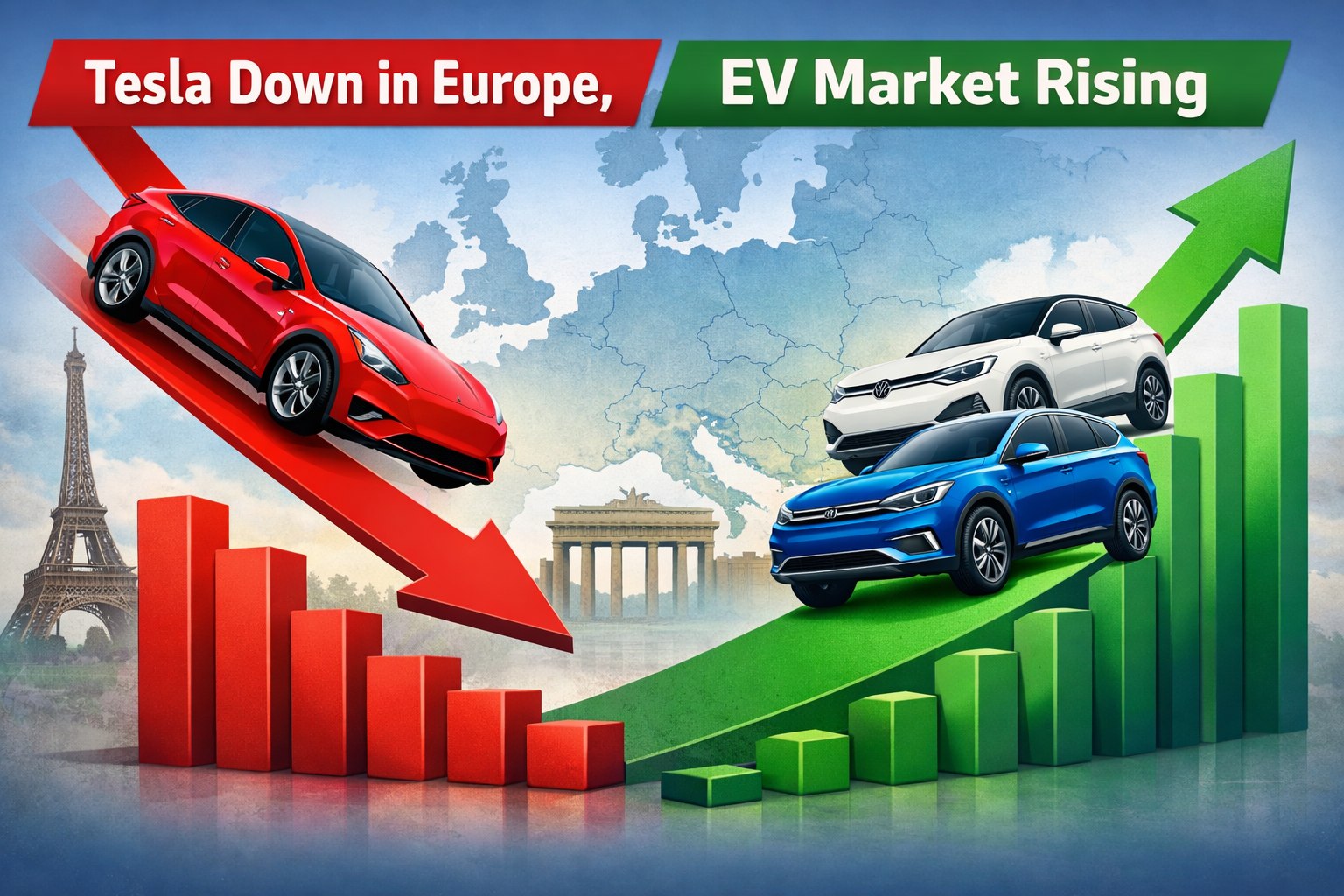
Why Tesla’s European Sales Are Falling While the EV Market Surges in 2026
Executive Summary
Tesla’s European sales have declined sharply at the start of 2026, even as the broader battery-electric vehicle (BEV) market across Europe continues to expand at a healthy pace. This divergence has sparked intense debate among investors, analysts, and Tesla owners alike.
In January 2026, registrations for vehicles produced by Tesla dropped significantly year-over-year in several key European markets, while overall BEV registrations grew. The result: Tesla’s market share contracted in Germany, France, and parts of Scandinavia — regions historically considered strongholds.
This article provides a deep, data-driven analysis of:
-
What’s happening in the European EV market
-
Why Tesla’s registrations are declining
-
How competitors are gaining ground
-
The strategic implications for Tesla in 2026
-
What this means for current and future Tesla owners in Europe
We focus exclusively on verified developments and official market data — no speculation, no outdated recall coverage, and no rumor-driven narratives.
1. The European EV Market in Early 2026: Growth Without Tesla
1.1 Europe’s EV Momentum Remains Strong
The first key insight: Europe’s EV market is not shrinking.
In fact, battery-electric vehicle registrations across the European Union and UK grew in January 2026 compared to January 2025. This growth was driven by:
-
Stricter EU fleet CO₂ targets
-
Increased availability of affordable BEVs
-
Strong corporate fleet electrification
-
Urban emission zone expansions
Countries like Germany, France, the Netherlands, Norway, and the UK reported solid year-over-year BEV growth. The market environment itself is not collapsing — it is evolving.
1.2 A Structural Shift in Demand
The European EV buyer in 2026 looks different from 2021–2022:
-
More price sensitive
-
More brand-agnostic
-
Increasingly open to Chinese EV brands
-
Interested in compact and urban models
Tesla once dominated the “aspirational EV” segment. Now, European consumers have dozens of competitive alternatives — many priced below €40,000.
1.3 Market Share Compression
Tesla’s decline is best understood as relative contraction, not total market disappearance.
When a market grows rapidly and competitors expand faster than the incumbent, even stable sales can result in market share loss. In Tesla’s case, however, some absolute sales declines are also evident in specific markets.
2. Tesla’s Registration Data: Where the Decline Is Happening
2.1 Germany
Germany is Europe’s largest auto market and a critical benchmark. Early 2026 data shows Tesla registrations declined sharply year-over-year.
Why Germany matters:
-
Strong domestic EV competition
-
High fleet purchasing activity
-
Highly price-competitive environment
Tesla’s vehicles face direct competition from German manufacturers that have rapidly improved BEV quality and availability.
2.2 France
France presents a different challenge:
-
Government incentives increasingly favor lower-priced and locally produced vehicles
-
Rising popularity of compact EVs
-
National preference trends shifting
Tesla’s lineup — primarily mid-size sedans and crossovers — is not ideally positioned in the sub-€30k segment that is expanding fastest.
2.3 Scandinavia
Tesla historically performed exceptionally well in Norway and Sweden. While still competitive, growth rates have normalized and intensified competition has eroded dominance.
In Norway, BEV penetration is already above 80%. The growth ceiling is effectively reached. Now competition becomes purely about brand preference and price.
2.4 United Kingdom
The UK remains relatively resilient for Tesla, but even here, market share faces pressure as more alternatives enter the fleet and leasing channels.
3. The Competitive Landscape: Who Is Gaining?
3.1 Volkswagen Group
Volkswagen Group has significantly strengthened its ID lineup. Models such as the ID.3 and ID.4 now offer improved software, extended range, and competitive pricing.
Volkswagen benefits from:
-
Extensive dealer network
-
Local production perception
-
Fleet channel relationships
3.2 BYD’s Rapid Expansion
BYD has expanded aggressively across Europe with competitive pricing and diverse models.
Key advantages:
-
Vertical battery integration
-
Cost efficiency
-
Multiple body styles
BYD’s pricing strategy undercuts many Western manufacturers, including Tesla in certain segments.
3.3 Hyundai and Kia
Hyundai Motor Company and Kia Corporation continue to perform strongly in Europe with well-reviewed EVs offering strong warranties and practical design.
3.4 Stellantis Group
Stellantis leverages brands like Peugeot, Opel, and Fiat to serve compact urban EV segments Tesla does not currently target.
4. Why Tesla Is Losing Momentum in Europe
4.1 Limited Model Diversity
Tesla’s European portfolio remains concentrated on:
-
Tesla Model Y
-
Tesla Model 3
While both are strong products, Europe’s fastest-growing segments include:
-
Compact hatchbacks
-
Sub-compact crossovers
-
Urban EVs
Tesla currently does not compete below the mid-size segment.
4.2 Price Sensitivity
European buyers in 2026 show heightened price discipline. With energy prices stabilizing and EV options expanding, consumers compare total ownership costs carefully.
Tesla’s pricing strategy, once highly disruptive, is now one of many competitive options.
4.3 Brand Maturity
Early Tesla adopters were innovation-driven buyers. In 2026, Tesla is no longer a niche disruptor — it is an established mainstream brand. Growth now depends less on novelty and more on segment coverage.
4.4 Policy Shifts
Some European incentive programs have been revised or reduced. This affects premium-priced vehicles more heavily than lower-cost EVs.
5. Production and Supply Dynamics
5.1 Gigafactory Berlin
Gigafactory Berlin-Brandenburg plays a critical role in supplying European Model Y demand.
Production capacity is high, but demand fluctuations create inventory management challenges.
5.2 Export Dependencies
Tesla historically balanced European demand through global exports. As global demand patterns shift, allocation decisions become more complex.
6. Strategic Implications for Tesla
6.1 The Need for a Lower-Cost Model
Industry analysts widely expect Tesla to introduce a lower-priced compact vehicle platform.
Without entering the sub-€30k category, Tesla risks ceding long-term volume leadership.
6.2 Software & FSD Differentiation
Tesla’s long-term strategy leans heavily on software differentiation. However, European regulatory environments remain cautious regarding advanced driver-assistance systems.
Tesla must adapt messaging and feature rollout carefully across EU markets.
6.3 Brand Experience Expansion
Tesla’s direct-to-consumer sales model continues to offer cost advantages, but experiential retail — including flagship locations — may become more important in competitive markets.
7. What This Means for European Tesla Owners
7.1 Resale Values
Short-term resale pressure may occur if market share continues to decline. However, strong Supercharger access and OTA software support remain differentiators.
7.2 Service Infrastructure
Tesla continues expanding service centers across Europe. There is no evidence of retrenchment.
7.3 Charging Network
The Tesla Supercharger network remains one of the strongest competitive advantages in Europe, even as third-party charging networks improve.
8. Is This a Temporary Dip or Structural Shift?
Three possible scenarios exist:
Scenario 1: Temporary Demand Adjustment
A refreshed model cycle could restore growth.
Scenario 2: Competitive Equilibrium
Tesla stabilizes at a lower but still strong market share.
Scenario 3: Long-Term Share Erosion
Without a compact entry model, share could decline structurally.
9. Investor and Industry Perspective
Tesla’s European softness contrasts with continued global ambitions. Analysts debate whether Tesla’s valuation should rely more on:
-
AI and software
-
Energy storage
-
Robotics
Or remain primarily automotive-driven.
Conclusion
Tesla’s European sales decline in early 2026 is not occurring in a shrinking market. Instead, it reflects:
-
Intensifying competition
-
Shifting consumer preferences
-
Limited model segmentation
-
Pricing pressure
The European EV market is expanding — but it is diversifying rapidly. Tesla remains a powerful player, but no longer the uncontested leader in every segment.
For European Tesla owners, the fundamentals remain strong:
-
Over-the-air updates
-
Supercharger reliability
-
Strong brand recognition
However, 2026 marks a strategic inflection point. Tesla’s next moves — especially around lower-cost vehicles and localized adaptation — will determine whether this dip becomes a turning point or merely a pause.
FAQ
Q1: Is Tesla exiting the European market?
No. Tesla continues operating factories, service centers, and retail locations across Europe.
Q2: Are Tesla vehicles becoming less competitive?
Not necessarily. They remain technologically advanced but face more alternatives.
Q3: Will Tesla release a cheaper model for Europe?
Tesla has indicated plans for lower-cost platforms, though timelines remain uncertain.
Q4: Should current owners worry about support?
No evidence suggests service or charging infrastructure reductions.
Q5: Is the overall EV market in Europe shrinking?
No. It is growing — but Tesla’s share is decreasing within that growth.