
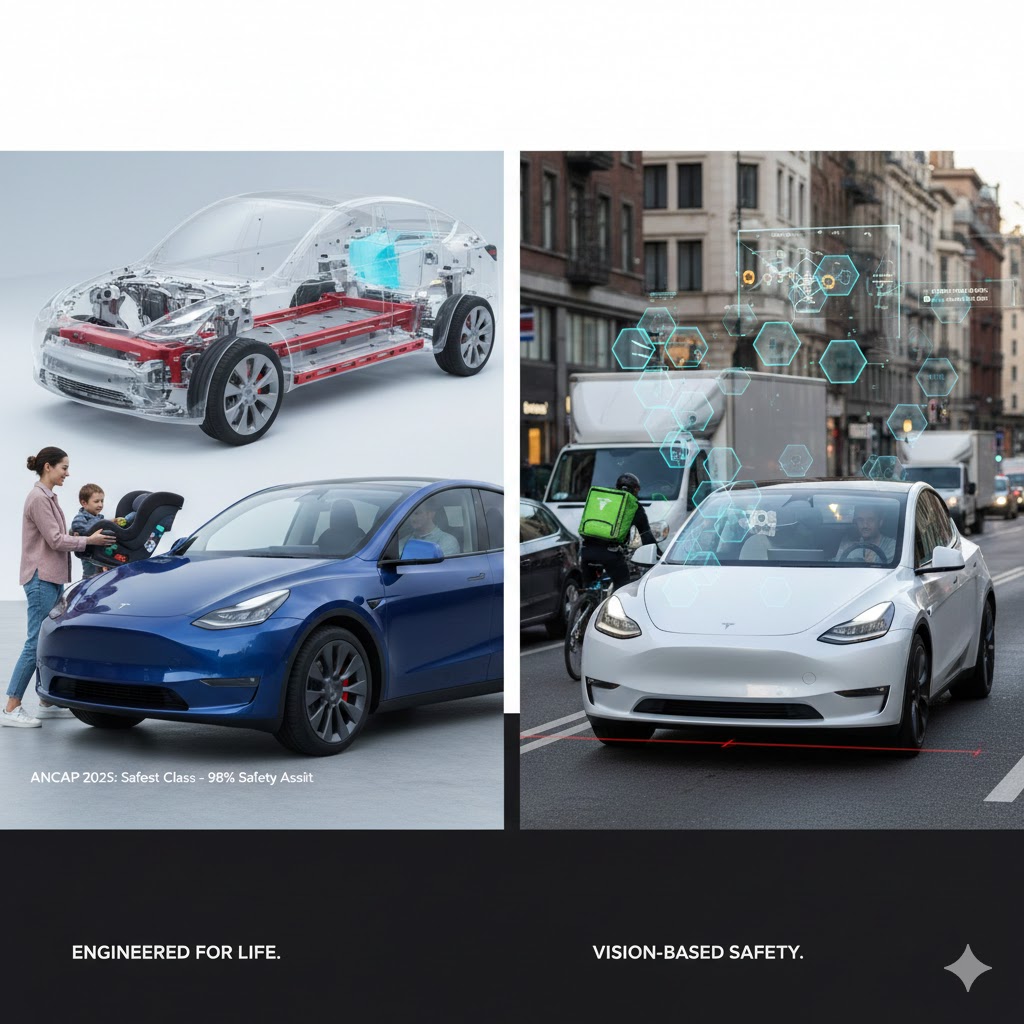
Introduction: Safety is the New Luxury
For decades, the automotive world held a singular truth: if you wanted the safest car on the road for your family, you bought a Volvo. It was an unspoken rule, cemented by the invention of the three-point seatbelt and years of marketing centered on survival. But as we settle into 2026, that narrative has not just shifted; it has been completely rewritten by a company once mocked for panel gaps and paint quality.
The Tesla Model Y has officially achieved what automotive engineers call a "statistical anomaly" in safety testing. Following the release of the late 2025 ANCAP (Australasian New Car Assessment Program) results—widely regarded as one of the strictest testing protocols alongside Euro NCAP—the Model Y hasn't just passed; it has set a new benchmark for what is physically and digitally possible in passenger protection.
With a weighted safety score that eclipses legacy competitors and new EV entrants alike, the Model Y has cemented its position not just as the world's best-selling car, but as the world's safest sanctuary. But what actually goes into these scores? Is it just heavy steel, or is it something more?
In this comprehensive deep dive, we peel back the aluminum skin of the Model Y to understand the "Safety First" architecture. We will analyze the physics of the Giga-castings, the predictive power of Tesla Vision, and why this specific ANCAP victory spells trouble for competitors who are still treating safety as a checklist rather than a core operating system.
Chapter 1: The ANCAP Verdict – dissecting the Numbers
To understand the magnitude of this achievement, we must first look at the raw data released by ANCAP in late 2025. The protocols were updated recently to include more rigorous testing for "vulnerable road users" (pedestrians/cyclists) and "motorcyclist detection," areas where many large SUVs fail.
The Record-Breaking Safety Assist Score The headline statistic is the 98% score in the Safety Assist category. This metric measures the car's ability to avoid a crash in the first place. It involves testing the Automatic Emergency Braking (AEB), Lane Support Systems (LSS), and Speed Assistance Systems (SAS).
-
The Context: Most 5-star vehicles hover in the 80-85% range. Achieving 98% implies near-perfection in identifying phantom pedestrians, stopping for cross-traffic, and maintaining lane integrity under duress.
-
The Significance: This score proves that the removal of radar and ultrasonic sensors (USS) in favor of a "Vision Only" approach—a move controversial in 2022—has been fully vindicated by 2026 standards. The camera suite simply sees more, faster.
Adult Occupant Protection: 97% In the brutal physical crash tests—frontal offset, full-width frontal, and the dreaded side pole impact—the Model Y scored a staggering 97%.
-
The "Far-Side" Factor: A key contributor to this score was the implementation of the "far-side" center airbag, which deploys between the driver and passenger to prevent head-clash during side impacts. While standard in Europe and Australia, this feature highlights Tesla's adaptability to evolving safety standards.
-
Cabin Integrity: The report specifically noted that the passenger compartment "remained stable" in the frontal offset test. This phrase is the gold standard in crash engineering. It means the survival space was not compromised, allowing the airbags and seatbelts to do their work without the dashboard crushing the occupants' legs.
Chapter 2: The Physics of Survival – Giga-Castings and Structural Rigidity
How does a car with a massive glass roof achieve such structural integrity? The answer lies in Tesla’s manufacturing revolution: Giga-casting.
The Front and Rear Megacasts Traditional unibody cars are welded together from hundreds of stamped metal parts. In a crash, every weld point is a potential point of failure or energy dissipation unpredictability. The Model Y (especially the units produced in Berlin and Texas, which supply the bulk of the Western market) utilizes massive front and rear castings.
-
Energy Absorption: These single-piece aluminum die-casts are designed with specific internal ribbing. When an impact occurs, the casting acts as a unified energy sponge. It directs the kinetic force of the crash around the passenger cell rather than through it.
-
Torsional Rigidity: The sheer stiffness of the castings means the car doesn't twist or buckle unpredictably. This rigidity is crucial not just for handling, but for ensuring the doors can still open after a severe collision—a critical factor for first responders extraction.
The Battery as a Shield The structural battery pack serves a dual purpose. Located at the bottom of the chassis, it gives the Model Y an exceptionally low center of gravity.
-
Rollover Resistance: In the event of a T-bone collision or a sharp swerve, the massive weight of the battery anchors the car to the road. The Model Y has one of the lowest rollover risks of any SUV ever tested by the NHTSA or ANCAP. It physically wants to stay upright.
-
Side Impact Reinforcement: The battery pack itself is reinforced with high-strength steel lateral beams. It acts as a hardened floor that prevents a side-impacting vehicle (or pole) from intruding deeply into the cabin.
Chapter 3: The Digital Guardian – How Tesla Vision Predicts the Future
Hardware protects you when a crash happens. Software protects you from the crash ever happening. This is where Tesla separates itself from the legacy pack.
The "Latency" Advantage In 2026, the Model Y is running on the advanced AI4 hardware (and newer builds moving to AI5). The speed at which the car processes visual data is superhuman.
-
Behavioral Prediction: Unlike traditional AEB which reacts to "object in path," Tesla's neural networks predict behavior. The system tracks the head movements of pedestrians (via body pose estimation) or the wheel angle of a car at a junction. It knows a car is about to cut you off before the other driver even commits to the turn.
-
Spatial Memory: Even if a cyclist is temporarily obscured by a parked truck, the Occupancy Network "remembers" they are there. This object permanence allows the Model Y to brake for threats it cannot currently see but knows exist.
The "Active Hood" and Vulnerable Road Users Part of the high ANCAP score comes from pedestrian protection. The Model Y features an "active hood" mechanism. If the bumper sensors detect a collision with a pedestrian, the rear of the hood instantly pops up by 80mm.
-
The Physics: This creates a cushion of air between the flexible aluminum hood and the hard engine block (or in Tesla's case, the frunk components and structural beams). It acts as a trampoline for the pedestrian's head, significantly reducing the risk of fatal brain injury.
Chapter 4: The Competitive Landscape – Tesla vs. The World
To truly appreciate the Model Y's standing, we must compare it to its contemporaries in the 2026 market.
Tesla Model Y vs. Volvo EX90 The Volvo EX90 is a technological marvel and carries the torch of Volvo safety. However, the Model Y competes at a significantly lower price point while matching or exceeding the Volvo in specific active safety metrics. While Volvo relies on LiDAR for long-range detection, Tesla's Vision approach has proven to be more robust in identifying edge cases in urban environments, leading to higher "Safety Assist" scores in standardized tests.
Tesla Model Y vs. BYD Atto 3 / Seal U Chinese competitors like BYD have scored 5 stars in Euro NCAP and ANCAP as well. However, the depth of the scores differs. Tesla consistently scores higher in the "occupant status monitoring" (driver attention) and the sophistication of its lane-keeping assist. Where some competitors' lane assists ping-pong between lines, the Model Y centers the vehicle with confidence, reducing driver fatigue—a major, often overlooked, safety factor.
The Legacy Auto "Checkbox" Approach Many legacy manufacturers treat safety features as "options" or "packages." In 2026, you might still need to pay extra for "Driver Assist Plus" on a BMW or Audi to get the full suite of safety interventions. Tesla's philosophy remains: Safety is standard. Every Model Y, whether it's the base RWD or the Performance trim, leaves the factory with the exact same active safety capabilities. This democratization of safety is a key factor in its global dominance.
Chapter 5: The "Soccer Mom" Pivot – Marketing to the Heart
For years, Tesla marketing (driven largely by Elon Musk's X account and word of mouth) focused on 0-60 times, range, and Supercharging. The 2025/2026 ANCAP results mark a pivotal shift in brand perception.
From "Tech Bro" to "Trusted Guardian" In the US and Europe, the "Soccer Mom" (or "School Run Dad") demographic is the most lucrative segment. These buyers prioritize safety above all else. The Model Y is no longer just the "cool electric car"; it is the logical successor to the Honda CR-V or Toyota RAV4, but with a safety profile that outclasses them both.
The Insurance Ripple Effect Insurance premiums for EVs have historically been high due to repair costs. However, actuarial data is starting to catch up with the safety scores. Insurers in Europe are beginning to offer specific discounts for vehicles with high "Active Safety" scores because the data shows these cars crash less frequently. The ANCAP win provides hard data for owners to negotiate better premiums.
Conclusion: The Standard has been Raised
The Model Y's triumph in the 2025/2026 ANCAP testing is not just a win for Tesla; it is a win for the consumer. It forces the rest of the industry to chase a moving target. It proves that a car does not need to be laden with expensive LiDAR sensors to be safe; it needs intelligent software and uncompromising structural engineering.
For the potential buyer in 2026, the choice is becoming increasingly simple. You can buy a car that was designed to pass crash tests, or you can buy a car that was designed to avoid them entirely. The Model Y is the latter, but in the rare event that physics takes over, it stands ready to sacrifice itself to protect the cargo that matters most: your family.
As we look toward the rumored "Juniper" refresh later this year, one thing is certain: the bar for what constitutes a "safe car" has been permanently raised to the height of a Model Y.
FAQ: Model Y Safety Questions
Q: Is the Chinese-made Model Y (Shanghai) as safe as the German (Berlin) or US (Texas) models? A: Yes. All production facilities adhere to the same strict safety designs. In fact, the ANCAP results are often based on Shanghai-built units exported to Australia/New Zealand, proving their world-class build quality.
Q: Does the glass roof make the car less safe in a rollover? A: Contrary to intuition, the glass roof is incredibly strong. It is laminated safety glass capable of withstanding four times the weight of the car. In crash tests, the glass roof often remains intact, contributing to the rigidity of the safety cell.
Q: Do I need to buy "Full Self-Driving" (FSD) to get these safety features? A: No. All the safety features mentioned in the ANCAP score (Automatic Emergency Braking, Lane Keeping, Blind Spot Warning) are standard on every Tesla (Basic Autopilot). FSD adds navigation capabilities, but the core safety shield is free.
Q: How does the Model Y handle "Phantom Braking" in 2026? A: While an issue in early Vision builds (2022-2023), software updates throughout 2024 and 2025 have drastically reduced phantom braking events. The current software stack is much better at distinguishing between real threats and shadows/overpasses.