
I. The Holy Grail of Battery Tech: Beyond the "S-Curve"
For nearly six years, the "Dry Battery Electrode" (DBE) process was the white whale of the electric vehicle industry. First teased at Tesla’s 2020 Battery Day, the promise was simple but revolutionary: remove the liquids, remove the massive drying ovens, and slash the cost of the most expensive component of an EV. However, the road from a laboratory proof-of-concept to a mass-produced industrial product proved to be what Elon Musk recently described as "agony."
As of February 2026, the agony has officially turned into an advantage. In the Q4 2025 earnings update, Tesla confirmed that it has finally achieved high-volume mass production of 4680 cells using dry electrode technology for both the anode and the cathode. This is not just a marginal improvement; it is a fundamental decoupling of Tesla’s growth from the traditional, toxic, and energy-intensive "wet" manufacturing process that has dominated the industry for decades.
II. The Technical Breakthrough: Physics Over Chemistry
To appreciate why the dry process is a game-changer, we must look at the "Wet Slurry" method it replaces. Traditionally, battery chemicals are mixed with toxic solvents like NMP (N-Methyl-2-pyrrolidone) to create a paste. This paste is painted onto foils and then sent through drying ovens that are often over 50 meters long. These ovens consume massive amounts of electricity and floor space, and the solvents must be meticulously captured and recycled to avoid environmental catastrophe.
The Solvent-Free Revolution
Tesla’s dry process, largely evolved from the technology acquired from Maxwell Technologies, eliminates the liquid entirely.
-
Direct Application: The active materials (lithium, nickel, cobalt, etc.) are mixed as dry powders with a binder.
-
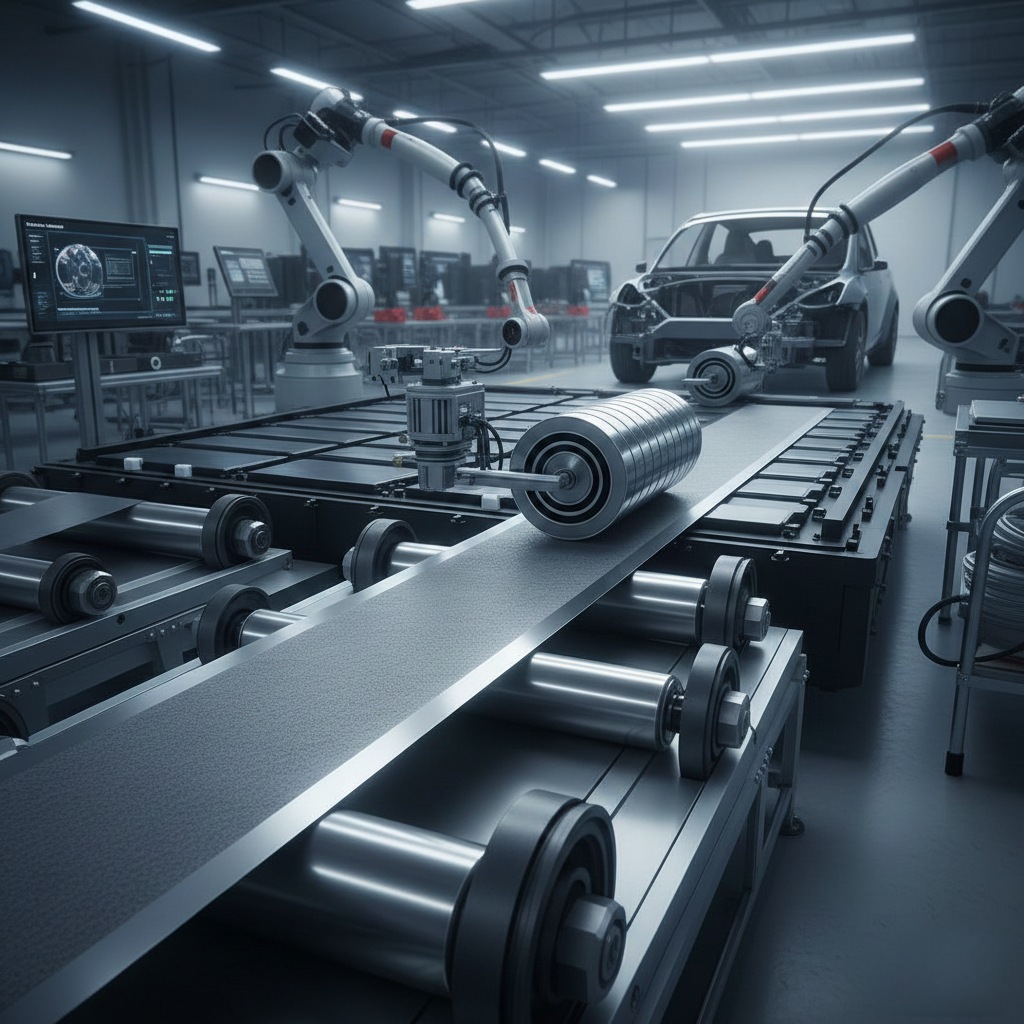
The "Teflon" Effect: Under extreme pressure between massive rollers (calenders), the binder fibrils stretch out to form a self-supporting film.
-
Eliminating the Ovens: Because there is no liquid to evaporate, Tesla has removed the 50-meter drying lines. This reduces the factory footprint by over 70% and cuts energy consumption by a staggering 80% per kilowatt-hour of capacity.
Improving Energy Density and Lifespan
By removing the solvent, Tesla has solved a hidden problem: "First-Cycle Capacity Loss." In wet batteries, microscopic solvent residues can cause unwanted chemical reactions during the first charge. The DBE process avoids this, leading to more stable chemistry. Furthermore, the dry process allows for thicker electrodes—increasing the ratio of active material to inactive foil—which pushes the 4680's energy density toward the 300 Wh/kg mark.
III. The 2026 Model Y: The First "True" 4680 Vehicle
While early 4680-equipped Model Ys from 2022 and 2023 were often criticized for underperforming compared to their 2170-cell counterparts, the 2026 Model Y AWD (manufactured in Giga Texas) is a different beast entirely.
Real-World Performance
Owners taking delivery in early 2026 are reporting significant upgrades:
-
Thermal Management: The "tabless" design of the 4680 cell, combined with the uniformity of the dry-coated electrode, allows for superior heat dissipation. This means the car can maintain peak performance for longer without "thermal throttling."
-
The New Charging Curve: Testing at V4 Superchargers shows the 2026 Model Y holding a 250 kW charge rate significantly longer into the state-of-charge (SoC) than previous versions. Owners can now add 200 miles of range in approximately 12–14 minutes.
-
Structural Integrity: The cells remain integrated into the chassis as a structural element, but the weight savings from the more efficient dry-electrode pack has reduced the vehicle's curb weight by roughly 45 kg (100 lbs), translating to snappier handling and improved efficiency (Wh/mi).
IV. The Economic Moat: Navigating Trade Barriers and Tariffs
In the 2026 geopolitical climate, battery production is as much about politics as it is about physics. With increasing tariffs on Chinese-made LFP (Lithium Iron Phosphate) cells and stricter "rules of origin" for subsidies in the US and EU, Tesla’s in-house 4680 production is their ultimate shield.
Vertical Integration as a Defense
By producing the cells in-house in Austin, Texas, and soon in Giga Berlin, Tesla ensures:
-
Full Subsidy Eligibility: Vehicles like the Model Y and the upcoming Cybercab qualify for the maximum incentives because the "value-add" of the battery manufacturing is domestic.
-
Cost Parity with LFP: For years, LFP was the low-cost king. However, with the dry electrode process reducing manufacturing costs by 15-20%, Tesla’s high-nickel 4680 cells are now approaching price parity with LFP while offering 30% more energy density.
-
Supply Chain Resiliency: Tesla is no longer solely dependent on CATL or LG Energy Solution. This "vector of supply" allows Tesla to pivot production based on the shifting sands of global trade policy.
V. Conclusion: A New Benchmark for the Industry
The achievement of dry-electrode mass production is the moment Tesla transitions from a car company to a deep-tech manufacturing giant. While competitors like Volkswagen and GM are still struggling with "wet" Gigafactories that cost billions and take years to optimize, Tesla has simplified the formula.
For the owner, this means a car that is cheaper to buy, faster to charge, and built with a significantly lower carbon footprint. For the industry, it is a warning: the gap between Tesla’s margins and everyone else's is about to widen again. The "experimental" phase of the 4680 is over; the era of dominance has begun.
VI. FAQ: Your Questions on the New 4680 Tech
Q: How do I know if my new Model Y has the "Dry Electrode" 4680 cells? A: Currently, these cells are primarily found in the Model Y AWD (Standard Range) units produced at Giga Texas starting in late 2025. You can check your VIN; "7SA" prefix vehicles from Austin are the primary candidates.
Q: Is the 4680 battery more prone to degradation than the older 2170 cells? A: Actually, internal data and early lab tests suggest the opposite. The dry process results in a more robust mechanical bond between the material and the foil, which reduces "delamination"—a leading cause of battery capacity loss over hundreds of cycles.
Q: Will this technology be applied to the Model 3 or Cybertruck? A: Yes. Tesla has already begun integrating "Cybercells" (the performance variant of the 4680) into the Cybertruck. The Model 3 is expected to receive these cells during its next refresh in late 2026 to ensure it meets domestic content requirements for tax credits.
Q: Does the dry process make the car safer? A: Indirectly, yes. The absence of volatile organic solvents during manufacturing leads to a "cleaner" internal cell environment, reducing the risk of microscopic defects that can lead to internal short circuits.