
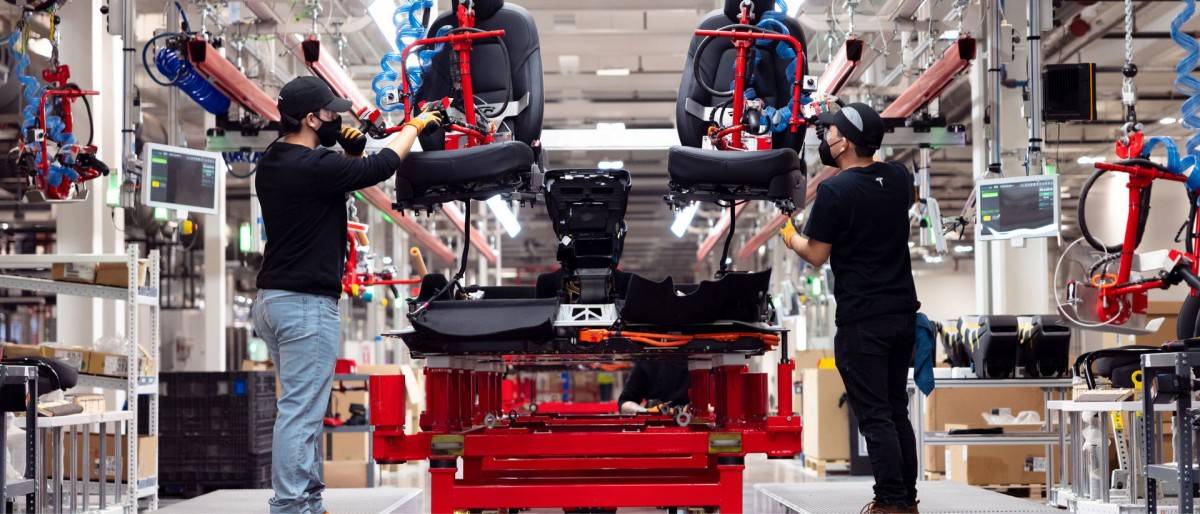
From futuristic concept to real‑world production, Tesla’s Cybertruck embodies the company’s drive to redefine automotive norms. Central to this journey is Giga Texas, where megacasting, 4680 battery integration, and a novel body‑in‑white architecture converge to mass‑produce an angular, stainless‑steel pickup unlike any before. As of mid‑2025, Giga Texas has moved beyond low‑volume pilot builds into substantive ramp‑up, hitting weekly targets that signal Tesla’s intent to capture the burgeoning electric pickup segment. Yet challenges remain—from supply‑chain strains and labor scaling to quality consistency. This article examines production metrics, manufacturing innovations, supply‑chain and workforce dynamics, market launch strategies, and the long‑term role of Cybertruck in Tesla’s lineup.
Chapter I: Production Ramp Metrics
1. Weekly & Monthly Build Rates
-
Early 2025: Giga Texas produced roughly 500 Cybertrucks per week in initial pilot runs, verifying complex assembly steps.
-
Q2 2025: Production ramp accelerated to 2,500 units per week, on track to reach 3,000 weekly by Q3.
-
Yield Improvements: Build‑quality yield climbed from 65 percent in February to over 85 percent by June, reflecting iterative process enhancements.
2. Target Curves vs. Reality
-
Original Plan: Tesla aimed for 5,000 weekly units by mid‑2025—a goal deferred due to supplier delays and first‑of‑a‑kind tooling issues.
-
Revised Projections: CEO commentary in May adjusted the target to 4,000 weekly by year‑end, balancing speed with quality.
3. Quality‑Control Statistics
-
Panel‑Gap Variance: 90 percent of vehicles now meet sub‑2 mm tolerance across body panels.
-
Paint & Weld Integrity: Early issues with weld splatter on exoskeleton seams dropped below 1 percent incidence after automation calibration.
-
Battery Module Defects: Less than 0.2 percent of modules flagged in final inspection, thanks to improved cell soldering and thermal‑management protocols.
Chapter II: Manufacturing Innovations
1. 4680 Dry‑Electrode Battery Integration
-
Battery Pack Assembly: Giga Texas integrates 4680 cells directly into structural pack trays, reducing module count and assembly steps.
-
Thermal Management: Novel tri‑core cooling plates circulate dielectric fluid between cell rows, maintaining optimal operating temperatures under heavy duty cycles.
-
Yield Enhancements: Automated cell insertion robots and inline ultrasound inspections cut cell breakage rates by half.
2. Mega‑Casting & Exoskeleton Approach
-
Gigacasting Machines: Two 8,000 ton casting machines produce front and rear underbody castings in single pours—eliminating hundreds of welds and reducing part count by 50 percent.
-
Stainless‑Steel Exoskeleton: Strap‑from‑void welding technique bonds stainless‑steel outer panels to the load‑bearing chassis shell, achieving class‑leading torsional rigidity.
-
Production Flexibility: Modular tooling allows rapid reconfiguration for spec or region‑specific variants without full-die changeovers.
3. Automation vs. Human Labor
-
Robot Density: Robots perform 70 percent of repetitive tasks (casting, welding, battery insertion), with humans focused on quality checks and final assembly steps.
-
Collaborative Robotics: Cobots assist human workers on panel alignment and interior trim, reducing ergonomic strain.
-
Workforce Training: Tesla’s onsite training academy graduated 1,200 new technicians in H1 2025, covering battery safety, stainless‑steel machining, and robotics oversight.
Chapter III: Supply‑Chain & Workforce Dynamics
1. Key Supplier Partnerships
-
Battery Cells: Primary sourcing from Tesla’s Gigafactory Nevada and third‑party 4680 supplies from Panasonic; Northvolt Europe serves as a backup.
-
Casting Alloys: Supplier agreements with European foundries for specialized stainless‑steel alloys tuned for Tesla’s cast structures.
-
Electronics & Interiors: Localized procurement in Texas for wiring harnesses and interior trim panels to shorten logistics lanes.
2. Logistics Flow
-
Inbound Supply: Automated rail spur connects Giga Texas to major ports and steel mills, allowing daily bulk deliveries of raw materials.
-
Just‑In‑Time Sequencing: Materials staged in-yard cranes feed directly to production lines, minimizing buffer inventories.
-
Outbound Distribution: Finished vehicles load onto electric car carriers bound for U.S. markets and prepped for container shipping to Europe.
3. Labor & Training
-
Staff Scaling: From 3,000 employees in January to over 7,500 by June, including engineers, machinists, and logisticians.
-
Safety & Compliance: OSHA‑certified programs reduced workplace incidents by 40 percent, with daily huddles and safety audits.
-
Community Impact: Tesla’s recruitment drives and apprenticeship partnerships with local technical colleges create regional economic benefits.
Chapter IV: Market Launch Strategy
1. Reservation Backlog & Lead‑Times
-
Reservation Count: Over 1 million global reservations as of July 2025, with the U.S. and Europe each accounting for about 40 percent.
-
Expected Lead‑Times: Early adopters in Texas see 12–16 week delivery windows; European reservations anticipate 20–24 week waits due to shipping and homologation.
-
Order Management: Tesla’s digital portal dynamically updates eta and allows spec swaps until 4 weeks before scheduled production.
2. Regional Launch Phases
-
Phase 1 (U.S. Only): Deliveries to U.S. reservation holders began May 2025, focused on Texas, California and Florida.
-
Phase 2 (Canada & Mexico): Planned for Q4 2025, leveraging NAFTA‑era trade provisions and local homologation.
-
Phase 3 (Europe): First shipments slated for Q1 2026, with Dublin and Rotterdam as initial ports of entry for homologation testing.
3. Pricing & Specification Tiers
-
Single‑Motor RWD: Starting at $49,900 in the U.S. (€52,900 ex‑VAT in Europe), with a 300 mile range.
-
Dual‑Motor AWD: $59,900 / €62,900, offering 340 mile range and 0–60 mph in 4.5 seconds.
-
Tri‑Motor Performance: $79,900 / €82,900, delivering 370 mile range, sub‑3 second sprints, and towing capacity of 14,000 lbs.
-
Optional Packs: Off‑road, towing, and base‑camp accessories sold as factory‑installed or aftermarket add‑ons.
Conclusion
Cybertruck production ramp at Giga Texas embodies Tesla’s relentless innovation—from 4680 structural batteries and megacasting to an all‑new stainless‑steel exoskeleton. While early volume fell short of initial high‑water marks, disciplined yield improvements, supplier scaling, and workforce expansion have poised weekly output to exceed 3,000 units by Q3 2025. The global reservation backlog underscores massive demand, but European deliveries hinge on homologation and shipping logistics. As Tesla navigates this complex ramp, Cybertruck’s success will determine Tesla’s ability to penetrate the pickup market and diversify beyond crossovers and sedans. For owners and investors alike, the key questions are: can Giga Texas sustain quality at scale, and will Cybertruck reshape the electric pickup landscape as boldly as its design promised?
FAQ
1. What is Giga Texas’s current Cybertruck output per week?
Approximately 2,500 units, targeting 3,000 by Q3 2025.
2. How do 4680 cells enhance Cybertruck performance?
They double energy density, reduce weight, and integrate structurally, boosting range and rigidity.
3. When will Europe begin receiving Cybertrucks?
Projected Q1 2026, pending homologation and shipping schedules.
4. Are there specification differences between U.S. and EU models?
EU models include additional lighting, side‑reflector safety features, and region‑specific charging adapters.
5. How competitive is Cybertruck pricing versus rivals?
Cybertruck undercuts many luxury EV pickups on price-per‑mile-of-range, while offering unmatched towing and payload capacity.