
Introduction
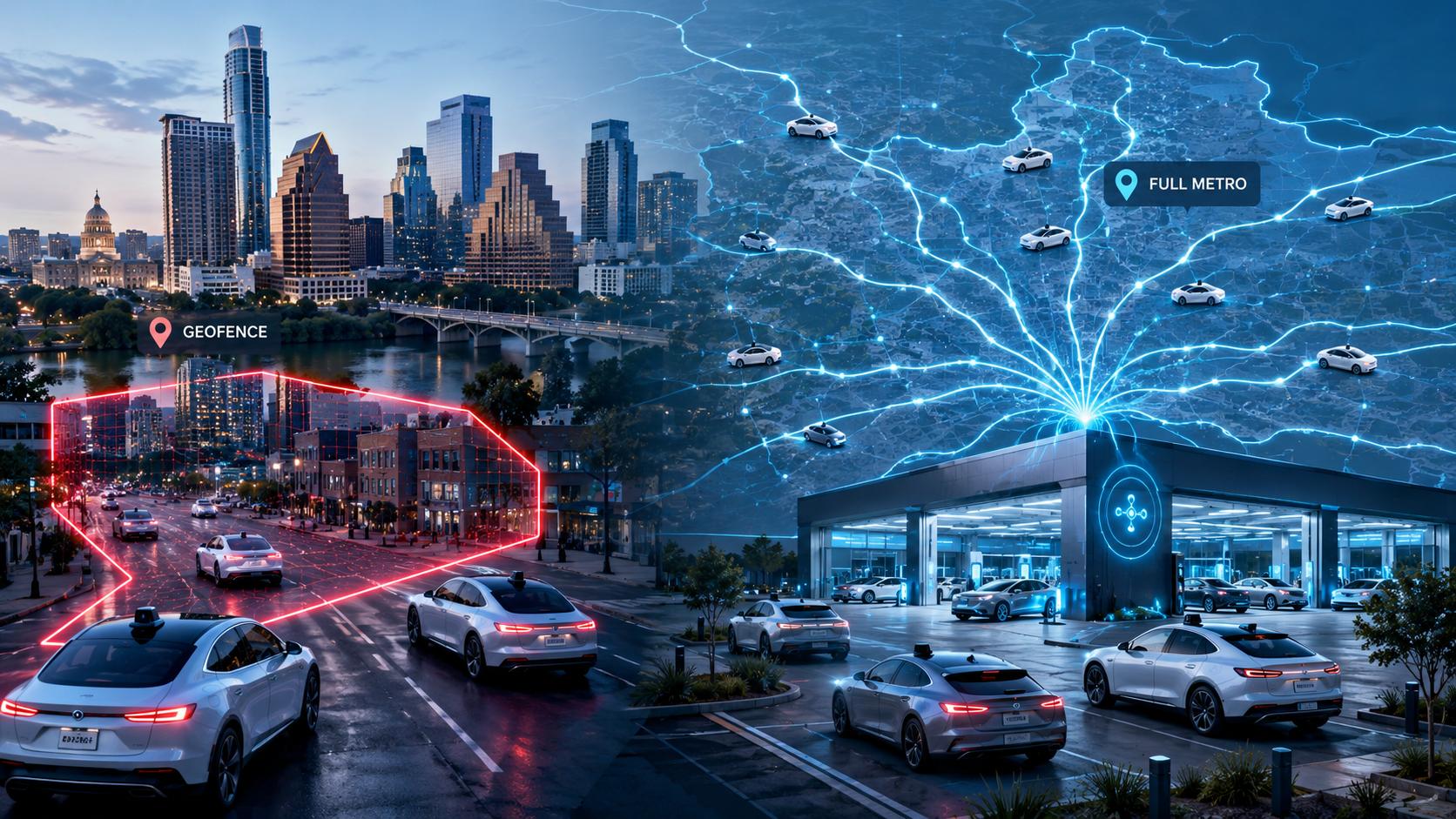
On June 3, 2026, Tesla’s official Robotaxi account on X posted a short but significant message: “Unsupervised Robotaxi now in the entire Austin Metro area.” Within hours, the news spread across financial and automotive media. Tesla had expanded its unsupervised robotaxi service from a small geofenced portion of South Austin to the entire metropolitan area — including suburbs like Pflugerville and Manor, major highways such as I-35, Gigafactory Texas, and Austin-Bergstrom International Airport.
The announcement was met with enthusiasm from Tesla fans and skepticism from industry observers. The reason for the mixed reaction is simple: expanding a geofence on a map is easy. Having enough vehicles to serve that expanded area is much harder. According to public data and presentations from Austin officials, Tesla operates approximately 50 robotaxis in the city — a number that has actually declined from earlier peaks. Competitor Waymo operates more than 250 vehicles in the same area. Customer wait times for Tesla robotaxis have sometimes exceeded 30 minutes. And Tesla‘s active unsupervised fleet in Austin has been shrinking, not growing, in recent weeks.
Chapter 1: The Road to Full Metro Coverage — A Timeline of Gradual Expansion
Tesla’s robotaxi program in Austin did not emerge overnight. It has been built through a series of incremental expansions over more than a year, each step widening the operating geofence and collecting valuable real-world driving data.
Phase 1: Limited Pilot (June 2025)
Tesla launched its initial robotaxi service in Austin in June 2025, operating a small number of vehicles within a tightly restricted geofence in South Austin. At this stage, the service was more of a technology demonstration than a commercial offering — the geofence was small, the fleet was tiny, and rides were limited to early adopters and Tesla employees.
Phases 2–4: Geofence Expansion (July–October 2025)
Throughout the second half of 2025, Tesla expanded the robotaxi operating zone in four separate steps. The company announced expansions in July, early August, late August, and late October 2025, each time roughly doubling the size of the geofenced area. By late October, the service area had grown to cover a substantial portion of Austin, though it still excluded northern suburbs, the airport, and major highway corridors.
Phase 5: The Dallas and Houston Launches (April 2026)
In a significant step toward multi-city operations, Tesla announced in April 2026 that it was rolling out robotaxi services in Dallas and Houston. However, early reports suggested that these services launched with extremely small geofences — Dallas with 3 vehicles, Houston with 6 — and have seen no growth since.
Phase 6: Full Metro Expansion (June 3, 2026)
The June 3, 2026, announcement marked the fifth geofence expansion overall and the first to cover the entire Austin Metro area. According to Teslarati, the new geofence encompasses suburbs like Pflugerville and Manor, I-35 highways, Gigafactory Texas, and Austin-Bergstrom Airport — effectively every corner of the metropolitan region. The expansion more than doubled the previous operating zone, which had remained static since October 2025.
Chapter 2: The Numbers That Matter — Fleet Size, Wait Times, and Utilization
While geofence expansion is visually impressive, the only numbers that determine whether robotaxis are useful are fleet size and wait times. On both metrics, Tesla faces significant challenges.
Fleet Size: 50 Vehicles (and Shrinking)
According to a presentation from Austin officials cited by multiple news outlets, Tesla has roughly 50 vehicles operating in the city. However, more granular tracking data from Robotaxi Tracker — a third-party monitoring service — suggests that the number of actively deployed unsupervised vehicles is significantly lower, around 20, and has actually declined in recent weeks. The unsupervised fleet peaked at 25 cumulative vehicles in late April 2026, then dropped.
The discrepancy between the 50 figure and the 20 figure may be explained by Tesla‘s practice of rotating vehicles in and out of service for maintenance, software updates, or data analysis. At any given moment, the number of robotaxis available for ride requests may be considerably lower than the number theoretically registered for the service.
For context, Waymo operates more than 250 robotaxis in Austin alone. Across all its US markets, Waymo operates approximately 3,000 robotaxis and completes over 500,000 paid trips per week. The scale gap between the two competitors is immense.
Wait Times: 30+ Minutes and Counting
Customer reports and media coverage consistently note that Tesla robotaxi wait times have sometimes exceeded 30 minutes. For a ride-hailing service to be competitive with Uber or Lyft, wait times need to be under 10 minutes, ideally under 5 minutes. A 30-minute wait is not merely inconvenient — it fundamentally undermines the value proposition of the service.
The relationship between fleet size and wait times is straightforward: the more vehicles in service, the shorter the wait times. Austin‘s metropolitan area covers hundreds of square miles. Fifty vehicles spread across that area means that, on average, there is one robotaxi for every 10 square miles. Even accounting for demand clustering in high-density areas, the math does not support sub-10-minute wait times.
Tesla did achieve a temporary milestone in January 2026 when its combined Austin and Bay Area robotaxi fleet reached 200 vehicles, reducing wait times in the Bay Area from 15 minutes to under 5 minutes. However, that 200-vehicle number included both unsupervised Austin vehicles and supervised Bay Area vehicles. By June 2026, the total active fleet — including both categories — had collapsed from 165 to just 34 vehicles, according to Electrek‘s analysis.
Utilization Rate: An Unanswered Question
Neither Tesla nor third-party researchers have published reliable data on robotaxi utilization — the percentage of time each vehicle spends carrying passengers versus idle. High utilization rates indicate strong demand and efficient fleet management, while low utilization rates suggest that the service is struggling to attract riders. Without utilization data, it is impossible to determine whether Tesla’s robotaxi program is economically viable or merely a technological showcase.
Chapter 3: The Technology — What Unsupervised Actually Means
One of the most persistent points of confusion about Tesla‘s robotaxi program is the term “unsupervised.” In common understanding, an unsupervised autonomous vehicle would require no human attention, oversight, or intervention. Tesla’s implementation, at least in its current form, falls short of that ideal.
Remote Monitoring and Safety Drivers
Despite the “unsupervised” label, Tesla‘s robotaxi service still involves human oversight. According to reports from January 2026, Tesla’s robotaxi rides in Austin still use safety monitors, with a passenger-seat monitor on local roads and a driver-seat monitor on highways. This means that every robotaxi currently has at least one human present who can take control if the autonomous system encounters a situation it cannot handle.
Tesla has said that it expects to remove safety monitors “soon” and has been testing fully driverless rides internally. As of June 2026, however, full driverless operation — meaning no human in the vehicle at all — has not been confirmed for commercial rides.
The distinction matters greatly. A robotaxi with a safety monitor is not fundamentally different from a standard Tesla with Autopilot engaged and a driver ready to intervene. The safety monitor is, in effect, a paid employee whose job is to sit in the vehicle and monitor the autonomous system. That is expensive, removes the cost advantage of autonomy, and raises questions about how scalable the model really is.
The Software Backbone: FSD v15 and Beyond
CEO Elon Musk has repeatedly emphasized that the pace of robotaxi scaling depends on software development, not hardware production. In May 2026, Musk stated that Tesla is waiting for its Full Self-Driving v15 software rewrite before scaling the fleet aggressively, pushing any meaningful ramp to late 2026 or early 2027.
FSD v15 is rumored to be a complete architectural rewrite that reduces reliance on high-definition maps and improves performance in complex urban environments. If the software lives up to the claims, it could enable more reliable autonomous operation with fewer interventions, potentially allowing Tesla to remove safety monitors and deploy vehicles at scale. But Musk has previously attached self-driving growth to other software updates that came and went, leading some observers to treat these timelines with skepticism.
Hardware: AI4 (HW4) and Dedicated Cybercab
Tesla‘s current robotaxis are standard Model Y vehicles equipped with the AI4 (HW4) computer. Musk has confirmed that AI4-equipped vehicles will be capable of running Unsupervised FSD without hardware upgrades. This is important because it means that every new Model Y sold to consumers could, in theory, be added to the robotaxi fleet if owners opted in — a potential pathway to rapid scaling.
Tesla has also announced plans for a dedicated robotaxi vehicle, codenamed Cybercab, which is scheduled to enter limited production in April 2026. The Cybercab is expected to be a purpose-built autonomous vehicle without a steering wheel or pedals, optimized for ride-hailing rather than personal ownership. If Cybercab reaches volume production, it could dramatically increase Tesla’s robotaxi fleet without cannibalizing consumer vehicle sales.
Chapter 4: The Competitive Landscape — Waymo‘s Huge Lead
No analysis of Tesla’s robotaxi program would be complete without a direct comparison to Waymo, Alphabet‘s autonomous driving subsidiary and the undisputed leader in commercial robotaxi operations.
Fleet Size: Waymo by a Landslide
As noted earlier, Waymo operates more than 250 robotaxis in Austin, while Tesla operates approximately 50. Across all US markets, Waymo has thousands of vehicles in service, completing hundreds of thousands of paid trips each week.
Texas Department of Motor Vehicles data from early June 2026 shows an even more dramatic disparity: Waymo has 577 registered robotaxis in Texas, while Tesla has just 42. If this data is correct, Tesla’s registered fleet is actually smaller than the 50 figure cited by Austin officials — suggesting that some of Tesla‘s vehicles may not yet be fully certified for unsupervised operation.
Operational Model: Waymo Is Fully Driverless
Waymo’s Austin service is fully driverless, with no human safety operator onboard. Tesla‘s service, by contrast, still uses safety monitors. This is a fundamental difference in operational readiness. Waymo has already solved the regulatory, technical, and safety challenges necessary to remove humans from the vehicle. Tesla has not.
Geofence Strategy: Different Approaches
Waymo prioritizes dense, high-quality coverage within carefully mapped zones. Its Austin service area is approximately 140 square miles, following a 50 percent expansion announced in early June 2026. Tesla‘s service area is larger, at approximately 171 square miles, but its fleet is far smaller, meaning coverage is thin across much of the zone.
Neither approach is inherently superior — they represent different trade-offs between coverage breadth and service quality. Waymo chooses to serve a smaller area extremely well, with short wait times and high reliability. Tesla chooses to serve a larger area, but with long wait times and thin coverage. For customers, the Waymo model is more practical today. For investors, the Tesla model offers greater long-term potential if the company can eventually scale its fleet to match its geofence.
Financial Backing: Waymo‘s War Chest
In 2026, Waymo raised $16 billion to fund expansion, including launches in London and Tokyo. That war chest gives Waymo the resources to build out its fleet, expand to new cities, and subsidize operations while achieving scale. Tesla has not disclosed comparable funding specifically for robotaxi operations, though the company’s overall balance sheet remains strong.
Chapter 5: The Skeptical View — Why Critics Question Tesla‘s Approach
Not everyone is impressed by geofence expansions and optimistic software timelines. Critics have raised three main objections to Tesla’s robotaxi strategy.
Objection 1: “Expanding a geofence is meaningless without vehicles to fill it.”
Electrek’s take on the June 3 expansion was blunt: “Expanding a geofence is essentially drawing a bigger box on a map. It costs nothing, requires no additional vehicles, and looks impressive in a tweet. But a ‘Robotaxi‘ service area without robotaxis to serve it is just a map.” This critique captures the core issue: Tesla has repeatedly widened its operating zone without adding proportional vehicles, leading to a situation where the service is available in name only across most of the metro area.
Objection 2: “Tesla is far, far behind schedule.”
Elon Musk has been promising full self-driving capabilities since 2016, and robotaxi networks since 2019. In 2025, Musk stated that robotaxis would cover at least 50 percent of the US population by the end of that year. With 2026 nearly half over, the actual coverage remains confined to parts of Texas, with a tiny fleet. Critics argue that each new geofence expansion is a distraction from the fundamental issue: Tesla has not yet built a scalable, reliable, fully driverless robotaxi service.
Objection 3: “Remote drivers suggest the technology isn‘t ready.”
The continued use of safety monitors and passenger-seat human operators suggests that Tesla does not yet trust its autonomous system to operate completely unsupervised. Some critics have speculated that each robotaxi may have a remote human operator monitoring the vehicle and ready to intervene — effectively a low-latency teleoperation system rather than true autonomy. Tesla has not publicly confirmed or denied this speculation.
Chapter 6: The Optimistic View — Why Believers See Progress
Despite the skepticism, Tesla supporters point to several positive indicators.
Indicator 1: Geofence expansion demonstrates system confidence.
Expanding to full metro coverage requires Tesla’s software to handle a wide range of driving conditions — downtown streets, suburban neighborhoods, airport access roads, and highway corridors. The fact that Tesla approved this expansion suggests that internal safety metrics have reached acceptable levels for a broader deployment. A company that was uncertain about its system‘s reliability would not take this step.
Indicator 2: Data collection accelerates.
Every robotaxi mile driven generates training data for Tesla’s neural networks. Expanding the geofence means exposing the system to a wider variety of roads, traffic patterns, weather conditions, and edge cases. Over time, this data should improve the performance of FSD across the entire Tesla fleet, not just robotaxis.
Indicator 3: The pivot from EVs to AI and robotics is real.
Robotaxis and Full Self-Driving software have become the main focus of Tesla‘s long-term strategy, according to CEO Elon Musk. The company is shifting its growth story from selling electric vehicles — a business facing increasing competition — to providing autonomous ride-hailing services — a business with software-like margins. This pivot requires aggressive investment and visible milestones. The Austin geofence expansion is a visible milestone, even if the underlying fleet remains small.
Indicator 4: The fleet will eventually grow.
Tesla’s small fleet today does not imply a small fleet forever. The company has the manufacturing capacity to produce hundreds of thousands of vehicles per year. The limiting factor is software readiness, not hardware production. If FSD v15 delivers the promised improvements, Tesla could rapidly scale its robotaxi fleet by redirecting production toward the Cybercab or enabling consumer-owned vehicles to join the network.
Chapter 7: What This Means for the Tesla Ecosystem
For Tesla owners — particularly those who have purchased FSD — the robotaxi program has direct and indirect implications.
FSD as Robotaxi Software
The autonomous software powering Tesla’s robotaxis is a version of FSD. Every improvement made to robotaxi software — better lane keeping, smoother acceleration, more reliable intersection navigation — eventually flows to consumer vehicles via over-the-air updates. In this sense, the robotaxi program serves as a real-world testing and validation platform that benefits all FSD users.
The Subscription Shift
In February 2026, Tesla began phasing out one-time FSD purchases in favor of a monthly subscription model. This shift aligns the FSD business more closely with the robotaxi business — both generate recurring software revenue rather than one-time hardware revenue. For owners, the subscription model lowers the upfront cost of accessing FSD but increases the long-term cost if they keep the vehicle for many years.
Potential to Earn Money
Tesla has long promised that FSD-equipped vehicles could generate income for their owners by participating in the robotaxi network when not in use. While that feature has not yet been activated, the Austin expansion keeps the possibility alive. If and when consumer-owned vehicles are allowed to join the network, every FSD-equipped Tesla in Austin could become a revenue-generating asset.
Chapter 8: Looking Ahead — What to Watch in the Coming Months
Several milestones will determine whether Tesla‘s robotaxi momentum continues or stalls.
FSD v15 Release
The most important near-term event is the release of FSD v15. If the software delivers the promised improvements — fewer interventions, better performance in complex urban environments, reduced reliance on maps — it could unlock the fleet scaling that Tesla has been waiting for. If v15 underwhelms, expect further delays and a skeptical response from investors.
Cybercab Production
Limited production of the dedicated Cybercab robotaxi is scheduled for April 2026. By mid-to-late 2026, we should see the first Cybercab units entering service, potentially supplementing or replacing the Model Y-based robotaxis currently in use.
Removal of Safety Monitors
Tesla has said it expects to remove safety monitors “soon”. When that happens — if it happens — it will be a genuine milestone demonstrating that the company has confidence in its fully driverless capabilities. Until then, the service remains at least partially human-dependent.
Expansion to New Cities
Tesla has announced plans to launch robotaxis in Miami, Phoenix, Las Vegas, and Dallas (beyond the initial small deployment). If these launches occur with meaningful fleet sizes and reasonable wait times, it will signal that the Austin program is a template rather than an anomaly.
Waymo’s Response
Waymo is not standing still. The company is expanding in Austin, raising capital, and launching in international markets. If Waymo continues to widen its lead while Tesla struggles to scale, investor sentiment could shift. Conversely, if Tesla begins closing the gap, Waymo‘s first-mover advantage could erode.
Conclusion
Tesla’s expansion of unsupervised robotaxi service to the entire Austin Metro area on June 3, 2026, is simultaneously a notable achievement and a source of frustration. Achieving full metro coverage — including suburbs, highways, the Gigafactory, and the airport — represents a genuine technical milestone. Expanding the geofence through five separate phases shows steady, consistent progress.
But the numbers tell a sobering story. Fifty vehicles serving hundreds of square miles leads to 30-minute wait times. A fleet that has been shrinking, not growing, in recent weeks raises questions about vehicle reliability or utilization. A competitor with more than 250 vehicles in the same city — and thousands nationwide — highlights how far Tesla has to go.
The robotaxi dream remains alive, but it is not yet a commercial reality. Tesla has built an impressive map. Now it needs to fill that map with cars.
For Tesla owners and investors, the path forward is clear: watch the fleet size, watch the wait times, and watch for the removal of safety monitors. Until those metrics improve substantially, the Austin robotaxi expansion is best understood as a statement of intent rather than a proven business model.
FAQ
Q: How many unsupervised Tesla robotaxis are actually operating in Austin?
A: According to Austin officials, approximately 50 vehicles. Third-party trackers suggest the actively deployed number may be closer to 20. The discrepancy likely reflects vehicles rotating in and out of service for maintenance, software updates, or data collection.
Q: Are these rides fully driverless?
A: No. Despite the “unsupervised” label, current rides still use safety monitors — a passenger-seat monitor on local roads and a driver-seat monitor on highways. Tesla has said it expects to remove safety monitors soon but has not yet done so for commercial rides.
Q: Why are wait times so long?
A: Wait times sometimes exceed 30 minutes because the fleet is too small to cover the expanded geofence. With roughly 50 vehicles serving hundreds of square miles, the average distance between available robotaxis is large, leading to long pickup times.
Q: How does this compare to Waymo?
A: Waymo operates more than 250 robotaxis in Austin (versus Tesla‘s ~50), is fully driverless (versus Tesla’s use of safety monitors), and completes over 500,000 paid trips per week across its US markets. Waymo‘s lead remains substantial.
Q: Will my personal Tesla ever be able to operate as a robotaxi?
A: Tesla has promised this feature for years but has not yet activated it. If and when it becomes available, vehicles with AI4 (HW4) hardware should be eligible. Consumer-owned vehicles are not currently part of the Austin robotaxi fleet.
Q: When will Tesla scale the Austin robotaxi fleet?
A: Elon Musk has said that Tesla is waiting for the FSD v15 software rewrite before scaling aggressively, pushing any meaningful ramp to late 2026 or early 2027. This timeline may slip, as previous software milestones have.
Q: Has the service expanded beyond Austin?
A: Tesla launched robotaxi services in Dallas and Houston in April 2026, but those launches occurred with very small geofences and minimal fleet sizes (3 vehicles in Dallas, 6 in Houston). No expansion has been reported since the initial launch.
Q: Is the robotaxi program profitable?
A: Tesla has not disclosed financial data for the robotaxi program. Given the tiny fleet size, high oversight costs, and low utilization implied by long wait times, profitability seems unlikely at this stage.