
Introduction: The Silent Language of the Road
Driving has never been just about following rules. Every experienced driver knows that the road has a silent language—the subtle hand wave that says "go ahead," the raised palm that means "stop," the urgent gesture that warns of danger ahead. These non-verbal cues are so fundamental to human driving that we barely notice them, yet they've remained largely inaccessible to autonomous systems. Until now.
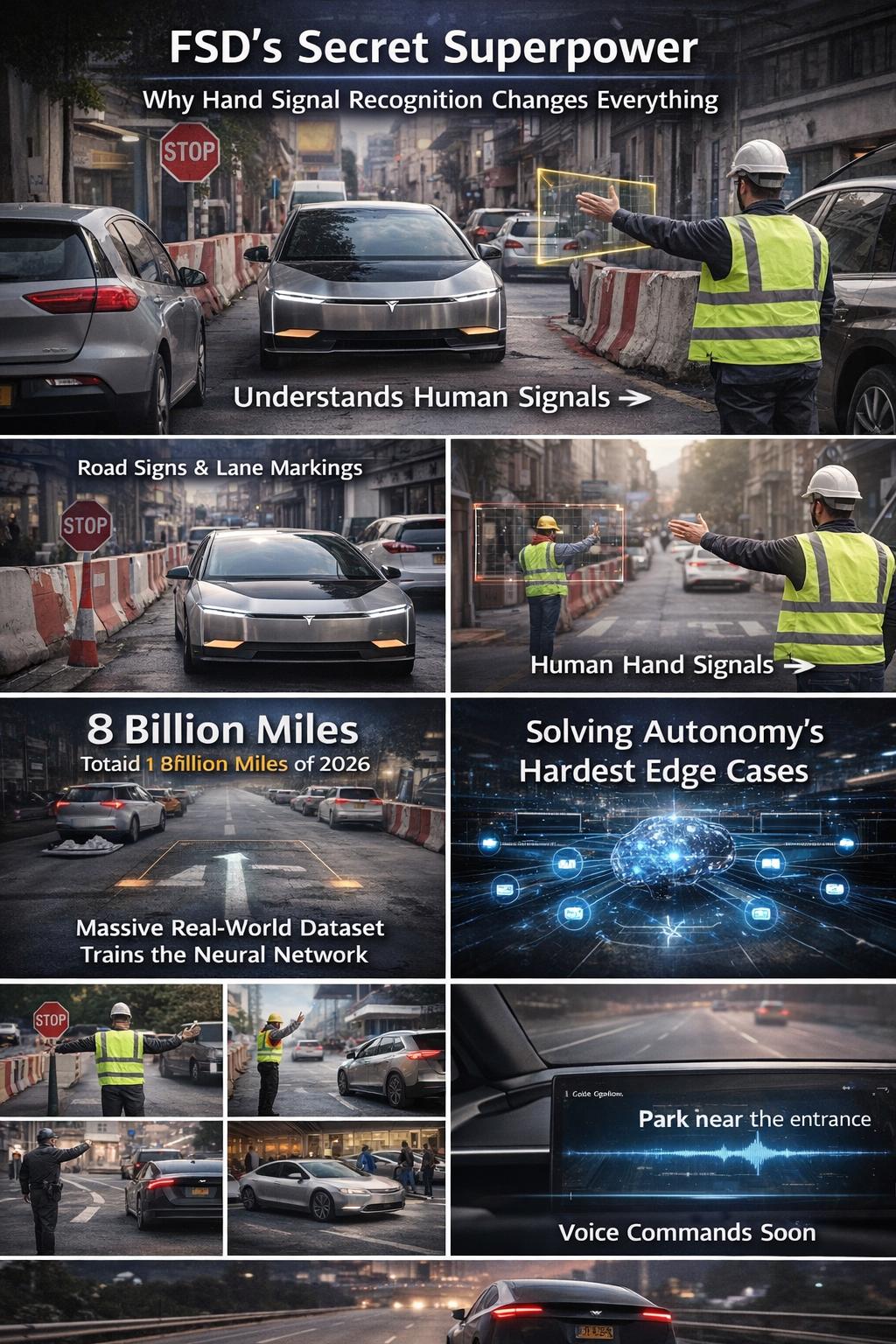
On February 22, 2026, Tesla Europe released a video that quietly demonstrated a breakthrough. The footage showed a Model 3 navigating an unmarked, narrow street in the Netherlands—the kind of ambiguous environment that autonomous systems have historically struggled with. As the vehicle approached a construction zone, a worker stood in the road, facing oncoming traffic. When he waved his hand forward, the Tesla proceeded. When he raised his palm in a stop gesture, the vehicle halted. The interaction was fluid, natural, and utterly unremarkable—except that no human was touching the controls.
Elon Musk amplified the video with a simple confirmation: "Tesla self-driving now recognizes hand signals". In that moment, Full Self-Driving crossed a threshold that few in the industry thought possible this decade. It had moved beyond pattern recognition to genuine social intelligence—the ability to interpret the intent behind human gestures, even when those gestures are informal, inconsistent, or contradict formal signals.
Chapter 1: The Video That Changed Everything
The Tesla Europe video, posted on February 22, is deceptively simple. It begins with a camera view from inside a Tesla Model 3 as it approaches a narrow street lined with parked cars. There are no lane markings, no clear right-of-way—just the kind of ambiguous urban environment that exists in every city but defies easy codification.
Ahead, a person stands in the road. They're not a crossing guard with official signage or a police officer in uniform—just someone directing traffic, perhaps for a construction project or a local event. The Tesla slows as it approaches, clearly having detected the person. Then the gesture comes: a forward wave, the universal signal for "proceed." The Tesla edges forward, passing safely. A moment later, the same person raises a palm. The Tesla stops.
What makes the video remarkable is what doesn't happen. There's no hesitation, no jerky braking, no uncertainty. The vehicle moves with the confidence of an experienced driver who's navigated a thousand similar situations. The safety monitor in the driver's seat keeps hands away from the wheel throughout.
Later in the same video, the Tesla encounters a more complex scenario: an intersection with a functioning traffic light showing red. But a police officer is present, gesturing for traffic to proceed despite the signal. The Tesla reads the officer's gesture, ignores the red light (as any human driver would), and moves through the intersection smoothly.
This is the critical distinction. The system isn't just recognizing hand shapes—it's understanding context. It knows that a police officer's gesture overrides a traffic light. It knows that a construction worker's wave means something different from a pedestrian's casual hand movement. It's interpreting meaning, not just detecting motion.
Chapter 2: The Technical Breakthrough - FSD v14.2
Hand signal recognition didn't emerge from a single software update. It's the product of years of incremental improvement in Tesla's neural network architecture, culminating in FSD v14.2 and its refinement v14.2.1.
From Rules to Reasoning
Earlier versions of FSD relied heavily on rule-based programming. Engineers would write code that told the vehicle how to respond to specific situations: stop at red lights, yield to pedestrians in crosswalks, and maintain lane position. This approach worked well for structured environments but broke down in the face of ambiguity. What should the car do when a construction worker waves it through a red light? The rules conflict, and rule-based systems don't handle conflict gracefully.
FSD v14.2 represents a fundamental shift. The system is built around an end-to-end neural network that takes camera inputs directly and outputs driving decisions, with minimal intermediate rule-based processing. This approach, sometimes called "vision transformers" or "foundation models for driving," allows the system to develop its own understanding of driving scenarios based on patterns learned from millions of real-world examples.
For hand signals specifically, the network has been trained to recognize not just the shape of a hand but the intent behind it. It understands that a hand raised with palm forward means "stop" in virtually any context. It understands that a waving motion usually means "proceed" or "come forward." It can even interpret more subtle cues: a finger pointing to an open parking spot, a hand signaling a lane change, a pedestrian's "after you" gesture at a crosswalk.
Higher Resolution, Better Understanding
One of the key technical improvements in v14.2 is increased image resolution from the camera system. Tesla's engineers have optimized the neural network's visual encoder to extract more information from each camera frame, particularly for small or distant objects. This matters for hand signals because gestures are often subtle and occur at a distance. A traffic director 50 meters away might make a small hand movement that's critical to understand. With higher resolution processing, the system can detect and interpret those gestures early enough to respond appropriately.
The improved resolution also helps with distinguishing gestures from random movements. A person adjusting their hat might look superficially similar to someone making a stop gesture. The network has learned to differentiate based on context, body position, and the subtle differences in hand orientation.
Real-Time Response
Once a gesture is recognized, the vehicle must respond instantly. FSD v14.2's planning algorithms have been optimized to incorporate gesture inputs alongside traditional signals like traffic lights, lane markings, and the movement of other vehicles. When a traffic director waves the car forward, the planner doesn't just override the stop—it recalculates the entire trajectory, smoothly accelerating through the intersection while maintaining awareness of cross traffic.
In the Tesla Europe video, this smoothness is evident. The vehicle doesn't jerk or hesitate when transitioning from stop to go. It moves with the fluidity of a human driver who's already anticipating the next move. That fluidity is the hallmark of a well-integrated system, where perception, planning, and control work in seamless harmony.
Chapter 3: The Data Advantage - Learning from 8 Billion Miles
Tesla's ability to train a neural network for gesture recognition depends on one critical resource: data. Lots of it. And Tesla has more real-world driving data than any other company on earth.
As of February 2026, Tesla owners have accumulated over 8 billion cumulative miles driven with FSD (Supervised) engaged. To put that number in perspective, it would take a single human driver over 150,000 years of continuous driving to cover that distance. And the growth is accelerating: in just the first 50 days of 2026, owners added another 1 billion FSD miles. At the current pace, the fleet is on track to log approximately 10 billion FSD miles this year alone.
The Scale of the Training Set
Every one of those miles generates data. When FSD is engaged, the vehicle's computers record video from all eight cameras, along with the driver's inputs, the vehicle's decisions, and the outcomes. When a human driver intervenes—taking over because the system made a mistake or encountered something it couldn't handle—that intervention becomes a training signal. The system learns what it did wrong and how to do better next time.
For gesture recognition, this data collection is invaluable. Every time a Tesla encounters a traffic director, a crossing guard, or a police officer, that interaction becomes part of the training set. The fleet collects examples from thousands of different people, with thousands of different gesturing styles, in thousands of different lighting and weather conditions. Over time, the neural network develops a generalized understanding of human gestures that works across this immense variety.
The Simulation Alternative
Other autonomous vehicle companies, notably Waymo, have taken a different approach. They rely heavily on simulation—creating virtual worlds where AI drivers can practice on synthetic scenarios. This approach has advantages: you can generate millions of miles of rare events (like a police officer directing traffic) without waiting for them to occur in the real world.
But simulation has a fundamental limitation: it can only generate scenarios that its creators imagine. Real-world driving is infinitely varied, and humans gesture in ways that no simulation could predict. The person who waves with their left hand while holding a coffee in their right. The construction worker who uses subtle finger movements to direct traffic. The pedestrian who makes eye contact and gives a quick nod that says "go ahead." These nuances emerge only from real data.
Tesla's approach—learning from the actual fleet—captures all of this variety. Every gesture the system encounters makes it slightly better at handling the next one.
Chapter 4: Real-World Scenarios - Where Gesture Recognition Matters
Hand signal recognition isn't a party trick—it's a critical safety capability that matters in dozens of everyday driving scenarios. Here are the situations where it makes the biggest difference.
Construction Zones
Temporary traffic control is one of the most challenging environments for autonomous vehicles. Lane markings may be obscured or changed. Signs may be temporary or contradictory. Human flaggers often direct traffic with hand signals, sometimes for hours at a time. A vehicle that can't understand these signals is effectively blind in construction zones.
With gesture recognition, FSD can navigate construction safely. It sees the flagger, understands whether it's being waved forward or signaled to stop, and proceeds accordingly—even if the formal signage says something different.
Police and Emergency Direction
When police officers direct traffic at accident scenes, parades, or special events, they often override normal traffic controls. They might wave cars through red lights, stop traffic on green, or direct vehicles into lanes that don't normally exist.
FSD's ability to recognize these gestures is essential for safe operation in urban environments. The system must understand that a police officer's gesture takes precedence over any traffic signal, and it must respond immediately and appropriately. The Tesla Europe video demonstrated exactly this capability: the vehicle proceeded through a red light because an officer gestured it forward.
Courtesy Gestures
Not all gestures are commands. Sometimes another driver waves you through an intersection, signaling that they're yielding their right-of-way. These courtesy gestures are common in everyday driving but have been nearly impossible for autonomous systems to interpret.
The Tesla Europe video showed this as well: an oncoming pickup truck driver waved to indicate that the Tesla could turn left across traffic. The system recognized the gesture, understood its meaning, and executed the turn smoothly.
Parking Valets and Attendants
For drivers who use valet parking, the interaction with parking attendants is routine. The attendant waves you forward, points to an open spot, and gestures for you to stop. A vehicle that can't understand these signals can't navigate a valet parking environment without human intervention.
With gesture recognition, FSD can handle these interactions autonomously. The vehicle sees the attendant's signals and responds appropriately, parking itself without the driver needing to take over.
Chapter 5: The Safety Case - Numbers That Matter
Gesture recognition isn't just about convenience—it's about safety. And Tesla's latest safety data suggests that FSD (Supervised) is already dramatically safer than human driving, even before this capability was fully developed.
According to Tesla's North America safety data, covering all road types over a 12-month period, vehicles operating with FSD (Supervised) were involved in one major collision every 5,300,676 miles. During the same period, the U.S. average for all vehicles was one major collision every 660,164 miles.
In other words, FSD (Supervised) is approximately eight times safer than the average human driver, based on the frequency of major collisions.
The Gesture Recognition Safety Dividend
Gesture recognition should improve these numbers further. Many of the scenarios where gestures matter—construction zones, police direction, unusual intersections—are precisely the situations where human drivers are most likely to make mistakes. A driver who misinterprets a flagger's signal could cause a serious accident. A driver who doesn't notice a police officer directing traffic could violate the law or create a hazard.
By handling these scenarios autonomously, FSD eliminates the risk of human error. The system never gets distracted, never misreads a gesture because it's looking at a phone, never becomes impatient, and proceeds when it should wait. It simply interprets the gesture correctly and responds appropriately, every time.
The Limits of the Data
Of course, the safety data comes with important caveats. FSD (Supervised) still requires an attentive driver who can take over if needed. The system isn't operating entirely autonomously, and the safety statistics reflect that fact. When FSD encounters a situation it can't handle, the driver intervenes, potentially preventing an accident that would otherwise have occurred.
The true test will come when vehicles operate without human supervision. Tesla's Cybercab, with no steering wheel or pedals, will provide that test. If gesture recognition works as well in unsupervised operation as it does in the supervised videos, the safety case for full autonomy will be significantly strengthened.
Chapter 6: The Regulatory Questions
As impressive as gesture recognition is, it raises difficult questions for regulators. Traffic laws are written assuming that drivers will follow formal signals—traffic lights, stop signs, and lane markings. When an autonomous system decides to override those signals based on a human gesture, is it breaking the law?
The Police Officer Scenario
The clearest case is a police officer directing traffic. In virtually every jurisdiction, a police officer's directions override traffic control devices. A driver who stops at a red light when an officer waves them through is actually violating the law by failing to follow the officer'sign.
For an autonomous vehicle, this is straightforward: follow the officer, not the light. FSD's gesture recognition enables exactly this behavior.
The Gray Areas
More ambiguous are scenarios involving non-official actors. A construction worker with no formal police powers directs traffic. A pedestrian waves a car through an intersection. Another driver yields their right-of-way with a hand gesture. In these cases, the legal status of the gesture is less clear.
Tesla's approach is to treat gestures as information, not commands. The system evaluates the context—who is making the gesture, where they're positioned, what authority they might have—and makes a probabilistic judgment about whether to follow it. In practice, this means the vehicle will follow a construction worker's directions (because they're clearly managing a work zone) but might be more cautious about following a random pedestrian's wave.
European Regulatory Landscape
In Europe, where the Tesla Europe video was filmed, the regulatory situation is particularly complex. Germany's and the Netherlands' traffic safety authorities have stated that AI systems should not replace human traffic directors. Yet the reality is that autonomous vehicles are already on European roads, and they're already encountering human gestures. Ignoring those gestures would be unsafe.
The solution, regulators are beginning to realize, is to update the rules rather than restrict the technology. If autonomous vehicles can interpret gestures as well as or better than humans, then the law should accommodate that capability. The Dutch RDW's expected decision on FSD approval in February 2026 may provide a template for how other European countries approach this issue.
Chapter 7: What's Next - Voice Prompts and Beyond
Gesture recognition is just one part of Tesla's broader push toward more natural human-vehicle interaction. Even as the system learns to understand what humans are saying with their hands, it's also learning to understand what humans say with their voices.
Voice Prompts for FSD
On February 21, 2026, Elon Musk confirmed that voice prompts for FSD are coming soon. This feature will allow drivers to give verbal instructions to the autonomous system: "Park close to the entrance," "Find a spot away from other cars," "Take the scenic route."
These voice commands address one of the longest-standing limitations of autonomous systems: they can't read your mind. A human driver knows that you want to park near the store entrance on a rainy day or far away in an empty lot on a sunny one. An autonomous system has no way of knowing these preferences unless you tell it.
Voice prompts solve this problem. By integrating natural language understanding with the driving planner, Tesla is creating a system that can respond to high-level instructions in real time. You don't need to program a destination into the nav system and hope the car parks appropriately—you can simply say what you want, and the car figures out how to do it.
Grok Integration
Tesla's recent integration of the Grok AI assistant into vehicles (initially in New Zealand and Australia) provides the underlying technology for voice understanding. Grok's large language model capabilities allow it to interpret complex, conversational requests and translate them into actionable instructions for the FSD system.
The combination is powerful: gesture recognition for understanding the outside world, voice recognition for understanding the inside world. Together, they create a vehicle that can communicate with humans in both directions—reading their signals and responding to their words.
Conclusion: When Cars Learn to See Us
For the first century of automotive history, the relationship between car and human was simple: the human commanded, the car obeyed. Steering wheel inputs became wheel angles. Pedal pressure became acceleration or braking. The car was a tool, and the human was the tool user.
Autonomous driving inverts this relationship. The car becomes the agent, and the human becomes the passenger. But that doesn't mean human input disappears—it just changes form. Instead of manipulating controls, humans communicate intent. A wave, a nod, a spoken word—these become the new interface between person and machine.
FSD's gesture recognition capability, demonstrated so vividly in the Tesla Europe video, is a milestone on this path. It shows that vehicles can understand not just the explicit signals of the road (traffic lights, signs, markings) but the implicit signals of human interaction. They can read the room.
The technology will improve. Gesture recognition will become more accurate, more nuanced, more widespread. Voice prompts will add another layer of communication. Eventually, riding in an autonomous vehicle will feel less like operating a machine and more like being chauffeured by a highly competent, utterly reliable, infinitely patient professional driver.
That driver will never be distracted, never be impatient, never misinterpret a gesture because they're having a bad day. It will simply see what you mean, and respond accordingly. And that, perhaps more than any technical specification, is what true autonomy looks like.