
Introduction
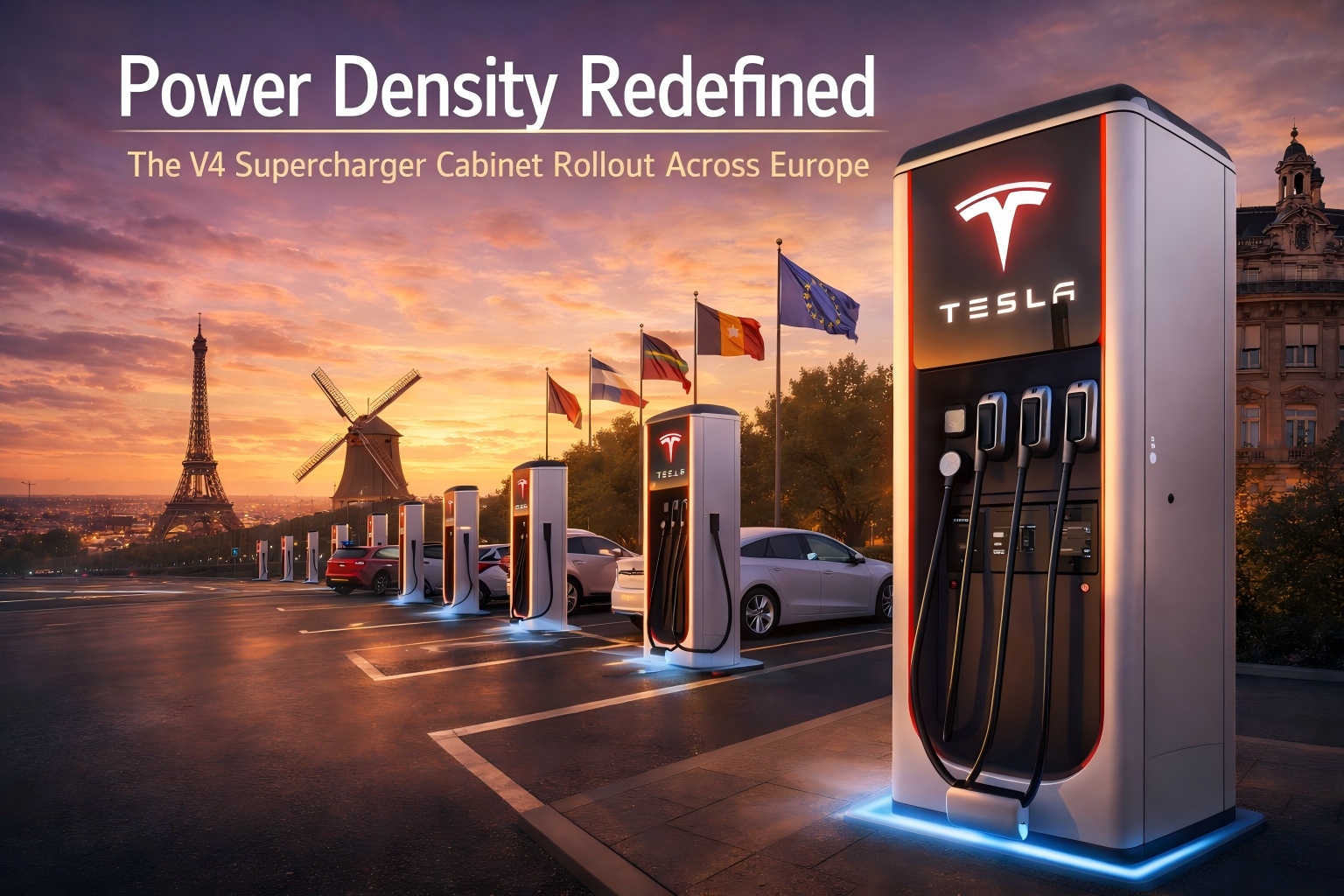
While much of the Tesla community focuses on autonomy and new vehicle models, a quieter but equally significant revolution is taking place at charging stations across Europe. This week, Tesla began installing the new V4 Supercharger cabinets at strategic locations in Germany and Norway, marking a substantial leap in charging infrastructure technology. To the casual observer, the stalls—the posts where drivers plug in—may look similar to the V4 stalls already in use. But the cabinet is where the true magic happens.
The V4 cabinet represents a complete overhaul of Tesla's charging architecture. It is designed not only to serve Tesla's current fleet more efficiently but also to future-proof the network for the Cybertruck's 800V architecture, the Tesla Semi, and the growing number of Non-Tesla EVs gaining access to the Supercharger network.
Section 1: V4 Cabinet vs. V4 Post—Understanding the Hardware
There has been significant confusion among owners regarding what constitutes a "V4 Supercharger." Many stations labeled as V4 over the past year have actually been V4 stalls powered by legacy V3 cabinets. The distinction is critical.
1.1 The Cabinet is the Brain
The Supercharger cabinet is the power electronics unit that converts grid AC power to DC power suitable for the vehicle's battery. The V3 cabinet, while revolutionary in its time, is limited to a maximum output of 250 kW per stall (when shared). The new V4 cabinet, however, is rated for a total output capacity of up to 500 kW per stall . This is achieved through advanced silicon carbide power electronics and a redesigned cooling system that allows for sustained peak output.
1.2 The Stall is the Interface
The V4 stall (the post with the cable) has been visible for months. It features a longer, liquid-cooled cable designed for ease of use with vehicles that have charging ports in different locations (such as the Cybertruck's rear driver's side or a Non-Tesla EV's front passenger side). It also includes an integrated payment terminal and a larger, more readable display . However, until this week, many of these stalls were "throttled" by the V3 cabinet behind them. With the new V4 cabinets coming online, these stalls can finally operate at their full potential.
1.3 Power Sharing Dynamics
One of the most significant upgrades in the V4 architecture is how power is distributed. V3 cabinets typically power a pair of stalls, sharing 250 kW between them. If both stalls are occupied, the power is split. The V4 system introduces a more flexible architecture where each cabinet can supply power to up to eight stalls, dynamically balancing the load based on demand and vehicle capability . This means that in a low-utilization scenario, a single vehicle might be able to draw significantly more than 250 kW, while in a high-utilization scenario, the system ensures all vehicles receive a reasonable charge without completely draining the grid connection.
Section 2: Performance Metrics—What the New Numbers Mean
The headline figures are impressive: up to 500 kW for passenger vehicles and a staggering 1.2 MW for the Tesla Semi . But real-world charging is more nuanced.
2.1 The Charging Curve Breakthrough
The most important metric is not the peak power, but the charging curve—how much power the vehicle can sustain as the battery fills up. Early tests of the V4 cabinet with a 2026 Model Y Long Range suggest that the vehicle can hold 350 kW+ from 10% state of charge (SoC) all the way to 40%, before gradually tapering. This compares to the V3 curve, which would peak at 250 kW briefly and then taper more aggressively. The result is a significant reduction in "time to 80%." Initial estimates suggest a drop from 27 minutes to under 19 minutes for a 10-80% charge on a compatible vehicle.
2.2 Unlocking the 800V Potential
Vehicles with 800V architectures, such as the Cybertruck and certain upcoming下一代 Tesla models, have been hampered by V3 Superchargers, which max out at around 400V. The V4 cabinet natively supports 800V charging, allowing the Cybertruck to charge at rates closer to its maximum capability. For European owners awaiting the Cybertruck's homologation, this infrastructure rollout is a prerequisite for a viable ownership experience.
2.3 Cold Weather Performance
One of the unsung benefits of the V4 cabinet is its improved cold-weather performance. The cabinet's advanced thermal management allows it to preheat the cable and ensure that power delivery is not throttled by freezing temperatures. In Norway, one of the first markets to receive the upgrade, this is a game-changer. Winter charging speeds have historically been a pain point for EV owners; the V4 cabinet mitigates this by ensuring the hardware is as warm and efficient as the vehicle's battery preconditioning system .
Section 3: The European Rollout—Germany and Norway Lead the Way
Tesla's decision to launch the V4 cabinet rollout in Germany and Norway is strategic.
3.1 Germany: The Heart of European Auto
Germany represents the toughest test for any charging technology. The Autobahn network demands high-speed, reliable charging for long-distance travel. By installing V4 cabinets at key German stations along major corridors (such as the A9 between Munich and Berlin), Tesla is signaling its commitment to supporting high-mileage drivers. The higher power density allows for faster turnarounds, reducing wait times at busy travel plazas.
3.2 Norway: The EV Capital of the World
Norway has the highest penetration of EVs in the world, and Tesla has a massive market share there. However, cold weather and high utilization rates have stressed the existing V3 network. The V4 cabinets, with their improved reliability and power density, are designed to alleviate these stresses. Reports from Oslo indicate that installation crews are working to upgrade stations that have historically seen the longest queues.
3.3 The CCS Compatibility Factor
Europe uses the CCS Combo 2 standard, which the V4 stalls natively support. The longer cables on the V4 stalls make it significantly easier for Non-Tesla EVs (from brands like BMW, Mercedes, and Ford) to use the Supercharger network. As Tesla opens more of its network to other manufacturers under the "Supercharger Open for Non-Tesla" initiative, having hardware that accommodates different port locations is essential. The V4 cabinet rollout is therefore not just about serving Tesla owners better, but about monetizing the network by attracting a broader customer base.
Section 4: Impact on the Charging Experience
For the average Tesla owner, the arrival of V4 cabinets will be felt in several tangible ways.
4.1 Reduced Congestion
Because each vehicle charges faster, the turnover rate at Supercharger stations increases. This means that even if a station has the same number of stalls, it can serve more cars per hour. For owners, this translates to shorter wait times, especially during peak travel seasons like summer holidays or Christmas.
4.2 The "Plug and Charge" Refinement
The V4 stalls feature improved authentication. The contactless payment terminal is more responsive, and the handshake between the car and the charger is faster. For Tesla owners, "Plug and Charge" (where the car is recognized and billing begins automatically) is now near-instantaneous. For Non-Tesla users, the process of tapping a credit card or using the Tesla app is streamlined.
4.3 Reliability and Uptime
Tesla claims that the V4 cabinet design prioritizes reliability . By reducing the complexity of the installation (fewer cabinets needed per site due to higher density) and improving component quality, the mean time between failures (MTBF) should increase. For owners, this means arriving at a station and finding all stalls operational—a crucial factor in building trust for long-distance travel.
Section 5: The Future Roadmap—V4 Across the Continent
The installations in Germany and Norway this week are just the beginning.
5.1 The 2026 Deployment Plan
Tesla has indicated that the V4 cabinet will be the standard for all new Supercharger stations built in Europe moving forward. Additionally, high-utilization existing stations will be retrofitted. France, the Netherlands, and the UK are expected to see V4 upgrades in the second half of 2026.
5.2 The Megacharger Connection
The 1.2 MW capability of the V4 cabinet is specifically designed for the Tesla Semi . While Megachargers (dedicated high-power depots for trucks) are a separate, even more powerful infrastructure, the V4 cabinet allows for "opportunity charging" of Semis at regular passenger vehicle stations. As the Tesla Semi fleet expands in Europe (with customers like DHL and ASOS showing interest), this infrastructure will be vital.
5.3 Grid Integration and Energy Storage
Many new V4 installations are expected to be paired with Tesla's Megapack battery systems on-site. This "Supercharger + Megapack" model allows the station to store energy during off-peak hours (when electricity is cheap) and discharge it during peak demand, reducing demand charges and stabilizing the grid. For the owner, this means more consistent pricing and a smaller carbon footprint.
Conclusion
The rollout of the V4 Supercharger cabinet across Europe marks a maturation of the EV charging landscape. It is no longer enough to simply have a charger; the industry now demands chargers that are faster, more reliable, and more versatile. Tesla's V4 architecture delivers on all fronts. For the European Tesla owner, the benefits are immediate: shorter charging stops, less waiting, and a network that feels less like a utility and more like a seamless extension of the vehicle itself. As the transition to electric vehicles accelerates, infrastructure like the V4 Supercharger is the bedrock upon which that transition is built.