
Introduction
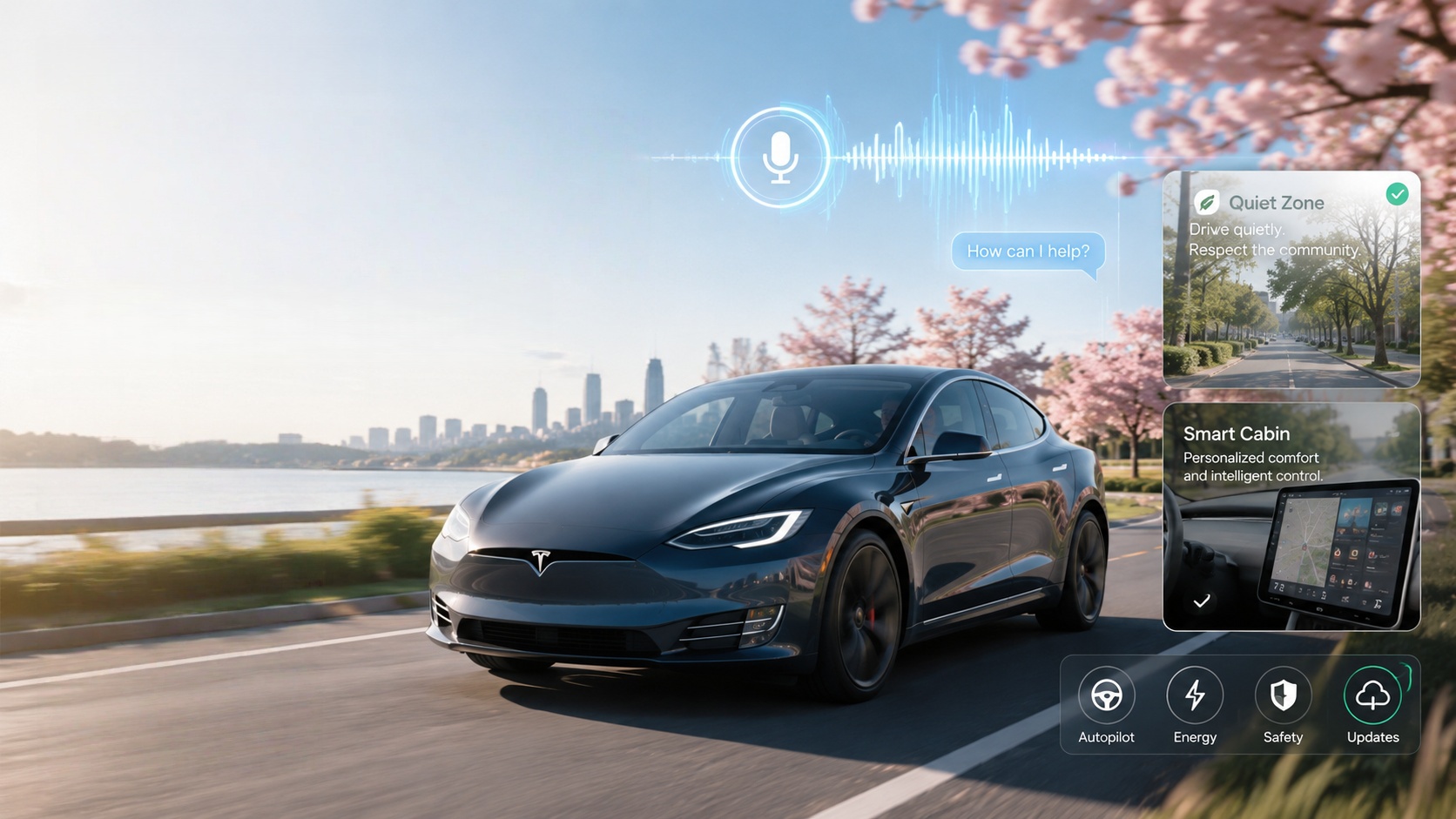
In May 2026, residents living near a newly opened Supercharger station on San Francisco’s Lombard Street had had enough. For months, their formerly quiet neighborhood had been transformed into what one local report described as an all-night “bass festival,” with Tesla drivers queuing late into the night, blasting music through premium sound systems, and occasionally blocking residential garages and engaging in behavior that city officials deemed “ridiculous and unacceptable.” The city installed a gate to restrict alley access. An overnight attendant was brought in from 9 p.m. to 5 a.m. to manage traffic and noise. But the problem persisted. So Tesla did something no other automaker on the planet could have done: it pushed a software update. Not a fleet-wide recall. Not a hardware retrofit. Not a policy memo. It pushed a location-specific over-the-air software update that targeted one Supercharger station, detected when a vehicle was plugged in and playing media above a certain volume threshold, and displayed a polite on-screen prompt — “Could you turn the volume down? Please be mindful of our neighbors” — alongside a single-tap “Lower” button.
Chapter 1: The Quiet Charging Zone — A Masterclass in Vertical Integration
1.1 The Problem: When Infrastructure Meets the Real World
The Lombard Street Supercharger station sits in San Francisco‘s Cow Hollow neighborhood, a dense residential area where the 24-hour operation of a 16-stall charging lot collided directly with the rhythms of urban life. Residents reported that the lot had turned quiet nights into a regular problem: cars lined up late, music playing at high volume, groups lingering near the chargers after midnight, bass from parked vehicles carrying directly into apartments, garages blocked, and even public urination becoming part of the overnight disorder around the site.
This was not a problem that traditional automotive infrastructure was designed to solve. A conventional gas station has attendants, lighting, and decades of zoning precedent. A Supercharger, by contrast, is fundamentally an unattended piece of electrical infrastructure located in a parking lot, with no staff and no built-in mechanism for behavioral enforcement. The complaints were real, persistent, and escalating — and they represented a new category of problem that the electrification of transport will inevitably generate as charging infrastructure moves deeper into residential neighborhoods.
1.2 The Technical Implementation
Tesla‘s response was a geofenced OTA update with remarkably precise trigger logic. Three conditions must be simultaneously true for the prompt to appear: the vehicle must be within the GPS-defined geofence of the designated station, the vehicle must be actively charging, and the media volume must exceed a predetermined threshold. When all three conditions are met, the center touchscreen displays a politely worded request — “Could you turn the volume down? Please be mindful of our neighbors” — accompanied by a single-tap “Lower” button that instantly reduces audio to a considerate level.
The design philosophy here is important. The prompt is framed as a request, not a command. It preserves driver autonomy — there is no forced volume reduction, no lockout of audio controls, no punitive consequence for ignoring the prompt. The “Lower” button is designed for frictionless compliance: a single tap, with no menu navigation required, reduces the audio immediately. As Teslerati noted in its May 26 report, physical “Quiet Charging Zone” signs installed on-site reinforce the digital nudge, creating a cohesive experience that blends software intervention with physical awareness.
Crucially, this is a location-specific deployment, not a fleet-wide change. The geofence applies only to the designated San Francisco station. Other Supercharger locations — including those in residential areas of Europe — are entirely unaffected. This surgical precision is what makes the implementation so notable: Tesla can push behavior-modifying software to a single parking lot without touching any other vehicle in its global fleet.
1.3 The Days vs.-Months Comparison
To understand why the Quiet Charging Zone has resonated so strongly across the industry, consider the alternative. In a traditional automotive ecosystem, the path from complaint to resolution would look something like this: the complaint reaches the OEM, which then contacts the third-party charging network operator — say, Electrek America or EVgo. A joint investigation must be launched, with both parties needing to coordinate across organizational boundaries. Designing the solution would require the charger to communicate location and status information to the vehicle, and the vehicle’s infotainment system — running Android Automotive, QNX, or another platform — would need to receive and interpret that signal. Cross-company API development would be required. Multi-company integration testing would follow, with each party navigating its own release cycles. The total timeline: months to years, with bureaucratic and technical hurdles at every stage.
Tesla‘s path was radically shorter. The complaint reached Tesla. Tesla owns the charger. Tesla owns the car. Tesla owns the software. A single team owned the entire problem. The solution — GPS geofence plus if-then logic: if geofence, and charging, and volume above threshold, then display prompt — required what was likely no more than a modest amount of code. The OTA push deployed the update in a matter of days.
This is not merely an interesting case study in engineering responsiveness. It is a fundamental redefinition of what a car company can be. As Max de Zegher, Tesla‘s Director of Charging, has articulated in a different context, the company’s philosophy is built around owning the full stack — from the power electronics in the charging cabinet to the touchscreen in the cabin. The Quiet Charging Zone is the most vivid demonstration yet of what that philosophy makes possible in practice.
1.4 The European and Multi-Brand Dimension
The Quiet Charging Zone also raises important questions about the expanding Supercharger ecosystem. As of April 2026, Tesla operates over 80,000 Supercharger stalls globally, with more than 27,500 of those open to non-Tesla vehicles from Ford, GM, Rivian, Hyundai, and Stellantis. When a Ford Mustang Mach-E or a Rivian R1T pulls into a Supercharger stall equipped with a Quiet Charging Zone geofence, that vehicle will not receive the in-car prompt — because those vehicles do not run Tesla software and are not connected to Tesla‘s OTA update pipeline.
This creates an interesting asymmetry. Tesla owners at that station will experience the polite digital nudge and the one-tap volume reduction. Non-Tesla owners will not. Whether this leads to a two-tier experience at shared charging stations — or whether Tesla eventually develops a cross-platform solution, perhaps via the Tesla app — remains an open question. What is clear is that Tesla’s vertical integration advantage does not extend to vehicles it does not control, and the growing number of non-Tesla vehicles at Supercharger stations will increasingly test the boundaries of what software-driven charging management can achieve.
Chapter 2: Hey Grok — Voice AI Comes to the Driver‘s Seat
2.1 From Tap-to-Talk to Hands-Free
When Tesla first introduced Grok — the AI assistant developed by Elon Musk’s xAI — to its vehicle fleet in July 2025, the reception was mixed. The assistant was undeniably capable, powered by one of the most advanced large language models available for consumer use. But the interaction model was fundamentally limited: to use Grok, drivers had to take their eyes off the road, locate a button on the touchscreen, and tap to activate voice input. For a company that has relentlessly pursued minimal-distraction interfaces, this was a conspicuous design gap.
The 2026 Spring Update closes that gap decisively. With version 2026.14, Tesla owners can now activate Grok entirely hands-free by simply saying “Hey Grok” — no screen tap required, no steering wheel button press needed. To end the conversation, drivers simply say “Goodbye.” Gizmodo captured the significance succinctly in its April 14 coverage: “Tesla drivers might be slightly less distracted by Grok while they’re driving, because now they can activate their favorite chatbot by saying ‘Hey Grok.’”
2.2 Location-Based Reminders: The Assistant Gets Contextual
The “Hey Grok” wake word is not merely a convenience upgrade — it unlocks a fundamentally new category of in-car functionality: location-based reminders. Drivers can now say, for example, “remind me to pick up milk when I‘m near home,” or “remind me to call the client when I arrive at the office.” Grok processes these requests, ties them to GPS coordinates, and delivers the reminder when the vehicle enters the relevant geographic zone.
This may seem like a modest feature — smartphones have offered location-based reminders for years — but its integration into the vehicle environment changes the nature of the interaction. Phone-based reminders require that the phone be on, unlocked, and within reach. In-car reminders arrive on the vehicle’s primary display, seamlessly integrated into the driving experience without requiring the driver to interact with a separate device. For Tesla, this represents the first meaningful step toward transforming Grok from a novelty chatbot into a genuinely useful driving companion.
2.3 What Grok Still Cannot Do
It is important to acknowledge the limitations. Despite the “Hey Grok” upgrade, Tesla‘s in-car voice assistant still cannot control core vehicle functions. You cannot ask Grok to set the climate control to 72 degrees, or change the media source, or adjust the seat heaters, or open the glovebox — all tasks that competing voice assistants, such as Mercedes’ MBUX, have been able to handle for years. Grok remains primarily an AI chatbot that happens to live in a car, rather than a deeply integrated vehicle control interface.
This gap matters because it highlights a broader strategic tension within Tesla‘s software ecosystem. The company has two voice interaction systems operating in parallel: the traditional voice commands system, which handles vehicle controls but lacks conversational AI capabilities, and Grok, which offers conversational AI but lacks vehicle control integration. Unifying these two systems — creating a single voice assistant that can both discuss complex topics and control the car — would represent a major step forward. The Spring Update’s “Hey Grok” feature, valuable as it is, does not bridge this divide.
2.4 The European Context
For European Tesla owners, the Grok upgrade carries particular significance. The European market has been a focal point for Tesla‘s AI expansion efforts, especially following the Dutch vehicle authority RDW’s approval of Full Self-Driving (Supervised) for use on Dutch public roads in April 2026. As FSD becomes available in more European markets, the value of a capable voice assistant that can explain system behavior, answer questions about autonomous features, and provide contextual guidance increases substantially. Grok‘s hands-free activation also aligns well with European Union regulatory emphasis on minimizing driver distraction — a concern that has shaped everything from touchscreen interface design to autonomous driving approval processes across the continent.
Chapter 3: The Self-Driving App — Gamification, Transparency, and the Subscription Imperative
3.1 The New Dashboard
The Spring Update introduces a completely redesigned Self-Driving application, accessible directly from the vehicle’s main touchscreen. The new interface consolidates what was previously scattered across multiple menus — subscription management, usage statistics, tutorial content, and driving telemetry — into a single, unified dashboard. It represents the most significant redesign of how Tesla owners interact with Full Self-Driving since the feature‘s initial beta launch in late 2020.
The centerpiece is a detailed statistics view that tracks and displays FSD usage with what can only be described as a gamified layer. The app shows the percentage of total miles driven with FSD engaged versus manual driving, displays usage patterns in bar chart format, and — most notably — introduces a “streak” counter that tracks how many consecutive days a driver has activated FSD. TechCrunch described the feature as “adding a gamified element to the driver assistance software.”
3.2 One-Tap Subscription
Equally significant from a business perspective is the streamlined subscription flow. Under the previous interface, subscribing to FSD required navigating through several menus on the touchscreen or using the Tesla mobile app. The new Self-Driving app collapses this process into a single action: eligible owners can start an FSD subscription with one tap. The subscription price is $99.99 per month in the United States.
There is an important hardware limitation to note: the one-tap subscription flow is only available on vehicles equipped with Tesla‘s AI4 chip, also referred to as Hardware 4.0, which began shipping in vehicles from January 2023. Owners of older vehicles with Hardware 3 are not included in this simplified flow. This is part of a broader and increasingly visible feature divergence between HW3 and HW4 vehicles — a topic explored in more detail later in this article.
3.3 The Subscription-Only Strategy
The one-tap subscription feature cannot be understood in isolation. On January 14, 2026, Elon Musk announced via X that Tesla would end the one-time purchase option for FSD after February 14, 2026. Previously, U.S. owners could purchase FSD outright for approximately 8,000,orsubscribefor99 per month. Under the new model, FSD is available exclusively through monthly subscription.
This shift from one-time purchases to recurring subscriptions is one of the most consequential changes to Tesla’s business model in years. One-time purchases tend to create uneven revenue spikes, typically tied to new vehicle sales cycles. Subscriptions, by contrast, generate predictable recurring revenue that compounds over time as the subscriber base grows. Industry analysts have noted that the shift to a subscription-only model is aligned with Tesla‘s effort to transition toward a software-centric recurring revenue structure.
NASDAQ’s analysis of the move was particularly direct: “The shift to subscriptions also fits better with Tesla‘s long-term financial goals. One-time purchases tend to create uneven revenue spikes, often tied to new vehicle sales. Subscriptions generate predictable, recurring revenue that compounds as the subscriber base expands.”
The Spring Update’s one-tap subscription feature is thus far more than a UX improvement. It is the user-facing mechanism for Tesla‘s strategic transition from an automaker that occasionally sells software to a technology company that sells transportation-as-a-service, with recurring software revenue as the engine of long-term profitability.
3.4 The Transparency Gap
Despite the wealth of statistics now available in the Self-Driving app, one notable category of data remains conspicuously absent: disengagement and intervention metrics. The app tracks miles driven with FSD, streaks of consecutive usage days, and the ratio of autonomous to manual driving — but it does not show how many times FSD required driver intervention, under what conditions those interventions occurred, or any comparative safety data.
This omission has drawn criticism from safety advocates and industry observers. If Tesla genuinely wants to build driver trust in its autonomous systems, providing transparent data about system limitations — not just system usage — would be a logical step. The absence of intervention data in an otherwise data-rich dashboard suggests that Tesla is prioritizing features that drive subscription adoption over features that drive informed decision-making.
3.5 The European Self-Driving App Rollout
The Self-Driving app initially debuted in Europe alongside the Dutch RDW’s approval of FSD in the Netherlands, where Tesla began rolling out the application to a limited number of vehicles with software update 2026.14. This European debut is significant because it demonstrates Tesla’s intent to build a globally consistent FSD experience, with the same subscription interface, statistics dashboard, and gamification features available whether a driver is in Amsterdam or Austin. For European Tesla owners, the Self-Driving app represents a signal that FSD is not merely a North American product being awkwardly exported, but rather a globally designed system with region-specific considerations built in from the start.
Chapter 4: Safety, Personalization, and the Hardware Divide
4.1 Blind Spot Warning Accent Lights
Among the Spring Update‘s safety features, none has generated more owner enthusiasm than the Blind Spot Warning Accent Lights. In vehicles equipped with wrap-around interior ambient lighting — specifically the Cybertruck, the “Highland” Model 3 (2024+), the refreshed Model Y (2025+), and the newest 2026 Model S and Model X — the accent lights now turn bright red when an object is detected in the vehicle’s blind spot and the turn signal is engaged. The system also activates when an approaching object is detected while the vehicle is parked, providing a visual warning against “dooring” incidents where a vehicle occupant opens a door into the path of an oncoming cyclist, pedestrian, or other vehicle.
The implementation is notably sophisticated. When a vehicle is approaching from the right-side blind spot, only the right door‘s accent light turns red. When a vehicle approaches from the left, only the left door’s accent light activates. In intersection scenarios where a vehicle is approaching from a difficult-to-see angle, both front and side accent lights illuminate red, giving the driver directional information about where the hazard is located. This differentiation provides crucial spatial awareness that complements — but does not replace — the existing audio chimes and center display visual indicators.
What makes this feature particularly clever is that it repurposes hardware originally designed for aesthetic ambient lighting into a safety system. The same LED strips that can pulse in sync with music or display a rainbow of user-selected colors now serve as an unmistakable red warning signal when the situation demands it. It is a quintessentially Tesla move: take existing hardware, push new software to it, and unlock a capability that no one expected when the hardware was first installed.
4.2 Hardware Requirements and the Growing Divide
The Blind Spot Warning Accent Lights feature also highlights a growing and increasingly significant division within the Tesla fleet. Because the feature relies on wrap-around LED accent lighting strips, it is strictly limited to vehicles that have this hardware: the Cybertruck, Highland Model 3, Juniper Model Y, and the newest Model S and Model X. Older Model 3 and Model Y vehicles — including those with the original interior design — do not have the necessary hardware and cannot receive this feature through any software update. Intel Atom-based (MCU2) vehicles are also excluded from the Blind Spot Warning Accent Lights, along with several other features.
This hardware-based feature divergence is not limited to accent lighting. The Spring Update reveals a clear and widening gap between what newer, AMD Ryzen-powered, AI4-equipped vehicles can receive and what older Intel Atom-based (MCU2) vehicles can access. Intel-based Teslas — a massive part of the global fleet — receive Pet Mode updates, trip tracking in the Energy app, and software improvements, but they do not receive the Self-Driving app, Grok, high-fidelity Unreal Engine-based visualizations, the interactive rear display maps, or the Blind Spot Warning Accent Lights.
For owners of older Teslas, this represents a tangible and growing experience gap. Vehicles that were cutting-edge at the time of purchase are increasingly excluded from the feature ecosystem that defines modern Tesla ownership. The company’s April 2026 confirmation that HW3 vehicles will not be capable of unsupervised Full Self-Driving — and its offer of a discounted trade-in program rather than a free upgrade — signals that this hardware-driven stratification is not a temporary phase but a permanent feature of Tesla‘s product strategy.
4.3 Pet Mode and the Personalization Push
In what might be described as the update’s most charming feature, Tesla has rebranded Dog Mode to Pet Mode and significantly expanded its customization options. Owners can now choose from three animated characters to display on the center screen when Pet Mode is active: a balloon dog, a balloon cat, or a hedgehog — dubbed the “Cyberhog” in Tesla’s promotional materials, complete with pixel sunglasses and a Hawaiian shirt. Owners can also customize the display with their pet’s name via the Controls menu.
The rebranding from Dog Mode to Pet Mode is more than cosmetic. By expanding beyond canine-specific branding, Tesla acknowledges that owners transport cats, hedgehogs, and other animals, and the customizable display makes the feature feel more personal. It is a small touch, but Pet Mode is one of Tesla‘s most beloved niche features — the ability to leave a pet safely in a climate-controlled vehicle with a reassuring on-screen message has likely prevented countless broken windows from well-meaning passersby. The added personalization is a welcome improvement that makes the car feel incrementally more like a personalized space and less like a generic appliance.
4.4 Dashcam, Trips, and Quality-of-Life Improvements
Several additional practical upgrades round out the Spring Update’s quality-of-life improvements. Dashcam recording retention has been extended from the previous one-hour rolling loop to up to 24 hours, with a permanent save option available for any clip — a meaningful upgrade for owners who use their vehicles for rideshare driving, road trips, or security monitoring. The Energy app now includes a Trips feature that allows owners to create and manage multiple trips to track energy consumption under different driving conditions, routes, or weather patterns. Weather maps have been improved with better color differentiation for rain and snow, including the past hour of precipitation data along the route. And for families, the rear passenger screen now features a fully interactive navigation map — a feature previously reserved for Tesla Robotaxi — allowing rear-seat passengers to track the vehicle‘s location and destination in real time.
These features may not generate headlines, but they represent the kind of incremental, compounding improvements that define the ownership experience of a software-defined vehicle. A Tesla purchased in 2026 will have more capabilities, better safety features, and a more refined user interface than an identical vehicle purchased in 2025 — not because the hardware changed, but because the software did.
Chapter 5: The European Dimension — Localization, FSD Expansion, and Regulatory Navigation
5.1 Region-Specific Visualizations
Among the Spring Update’s most technically significant yet underappreciated features is the introduction of region-specific vehicle visualizations. European Tesla owners who updated to 2026.14 found themselves looking at something new on their center displays: flat-fronted, cab-over European-style semi-trucks, rendered in crisp 3D alongside the familiar long-nose North American tractor-trailers that had been the standard visualization since the system‘s inception.
The technical details behind this feature reveal Tesla’s data-driven engineering philosophy at work. The European semi-truck 3D model was actually added to the vehicle software back in October 2025, alongside approximately fifteen other new visual assets — but Tesla held it in reserve, activating the model only once fleet data confirmed that the AI could recognize cab-over trucks with high confidence. This mirrors the approach Tesla previously took with horses and golf carts: build the visual asset, validate the AI‘s recognition capability using real-world fleet data, and only then enable the visualization.
The implications extend far beyond a simple graphics update. For the first time, Tesla is explicitly factoring international vehicle designs into its visualization engine, signaling a deliberate push to make FSD feel native in international markets rather than like a North American product awkwardly exported abroad. When European drivers see their center display accurately rendering the cab-over semi-trucks that dominate European highways, it builds immediate trust — the critical bridge between the car’s AI perception and the human behind the wheel. This trust is essential for regulatory approval: EU regulators have repeatedly emphasized human-AI transparency, and customized visualizations that match local road realities strengthen Tesla‘s case for broader FSD approvals.
5.2 The Netherlands Opens the Door
The European FSD expansion achieved a critical milestone on April 10, 2026, when the Dutch vehicle authority RDW approved Full Self-Driving (Supervised) for use on public roads in the Netherlands — including both highways and urban streets. The approval covered FSD software version 14.3, making the Netherlands the first European country to authorize supervised autonomous driving on its road network.
This regulatory breakthrough is significant for several reasons. The Netherlands serves as a type-approval authority for the European Union, meaning its certification carries weight across the continent. Tesla‘s strategy appears to be a country-by-country rollout rather than a single pan-European launch: the Netherlands approved FSD first, and reports indicate that Greece and Belgium are expected to follow, though Sweden and Finland have expressed concerns about FSD performance on icy roads and have delayed their approval processes.
5.3 The 2026.14 Update Across Europe
The Spring Update rolled out across Europe in waves, distributed as software versions 2026.14.1, 2026.14.2, and 2026.14.3. European owners received the majority of features available to their North American counterparts, including the Self-Driving app (initially deployed to a limited number of vehicles), Pet Mode customization, trip tracking, weather map improvements, and the region-specific vehicle visualizations. The “Hey Grok” wake word and the Blind Spot Warning Accent Lights are available on hardware-compatible vehicles.
For European Tesla owners, the Spring Update represents a meaningful alignment between the North American and European software experiences. Historically, European vehicles have lagged behind their U.S. counterparts in receiving major feature updates, due to a combination of regulatory requirements, different hardware configurations, and regional testing protocols. The 2026 Spring Update narrows this gap considerably, delivering a feature set that is substantially consistent across both continents.
5.4 What This Means for European Owners in Practice
For the European Tesla owner, the practical implications of the Spring Update are threefold. First, the Self-Driving app and FSD availability in the Netherlands mean that supervised autonomous driving is no longer a North American abstraction — it is a real, usable feature on European roads, with more countries expected to follow. Second, the region-specific visualizations demonstrate that Tesla is investing in making the European driving experience feel native rather than imported, which should accelerate both regulatory approval and consumer adoption. Third, the Quiet Charging Zone model — while currently deployed only in San Francisco — establishes a template for how Tesla can manage the inevitable friction between urban charging infrastructure and residential neighborhoods, a template that European cities with dense urban cores may find particularly relevant.
Chapter 6: The Strategic Architecture — What the Spring Update Reveals About Tesla’s Trajectory
6.1 Two Major Updates Per Year
Tesla has now established a clear rhythm of two major OTA pushes annually: a Holiday Update in December and a Spring Update around April. The 2025 Holiday Update introduced Grok to the vehicle for the first time, laying the foundational architecture for in-car AI. The 2026 Spring Update builds on that foundation — expanding Grok with hands-free activation, introducing the Self-Driving app, adding safety features like Blind Spot Warning Accent Lights, and layering in personalization touches like Pet Mode customization.
This biannual cadence has created a pattern where Tesla vehicles genuinely improve over time — not just through bug fixes and incremental tweaks, but through major feature additions that would be worthy of a new model year in any traditional automaker’s product cycle. It is the software-defined vehicle in its most tangible form: a car that is more capable, safer, and more personalized six months after purchase than it was on delivery day.
6.2 The Hardware Stratification Reality
The Spring Update also makes uncomfortably visible a reality that Tesla has been navigating for several years: not all Teslas are created equal, and the gap between older and newer hardware is widening at an accelerating pace. The features that define the 2026.14 experience — the Self-Driving app, Grok, Unreal Engine visualizations, interactive rear maps, Blind Spot Warning Accent Lights — are concentrated on AI4 (HW4) vehicles with AMD Ryzen processors and the latest interior hardware.
Intel Atom-based vehicles, which represent a substantial portion of the global fleet, receive Pet Mode, trip tracking, and some software refinements, but are locked out of the most transformative features. HW3 vehicles, similarly, have been confirmed as incapable of running unsupervised FSD. This is not a temporary gap that will be closed by a future update; it is a structural divergence driven by hardware capability ceilings.
For Tesla owners, this means that the long-term value proposition of a Tesla is increasingly tied to hardware generation. A 2026 Model Y with AI4 and AMD Ryzen will continue to receive major feature updates for years to come. A 2020 Model Y with HW3 and Intel Atom has likely already received its last truly transformative OTA update. This is not a failure of Tesla‘s OTA model — it is a natural consequence of rapid hardware evolution — but it represents a shift in the ownership calculus that prospective buyers should understand.
6.3 The Subscription Economy Takes Shape
The one-tap FSD subscription feature in the Self-Driving app is the visible tip of a much larger strategic iceberg. By eliminating the one-time FSD purchase option and moving to a subscription-only model, Tesla is systematically transitioning its revenue base from transactional hardware sales to recurring software income. The Spring Update’s gamification features — streaks, usage statistics, a polished subscription interface — are designed to drive adoption and retention of FSD subscriptions.
The scale of this ambition is captured in Musk‘s compensation plan: one of the product milestones required for the full payout is reaching 10 million active FSD subscriptions by 2035. With approximately 130 million vehicles on the road globally and growing, that target implies that roughly one in every 13 vehicles on the road would need to be paying Tesla $99 per month for autonomous driving software — a scale of subscription revenue that would fundamentally transform the company’s financial profile from an automaker to a software platform.
6.4 The European Regulatory Pathway
For European owners and regulators, the Spring Update provides a window into Tesla‘s approach to international expansion. The country-by-country FSD rollout — starting with the Netherlands, with Greece and Belgium expected to follow — reflects a pragmatic recognition that European regulatory fragmentation cannot be overcome with a single continental launch. The region-specific vehicle visualizations demonstrate that Tesla is willing to invest in market-specific adaptations rather than pursuing a one-size-fits-all approach. And the Quiet Charging Zone model, while currently a San Francisco phenomenon, establishes a template for how Tesla can proactively address the community relations challenges that will inevitably accompany the expansion of urban charging infrastructure in dense European cities.
Conclusion
The 2026 Spring Software Update is more than the sum of its features. The Quiet Charging Zone demonstrates that Tesla can solve real-world operational problems with nothing more than a geofenced OTA push — a capability that no other automaker can currently replicate. Hey Grok brings hands-free voice AI to the driver‘s seat, though it stops short of deep vehicle control integration. The Self-Driving app gamifies autonomous driving and streamlines subscriptions, serving as the user-facing mechanism for Tesla’s transition to a recurring-revenue software business. Blind Spot Warning Accent Lights repurpose aesthetic hardware into a safety system, while also exposing the growing divide between newer and older vehicle hardware. And the European-specific features — cab-over semi-truck visualizations, a country-by-country FSD rollout — signal that Tesla is serious about making its software ecosystem feel native in international markets.
Taken together, these features reveal a company that is operating on a fundamentally different plane from the traditional automotive industry. While legacy automakers grapple with the software transition — struggling to deliver OTA updates, wrestling with supplier coordination, and navigating the cultural shift from hardware-centric to software-centric product development — Tesla is shipping features that blur the line between a car company and a technology platform. A Tesla purchased today will have more capabilities next year than it does now. That proposition, more than any single feature, is the defining promise of the Spring Update.
Yet the challenges are real and growing. Hardware stratification means that the gap between the newest Teslas and older models is widening, not narrowing. The subscription-only FSD model raises long-term cost questions for owners who previously could purchase the feature outright. And the absence of intervention data in the otherwise data-rich Self-Driving app suggests a tension between transparency and commercial interest that Tesla has not yet resolved. For Tesla owners in the United States and Europe, the Spring Update is a clear net positive — a substantial feature drop that makes their vehicles safer, smarter, and more personalized. But it also offers a preview of the strategic decisions and hardware realities that will shape the Tesla ownership experience in the years ahead.
FAQ
Q1: How do I get the Spring Update 2026.14 on my Tesla?
The update (version 2026.14 and subsequent point releases such as 2026.14.1, 2026.14.2, and 2026.14.3) is being rolled out progressively across the global fleet via over-the-air download. To receive it, ensure your vehicle is connected to Wi-Fi and that software updates are enabled in your settings. The new Automatic Software Updates feature in 2026.14.3 allows your Tesla to install downloaded updates overnight while parked, ensuring you always have the latest version. Availability of specific features depends on your vehicle’s hardware configuration: AI4 (HW4) with AMD Ryzen receives the full feature set, while Intel Atom-based vehicles receive a subset of features.
Q2: Will my older Tesla (2020 Model 3, Intel Atom) get all the Spring Update features?
No. Intel Atom-based (MCU2) vehicles receive Pet Mode, trip tracking in the Energy app, dashcam improvements, weather map upgrades, and certain software refinements, but they do not receive the Self-Driving app, Grok, high-fidelity Unreal Engine visualizations, interactive rear display maps, or Blind Spot Warning Accent Lights. Hardware 3 (HW3) vehicles have been confirmed as incapable of running unsupervised FSD in the future, though a discounted trade-in program is available.
Q3: Is the Quiet Charging Zone feature active at Superchargers near me?
As of late May 2026, the Quiet Charging Zone feature has been deployed only at the San Francisco Lombard Street Supercharger station. It is a location-specific geofenced OTA update, not a fleet-wide feature. Tesla has not officially commented on plans to expand the feature to other locations. However, given the positive reception and the likely applicability of the model to other urban Supercharger sites near residential areas — particularly in dense European cities — expansion seems plausible in the future.