
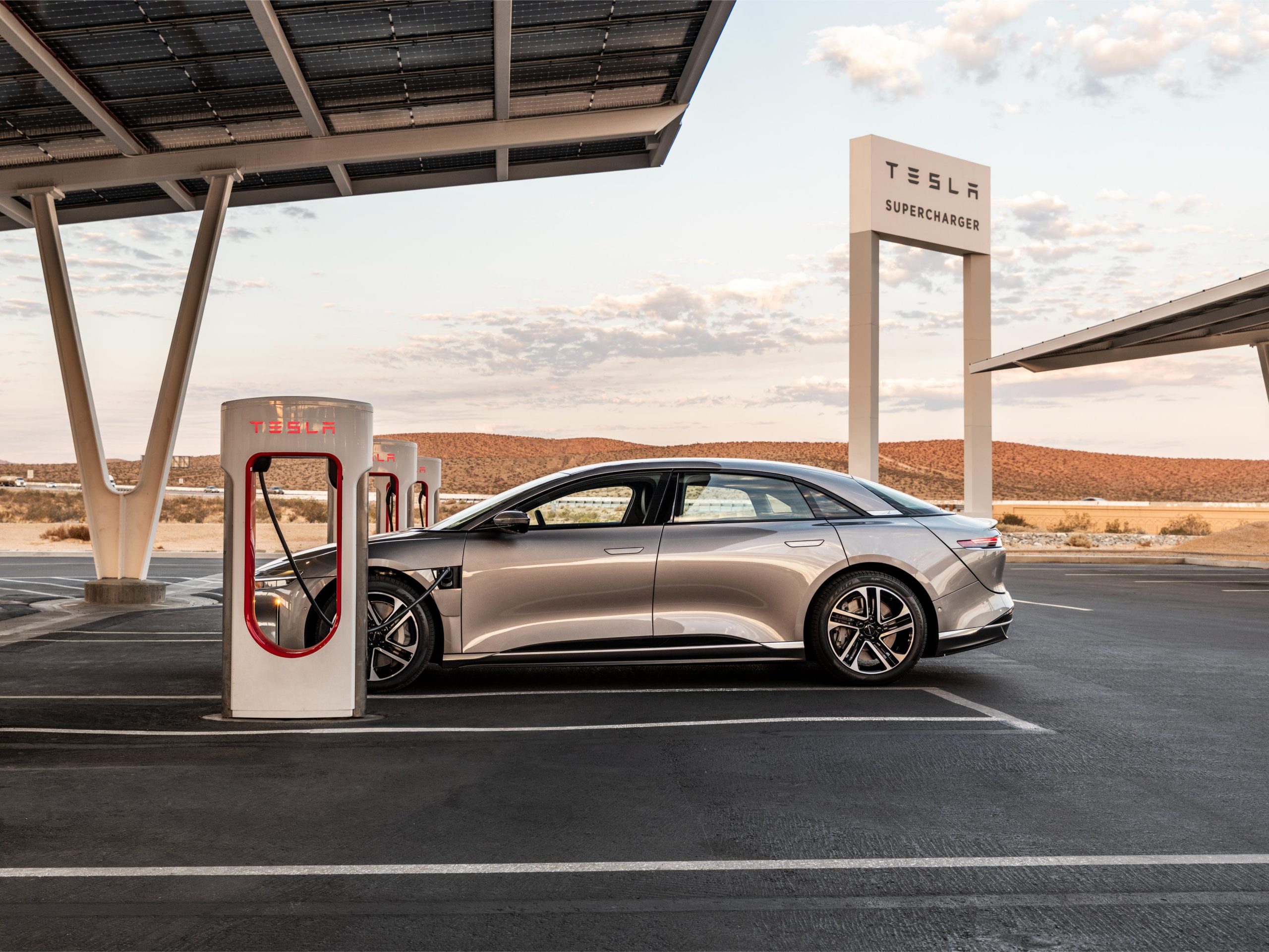
In 2025 the Supercharger network in Europe entered a new phase: Tesla started rolling out next-generation V4 hardware designed for much higher peak power per cabinet, more stalls per site, longer cables, and payment-on-post terminals — and it moved to selectively open parts of the network to non-Tesla cars either via native NACS ports on new vehicles or certified adapters. At the same time, a wave of automakers announced plans to adopt Tesla’s North American Charging Standard (NACS) or provide compatible adapters, which accelerates interoperability. The combination of higher-power V4 cabinets and broader access is reshaping the public-charging landscape in Europe: faster top-up options for compatible cars, more congestion-management challenges at popular sites, new etiquette norms, and a changing competitive dynamic for public charging operators.
This article explains the technical differences between V3 and V4 Superchargers, what NACS vs CCS compatibility means in practice, which manufacturers are joining the NACS path or adapter programs, how non-Tesla EVs can access Superchargers today, what charging speeds owners should realistically expect (given 400V vs 800V battery systems), practical trip-planning and queuing strategies, payment and billing changes, and the long-term implications for infrastructure, competition, and owners’ behavior. The goal is to give European and U.S. Tesla owners (and non-Tesla EV drivers considering Superchargers) everything they need to plan confidently for the new charging world.
1 — Why this matters now: the convergence of V4 hardware and NACS adoption
Two big trends collided in 2024–2025 and are now reshaping how drivers use fast charging:
-
V4 hardware rollout — Tesla’s V4 cabinets are designed to deliver much higher aggregate power per site (targeting ~500 kW per stall in many configurations, with very large cabinets able to support even higher aggregate outputs). The cabinets are intended to support a broader range of vehicle electrical architectures (400V and 800V) and to enable faster peak charge sessions for high-capability cars.
-
Interoperability via NACS & adapters — OEMs and some regional dealers began adopting the NACS port or promising factory-supplied or dealer-provided adapters so non-Tesla cars can plug into Tesla Superchargers. Where cars have native NACS ports, the charging experience can be nearly identical to a Tesla owner’s experience. Where adapters are needed, there are caveats (adapter certification, physical ergonomics, sometimes lower peak rates).
When combined, these trends promise faster, denser, and more broadly available DC fast charging at many Supercharger sites — but they also raise practical challenges: queuing, billing complexity across different vehicle brands, fair-use policies, and the need for different etiquette.
2 — The technical picture: V3 vs V4 and what “up to 500 kW” actually means
People see “500 kW” and assume lightning-fast full charges. The reality is more nuanced.
2.1 How V3 worked (short explainer)
-
V3 Superchargers moved Tesla from shared-power cabinets to per-stall power delivery, enabling sustained higher power peaks (commonly up to 250 kW depending on battery voltage and state-of-charge).
-
V3 reduced station-level contention since each stall could ramp independently to high rates.
2.2 What V4 brings to the table
-
Higher cabinet power: V4 introduces larger power cabinets intended to support significantly higher aggregate throughput and higher per-stall peak rates (targeting ~500 kW for certain vehicles under ideal conditions).
-
Compatibility across voltages: V4 cabinets are designed to serve both 400V and 800V battery architectures effectively, making them relevant to new cars built on 800V platforms (which can accept extremely high peak power).
-
More stalls per site: V4 also enables denser stall configurations to handle more simultaneous users.
-
Operational features: longer cables to reach plugs more easily, payment terminals at the post so non-Tesla users can pay without app friction, and better queuing/management systems.
2.3 Why “500 kW” rarely translates to continual 500 kW for your charge
-
The charging curve is shaped by battery chemistry, voltage, temperature, and the car’s battery-management system. Most cars will only take peak power for a short window (often the first few minutes) before throttling as state-of-charge rises or temperatures change.
-
800V cars (e.g., some newer performance EVs) benefit more from higher-power cabinets, because their architecture supports much higher initial currents. 400V cars usually charge slower even at a 500 kW capable cabinet because of conversion stages and thermal limits.
-
Environmental factors (cold batteries), cable length/resistance, and station configuration all affect realized power.
2.4 Practical takeaway
V4 matters — it significantly reduces the time needed for high-energy top-ups for cars that can accept it, and it raises the throughput of busy sites. But most everyday charging sessions will still be limited by the car’s battery characteristics and the practical need for only a quick top-up on long trips.
3 — NACS vs CCS: what the standards are and why carmakers are switching paths
Europe historically standardized on CCS (Combined Charging System). Tesla’s NACS (North American Charging Standard) originated as Tesla’s own connector in North America — over time it has become the de-facto Tesla interface. In 2024–2025 a wave of OEM announcements and adapter programs changed expectations.
3.1 Short primer on the two connectors
-
CCS (Combo 2 in Europe): a widely adopted European fast-charging standard used by virtually all legacy OEMs and many infrastructure operators. It’s robust, and European public chargers have long been built around CCS.
-
NACS: a smaller, sleeker connector design originating from Tesla. It’s become a preferred physical interface for some automakers because of ergonomics and adoption by Tesla’s large installed base.
3.2 Why OEMs are adopting NACS or offering adapters
-
Customer access to Superchargers: Tesla’s Supercharger network is extensive and, in many regions, the most reliable DC fast-charging option. Adopting NACS or providing an adapter opens that network to brand customers.
-
User experience: automakers want a plug-and-charge experience that rivals Tesla’s simplicity. Native ports on future vehicles reduce friction compared with adapters.
-
Competitive pressure: once a few premium brands commit to NACS, others follow to avoid customer complaints about charging access.
3.3 Policy and ecosystem implications
-
The transition creates short-term complexity (adapter logistics, billing integration), but over time it could lead to more direct competition between Supercharger-style networks and public CCS operators. In the medium term, a multi-connector landscape is likely: many sites will have both CCS and NACS options (either via dedicated sockets or adapters).
4 — Who’s on board (and how) — OEM adoption & adapter programs in 2024–2025
A rapid wave of announcements in 2024–2025 accelerated the NACS migration or adapter availability. The pattern is mixed: some automakers adopt native NACS ports on new models, others provide factory-supplied adapters, and a few partner on software integration to show Supercharger locations in their in-car maps.
4.1 Native NACS adoption
-
Several large manufacturers signaled a plan to deliver NACS ports on future EVs (tablets and press releases in 2024–2025 show a trend among premium brands to include NACS on certain models). This is the cleanest long-term path for interoperability and plug-and-charge.
4.2 Adapter programs
-
Other manufacturers promised to supply or subsidize CCS-to-NACS adapters for existing owners, while offering native NACS on future models. Adapter programs typically come with conditions (safety certification, registration, and sometimes reservation systems).
4.3 Soft launches and staged rollouts
-
Some premium brands began soft launches allowing access to Superchargers via the manufacturer’s app (and Tesla’s backend), moving toward a full plug-and-charge experience over months. That staged approach reduces integration risk and allows billing and identification flows to be proven.
4.4 Practical implications for owners
-
If you’re buying a brand-new EV that ships with a native NACS port, your Supercharger experience will likely be seamless and similar to a native Tesla user. If you plan to use an adapter, expect some manual steps and potential limitations in charge speed or user experience until full integration is implemented.
5 — How non-Tesla EVs can access Superchargers today (real, step-by-step)
Access methods vary by site and manufacturer. Here’s what non-Tesla drivers typically do now:
5.1 Native NACS-equipped vehicles
-
Plug & Charge (seamless) on compatible sites: some new vehicles with factory NACS ports support plug-and-charge flows where the car and charger authenticate automatically. Billing is handled by the car maker or through an exchange between accounts. This is the most convenient flow.
5.2 Vehicles using dealer-supplied or aftermarket adapters
-
Adapter + Tesla app or OEM app: Some manufacturers provide a certified CCS→NACS adapter. Users will connect the adapter and follow either the Tesla app or their OEM app for payment and session start. In some cases the adapter limits the peak power or requires a specific orientation to ensure safety.
-
Practical caveat: Not all adapters support the highest DC speeds, and adapters must be certified for DC fast charging. Be cautious about aftermarket adapters that aren’t explicitly approved.
5.3 Guest access via Tesla account
-
Tesla now allows certain non-Tesla vehicles access to Superchargers through the Tesla support process; you check availability on Tesla’s support page and at specific stations that have been opened to non-Tesla cars. Payment is handled through the Tesla app or the carmaker’s app per arrangement.
5.4 Using third-party roaming platforms
-
In some cases, Tesla’s charges and certain third-party CPOs integrate roaming, enabling some non-Tesla users to charge with cross-network authentication — though Tesla’s primary direct mechanism remains its own app and integration partnerships.
6 — Pricing & billing: what has changed and what owners should expect
Opening Superchargers to many OEMs introduces a billing complexity that Tesla and partners have to manage.
6.1 Tesla’s approach
-
For non-Tesla users, charging is typically billed per kWh (or per minute in jurisdictions where per kWh billing is restricted), with pricing that varies by site and local electricity/operational costs. Where plug-and-charge is enabled, billing is seamless; where apps are used, session start and stop events matter for cost.
6.2 Manufacturer-brokered billing
-
For native NACS-equipped cars, the OEM may bill the charge directly through the owner account, or it may be routed through Tesla’s billing backend with a settlement to the automaker. This is the model many manufacturers are standardizing toward.
6.3 Reservation, idle fees and fair-use
-
To manage congestion, Tesla increasingly pilots reservation systems and idle fees (charging for occupying a charger after a session completes). Expect to see more dynamic station rules (e.g., idle fees, time limits during peak hours) applied more broadly as non-Tesla demand rises.
6.4 Pricing expectations for drivers
-
Non-Tesla drivers using Superchargers should budget rates comparable to other network DC fast chargers, with site-to-site variability. In high-demand locations, prices can be higher.
7 — Real-world charging speeds: what to expect by car architecture
Charging speed depends more on the car and battery than merely on charger capability.
7.1 400V battery systems (majority of current EVs)
-
Many modern EVs still use 400V systems. Even when connected to a 500 kW-capable V4 stall, most 400V cars will be limited by their converters and battery chemistry — typical peak rates might remain in the 100–250 kW range depending on the car.
7.2 800V battery systems (emerging performance and luxury EVs)
-
Cars designed for 800V architectures (e.g., some recent performance models) can make much better use of high-power cabinets, sustaining very high peak rates for longer and significantly shortening top-up times.
7.3 Battery state-of-charge, temperature and heat management
-
Real-world achievable kW varies by battery temperature and current SOC. Cold batteries will accept far less power; charging speed typically tapers off above ~60–70% SOC.
7.4 Practical route planning implications
-
For long trips, plan to charge early (top-off to 70–80% rather than chasing a 90–100% fill), use mid-line stops where V4 is present for the fastest top-ups, and avoid full charges on congested sites where late-session tapering makes long stays inefficient.
8 — Site design, queuing and etiquette: how behavior must adapt
With more non-Tesla cars arriving at Superchargers and more powerful stalls, user behavior becomes critical to keep throughput high.
8.1 Reservation systems and etiquette
-
Where available, use reservation properly. Don’t hog a stall beyond your session (idle fees may apply). Move your car once charging completes or when you reach a planned threshold (e.g., 80%). If a site is full, be courteous and avoid blocking access or splicing into pairs.
8.2 High-power fairness
-
If you’re in a low-capacity vehicle and someone with an 800V car has a short, urgent top-up, it’s courteous to offer to swap when sessions are short; conversely, don’t queue a huge battery fill during peak times.
8.3 Adapter etiquette
-
If using an adapter, ensure it’s stowed neatly when not in use and be mindful of cable routing so you don’t block aisleways or create tripping hazards.
8.4 Charging times & parking
-
Use public lots or nearby parking if you need to wait for someone who’s charging; don’t leave your car occupying a high-speed stall for long non-charging errands.
9 — Planning tools and apps: the practical toolkit
Make the new Supercharger world easier with these steps and tools:
9.1 Use official maps first
-
Tesla’s map has the most up-to-date Supercharger live-stall data for Tesla owners. Some OEM apps are integrating Supercharger locations too as they roll out native NACS support.
9.2 Trip planner best practices
-
For long trips, route through confirmed V4-capable sites if you drive an 800V vehicle. If you drive a 400V car, a dense network of V3/CCS sites can be sufficient and sometimes more available.
9.3 Keep an adapter (if certified) in the trunk only if you’re approved to use it
-
If your manufacturer offers a certified adapter, learn the correct usage and storage method. Use only manufacturer-approved adapters for safety and warranty reasons.
9.4 Watch live occupancy
-
High-traffic sites often show live occupancy indicators in-apps; use them to minimize queuing. If a site is full, shift to slightly out-of-the-way sites with lower congestion.
10 — Reliability, maintenance and availability: what’s changing for owners
Supercharger reliability has historically been high relative to public charging networks, but expanded access and denser use introduce operational pressures.
10.1 More users = more wear & more maintenance demand
-
Higher throughput and different connector use patterns (with adapters) increase maintenance needs. Tesla’s remote monitoring and predictive maintenance capabilities help mitigate downtime, but expect more scheduled and unscheduled maintenance episodes as volumes grow.
10.2 Redundancy & site design
-
V4’s higher cabinet power and more stalls help by increasing throughput, but redundancy planning (having multiple cabinets or pairing with nearby chargers) remains key to avoiding single-pain-point outages.
10.3 What owners can do
-
Report broken stalls promptly via the app, follow posted rules, and consider backup sites in trip plans.
11 — Competition & the charging ecosystem: how Superchargers affect other operators
Opening Superchargers to more OEMs accelerates competition in public charging.
11.1 Public networks will respond
-
Networks like Ionity, Fastned, and others will adjust pricing, speed offerings and amenities. Expect more dynamic pricing, loyalty incentives, and partnerships to keep customers.
11.2 Retail & site amenities
-
Charging site quality (shelter, restrooms, on-site stores) becomes a differentiator as drivers choose where to stop for their charging session.
11.3 Long-term market structure
-
The big question is whether Tesla’s network will remain service-dominant in Europe or whether public networks will aggressively expand capacity and partner integrations to level the playing field. For now, Tesla retains a built advantage in many corridors.
12 — Case studies: sample routes and how V4+NACS changes the trip
To make it practical, here are two short case studies showing different vehicle architectures and trip planning choices.
12.1 Case A — 800V performance EV (long-distance express trip)
-
Profile: 800V car, likes short stops.
-
Strategy: Route via V4-capable Superchargers. Expect single-stop top-ups that add 200+ km of range in ~10–15 minutes under ideal conditions. Use plug-and-charge where available for speed and simplicity.
12.2 Case B — 400V family EV (long-distance, errand-including stops)
-
Profile: 400V car owner traveling in family convoy.
-
Strategy: Accept longer charge times. Use denser network of chargers (Mixture of Superchargers and CCS operators). Aim for longer stops with amenities. Be mindful of queuing; avoid peak times if possible.
These examples show why V4 benefits some vehicles enormously and other vehicles only moderately.
13 — Practical checklist for Tesla owners (what to do now)
-
If you drive a Tesla: confirm whether your car supports V4 and which sites near you are V4-enabled. Update the Tesla app to see live status. Learn the new idle-fee and reservation policies at busy sites.
-
If you drive a non-Tesla with native NACS: verify plug-and-charge credentials and billing setup in your OEM app prior to a trip.
-
If you rely on an adapter: only use manufacturer-approved adapters; carry them properly and be ready for slower or manual start flows.
-
Trip planning: pick V4 sites for short stops if you have an 800V car; otherwise plan for conservative charge times and alternate sites.
-
Etiquette: move your car promptly when charging finishes, avoid long fills during peak times, and use the app to inform others of session completion if allowed.
14 — Policy, regulation and standardization: the unresolved pieces
European charging historically centers on CCS. The spread of NACS creates questions for regulators and standard bodies:
14.1 Certification & safety
-
Adapters for DC fast-charging must meet strict certification: misuse or poor adapters pose safety risks. Regulators and OEMs are working to ensure approved adapters comply with DC charging standards.
14.2 Billing and Roaming interoperability
-
Cross-vendor billing requires secure identity and settlement systems. The industry is moving toward standardized roaming frameworks, but integration across many OEMs and networks takes time.
14.3 Infrastructure planning
-
National and local planners must accommodate higher-power cabinets (grid upgrades, transformer capacity, and planning permits). V4 deployments may require additional grid reinforcement at some sites, which prolongs build timelines.
15 — The economics: costs, ROI and who pays for grid upgrades
High-power charging is expensive to install and to operate. Behind every V4 cabinet are significant grid and equipment costs.
15.1 Cost drivers
-
Power cabinet costs, civil works, site acquisition, and grid connection fees are the main capital expenses.
-
Operational costs include electricity at high demand times, station maintenance, and network management.
15.2 Who pays?
-
For Tesla, the network historically is vertically integrated as part of customer value. Opening stations to others introduces new revenue streams (charging fees for non-Tesla users), but also higher maintenance and coordination costs.
15.3 ROI considerations
-
Operators (including Tesla) evaluate ROI based on throughput, customer loyalty uplift, ancillary retail sales and possible partnership revenues. In high-traffic corridors V4 makes clear economic sense; in rural low-traffic areas it may not.
16 — Long-term outlook: what the next 3–5 years may look like
-
Normalization of multi-connector sites: Expect a gradual normalization where many major sites support both CCS and NACS (native or via certified adapters).
-
Faster trip times for compatible cars: 800V adoption grows and drivers benefit from short top-ups at V4 sites.
-
More sophisticated congestion management: reservations, dynamic pricing, and idle fees become mainstream to manage utilization.
-
Stronger competition: public networks respond with better speeds, improved amenities, and integrated roaming to protect their customer base.
-
Grid & policy responses: utilities will implement managed charging and demand-side measures to accommodate high-power demands.
17 — Frequently asked questions (concise answers)
Q: Can every EV charger at a V4 Supercharger take 500 kW?
A: No. The charger might be capable, but your car’s battery architecture, state-of-charge and temperature largely determine how much of that power it will accept.
Q: Will adapters damage my car or the Supercharger?
A: Certified OEM adapters should be safe. Do not use uncertified or homemade adapters for DC fast charging.
Q: Will Supercharger access mean CCS networks become obsolete?
A: No. CCS networks will remain critical, and many regions will see co-existence. CCS-based public operators will continue to serve vehicles without NACS or adapters.
Q: Are Superchargers free for non-Tesla cars?
A: No. Non-Tesla users will be billed per session or kWh, typically at competitive DC fast charging rates.
Q: Will my Tesla app still work if I use Superchargers in another country?
A: Yes — Tesla’s in-app functionality is global for Tesla owners; platform features for non-Tesla cars depend on OEM integrations in each market.