
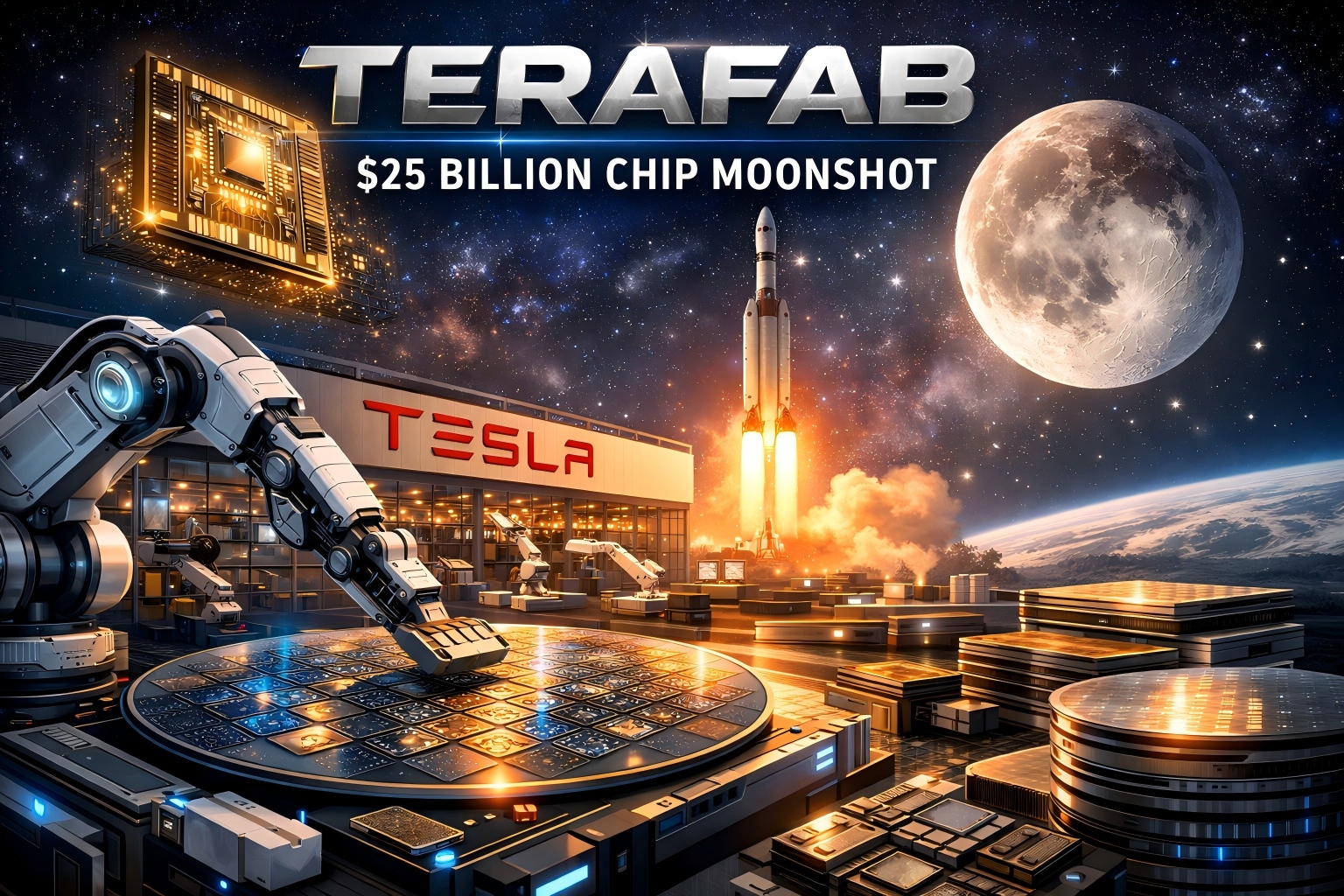
Introduction: The Night Elon Musk Decided to Build the Largest Chip Factory on Earth
On a warm evening in late March 2026, inside Austin’s decommissioned Seaholm Power Plant, Elon Musk stood beneath beams of light cutting through the darkness and made an announcement that would send shockwaves through Silicon Valley, Wall Street, and semiconductor manufacturing hubs from Taiwan to Arizona. The venue was deliberate: a retired industrial facility, once a symbol of Austin’s energy past, now repurposed as the stage for what Musk described as “the most ambitious manufacturing project in human history”.
Terafab—the name itself a deliberate escalation from Gigafactory—represents a fundamental pivot in Musk’s industrial strategy. For years, Tesla has relied on established chipmakers like TSMC, Samsung, and Micron to supply the silicon that powers its vehicles, its Dojo supercomputer, and its artificial intelligence ambitions. No longer. Standing before an audience that included Texas Governor Greg Abbott, Musk delivered a stark ultimatum: “We either build Terafab or we don’t have the chips”.
The numbers attached to this declaration are almost incomprehensible. Terafab targets annual production of 1 terawatt of computing capacity—a figure that dwarfs the approximately 0.5 terawatts generated annually across the entire United States electrical grid. The facility aims to produce between 100 billion and 200 billion chips per year using 2-nanometer process technology, a node so advanced that currently only TSMC has demonstrated it at scale. Musk projects that 80% of this output will be destined for space-based applications, powering AI data centers in orbit, while the remaining 20% will serve terrestrial needs: Tesla vehicles, Optimus humanoid robots, and xAI’s machine learning infrastructure.
Chapter 1: Terafab Unveiled – What Musk Actually Announced
The March 21 Event
The Seaholm Power Plant event was characteristic Musk: theatrical, light on specific timelines, and heavy on sweeping ambition. The choice of venue was symbolic—a repurposed industrial space representing the transformation of energy infrastructure, now being repurposed for computing infrastructure. Musk shared the stage with Texas Governor Greg Abbott, underscoring the political and economic significance of the project for the state.
What made this announcement different from previous Musk spectacles was the degree of cross-company integration. Terafab is explicitly framed as a joint venture between Tesla, SpaceX, and xAI—the first time Musk has formally united his three major enterprises under a single industrial initiative. This unification is critical to understanding the project’s scope: Terafab is not merely a Tesla chip factory; it is the manufacturing backbone for Musk’s entire ecosystem, from Earth-bound robots to orbital AI data centers.
Physical Location and Scale
Terafab will occupy the North Campus of Giga Texas, a site that has been under preparation for months. Drone footage captured throughout late 2025 and early 2026 revealed massive earth-moving operations just north of the existing Gigafactory, on a scale comparable to the original Giga Texas footprint. Permit documents filed with Travis County on March 13, 2026, indicate that Tesla is seeking approval for over 5.2 million square feet of new building space.
The initial phase calls for a 2-million-square-foot research-and-development facility adjacent to the existing factory, with full-scale development eventually requiring “thousands of acres”. Construction activity visible north of the current facility includes ground clearing, soil reclamation, and infill operations—early-stage work consistent with major foundation pours.
Technical Specifications
The technical targets Musk outlined are breathtaking in their ambition:
Process Technology: 2-nanometer node production. Currently, TSMC is the only company in the world that has achieved 2nm production at scale, a capability that required decades and hundreds of billions of dollars in research and development.
Production Capacity: Initial target of 100,000 wafer starts per month, with ambitions to scale to 1 million wafer starts per month at full capacity. To put this in perspective, a typical leading-edge fab operates at 50,000 to 100,000 wafers per month; Musk is proposing a facility that would eventually produce ten times that volume.
Annual Chip Output: 100 billion to 200 billion chips per year.
Computing Capacity: 1 terawatt annually—approximately 50 times current global chip production capacity.
Facility Structure: Terafab is designed as a 10-module facility, with each module capable of handling 100,000 chips per month. The architecture integrates logic chip fabrication, memory production, advanced packaging, mask making, and testing under a single roof—an integration Musk claims “nobody in the world has attempted”.
Two Chip Classes
Musk specified that Terafab will produce two distinct classes of chips:
Class One: Terrestrial-Optimized Chips
These chips will power Tesla vehicles and Optimus humanoid robots. The first generation will be the AI5 chip, which Musk previously indicated would be manufactured by TSMC and Samsung for near-term capacity, with Terafab eventually taking over mass production. A subsequent AI6 chip is also in development. These chips are optimized for edge inference—the computational work required for autonomous driving decisions and robot operations.
Class Two: Space-Optimized Chips
These chips are designed for the harsh environment of space, where radiation, temperature extremes, and vacuum conditions impose unique constraints. Musk noted that space chips must “operate at higher temperatures” to reduce thermal management weight and withstand high-energy particle bombardment. During the presentation, Musk displayed a concept rendering of a 100-kilowatt AI micro-satellite, suggesting that future space-based AI infrastructure could scale to megawatt-level satellites.
The allocation between these classes reflects Musk’s long-term vision: roughly 20% of Terafab’s output will serve Earth-based applications, while 80% will be deployed in space.
Chapter 2: The Strategic Rationale – Why Musk Believes He Has No Choice
The Supply Chain Argument
Musk’s core argument for Terafab is deceptively simple: existing chip suppliers cannot meet his companies’ projected demand. “Even under optimistic expansion scenarios,” Musk stated during the January 2026 earnings call, “the world’s fabs can’t keep up with what we need”. At the Terafab event, he elaborated: “Semiconductor manufacturers are expanding, but the speed is far below what we expect”.
The numbers Musk cites are striking. He estimates that current global AI chip production is approximately 20 gigawatts annually—about 2% of what he calculates his companies will require. “Either we build Terafab, or we don’t have the chips,” Musk said flatly.
This argument extends beyond Tesla’s immediate needs. Musk envisions a future where:
-
Optimus humanoid robots ultimately reach annual production volumes of 10 million to 1 billion units—10 to 100 times current global automobile production.
-
Tesla vehicles continue scaling toward 20 million units annually, each requiring increasing onboard compute for autonomy.
-
xAI’s infrastructure demands massive training clusters for foundation models.
-
SpaceX’s satellite constellation evolves into orbital AI data centers, with the company having filed with the FCC for permission to launch 1 million data-center satellites.
The Vertical Integration Imperative
Terafab represents the logical endpoint of Musk’s vertical integration philosophy. Tesla already manufactures its own batteries, drivetrains, and much of its vehicle structure. The company designs its own chips (the AI5, for example) but has traditionally relied on foundries for fabrication. Terafab would close the loop: design, fabrication, packaging, and testing under one roof.
Musk emphasized that this integration enables a “recursive iteration loop” that conventional chip manufacturing cannot match. When design, manufacturing, and testing are co-located, the cycle time for improvements compresses dramatically. “The speed of iteration could be an order of magnitude faster than anywhere else,” Musk claimed.
The Cleanroom Controversy
Perhaps the most controversial aspect of Musk’s manufacturing philosophy is his proposed approach to cleanroom standards. Traditional semiconductor fabs maintain extremely strict environmental controls because microscopic particles can destroy delicate chip features. Musk has suggested that Terafab could employ a different approach—a “wafer isolation” concept that would allow less stringent cleanroom standards. In characteristically provocative fashion, Musk joked that the facility might allow workers to “eat cheeseburgers and smoke cigars” inside.
Industry experts reacted with skepticism. NVIDIA CEO Jensen Huang, when asked about Terafab, noted that building advanced chip factories “is not that easy” and suggested that matching TSMC’s yield rates would be “almost impossible”. EUV lithography machines—critical for 2nm production—are extraordinarily sensitive to environmental contaminants, and the machines themselves are back-ordered through 2027
Chapter 3: The Terafab Numbers – What 1 Terawatt Actually Means
Understanding the Scale
To grasp the magnitude of Musk’s ambition, it helps to unpack what 1 terawatt of computing capacity represents.
Context: The United States’ total electricity generation capacity is approximately 0.5 terawatts. Musk is proposing a chip factory whose annual output equals twice the nation’s entire electrical grid capacity.
Comparison to Existing Capacity: Current global chip production capacity is estimated at about 20 gigawatts annually. Terafab’s 1 terawatt target represents a 50-fold increase over current global capacity.
Per-Wafer Economics: A typical 2nm wafer costs between $20,000 and $30,000. At 100,000 wafers per month, the annual wafer value would be $24–36 billion. At the 1-million-wafer-per-month target, the numbers reach $240–360 billion annually—comparable to the entire global semiconductor industry’s current revenue.
Investment Requirements
Building a leading-edge semiconductor fab requires staggering capital. JPMorgan estimates that constructing a 100,000-wafers-per-month 2nm facility costs between $50 billion and $60 billion at current prices. Terafab’s announced investment target of $20–25 billion appears low by these standards.
Morgan Stanley’s semiconductor analysts described the challenge as “Herculean” in a research note following the announcement. The gap between Terafab’s stated investment and industry benchmarks raises immediate questions:
-
Is the $20–25 billion figure for the initial phase only? Musk has not clarified whether this covers the full 10-module vision or just the initial 2-million-square-foot R&D facility.
-
How will Tesla finance this? Tesla’s 2026 capital expenditure guidance was already increased to approximately $20 billion. Terafab would require significant additional spending at a time when Tesla is funding multiple ambitious growth projects simultaneously.
-
What about EUV equipment? High-NA EUV lithography machines, required for advanced nodes, are manufactured exclusively by ASML. Lead times stretch 12–24 months, and new customers typically wait longer.
Timeline Questions
Musk provided no specific timeline for Terafab’s construction or production ramp. The targets he has mentioned include:
-
AI5 mass production: Mid-2027 (with initial production through TSMC and Samsung)
-
Terafab initial capacity: 2027 target for 100,000 wafers per month
-
Full capacity: 2029 target
Industry observers note that semiconductor fabs typically take 3–5 years from groundbreaking to volume production. The fact that Tesla has not yet broken ground—site preparation is visible, but foundation work is still in early stages—suggests that 2027 production targets are extremely aggressive.
Chapter 4: The Execution Challenge – Why Terafab Faces Skepticism
The Talent Gap
Tesla has never manufactured semiconductors. The company has chip design expertise—the AI5 and Dojo teams are highly capable—but fabrication is an entirely different discipline. Semiconductor manufacturing requires specialized engineers with experience in process development, equipment operation, materials science, and yield management.
Bernstein semiconductor analyst Stacy Rasgon captured the industry’s skepticism: “Because it’s Musk, I won’t dismiss it out of hand. But I suspect this is actually harder than putting a rocket on Mars”. Rasgon pointed to TSMC’s Arizona fab as a cautionary tale: the project required years of delays and the importation of engineers from Taiwan to support production ramp. “These talents don’t grow on trees,” Rasgon said.
Technology Concentration
Advanced semiconductor manufacturing is one of the most concentrated industries on Earth. Only three companies have production-validated advanced process nodes: TSMC, Intel, and Samsung. Musk is proposing to build a facility that would leapfrog decades of cumulative learning.
JPMorgan’s analysis of Terafab’s potential impact identified three primary obstacles:
-
Technology Concentration: Advanced process technology is highly concentrated among incumbents. Even IBM, a pioneer in semiconductor research, only offers laboratory-level roadmaps—not production-ready processes.
-
Engineering Accumulation: The transition from process development to mass production requires extensive engineering across the supply chain: equipment, EDA tools, materials, and chemicals. Each of the hundreds of manufacturing steps carries yield consequences.
-
Capital Intensity: A 100,000-wafer-per-month 2nm fab requires $50–60 billion in investment, with continuous R&D spending required to maintain technological leadership across generations.
The Learning Curve
Semiconductor manufacturing innovations—FinFET, gate-all-around, EUV lithography—typically require 15–20 years to transition from laboratory research to mass production. JPMorgan noted that whether this timeline can be compressed is “the critical variable” for Terafab’s viability.
Musk has a track record of compressing development cycles in industries—automotive manufacturing, space launch, battery production—where incumbents had grown complacent. But semiconductor fabrication operates at physical limits that may be less forgiving. The laws of physics governing electron tunneling at 2nm geometries do not yield to willpower, no matter how intense.
Chapter 5: The Space Connection – Why 80% of Terafab’s Output Is Destined for Orbit
The Thermal Argument
One of the most unexpected elements of Musk’s Terafab announcement was the revelation that 80% of the facility’s output would be deployed in space. The reasoning combines thermal physics with economic logic.
“In space, there’s no atmosphere,” Musk explained. “You can run chips at much higher temperatures without the constraints of terrestrial cooling systems”. This allows chips to be designed without the extensive thermal management infrastructure required on Earth—reducing weight, complexity, and cost.
The Solar Energy Advantage
Space-based solar arrays receive 5–10 times the solar energy of ground-based panels, with no night cycles, weather interruptions, or seasonal variations. Musk calculates that within two to three years, “the cost of deploying AI chips in space will fall below the cost of terrestrial deployment”.
This cost crossover, if achieved, would fundamentally alter the economics of AI infrastructure. Data centers currently consume enormous amounts of electricity and require extensive cooling. Moving computation to orbit would:
-
Eliminate cooling costs
-
Reduce energy costs through superior solar access
-
Bypass terrestrial land-use constraints and NIMBY opposition
-
Enable true global coverage for latency-sensitive AI applications
The SpaceX Integration
Terafab’s space focus aligns with SpaceX’s strategic direction. The company is preparing for what could be the largest IPO in history—Bloomberg reports a potential $50 billion fundraising at a valuation exceeding $1.75 trillion. The core investment thesis for this IPO is the deployment of orbital AI data centers.
SpaceX’s recent acquisition of xAI (Musk’s artificial intelligence company) now appears in a new light. xAI will be the primary consumer of Terafab’s space-bound chips, running AI models on orbital infrastructure. The integration creates a closed loop: Terafab manufactures chips, SpaceX launches them, xAI operates them.
The Lunar Ambition
Musk did not stop at orbital deployment. During the Terafab presentation, he outlined a longer-term vision for achieving petawatt-scale computing—1,000 times Terafab’s target. The mechanism? A lunar electromagnetic mass driver.
“On the Moon, gravity is one-sixth of Earth’s, and there’s no atmosphere,” Musk explained. “You can use electromagnetic acceleration to launch payloads directly into deep space without rockets”. This would enable the deployment of AI satellites at costs far below anything possible from Earth.
Musk acknowledged the futuristic nature of this vision, joking that it “starts to look like the opening of Idiocracy”. But the fact that he included it in the Terafab announcement signals that he considers it not a distant fantasy but a logical extension of the trajectory he is charting.
Chapter 6: Market and Competitive Implications
Impact on TSMC and Incumbents
JPMorgan’s analysis concluded that Terafab’s probability of substantially impacting TSMC in the near term is “low”. The reasoning centers on the long switching cycles in semiconductor supply chains:
-
Chip design cycles take 2–3 years
-
Production ramp adds another 1–2 years
-
Total switching time spans 3–5 years with extremely high transition costs
Even if Terafab executes perfectly, it would take years to reach volumes that challenge incumbents. In the meantime, TSMC continues expanding: N3 capacity is projected to reach 165,000–170,000 wafers per month by year-end, with N2 capacity targeting 100,000 wafers per month by late 2026.
The AI5 Bridge Strategy
Notably, Tesla is not waiting for Terafab to secure AI5 supply. The AI5 chip will initially be manufactured by TSMC’s Arizona facility and Samsung’s Taylor, Texas facility, with small-batch pilot production expected in 2026 and mass production targeted for mid-2027. This dual-track approach provides insurance: Terafab represents the long-term vision, while established foundries supply near-term needs.
Financial Market Reaction
Equity markets responded to the Terafab announcement with cautious optimism. Tesla shares saw modest gains following the March 21 event, but analysts remain divided on the capital allocation implications.
The key question for investors is whether Terafab represents a visionary long-term investment or a distraction from Tesla’s core automotive business. With Tesla already funding Cybertruck ramp, next-generation vehicle platforms, and Optimus production, adding a multi-billion-dollar semiconductor fab stretches the company’s financial capacity.
Conclusion: The Moonshot Logic of Terafab
Terafab is either the most ambitious industrial project of the 21st century or a classic Musk overreach—and at this stage, it is impossible to know which. What is clear is the underlying logic: Musk believes that the convergence of AI, robotics, and space-based infrastructure will require computing capacity that current industry roadmaps cannot supply. His solution is to build that capacity himself.
The obstacles are formidable. Tesla has no semiconductor manufacturing experience. The capital requirements exceed the company’s current investment capacity. The technology is concentrated among incumbents who have spent decades and hundreds of billions perfecting their processes. And the timeline Musk has suggested—initial production in 2027—appears optimistic by any conventional measure.
Yet Musk has a history of succeeding in industries where incumbents told him he could not. Electric vehicles, reusable rockets, mass-market battery production—in each case, Musk proved skeptics wrong. Semiconductor manufacturing may be the hardest technical challenge he has tackled, but it would be unwise to dismiss the possibility that he makes progress where others see impossibility.
For Tesla owners, Terafab represents a bet on the future value of their vehicles. If Musk succeeds, future Tesla cars will have access to custom-designed chips that optimize for autonomy in ways that commodity silicon cannot match. If Terafab fails, the financial cost could be substantial, but the AI5 supply secured through TSMC and Samsung ensures that Tesla’s near-term product roadmap remains intact.
In the end, Terafab is quintessential Musk: audacious, expensive, technically dubious to experts, and potentially transformative if it works. Whether it becomes another Gigafactory success story or another SolarCity-style cautionary tale remains to be written. What is certain is that the semiconductor industry—and anyone watching the future of computing—will be watching Austin closely over the next several years.
Frequently Asked Questions
Q: When will Terafab begin producing chips?
A: Musk has not provided a specific production timeline. The target is initial 2nm production in 2027, with full capacity aimed for 2029. However, site preparation is still in early stages, and semiconductor fabs typically take 3–5 years from groundbreaking to volume production.
Q: How much will Terafab cost?
A: The announced investment target is $20–25 billion. Industry analysts estimate that a 100,000-wafer-per-month 2nm fab typically requires $50–60 billion, suggesting the announced figure may represent initial-phase investment only.
Q: Will Terafab affect Tesla vehicle deliveries?
A: Not directly. Tesla’s near-term chip needs will be met by TSMC and Samsung, who are manufacturing the AI5 chip for initial production. Terafab represents a long-term capacity solution.
Q: Why is SpaceX involved in a chip factory?
A: Terafab is a joint venture between Tesla, SpaceX, and xAI. Approximately 80% of the facility’s output is intended for space-based applications—AI data centers in orbit, powered by SpaceX launch capabilities and operated by xAI.
Q: Is 2nm chip manufacturing actually feasible for a new entrant?
A: The technical challenges are immense. Only TSMC has demonstrated 2nm production at scale. Intel and Samsung are working to catch up. Tesla has no semiconductor manufacturing experience, and the industry’s learning curve spans decades.
Q: What happens if Terafab fails?
A: Tesla has a contingency plan. The AI5 chip is being manufactured by TSMC and Samsung for near-term needs. Terafab failure would likely result in significant financial write-downs but would not immediately impact vehicle production.