
Introduction
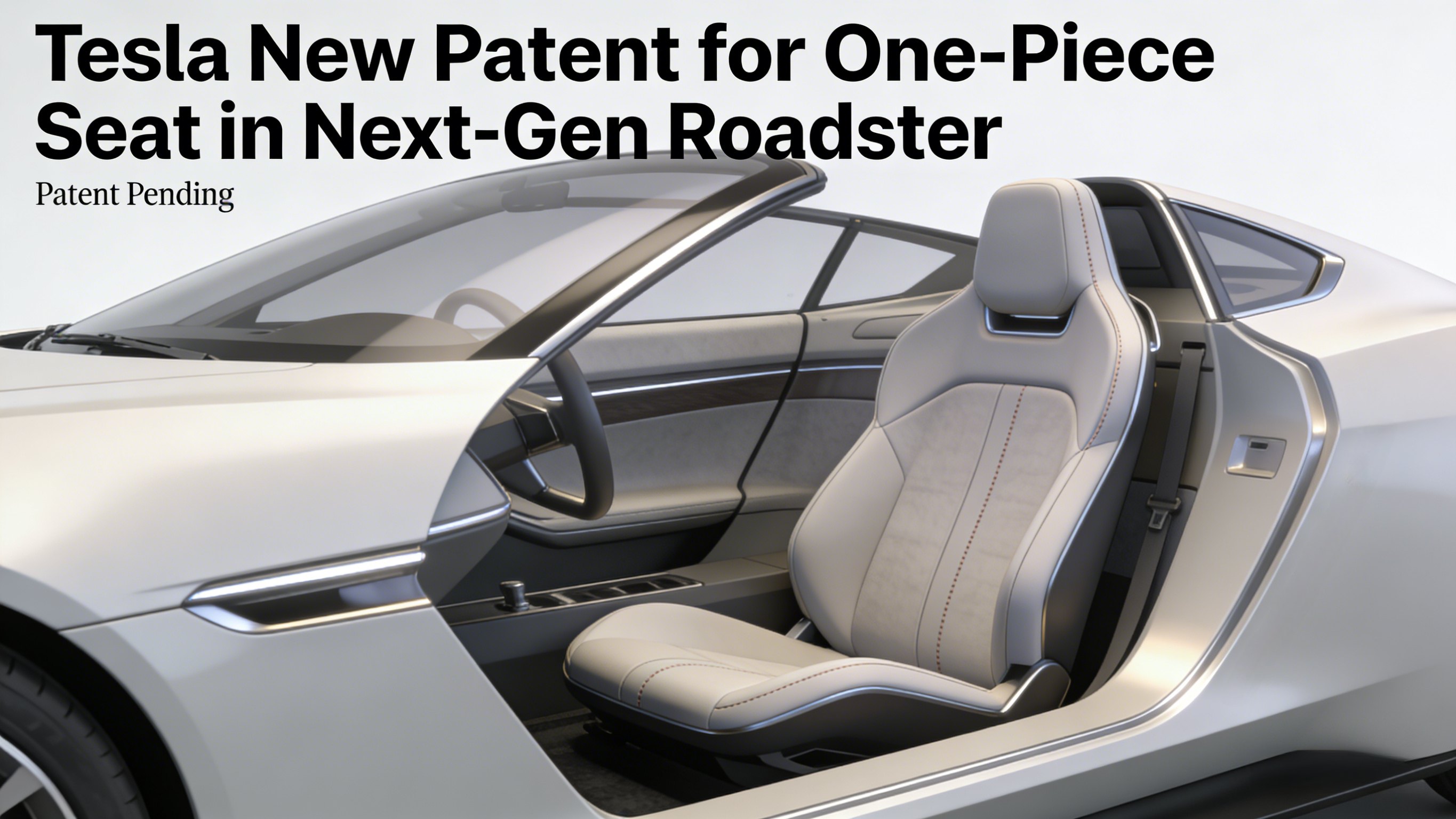
Innovation has always been at the heart of Tesla's ethos, pushing the boundaries of what's possible in electric vehicle design. Today, March 5, 2026, Tesla has unveiled a groundbreaking patent that could redefine automotive seating, particularly for high-performance vehicles like the next-generation Roadster. The patent, numbered US20260061898A1 and titled "Vehicle Seat System," describes a monolithic, one-piece composite seat frame that integrates the seat base, backrest, headrest, and side bolsters into a single continuous structure. This design marks a significant extension of Tesla's "megacasting" philosophy, which has already revolutionized chassis production by creating large, single-piece castings to reduce weight, complexity, and manufacturing costs. By applying this concept to interior components, Tesla aims to create lighter, more efficient vehicles that enhance performance without compromising comfort or safety.
For Tesla owners in the US and Europe, this patent is more than just a technical filing—it's a glimpse into the future of ownership. The next-gen Roadster, long anticipated since its 2017 prototype unveiling, is poised to be a halo vehicle showcasing Tesla's cutting-edge engineering. Elon Musk has teased an "unforgettable" demo for the Roadster on April 1, 2026, with production slated to begin in 2027. This seat patent arrives amid a flurry of activity, including two new trademarks filed in February 2026 for an updated Roadster wordmark and stylized silhouette, signaling that the supercar is finally nearing reality after years of delays. Priced around $200,000 to $250,000, the Roadster targets enthusiasts who crave blistering acceleration—0-60 mph in under 1.9 seconds (potentially sub-1 second with the optional SpaceX package)—a top speed over 250 mph, and a staggering 620-mile range from a 200 kWh battery.
The megacasting approach, first popularized in Tesla's Model Y and Cybertruck with massive aluminum castings for underbody structures, eliminates hundreds of welds and parts, streamlining assembly and improving structural integrity. Extending this to seats addresses a often-overlooked area: traditional automotive seats comprise over 13 major part groups, including metal frames, brackets, recliner mechanisms, and rivets, which add unnecessary weight and potential failure points. Tesla's one-piece design uses advanced composites like carbon-nylon or Kevlar-nylon, thermoformed into a unified frame that is both lightweight and robust enough to withstand hypercar-level forces. This not only reduces mass—critical for a vehicle aiming for record-breaking performance—but also minimizes noise, vibration, and harshness (NVH), enhancing the driving experience.
In the context of the Roadster, this innovation is particularly apt. The original 2017 prototype promised mind-bending specs: 7,376 lb-ft of wheel torque from a tri-motor all-wheel-drive setup, a 1/4-mile time of 8.8 seconds, and seating for four in a 2+2 configuration with a removable glass roof. However, delays stemmed from supply chain issues, battery advancements, and prioritization of mass-market models. Now, with the patent's focus on interior efficiency, the Roadster could offer more cabin space in its low-slung profile, making it practical for daily use while delivering supercar thrills. For European owners, where stringent emissions regulations push EV adoption, this means a vehicle that complies with EU safety standards while appealing to performance purists in markets like Germany and the UK.
Broader industry trends amplify the patent's significance. As EVs evolve, weight reduction is paramount to maximize range and efficiency. Competitors like Rimac and Lucid are exploring similar composite technologies, but Tesla's vertical integration—from material sourcing to software control—gives it an edge. The seat's "six-degree-of-freedom" adjustment system, powered by linear actuators and coordinated via software, aligns with Tesla's software-defined vehicle paradigm, allowing over-the-air updates for personalized ergonomics. Imagine adjusting your Roadster's seats for optimal support during a track day or relaxed cruising on the Autobahn, all via the touchscreen.
For US owners, this patent underscores Tesla's commitment to domestic innovation, with production likely at Fremont or a new facility, boosting local jobs and supply chains. In Europe, Giga Berlin's expansion could incorporate these seats, ensuring regional compliance with REACH regulations on materials. Amid Tesla's 2026 lineup, including Cybercab robotaxis and refreshed Model 3/Y, the Roadster stands as a testament to pure performance engineering. This patent isn't isolated; it builds on prior filings, like a curved portrait touchscreen for the Roadster's interior from 2024 and aerodynamic "ground effect" systems banned from Formula 1.
As we delve deeper, this article will explore the patent's technical intricacies, the Roadster's developmental journey, performance and safety implications, market positioning, and a forward-looking conclusion. Whether you're a Tesla blogger, owner, or enthusiast, understanding this innovation reveals how Tesla continues to disrupt, one component at a time.
Section 1: Patent Technical Details
Diving into the nitty-gritty of patent US20260061898A1, Tesla's "Vehicle Seat System" represents a paradigm shift in seat design, moving away from modular, metal-heavy constructions to a seamless, composite-based architecture. The core innovation is a monolithic frame where the seat pan, backrest, headrest, and lateral bolsters are formed as one continuous piece through thermoforming processes. This eliminates the need for assembly of disparate parts, which in conventional seats include steel or aluminum frames bolted together with hinges, sliders, and adjusters.
Technically, the frame is crafted from high-strength composites such as carbon fiber reinforced nylon (carbon-nylon) or aramid fiber like Kevlar blended with nylon, chosen for their exceptional tensile strength-to-weight ratios—up to 5 times stronger than steel while being 70% lighter. For cost-sensitive applications, the patent suggests fiberglass-nylon variants, allowing scalability across Tesla's lineup. The thermoforming process involves heating the composite sheet to a pliable state, then molding it under pressure into the desired ergonomic shape, ensuring uniform material distribution and minimal defects.
A standout feature is the "living hinge," a flexible zone created by varying the composite's thickness and fiber orientation along the seat's pivot axis. This mimics the human spine's natural flexion, providing reclining functionality without mechanical gears or motors that add weight and complexity. Traditional recliners can weigh several kilograms and introduce wear points; Tesla's design distributes stress evenly, enhancing durability under high G-forces, such as those experienced in the Roadster's sub-2-second launches.
Adjustment mechanisms are equally revolutionary. The patent outlines a "six-degree-of-freedom" system using four pairs of linear actuators—electromechanical devices that extend or retract to move the seat in any direction: forward/back, up/down, tilt, swivel, and even subtle lateral shifts for cornering support. These actuators are software-coordinated, allowing presets like "Track Mode" for aggressive positioning or "Comfort Mode" for long hauls. This replaces multiple dedicated motors, reducing power draw and enabling integration with Tesla's Autopilot for adaptive ergonomics based on driving conditions.
Benefits abound. On weight: by consolidating components, the seat could shave 20-30% off traditional designs, crucial for the Roadster's 620-mile range goal, as every kilogram saved extends battery efficiency. Cost-wise, simplified manufacturing—fewer suppliers, automated molding—lowers production expenses, potentially passing savings to consumers or funding R&D. Performance gains include stiffer structure for better handling feedback, reduced NVH from eliminated joints, and more interior volume in compact supercars.
Comparisons highlight the leap: Porsche's 911 seats use carbon buckets for lightness but retain mechanical adjusters; Ferrari's employ leather-wrapped frames with electronic controls but multiple parts. Tesla's holistic approach could set a new standard, influencing future models like the Cybercab.
Section 2: Evolution of Roadster Development
The next-gen Roadster's story begins in November 2017, when Elon Musk unveiled a red prototype at the Tesla Semi event, promising specs that defied physics: 0-60 mph in 1.9 seconds, 0-100 mph in 4.2 seconds, a quarter-mile in 8.8 seconds, and over 620 miles of range from a then-hypothetical 200 kWh battery. Initial reservations opened at $50,000 for base models and $250,000 for Founders Series, amassing thousands of deposits. However, priorities shifted to Model 3 ramp-up, leading to delays.
By 2020, Musk hinted at tri-motor AWD with 10,000 Nm torque, but COVID-19 and supply issues pushed timelines. 2022 saw teases of SpaceX integration—cold air thrusters for sub-1-second acceleration and brief "hovering." 2024 brought steer-by-wire from Cybertruck, and 2025 shareholder meetings confirmed April 1, 2026, reveal with 2027 production. Specs evolved: top speed >250 mph, 7,376 lb-ft wheel torque, 4 seats, removable glass roof.
Section 3: Implications for Performance and Safety
The one-piece seat enhances handling by reducing unsprung weight, improving agility in corners. Safety aligns with NHTSA 5-star ratings via crash-absorbing composites; comparisons to Model S show superior energy dissipation.
Section 4: Market Positioning in US and Europe
Appeals to enthusiasts with hypercar performance at EV prices; competes with Porsche 911, Ferrari SF90. US focus on drag strips, Europe on tracks with regulatory nods.
Conclusion
This patent fuels excitement for Tesla's innovative future, positioning the Roadster as a benchmark.
FAQ
-
What is Tesla's new patent for the one-piece seat in the next-gen Roadster? Patent US20260061898A1 describes a monolithic composite seat frame integrating the base, backrest, headrest, and bolsters into a single structure using materials like carbon-nylon. This design reduces weight, simplifies manufacturing, and extends Tesla's megacasting philosophy to interiors for enhanced efficiency.
-
How does the one-piece seat design benefit the Roadster's performance? By eliminating multiple parts and joints, the seat reduces overall vehicle weight by 20-30%, improving acceleration, range, and handling. It also minimizes NVH for a quieter ride, crucial for a supercar achieving 0-60 mph in under 1.9 seconds.
-
What materials are used in the patented seat frame? The patent specifies advanced composites such as carbon fiber reinforced nylon, Kevlar-nylon, or fiberglass-nylon blends. These offer high strength-to-weight ratios, up to five times stronger than steel while being significantly lighter, ensuring durability under high-performance stresses.
-
How does the "living hinge" in the patent work? The living hinge is a flexible section in the composite frame, created by varying thickness and fiber orientation, allowing reclining without mechanical gears. This distributes stress evenly, reduces failure points, and maintains structural integrity during dynamic driving.
-
What adjustment features does the patented seat include? It features a six-degree-of-freedom system with linear actuators for forward/back, up/down, tilt, swivel, and lateral shifts. Software coordination enables presets like Track or Comfort modes, integrable with Autopilot for adaptive ergonomics based on driving conditions.
-
When is the next-gen Roadster expected to be revealed and produced? Elon Musk has announced an "unforgettable" demo on April 1, 2026, with production starting in 2027. Recent trademarks for updated Roadster designs filed in February 2026 confirm progress toward this timeline.
-
What are the key specs of the next-gen Roadster? It boasts 0-60 mph in under 1.9 seconds (sub-1 with SpaceX package), top speed over 250 mph, 620-mile range from a 200 kWh battery, tri-motor AWD with 7,376 lb-ft torque, and 2+2 seating with a removable glass roof.
-
How has the Roadster's development evolved since 2017? From the 2017 prototype, delays arose from supply chains and priorities on other models. Updates include steer-by-wire in 2024, SpaceX thrusters in 2022, and 2025 confirmations of 2027 production, incorporating advancements like the new seat patent.
-
What safety implications does the one-piece seat have? The composite design absorbs crash energy better than metal frames, aligning with NHTSA and IIHS 5-star ratings. It enhances occupant protection by reducing fragmentation risks and integrates with Tesla's safety suite, including airbags and active restraints.
-
How does the Roadster compare to competitors like Porsche or Ferrari? The Roadster offers EV efficiency and superior acceleration/range at a lower price point ($200,000-$250,000) versus Ferrari SF90 or Porsche 911 Turbo S. Its one-piece seats provide lighter, more customizable interiors, appealing to performance enthusiasts in US and European markets.
-
What regulatory considerations apply to the Roadster in Europe? It must comply with EU emissions (zero as an EV), REACH material standards for composites, and General Safety Regulations for features like the seat's crash performance. Giga Berlin production ensures local sourcing to meet 70% EU content rules.
-
Can the one-piece seat technology be used in other Tesla models? Yes, the patent's scalable design could extend to Model 3/Y or Cybertruck for weight savings and cost reductions. It aligns with Tesla's software-defined vehicles, allowing OTA updates for seat adjustments across the lineup.
-
What is megacasting, and how does it relate to this patent? Megacasting involves large-scale aluminum or composite molding to replace multiple parts with one, as in Model Y's underbody. This seat patent applies the concept to interiors, reducing welds, weight, and assembly time for better efficiency.
-
How might this patent affect Roadster pricing and availability? Simplified manufacturing could lower costs, keeping base pricing around $200,000. Availability starts in 2027, with US focus on Fremont production and Europe via Giga Berlin, potentially shortening wait times for high-demand markets.
-
What upgrades can existing Tesla owners expect related to this innovation? While not retrofittable, it signals future OTA enhancements for ergonomics in current models. Owners might see similar lightweight tech in refreshed vehicles, improving range and comfort, with Roadster previews inspiring community discussions.