
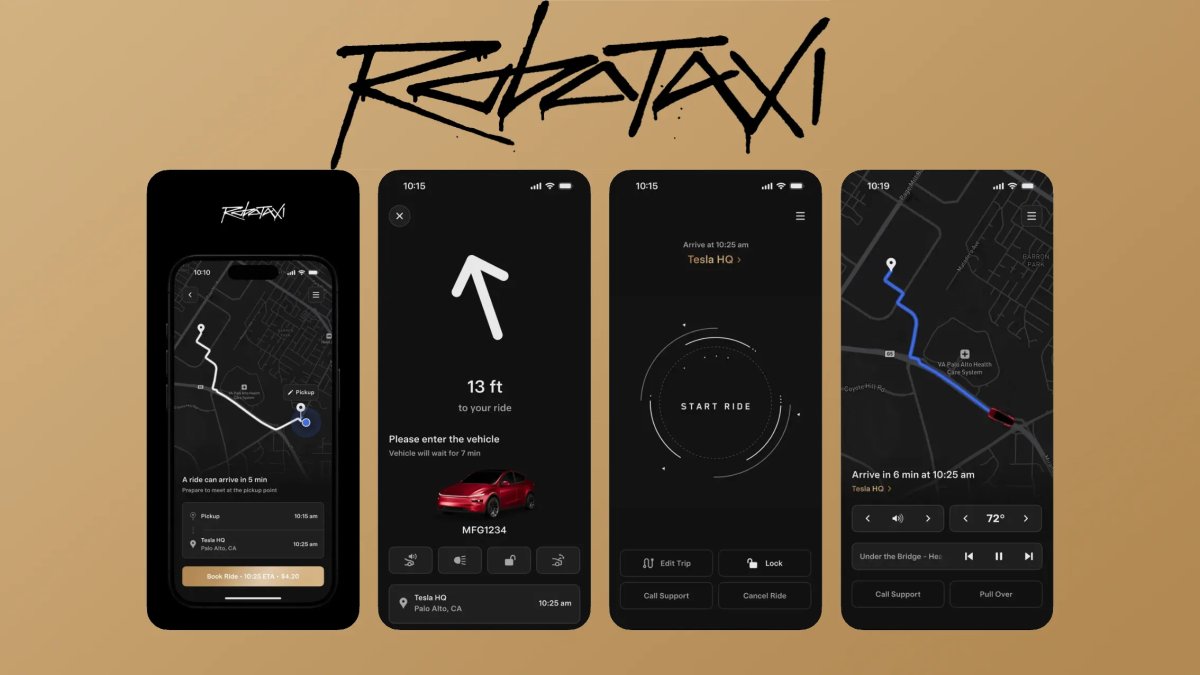
Tesla quietly moved its robotaxi program from closed pilots to a public-facing waitlist by releasing a Robotaxi app on iOS in early September 2025, allowing wide sign-ups in cities like Austin and San Francisco. The rollout is intentionally cautious — vehicles still run with safety drivers/supervisors in most areas — and regulators in both the U.S. and EU will dictate how fast the service can scale. This article explains what has changed, why it matters to Tesla owners and riders in the U.S. and Europe, and the concrete operational, legal, and economic implications to watch over the next 6–18 months.
1. Introduction — why this matters now
Tesla’s robotaxi program has been one of the company’s boldest long-term bets: software-first, fleet-leveraged, and vertically integrated. Through the first half of 2025, Tesla ran limited pilot services in Austin (first public pilot) and later in San Francisco, inviting influencers and select users to test the experience. In early September 2025 Tesla opened its Robotaxi app to the wider public on the Apple App Store, allowing iPhone users to download the app and join waitlists for select cities; Android availability followed later in stages. That move shifts robotaxi from a hard-to-access pilot into a product that’s discoverable by millions — but it does not mean fully driverless operations are suddenly available to everyone.
This matters for multiple reasons: it expands the group of people who will ride in Tesla’s supervised robotaxis and therefore the dataset Tesla collects about passenger behavior and edge-case scenarios; it increases visibility and regulatory scrutiny; and it ramps public expectations about what “robotaxi” actually means in practice. Below I unpack the facts, the tech, the regulations, the safety record, economics, and practical actions for owners, riders, and local policymakers.
2. Quick timeline: from tease to public waitlist
-
2019–2023: Tesla hypes robotaxis as a future business line; FSD Beta expands through iterative OTA improvements.
-
2024–2025 (early): Internal pilots, closed tests, and regulatory meetings in select locations — notably Austin, Texas, followed by choose Francisco San tests.
-
June–July 2025: Tesla operates small-scale pilot robotaxi rides in Austin and San Francisco with invited users and media.
-
September 3–4, 2025: Tesla releases a public-facing Robotaxi app on iOS that lets the general public download and join city-specific waitlists. Some users report very short waits before being invited; others were moved back on the waitlist as Tesla manages capacity.
That sequence explains why, in practice, the app’s public launch is a big PR and onboarding step but not a full commercial expansion — Tesla’s underlying fleet size, regulatory approvals, and safety monitoring practices remain the constraints.
3. What “public app” actually means — not a full launch
When Tesla says the Robotaxi app is “open to the public,” it means you can download the app (initially iOS), create an account, and join a queue to request future rides. It does not mean you can summon a fully autonomous, unsupervised car tomorrow in Seattle or Berlin.
Key operational caveats to keep in mind:
-
The service availability is city-limited. At the time of this writing, Austin and San Francisco are the primary cities where authorized robotaxi rides (with supervision) are being staged.
-
Tesla is actively limiting ride volume by using waitlists, staged invitations, and capacity controls to avoid overwhelming early operations and to monitor system performance closely. Users have reported being invited then placed back on the waitlist as the company adjusts access.
-
Vehicles in most operational contexts still carry human supervisors (safety drivers or monitors); Tesla’s public communications and regulatory filings indicate the company aims to reduce or remove on-board safety drivers later, but that timeline is constrained by regulators and technical validation.
So — public app != world launch. Instead, it’s an important step toward scaled operations: public users provide richer, real-world feedback; Tesla can simulate user demand patterns; and the company broadens the base of people who’ve accepted robotaxi legal terms and privacy settings.
4. How the system currently operates: safety drivers, monitors, and software gating
Tesla has iterated its supervision model several times. Early pilots used human monitors in passenger seats; Tesla moved to placing supervising staff into driver seats in recent iterations — ostensibly to align with safer response ergonomics and regulatory expectations. The company’s operations now combine three layers:
-
Onboard software — the FSD stack (vision neural nets, prediction, planning, and control).
-
Human supervision — in-car safety monitors (for now), trained to intervene when the system struggles. Tesla’s public messaging indicates a phased approach to reduce human supervision as the software proves itself.
-
Fleet telemetry & remote oversight — massive data collection and remote monitoring pipelines that log edge-case behavior, inform training, and trigger staged OTA updates.
Operational gating remains conservative: only a portion of the fleet receives early features; vehicles with known hardware configurations are prioritized; Tesla monitors performance, and it can quickly throttle or rollback features if telemetry shows regressions.
5. Regulation: how U.S. and Europe differ and why that matters
Regulatory regimes are the single biggest determinant of how fast robotaxi fleets can scale in any given region. The U.S. and Europe take different approaches:
United States: state patchwork + federal oversight
In the U.S., states set driving rules and enforcement, while federal agencies like NHTSA focus on vehicle safety standards and crash investigations. Texas, for example, has taken a permissive stance toward certain AV operations, which helped Tesla pilot early services in Austin. California’s regulators and local safety officials remain more cautious; San Francisco pilots operate under close scrutiny from city and state authorities. That patchwork means Tesla must adapt operational modalities per state and city, and the speed at which safety drivers can be removed will vary by jurisdiction.
Europe: harmonization vs conservatism
Europe’s regulatory backbone includes UNECE rules and national agencies that can be stricter on system-initiated maneuvers and data reporting. The European approach typically requires technical documentation, validation evidence, and sometimes private testing before public deployments. This has led to country-by-country variance in permitted behaviors and a generally slower runway for fully unsupervised operations.
What that means practically: even if Tesla’s software reaches a readiness threshold, national and local approvals will dictate when the company can operate unsupervised robotaxis in EU capitals — and those approvals are expected to be more conservative and data-driven than many U.S. state-level permissions.
6. Safety record, incidents, and the public perception problem
Autonomy’s biggest challenge is twofold: technical edge cases and public trust. Tesla’s robotaxi programs to date have operated under tight supervision and limited hours, but every incident draws significant attention.
-
Early pilot reports note a small number of “safety concerns” flagged by city officials in Austin; none have been publicly characterized as catastrophic at the time of these early trials. Municipal reporting and local press stories indicate close monitoring of near-misses and any system-involved incidents.
-
Every software regression or high-profile incident risks resetting regulatory goodwill and slowing approval timelines. The strategy Tesla is using — staged rollouts, waitlists, and in-car supervision — is designed to limit public exposure while collecting abundant training data.
Perception matters. For most riders, a single reported incident can erode confidence, even if incident rates decline overall. Tesla must therefore maintain transparent incident reporting, collaborate with regulators on independent safety audits, and demonstrate clear, measurable improvements in disengagement rates and safety metrics.
7. The economics of robotaxis: unit math, pricing, and fleet scaling
A common driver of robotaxi investment is transformative unit economics: replacing human drivers with software could dramatically lower per-ride costs. But economics depend on many variables:
-
CapEx per vehicle — the amortized cost of a Tesla outfitted for robotaxi service (vehicle purchase, added sensors if any, maintenance).
-
Utilization — percentage of hours a vehicle is generating revenue. Higher utilization dramatically improves unit economics but increases wear.
-
Operating costs — electricity (or charging time/availability), cleaning, software and data costs, insurance, and local regulatory compliance expenses.
-
Margin model — whether Tesla keeps the majority of fare revenue, uses intermediary partners, or runs a wholesale model for third-party fleet operators.
Tesla’s advantage is fleet scale and OTA improvements that theoretically reduce per-vehicle R&D cost per incremental feature. But scaling beyond tens of thousands of cars requires regulatory alignment, high utilization without sacrificing safety, and a charging/refueling infrastructure that minimizes downtime.
Many industry analysts caution that while the long-term upside is large, early economics will be tough: the need for safety drivers, insurance premiums, and limited city coverage will keep per-ride costs higher than legacy ride-hailing for the near term. Analysts have modeled varied ramp speeds: Tesla could see slow initial adoption followed by faster scaling as regulatory and technical hurdles are resolved.
8. How robotaxi changes the competitive landscape
Tesla’s robotaxi approach differs from Waymo, Cruise, and others in fundamental ways:
-
Tesla: vision-first, OTA-updated FSD running on a huge distributed fleet of customer and company vehicles; emphasizes incremental rollouts and consumer exposure.
-
Waymo/Cruise: more conservative, sensor-diverse stacks, extensive closed-area testing, and operator-run commercial fleets in carefully mapped cities; Waymo has deployed driverless operations in multiple cities.
Implications for incumbents:
-
Established ride-hailing players (Uber, Lyft) may partner, buy, or double down on human fleets, while new entrants will pressure city regulators to enforce strict metrics.
-
Public transit agencies may face political pressure as robotaxis enter certain corridors; there’s evidence cities are already studying curb-space allocation and congestion impacts from AV fleets.
For Tesla: success depends on three things: (1) continued improvement in edge-case handling, (2) regulatory approvals across major metropolitan regions, and (3) cost-effective fleet utilization.
9. Privacy, data, and rider protections
Robotaxis gather a lot of data: video, sensor logs, trip metadata, and possibly passenger interactions inside the car. That raises privacy and consumer protection concerns:
-
Data retention and access: who gets to see in-vehicle camera footage (Tesla, law enforcement, insurers)? What are the retention policies?
-
User consent: Tesla’s Robotaxi terms require explicit consent to data collection and terms of service that riders must accept; those terms vary in readability and legal enforceability by jurisdiction.
-
Regulatory frameworks: the EU’s GDPR and member-state privacy laws impose rigorous data-protection requirements that could complicate footage retention and cross-border data flows. In the U.S., rules are patchwork, and some states have stronger privacy frameworks than others.
For riders, city officials, and regulators, clarity on data practices (when footage is shared with law enforcement, how long it’s kept, anonymization techniques) will be essential for public acceptance.
10. What this means for Tesla owners and potential riders — practical guidance
If you’re a Tesla owner, a local policymaker, or an EV-interested rider in the U.S. or Europe, here’s how to think about today’s expansion:
For Tesla owners
-
You might see regional changes: if you live in Austin or San Francisco, you may notice more robotaxi activity in your neighborhood. If you’re an owner with FSD enabled, don’t assume robotaxi availability changes your personal vehicle’s capabilities — those remain gated by Tesla’s FSD release schedules and local rules.
-
Privacy considerations: check your car’s data-sharing settings and consider whether you want to share dashcam footage publicly or retain it locally.
-
Potential economic opportunities: owners in some areas may be able to enroll vehicles in fleet programs in future Tesla offerings (lease-back, managed fleet), but this remains speculative and depends on regional rules and business products.
For riders
-
Read the terms: the Robotaxi app requires explicit acceptance of terms and safety waivers. Read them carefully so you understand liability, data sharing, and passenger responsibilities.
-
Expect variable experience: early riders report conveniences like trunk control and Bluetooth unlocking, but also limited availability and conservative routing to minimize risk.
For policymakers
-
Curb management matters: cities should plan curb-space allocations and pick-up/drop-off zones to limit congestion and maintain safety.
-
Data-sharing agreements: set standards for incident reporting and minimal telemetry that companies must share with regulators to permit oversight.
11. Legal liability and insurance implications
Until regulators formally recognize unsupervised operation as certified Level 4 or 5 and assign corporate liability frameworks, questions remain:
-
Who is liable in a crash? In most jurisdictions today, the human occupant/driver remains legally responsible while the vehicle operates in a supervised mode. If Tesla’s robots begin operating unsupervised, legal frameworks will need to shift toward manufacturer liability or a hybrid model.
-
Insurance market reactions: insurers will update underwriting models and policy language to reflect AV-specific risk vectors. Expect explicit clauses about FSD versions, supervised vs unsupervised operation, and whether robotaxi rides are covered under ride-hailing or commercial lines. Early adopters in pilot cities may face different premium structures.
These legal changes will have direct economic consequences for both riders and fleet operators.
12. City case studies: Austin and San Francisco (what’s happening on the ground)
Austin, Texas
Austin was the first major public pilot city for Tesla’s robotaxi program in mid-2025. Texas’ permissive AV policies helped Tesla quickly operationalize supervised rides there. Local reporting indicates monitored operations and a handful of “safety concerns” flagged by city officials rather than major collisions. Austin’s experience is instructive: permissive regulation accelerates operational testing but brings public-safety scrutiny.
San Francisco, California
San Francisco poses a tougher regulatory and operational environment: dense urban streets, complex curb rules, and multiple AV competitors already operating in controlled lanes. Tesla’s launches there were smaller and more controlled; the company must navigate city permitting and intense local media scrutiny. San Francisco’s pilots underline how complex urban driving is for AVs, and how cities require robust incident reporting and public engagement.
These two cities show the variance across local regulatory and operational environments, reinforcing that nationwide or continental rollouts will be inherently staggered.
13. Ethical and social considerations
Robotaxis change urban mobility and bring thorny social questions:
-
Equity: will robotaxi services be available equitably across neighborhoods, or targeted at affluent corridors first?
-
Congestion: high-utilization fleets can increase vehicle miles traveled (VMT) if not carefully managed, potentially worsening congestion rather than reducing it.
-
Employment: driverless fleets threaten traditional driving jobs, though they could create new tech and operations roles.
Policymakers must weigh potential benefits (reduced crash risk, new mobility access) against these social trade-offs.
14. What to watch next (near-term indicators)
If you want to follow how the robotaxi story unfolds, watch these indicators closely over the next 3–12 months:
-
Regulatory filings and approvals in major EU capitals and U.S. states (RDW/UNECE notes in Europe; state DOT/NHTSA engagement in the U.S.).
-
Telemetry transparency — whether Tesla will publish or permit independent audits of key safety metrics (disengagements, near-miss rates).
-
Insurance announcements — changes in coverage and policy language tailored to robotaxi operations.
-
Fleet scaling evidence — more cities, increased vehicle counts, or an Android app launch that significantly expands user access.
15. Long-term outlook: timelines and scenarios
Many timelines remain speculative. CEO statements suggest Tesla aims to remove on-board safety drivers by the end of 2025 and scale toward unsupervised service later. Analysts offer divergent scenarios: some expect staggered, city-by-city rollout culminating in broad robotaxi availability by 2028–2030; others warn of slower progress if regulators demand more exhaustive independent validation. Regardless of the precise schedule, four structural forces will matter most:
-
Technical readiness (edge-case handling and robust fallback behaviors).
-
Regulatory alignment (harmonized approvals across major markets).
-
Public trust and safety record (incident transparency and demonstrable improvements).
-
Commercial economics (charging, utilization, and insurance costs that support a viable unit model).
Tesla’s approach — rapid public exposure and massive fleet data collection — contrasts with Waymo’s more cautious, mapping-heavy route; the market will judge which approach scales most effectively and safely.
16. Conclusion — the practical takeaway for US & EU readers
Tesla’s September 2025 pivot to a public-facing Robotaxi app is a meaningful milestone. It lowers the barrier for public participation and scales the data pipeline Tesla uses to improve its FSD stack. But it is also a cautious, staged step: service remains limited to key cities for now, safety drivers and supervisors are still required in most contexts, and regulatory approvals will be the binding constraint across Europe and many U.S. localities.
If you’re a Tesla owner: expect more robotaxi presence in cities where pilots are active, but don’t conflate the app with full driverless availability. If you’re a rider: review terms, be prepared for variable access, and weigh privacy trade-offs. If you’re a policymaker: start planning curb-space, data reporting requirements, and incident transparency rules now.
This is a live, rapidly evolving story. Over the next year we’ll see whether the staged public rollout yields safer, audited performance improvements that satisfy regulators — or whether regulators and public skepticism slow the path to truly unsupervised robotaxis.
FAQ
Q1: Is Tesla’s Robotaxi now fully driverless anywhere?
A: Not broadly. Tesla operates supervised pilot services in select cities; fully unsupervised operations require regulatory sign-offs and broader demonstration of safety.
Q2: Which cities can use the Robotaxi app today?
A: As of early September 2025, Austin and San Francisco are the main pilot cities, with app waitlists enabling public sign-up. Expect more cities to follow as capacity and approvals expand.
Q3: Do Robotaxi rides cost more or less than Uber/Lyft?
A: Pricing models are still experimental. Early rides may be priced competitively, but real comparative pricing depends on utilization, subsidies, and local market dynamics.
Q4: Will my insurance cover me if I ride in a robotaxi?
A: Many ride-hailing coverages apply, but specifics depend on provider terms and whether the vehicle is operating in supervised or unsupervised mode. Check terms before riding.
Q5: What data does Tesla collect during a robotaxi ride?
A: Camera feeds, telemetry, and trip metadata are collected to improve safety and software. Data-sharing controls vary by jurisdiction and the app’s terms of service; riders should review those terms closely.
Q6: When will Tesla remove safety drivers?
A: Tesla’s public statements have targeted removal of on-board safety drivers by the end of 2025, but this depends on software readiness and regulatory approvals and thus remains uncertain.