
Introduction: The Return of the Prodigal Cell
For the past two years, the narrative surrounding Tesla’s in-house battery program was one of "Cybertruck exclusivity." While the stainless-steel behemoth served as a testbed for the 4680 form factor, the high-volume Model 3 and Model Y lines in Europe and the US largely relied on tried-and-true 2170 cells from Panasonic and LG, or LFP cells from CATL.
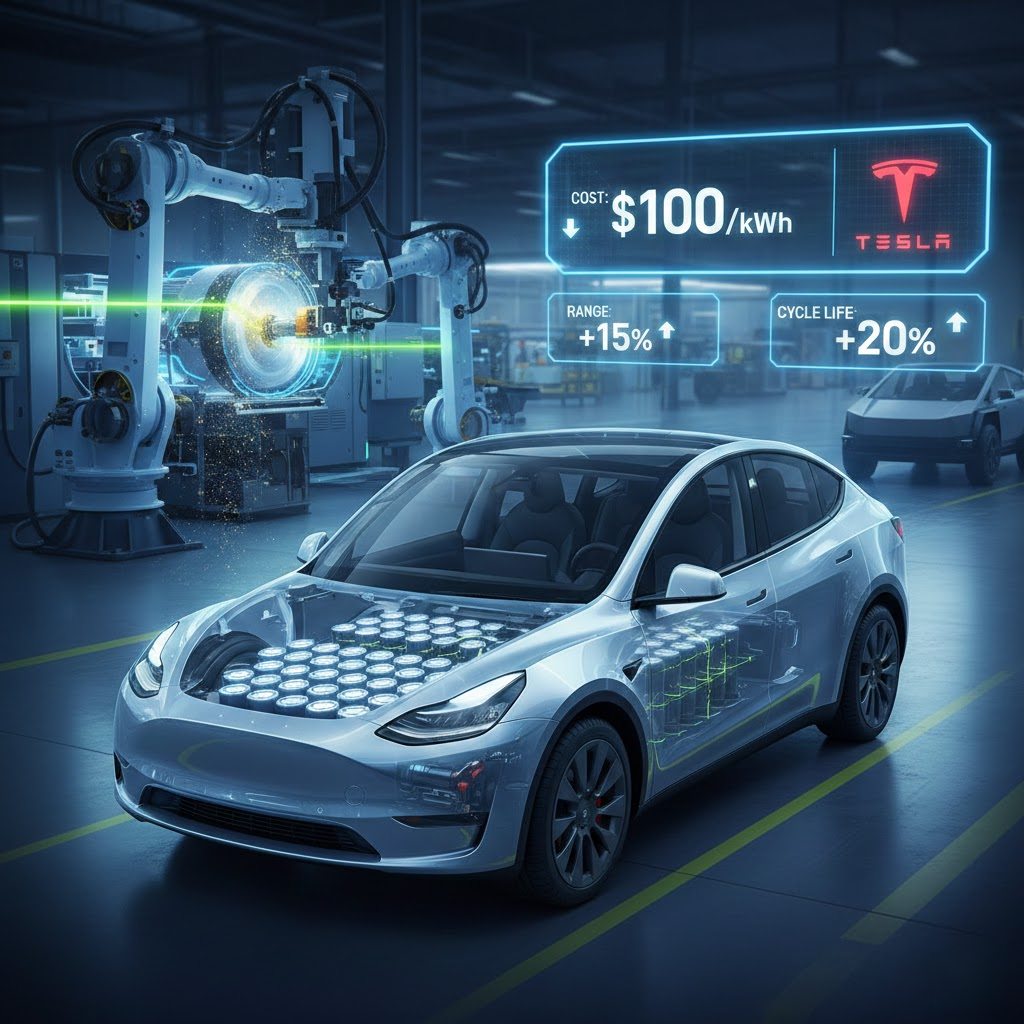
However, as of today, February 13, 2026, the strategy has officially shifted. Following Tesla’s landmark Q4 2025 announcement and the confirmation of "full dry electrode" mass production, the 4680 cell is making a triumphant return to the Model Y. This is not just a hardware update; it is a fundamental pivot in Tesla’s quest for the "Holy Grail" of EV manufacturing: the sub-$100/kWh battery pack.
I. The Dry Electrode Breakthrough: Mastered at Last
The "Dry Battery Electrode" (DBE) process has been Tesla’s white whale since the acquisition of Maxwell Technologies in 2019. Traditional battery manufacturing is a "wet" process: active materials are mixed into a toxic solvent (NMP) to create a slurry, coated onto foil, and then sent through massive, 50-meter-long drying ovens that consume enormous amounts of energy.
Mastering the Paradox
The dry process eliminates the solvent entirely. Instead, active materials are mixed with a binder (PTFE/Teflon) that "fibrillates"—forming microscopic webs that hold the powder together—when subjected to high pressure.
-
Energy Efficiency: By removing the massive drying ovens, Tesla has reduced the energy footprint of its electrode lines by an estimated 70-80%.
-
Factory Footprint: Giga Texas has successfully condensed its battery production lines, reclaiming nearly 50% of the floor space previously required for wet coating.
-
The February Milestone: Internal reports indicate that as of this week, Tesla has achieved a stable yield rate exceeding 90% for both the anode and cathode using the dry process—a feat previously thought impossible for mass production.
II. The 2026 Model Y "Juniper" Integration
The re-integration of the 4680 cell into the Model Y (specifically the 2026 "Juniper" refresh) provides three critical advantages for owners in the US and Europe.
1. Structural Integrity and Weight Reduction
The 4680 cells are housed in a structural battery pack, meaning the cells themselves provide the strength of the car's floor.
-
Weight Savings: The 2026 Model Y 4680 variant is approximately 10% lighter than its 2170-cell predecessor.
-
Handling: This reduction in "unsprung mass" and a lower center of gravity significantly improves the nimble handling characteristics that European drivers prioritize.
2. Thermal Management and Charging
The "tabless" design of the 4680 cell allows electrons to travel a much shorter distance to exit the cell.
-
Faster 10-80% Sprints: On the new V5 Superchargers, the 2026 Model Y can sustain higher peak charging rates (up to 250kW) for a longer duration of the charging curve.
-
Cooling Efficiency: The larger form factor, combined with the tabless architecture, generates less internal resistance ($I^2R$ losses), meaning the car requires less active cooling during high-speed Autobahn driving.
3. Energy Density Gains
While early 4680 cells struggled to match the energy density of the best 2170s, the 2026 "Generation 3" 4680 cells have reached 300 Wh/kg. This allows for a 15% increase in range without increasing the physical size of the battery pack.
III. Economic and Geopolitical Strategy: Bypassing the Tariffs
The move to bring 4680 production "in-house" and localized in Texas (and soon, expanded lines in Berlin) is a calculated move to navigate the 2026 trade landscape.
-
US Tax Credits: By manufacturing the cells in Austin, the 2026 Model Y remains fully eligible for the $7,500 Federal Tax Credit, as it meets the increasingly strict "Domestic Content" requirements.
-
European Resilience: As the EU introduces new carbon footprint regulations for batteries, Tesla’s low-energy dry process gives Giga Berlin-made cars a "Carbon Passport" advantage over competitors importing high-emission cells from overseas.
-
Cost Parity: Tesla’s internal data suggests the DBE breakthrough has slashed cell manufacturing costs by roughly 18% compared to 2024 levels, allowing Tesla to maintain healthy margins even as they lower MSRPs to compete with emerging budget brands.
IV. Conclusion: The Foundation for the Next Gen
The successful scaling of the 4680 cell is the final "green light" for Tesla’s future roadmap. Without this breakthrough, the upcoming "Cybercab" and the long-rumored $25,000 Next-Gen platform would not be financially viable.
For the current Tesla owner, the 2026 Model Y with 4680 cells represents the pinnacle of "Vertical Integration." It is a vehicle where the chemistry, the software, and the structural frame were designed in a single, cohesive ecosystem.
FAQ: Your 4680 Battery Questions Answered
Q: How can I tell if my 2026 Model Y has the 4680 cells? A: Check your vehicle's VIN. In 2026, models produced in Austin with the "A" plant code that feature the "Standard Range Plus" or the new "AWD Long Range" configurations are the primary recipients of the in-house 4680 packs.
Q: Is the 4680 battery "Long Range" actually better than the 2170? A: In terms of longevity, yes. The dry electrode process reduces the "first-cycle capacity loss" that occurs in wet-processed cells, meaning the 4680 should exhibit less degradation over 200,000 miles.
Q: Does the dry process affect battery safety? A: Actually, it enhances it. The absence of volatile solvents during manufacturing reduces the risk of microscopic "dendrite" formation, which is a leading cause of internal shorts in lithium-ion batteries.
Q: Will the 4680 be available in Europe soon? A: Yes. Giga Berlin has begun installing the second-generation DBE coating lines as of January 2026. Expect the "Made in Germany" 4680 Model Ys to hit the market by late Q3 2026.