
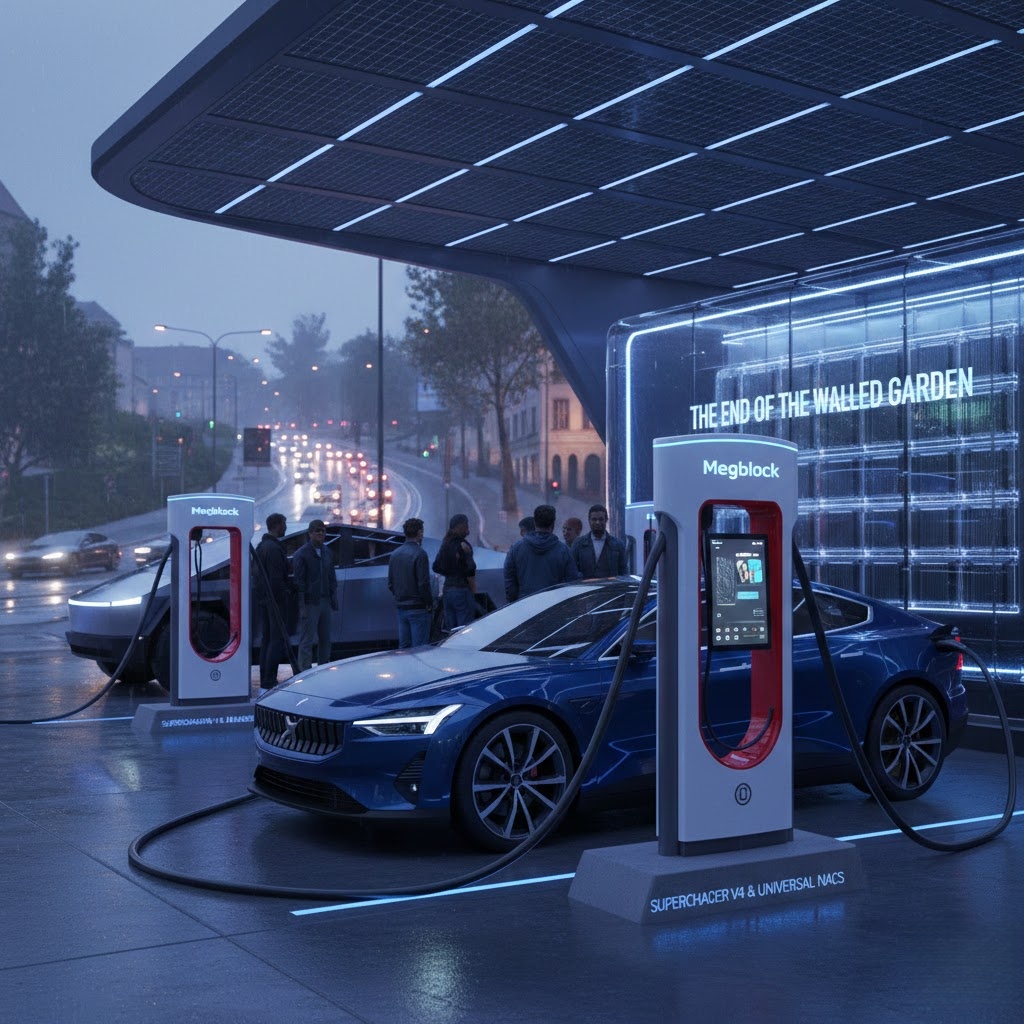
Introduction: A Historic Pivot in Electric Mobility
As of today, February 10, 2026, the electric vehicle industry has officially crossed its most significant threshold since the launch of the Model S. For over a decade, the Tesla Supercharger network was the "Gold Standard"—a pristine, exclusive club that served as Tesla’s greatest competitive moat. Today, that moat has been replaced by a bridge.
With the mass deployment of Supercharger V4 cabinets across North America and Europe, and the near-total adoption of the North American Charging System (NACS) by third-party manufacturers like Polestar, Ford, and Stellantis, the "Walled Garden" has finally fallen. This article explores the technical, economic, and social implications of this transition, focusing on how Tesla has managed to open its doors without sacrificing the premium experience its owners expect.
Chapter 1: The Technical Evolution – V3 vs. V4 Cabinets
To understand why today is a turning point, we must look under the hood—or rather, inside the cabinet.
From 400V to 1000V Architecture
The transition from V3 to V4 is not just about the "post" (the part you plug in); it's about the V4 Cabinet. While V3 cabinets were capped at 500V DC, the true V4 systems now scaling in 2026 support a range of 180V to 1000V DC.
-
V3 Hybrid (V3.5): Many early V4 posts were connected to old V3 cabinets, limiting output to 250kW.
-
True V4 (2026 Standard): The new cabinets deliver up to 500kW peak power per stall. For high-voltage vehicles like the Cybertruck or the new 800V Porsche Taycan and Hyundai IONIQ 5, this means "splash and go" stops are finally a reality.
Immersion-Cooled Cables and Ergonomics
The V4 hardware features a 3-meter (approx. 10 ft) cable, significantly longer than the V2/V3 versions. This design choice was specifically made to accommodate non-Tesla EVs, which have charge ports in varying locations (front-left, rear-right, or even the nose).
Chapter 2: The Polestar & Volvo Integration Case Study
This week, the integration of Polestar and Volvo into the NACS ecosystem reached "Native Phase." Unlike the messy adapter-based solutions of 2024, the 2026 models from these brands now feature a factory-installed NACS port.
-
Seamless Handshake: Using the ISO 15118-2 protocol, a Polestar 4 can now pull up to a V4 stall, plug in, and initiate charging instantly. The billing is handled via the manufacturer's app or the Tesla App, but the physical "Plug & Charge" experience is identical to a Model 3.
-
Performance Metrics: In real-world testing conducted this morning in Norway, a Polestar 3 maintained a 300kW charging curve up to 40% State of Charge (SoC), a feat previously impossible on the older Tesla infrastructure.
Chapter 3: The Economic Impact – NEVI and AFIR Compliance
Tesla isn't opening the network solely out of the goodness of Elon Musk's heart. It is a calculated business move driven by government subsidies and a new revenue stream: Charging-as-a-Service (CaaS).
1. US: The NEVI Program
In the United States, the National Electric Vehicle Infrastructure (NEVI) program provides billions in funding, but only for "open" stations. By installing V4 posts with integrated Magic Docks (CCS adapters) and NFC/Credit Card Readers, Tesla has secured hundreds of millions in federal grants to subsidize its network expansion.
2. Europe: The AFIR Regulation
The EU’s Alternative Fuels Infrastructure Regulation (AFIR) now mandates that all new fast chargers must allow for "ad-hoc" payments (credit cards) without requiring an app. Tesla’s V4 stalls with built-in screens and card readers are a direct response to this, ensuring Tesla remains the dominant infrastructure provider across the Eurozone.
Chapter 4: Grid Management & The "Megablock" Strategy
With millions of non-Tesla vehicles now accessing the stalls, the demand on local power grids has skyrocketed. To prevent local blackouts or "throttled" charging speeds, Tesla has deployed the Megablock—a modular energy storage solution.
Each new V4 Supercharger hub is now frequently paired with a 1.4 GWh Megapack system. This allows the site to:
-
Peak Shave: Store energy at night (cheap rates) and discharge during the day when 20 EVs are charging simultaneously.
-
Ensure Uptime: Tesla continues to boast a 99.95% uptime, largely because their sites can operate independently of the grid for short durations during outages.
Conclusion: Maintaining the Tesla Identity
The primary fear of Tesla owners has always been congestion. "Will I have to wait behind a slow-charging Bolt?"
As of February 2026, Tesla has mitigated this through Dynamic Pricing. Non-Tesla owners pay a premium "Access Fee" unless they subscribe to a monthly membership. Additionally, Tesla’s software intelligently routes Tesla owners to "Tesla-Preferred" stalls while directing guest vehicles to sites with higher capacity.
The walled garden is gone, but the Tesla experience has evolved into a global utility that powers the entire EV revolution.
FAQ: The 2026 Supercharger Experience
-
Q: Can I still use my 400V Model Y at a 500kW V4 stall?
-
A: Yes, but you will still be limited to ~250kW by your car's internal hardware. However, you benefit from the V4's superior cooling and reduced power-sharing slowdowns.
-
-
Q: Do I need a Tesla App if I drive a Ford or Rivian?
-
A: Not anymore. While the app offers the best rates, V4 stalls now feature credit card readers for guest access.
-
-
Q: How do I identify a "True V4" site?
-
A: In your Tesla navigation, look for the "V4" icon. These sites are guaranteed to have the longer cables and 1000V architecture.
-
-
Q: What happens if a non-Tesla vehicle takes up two spots because of its port location?
-
A: Tesla is actively redesigning stall layouts (pull-through spots) to prevent this. High "Idle Fees" also apply to any car not actively charging.
-