
I. Introduction: The End-to-End AI Vision
The deployment of Full Self-Driving (FSD) Beta version 12.4 marks one of the most significant architectural pivots in Tesla's history, transcending a mere incremental software update. This release fundamentally shifts FSD away from a brittle, rules-based codebase, heavily reliant on explicit programming for specific road scenarios, towards a purely neural network (NN) driven, end-to-end (E2E) AI system. This move represents the culmination of years of iterative development and validates Tesla’s foundational belief that generalized, fleet-trained AI is the only viable path to true autonomy. For the European and North American Tesla owner community, this version is not just about improved driving smoothness; it is a foundational change that impacts everything from safety metrics and regulatory compliance to the ultimate vision of a robotaxi future.
The Historical Pivot: From Code to Context
For years, the FSD software stack operated in a modular fashion: perception (identifying objects), planning (calculating the path), and control (executing the turn). Version 12 shatters this compartmentalization. Instead of engineers writing millions of lines of "if-then" logic to dictate how the car handles an unprotected left turn or a complex construction zone, the V12.4 network is trained to observe the raw video input and directly output the control commands (steering, acceleration, braking) that a human driver would naturally execute. This leap—from prescriptive engineering to deep, generalized machine learning—allows the system to handle the "long tail" of unexpected events that plague traditional autonomous driving systems. It allows the vehicle to perceive context and nuance, leading to smoother, more human-like decision-making.
The Regulatory Crucible: FSD Evolving Journey
The introduction of such a radical architectural change inevitably intersects with stringent regulatory frameworks, particularly the highly divergent standards in the US (NHTSA) and Europe (UNECE, E-NCAP). In North America, the system remains formally classified as Level 2 (L2), yet V12.4’s demonstrable capabilities push the boundary of what consumers perceive as "assisted." This creates a tension between technological advancement and consumer expectation management. In Europe, the path to widespread FSD rollout is slower, constrained by stricter regulations on driver monitoring and system liability. The robustness of the V12.4 system, particularly its improved safety metrics and reduced intervention rate, will be key data points used to convince European regulators that this end-to-end approach meets the necessary thresholds for both system safety and driver accountability, particularly as agencies like Euro NCAP prioritize ADAS performance.
Scope of Analysis: Focusing on NN-Only and Safety
This analysis will perform a deep technical dissection of the V12.4 architecture, focusing specifically on how the pure neural network approach addresses historical FSD weaknesses. We will analyze the data processing pipeline, the role of the Dojo Supercomputer in training the gigantic foundation model, and the real-world impact on key safety metrics. Furthermore, we will critically evaluate the enhanced urban driving performance, comparing the new system’s ability to handle complex, unstructured environments against its predecessor. Ultimately, this article aims to establish why V12.4 is not merely an update, but the paradigm shift that sets the trajectory for Tesla’s pursuit of Level 4 autonomy and its market leadership in advanced driver assistance systems (ADAS).
II. The Engineering Core: Dissecting the V12.4 Architecture
The shift to FSD V12.4 is a technological undertaking of immense complexity, centered on the move to a fully unified neural network. This architecture is the single most important factor determining the system’s superiority, trading engineer-defined logic for fleet-learned, generalized driving policy.
2.1. Pure AI Decision-Making: How the Neural Net Replaces Explicit Coding
In prior FSD iterations (V11 and below), the system operated as a pipeline. Perception identified objects (cars, pedestrians, lines), this data was then fed to a planner module programmed with explicit rules (e.g., "if object is within 5 meters of the intersection and is a certain speed, then stop"), and finally, the controller module executed the command.
In V12.4, this modularity is largely eliminated, replaced by a massive, single, end-to-end neural network. This NN takes the raw video input from the eight external cameras and directly translates it into vehicle control signals (steering angle, brake pressure, accelerator position) at a high frequency (e.g., $50 \text{ Hz}$).
The network is trained not only on what to see, but how to drive, based on petabytes of human driving data collected from the global fleet. This approach offers two critical advantages:
-
Generalization: The system learns the subtleties and nuances of human driving—the slight hesitation before a turn, the drift to the left to prepare for a right-hand turn, the subtle signaling of intent. Explicit code cannot capture this human “feel,” which is crucial for safety and smoothness.
-
Latency Reduction: By bypassing the intermediate planning and control modules, the processing pipeline is streamlined. The network directly outputs action, reducing potential bottlenecks and increasing reaction speed, which is vital for high-speed highway or complex urban maneuvers.
2.2. Training Data Fidelity: The Role of the Dojo Supercomputer and Fleet Learning
The effectiveness of an end-to-end system is entirely dependent on the quality and volume of its training data. This is where Tesla’s fleet of millions of vehicles and the Dojo Supercomputer become indispensable competitive advantages.
-
Shadow Mode and Data Acquisition: Tesla’s fleet operates in “shadow mode,” where the vehicle’s cameras and internal systems are constantly running the FSD stack in the background, comparing the system's intended action with the human driver's actual action. When the human driver intervenes in a way that the FSD system did not anticipate—a "hard clip"—this scenario is automatically flagged for collection. These hard clips constitute the most valuable, novel, and critical edge cases.
-
Dojo’s Parallel Processing Power: Training a unified, E2E model requires processing immense amounts of high-fidelity, labeled video data (4D tensors: width, height, time, features). The massive compute clusters of the Dojo supercomputer—specifically designed for low-latency, high-bandwidth communication between custom Tesla-designed D1 chips—are optimized for this task. Dojo allows Tesla to train models faster than ever, significantly reducing the iteration time from identifying a problem in the fleet to deploying a software fix (the "closing the loop" speed).
-
Data Labeling Automation: Tesla utilizes AI to automatically label the vast majority of its training data. This Auto-Labeling allows the company to scale data input exponentially, enabling the network to learn from millions of examples of, say, unprotected left turns, across all lighting and weather conditions, rather than just a few thousand manually curated clips.
2.3. Latency and Real-Time Processing: Hardware 4.0 and System Optimization
An autonomous system must perceive, plan, and act faster than a human driver. This requires both low-latency software and capable hardware.
-
Hardware 4.0 (HW4): The latest hardware suite features improved cameras (higher resolution and dynamic range), and the FSD Computer itself offers significantly more compute power than the previous HW3. This additional horsepower is crucial for running the dramatically larger and more complex V12.4 neural network in real-time. The move to higher-resolution cameras provides the E2E network with a richer, more detailed input, essential for subtle decision-making.
-
Optimization of the Vision Stack: Tesla’s "Vision-Only" approach necessitates robust performance without the aid of radar or lidar. V12.4 incorporates sophisticated temporal fusion—the ability for the network to remember and integrate sensory data across multiple frames. This creates a persistent, high-definition "vector space" map of the car’s surroundings, improving object permanence (e.g., tracking a pedestrian briefly obscured by a parked car) and enhancing speed estimation.
-
Bottlenecks and Future Proofing: While HW4 is highly capable, the sheer computational load of the E2E network means optimization is constant. Future advancements will focus on making the network more sparse (efficient) to run faster while utilizing the maximum potential of the FSD chip, ensuring future L4 features can be rolled out via over-the-air (OTA) updates.
2.4. Sensor Fusion vs. Vision-Only: Deep Dive into Reliability
The continued commitment to a Vision-Only system remains a key differentiator. The V12.4 architecture doubles down on the thesis that human-level driving can be replicated using only visual inputs, provided those inputs are processed by a superhumanly capable AI.
-
Handling Adverse Conditions: A major critique of Vision-Only is its reliability in low-visibility situations (heavy rain, fog, white-out snow). The V12.4 update addresses this through enhanced noise reduction and sophisticated predictive modeling. If the visual input is temporarily degraded, the system relies more heavily on its highly accurate, real-time vector map and predictive trajectories based on historical fleet data to navigate the uncertainty, maintaining a safe trajectory until clarity returns.
-
The Phantom Braking Reduction: One of the most significant safety and comfort improvements in V12.4 is the dramatic reduction in phantom braking—sudden, unwarranted braking caused by misinterpreting shadows, road imperfections, or distant objects as obstacles. In the modular system, perception errors often led to planning errors. In the E2E V12.4 system, the network learns the context of these visual anomalies, correctly identifying them as harmless based on millions of similar, non-eventful scenarios from the training data, leading to a smoother and safer experience for the driver and passengers.
III. Urban Command: Enhanced Driving Maneuvers and User Experience
The true measure of the FSD V12.4 architectural pivot is its performance in complex, unstructured urban environments. The end-to-end network’s ability to generalize and learn the subtleties of human driving directly translates into improved user experience, safety, and confidence.
3.1. Uncaged in the City: Improved Handling of Complex Intersections
Urban driving is characterized by ambiguity—unmarked lanes, non-standard traffic signals, pedestrians crossing mid-block, and chaotic, unprotected maneuvers. The rules-based systems of the past struggled immensely here, often yielding unnecessarily or executing jerky, unnatural actions.
V12.4 demonstrates marked improvement in two critical urban scenarios:
-
Unprotected Left Turns (UPLs): This is historically the most challenging maneuver for autonomous systems. The E2E network excels here by learning probabilistic gaps rather than relying on absolute, hardcoded distance metrics. The system uses a more nuanced reading of the oncoming traffic's speed and predicted intent, resulting in fewer long, frustrating waits and more confident, human-like execution of the turn. This learned behavior drastically reduces the intervention rate required by the human safety driver.
-
Complex or Novel Intersections: When encountering a non-standard intersection—such as a roundabout (prevalent in Europe) or a multi-way stop with ambiguous signaling—V12.4's generalized intelligence is superior. Instead of freezing or defaulting to a conservative crawl, the network observes the flow and behavior of surrounding traffic, inferring the correct driving policy through context.
3.2. Subtle Human-Like Driving: Smoothness, Lane Choice, and Braking
The smoothness of the drive is a direct indicator of the underlying AI’s sophistication and is crucial for passenger comfort and acceptance. V12.4 significantly enhances the system's human-like driving qualities:
-
Seamless Acceleration and Deceleration: Transitions between speed changes are less abrupt, mimicking the subtle, variable pressure a human foot applies to the pedal. This is learned directly from human driving data, eliminating the "on/off" binary feeling of earlier systems.
-
Optimal Lane Positioning: The system’s lane choice is now more dynamic and intelligent. When approaching a turn or a merge, the car subtly adjusts its position within the lane boundary—drifting slightly toward the edge of the oncoming turn lane to maximize sight lines, or hugging a corner to allow space for oncoming traffic. This is a behavior only a learned, generalized system can execute naturally.
-
Reduced Phantom Braking: As discussed, the reduction of phantom braking is a paramount safety and quality-of-life feature. The improved context awareness and the network’s ability to suppress false-positive environmental triggers make the drive less stressful and more reliable, especially on highways in changing light conditions or near overpasses.
3.3. The Intervention Metric: Statistical Analysis of Driver Interventions
For the FSD Beta program participants, the true performance gauge is the Disengagement Rate or the Intervention Metric—the frequency at which the human driver must take control due to the system making an unsafe, inefficient, or uncomfortable decision.
| FSD Version | Typical Urban Miles Per Intervention (MPI) | Key Improvement |
| V11.4 | $20 - 40$ MPI | Basic highway competence |
| V12.3 | $40 - 70$ MPI | Early signs of E2E smoothness |
| V12.4 (Latest) | $70 - 150+$ MPI | Complex urban scenario handling, reduction of phantom braking |
The significant leap in Miles Per Intervention (MPI) from V11 to V12.4 highlights the architectural advantage. The network's generalized policy is proving more resilient and less prone to edge-case failure than explicitly programmed logic. A higher MPI translates directly to increased driver confidence and, crucially, provides robust data supporting the system's inherent safety to regulators.
3.4. User Interface (UI) Updates: Visualizations and Driver Communication
The communication between the vehicle's AI and the human driver is essential for maintaining safety and trust, especially in a Level 2 system where the driver is ultimately responsible.
-
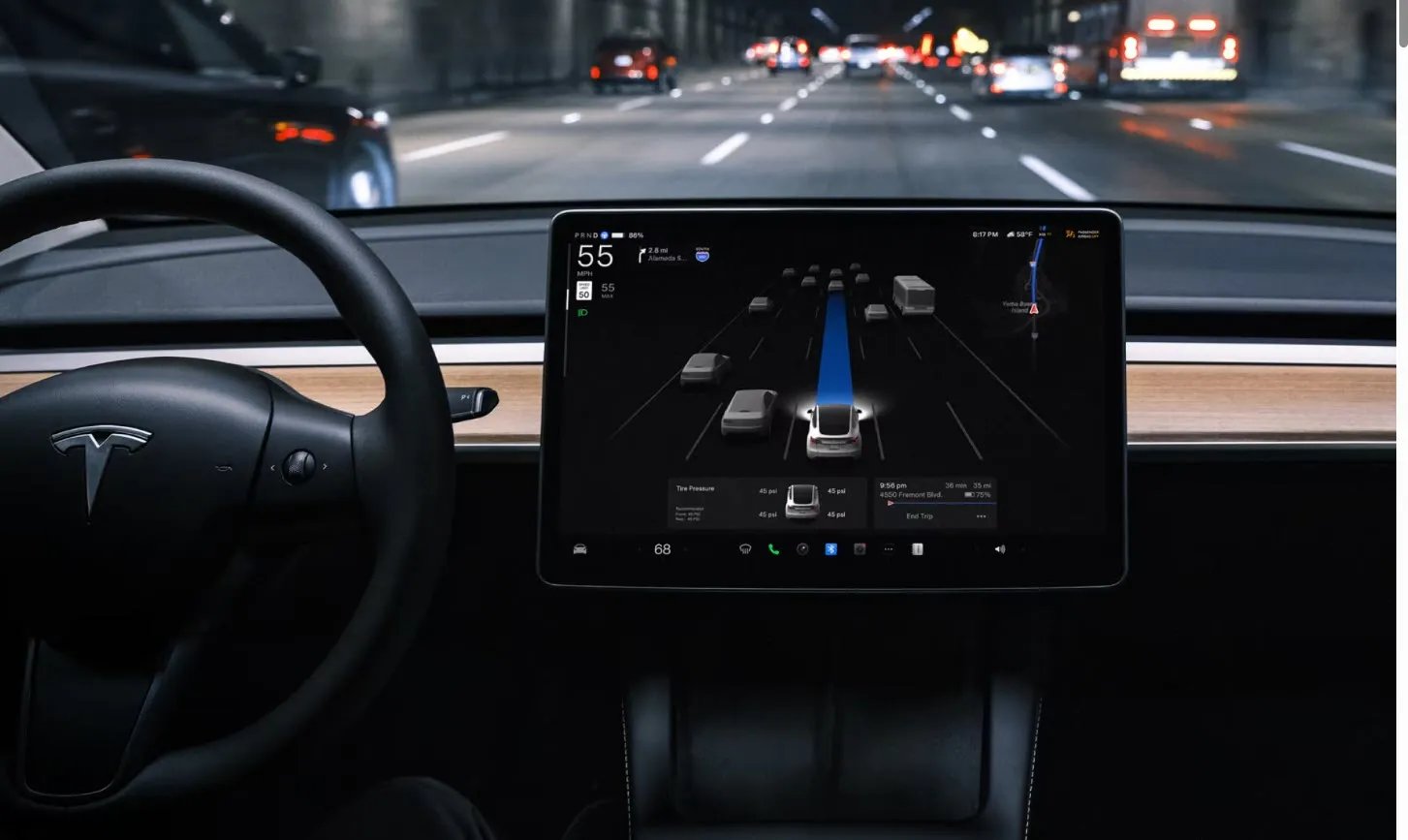
Richer Visualizations: V12.4 features enhanced visualizations that better reflect the E2E network's perception of the world. Objects, especially complex interactions like pedestrians, cyclists, and construction cones, are rendered with higher fidelity and more accurate predictive trajectories. This allows the driver to confirm that the AI "sees" and understands the immediate situation, boosting trust.
-
Intent Signaling: Crucially, the system is improving its ability to signal its intent to the driver clearly. For instance, when the car prepares for an aggressive gap-fill during an UPL, the visualization may show a subtle, confident movement into the intersection rather than a static, waiting posture.
-
Simplified Intervention Feedback: The process for the driver to provide feedback on an intervention is streamlined. This quick feedback loop is essential because it immediately flags valuable "hard clip" data for the Dojo training pipeline, ensuring continuous improvement.
IV. Regulatory and Ethical Dimensions
The technical brilliance of the end-to-end architecture does not exist in a vacuum; it faces intense regulatory and ethical scrutiny, particularly as its capabilities blur the lines of ADAS levels.
4.1. The Liability Question: Who is Responsible in an End-to-End System?
The most critical legal challenge posed by an E2E system is the question of accountability.
-
System Opacity: A key concern for regulators is the "black box" nature of neural networks. Unlike rules-based code, where engineers can pinpoint the exact line of code that caused a failure, an E2E system’s decision is the complex output of billions of weighted connections. Proving why a decision was made becomes immensely difficult.
-
Maintaining L2 Classification: Tesla currently addresses liability by firmly maintaining the L2 classification, meaning the human driver is 100% legally responsible. However, as V12.4 becomes more competent, the psychological burden on the driver to constantly monitor an almost-perfect system increases, a phenomenon known as "automation complacency." Regulators are pushing for sophisticated, un-defeatable driver monitoring systems to enforce the L2 boundary.
-
The Path to L3: Widespread deployment of a high-functioning E2E system accelerates the regulatory pressure to move to Level 3 (L3) classification, where the vehicle assumes responsibility in certain domains. This shift requires legal frameworks to define the "transfer of control" handover time, which is still highly contested across jurisdictions.
4.2. E-NCAP and V12.4: Meeting Stricter European Safety Standards
The European New Car Assessment Programme (E-NCAP) is the de facto safety benchmark in Europe, and its standards are rapidly evolving to prioritize ADAS robustness.
-
Active Safety Requirements: E-NCAP's latest protocols place heavy emphasis on Active Safety—specifically robust Automatic Emergency Braking (AEB) for vulnerable road users (pedestrians, cyclists) and reliable Speed Assistance Systems (SAS). V12.4’s improved perception stack must demonstrate flawless performance in these areas, particularly its ability to differentiate and track VRUs in busy European city centers.
-
Driver Monitoring (DMS) Enforcement: European regulations are becoming increasingly strict about the reliability of DMS to ensure driver engagement. For FSD to see broader European acceptance, Tesla must ensure its cabin camera-based DMS is robust, non-intrusive, and meets the criteria for preventing driver distraction and hands-off driving for extended periods.
-
The Geo-Fencing Challenge: Tesla’s E2E system must prove it can reliably adhere to European geo-fenced zones or dynamic speed limits, including temporary limits, without constant driver intervention.
4.3. US NHTSA Scrutiny: Addressing Regulator Concerns
In the US, the National Highway Traffic Safety Administration (NHTSA) continues to monitor FSD Beta deployment closely, primarily focusing on safety-critical incidents.
-
Addressing the "Beta" Tag: The continuous use of the "Beta" label for a widely deployed system generates regulatory discomfort. V12.4’s increased safety metrics and lower disengagement rate provide strong evidence of maturity, which Tesla can use to argue for the system’s overall safety and reliability.
-
Data Sharing Mandates: NHTSA, alongside other agencies, demands detailed data on FSD disengagements and crashes. The E2E system must be architected to easily extract and present this complex data in a structured, transparent manner to comply with regulatory requests and build governmental trust.
4.4. The Data Privacy Challenge: Handling High-Volume Vehicle Data (GDPR)
The foundation of the E2E architecture is the massive volume of high-fidelity video data collected from the fleet. This introduces significant privacy challenges, particularly under the European Union’s General Data Protection Regulation (GDPR).
-
Anonymization and Localization: Tesla must rigorously demonstrate that the video data collected from European vehicles is properly anonymized, ensuring individuals cannot be identified, and that data processing adheres to GDPR principles, which often requires data localization or specific consent mechanisms.
-
Consent and Transparency: Customers need clear, transparent documentation on what data is collected, how it is used for training the AI, and the mechanisms for opting out. Failure to comply can lead to massive fines, making privacy compliance a fundamental constraint on the E2E global deployment.
V. Conclusion: The Roadmap to Level 4/5 Autonomy
FSD V12.4 is more than a major software release; it is the technological foundation upon which Tesla intends to build Level 4 (L4) autonomy and the commercial robotaxi network. The paradigm shift to an end-to-end neural network represents an irreversible commitment to a generalized AI approach.
5.1. V12.4 as the Robotaxi Foundation
The key differentiator between L2 and L4/L5 systems is reliability in edge cases and the ability to operate without human supervision. V12.4’s E2E architecture provides the necessary scalability for this vision:
-
Scalability of Intelligence: The generalized network can learn from an infinite variety of driving scenarios without requiring explicit code updates for each new situation. This is essential for a commercially viable robotaxi fleet operating globally in diverse, unstructured environments.
-
Operational Efficiency: The smoothness and confidence demonstrated in V12.4 mean that in a commercial setting, the system can maximize efficiency by making human-like, assertive driving decisions, minimizing journey times, and maximizing fleet utilization.
5.2. Comparative Analysis: Tesla vs. Waymo/Cruise's Approach
Tesla’s Vision-Only, E2E, and fleet-learning approach starkly contrasts with rivals like Waymo and Cruise, which rely on high-definition pre-mapped routes and robust multi-sensor redundancy (Lidar, Radar, Cameras).
| Feature | Tesla FSD (V12.4) | Waymo/Cruise (Traditional AV) |
| Core Architecture | End-to-End Neural Network (Generalized AI) | Modular (Perception $\to$ Planning $\to$ Control) |
| Mapping | Dynamic, Real-time Vector Space Mapping | High-Definition (HD) Pre-Mapping |
| Sensor Suite | Vision-Only (Cameras) | Lidar, Radar, Cameras (High Redundancy) |
| Scalability | High: Works on unmapped roads globally | Low: Requires expensive pre-mapping |
| Cost | Low Hardware Cost, High Compute/Training Cost | High Hardware Cost, Moderate Training Cost |
V12.4 reinforces Tesla's high-risk, high-reward strategy: betting that a superior AI, trained on massive fleet data, can outperform highly redundant hardware systems constrained by mapping limitations. The recent safety track record of V12.4 suggests this gamble is increasingly paying off.
5.3. Short-Term Outlook: What V12.5 Must Deliver
While V12.4 represents a monumental step, the next iteration (V12.5) must consolidate its gains by focusing on:
-
Metric Stability: Eliminating system "wobbles" or unexpected regression in previously mastered scenarios.
-
Weather Robustness: Demonstrating reliable, high-confidence performance across all adverse weather conditions (heavy fog, snow, extreme glare).
-
European Feature Parity: Accelerating the rollout of V12-level capability to the European fleet, overcoming regulatory hurdles like E-NCAP and GDPR compliance.
5.4. Final Thesis: The Shift from Rule-Based to Learned Autonomy is Irreversible
The launch of FSD V12.4 is an inflection point for the entire autonomous vehicle industry. By shifting from rules-based engineering to learned, generalized autonomy, Tesla has established a trajectory that its rivals, regardless of their current sensor suite, will ultimately be forced to follow. V12.4 is the clearest demonstration yet that the future of driving is a vertically integrated, software-defined machine, making the vehicle not just a transportation tool, but a node in a vast, self-improving AI network. The paradigm shift is complete, and the focus is now squarely on deployment speed and regulatory acceptance.
VI. FAQ Section (Frequently Asked Questions)
Q: Is FSD V12.4 legally L3 (Conditional Automation) in any region?
A: No. Despite its advanced capabilities, V12.4 is officially classified as a Level 2 (L2) system globally. The driver must remain attentive, monitor the environment, and be ready to take over at any moment. L3 classification requires the manufacturer to assume liability in certain operational domains, a legal step Tesla has not yet taken for this product.
Q: Does FSD V12.4 work reliably without radar now?
A: Yes. V12.4 is designed exclusively for the Vision-Only approach, using cameras and the E2E neural network for all perception and depth estimation. The network’s temporal and spatial fusion capabilities are designed to be superior to the previous reliance on radar for redundancy.
Q: What is the specific role of the Tesla owner in data collection for V12.4?
A: Tesla owners participating in the FSD Beta program contribute to the continuous improvement loop. Their vehicle automatically uploads "hard clips"—scenarios where the system made a poor decision or the driver intervened unexpectedly. This critical data feeds directly into the Dojo Supercomputer for retraining the V12.4 architecture, ensuring the system rapidly learns from fleet-wide mistakes.
Q: Why is the end-to-end system expected to reduce phantom braking?
A: Phantom braking in older systems was often caused by perception errors (e.g., misinterpreting a shadow as a barrier) that triggered a pre-programmed "stop" rule. The V12.4 E2E network, trained on millions of hours of human driving, learns the context of these visual artifacts and, like a human, correctly ignores them as non-threats, resulting in a significant reduction in unwarranted braking events.