
Introduction
When evaluating a modern vehicle, it is easy to focus entirely on exterior styling, acceleration metrics, or battery range. However, for the modern Tesla owner, the cabin environment represents their primary daily living space. Tesla’s software-defined vehicle architecture allows the cabin to transform continuously, evolving from a simple command center into a highly advanced, context-aware safety cocoon and intelligent personal assistant.
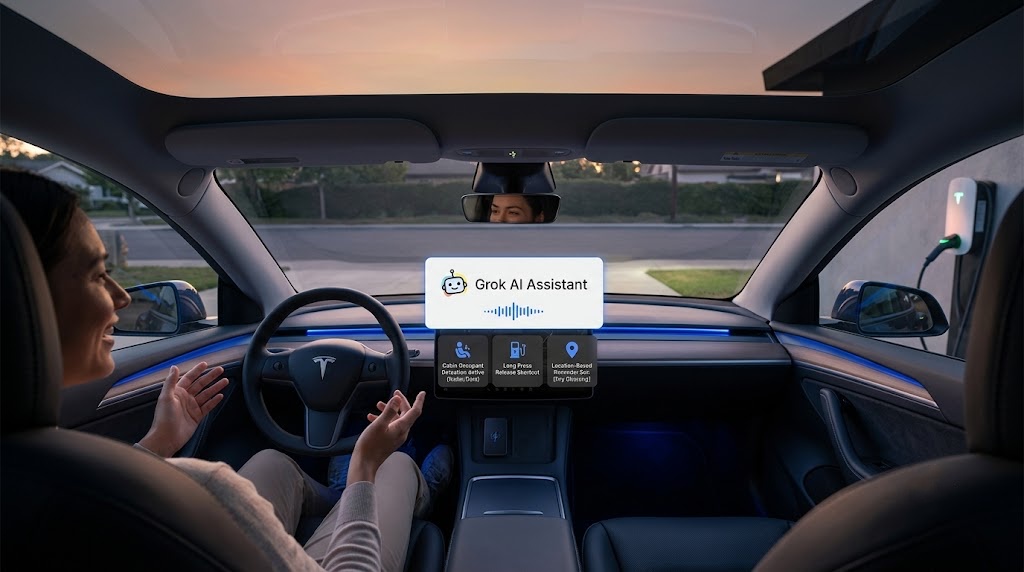
With the release of the 2026 Spring and Summer firmware branches (including updates 2026.2.3 and 2026.12.1), Tesla has introduced three groundbreaking features that fundamentally redefine cabin safety and user convenience: Child Left-Alone Detection, the Active Charge Release shortcut, and the hands-free "Hey Grok" voice AI integration. This comprehensive guide provides an exhaustive analysis of these three features, detailing the complex hardware networks that power them, their daily operational logistics, and how they protect both your family and your sanity.
2. Child Left-Alone Detection (Firmware 2026.2.3)
Every summer, tragic stories emerge of children suffering from heatstroke after being accidentally left inside hot vehicles. While Tesla’s Cabin Overheat Protection has long prevented interior temperatures from exceeding dangerous levels, Child Left-Alone Detection represents a massive, proactive leap in active safety technology.
The Multi-Sensor Detection Loop
This system does not simply rely on basic weight sensors in the seats, which can be easily fooled by heavy packages or gym bags. Instead, update 2026.2.3 orchestrates a complex, multi-layered sensor network:
-
Cabin Millimeter-Wave Radar: Mounted in the roof console, this ultra-sensitive radar sensor can detect micro-movements, including the tiny chest rise and fall of a sleeping infant, even if they are covered by a thick blanket.
-
Cabin Camera (Visual AI): The high-resolution camera mounted above the rearview mirror utilizes edge-based machine learning to scan the cabin, identifying human facial structures and physical profiles.
-
Acoustic Profiling: The cabin microphones scan for specific frequency patterns matching a child’s crying or breathing distress.
The Emergency Alert Sequence
If the vehicle is locked and the system confirms an unattended child is inside, it initiates a high-visibility, multi-tier emergency protocol to immediately attract attention:
EMERGENCY ALERT TIMELINE |
[T = 0s] System confirms unattended child inside.
[T + 5s] App Notification: Sends urgent warning to phone.
[T + 30s] Cabin Climate: Automatically engages AC at 70°F.
[T + 60s] Exterior Alert: Flashes lights & sounds horn.
This triple-tier alert loop ensures that the occupant remains completely safe in a climate-controlled cabin while ensuring the owner—or nearby pedestrians—are immediately alerted to intervene.
3. Active Charging Cable Release Shortcut
Charging a Tesla is designed to be as seamless as possible, but cold weather or minor system hiccups can occasionally make unlatching the charge cable a frustrating process. Historically, if the charge port lock failed to disengage automatically, owners had to unlock the car, navigate through the touchscreen menus, or open the trunk to pull the mechanical emergency release cable.
The Rear Door Handle Shortcut
To streamline this process, Tesla has introduced a highly elegant, completely physical shortcut in update 2026.2.3:
-
The Action: Simply walk up to the locked vehicle with a recognized key (your phone key or key fob) nearby, and pull and hold the rear-left door handle (the handle directly adjacent to the charge port) for exactly 3 seconds.
-
The Result: The vehicle immediately stops any active charging session, safely cuts the electrical current, and disengages the physical locking pin, allowing you to smoothly pull the charging cable out.
Safety Guardrails
To prevent tampering or accidental disconnects by strangers, this shortcut is protected by strict safety logic:
-
Proximity Requirement: A verified key (phone, key fob, or key card) must be within 3 feet (1 meter) of the vehicle during the 3-second hold.
-
Current Interruption: The onboard charger communicates with the wall connector to gracefully terminate power flow before the locking pin retracts, completely eliminating any risk of electrical arcing.
4. "Hey Grok" and Interactive Cabin AI
Traditional automotive voice control systems are notoriously rigid, requiring drivers to memorize precise, awkward commands like "Navigate to [Address]" or "Set temperature to 72 degrees." In the 2026 Spring Update, Tesla shattered this limitation by introducing the hands-free "Hey Grok" voice assistant.
True Natural Language Processing
Powered by xAI's advanced language models, Grok brings genuine, conversational artificial intelligence directly into the driving experience. Drivers no longer need to touch the steering wheel buttons to activate voice controls. Simply saying "Hey Grok" wakes the system, allowing for highly complex, multi-step, and context-aware requests.
Location-Based Contextual Reminders
One of the most powerful everyday applications of "Hey Grok" is the integration of location-based reminders. For example, a driver can say:
"Hey, Grok, remind me to grab the dry cleaning when I get close to home."
The vehicle’s navigation engine and Grok’s semantic processor work in tandem. When the vehicle’s GPS coordinates enter a 500-meter radius of the owner's designated "Home" address, the center screen displays a prominent reminder card accompanied by a gentle audio chime, seamlessly bridging the gap between digital thoughts and physical location.
Conclusion
The modern Tesla cabin is no longer just a static collection of screens and leather seats. Through features like Child Left-Alone Detection, the Active Charge Release shortcut, and the conversational intelligence of "Hey Grok," Tesla has created an environment that actively protects its occupants, simplifies daily operational mechanics, and understands human needs like no other vehicle on earth. This continuous evolution of cabin intelligence is what truly sets the Tesla ownership experience apart from legacy automotive manufacturers.
FAQ
Q1: Does Child Left-Alone Detection work if the car battery is extremely low?
A: The system is designed to run down to 20% battery state-of-charge. If the battery drops below 20%, the system will send an urgent, persistent notification to the owner's phone advising them to return immediately as climate support may become limited.
Q2: Can I use the rear-left door handle shortcut to release non-Tesla charging cables (like CCS or J1772 adapters)?
A: Yes. The shortcut acts on the vehicle’s physical lock mechanism inside the charge port throat, meaning it will successfully unlock any standard adapter or charging cable plugged into the port.
Q3: Does "Hey Grok" require a Premium Connectivity subscription to work?
A: Yes. Because Grok utilizes live, cloud-based natural language processing and real-time internet search capabilities, an active Premium Connectivity subscription is required to use the hands-free voice assistant.
Q4: Can "Hey Grok" control vehicle hardware functions like opening the glovebox?
A: Yes. Grok is deeply integrated with the vehicle’s local CAN bus network, allowing you to adjust climate controls, open the glovebox, toggle heated seats, and manage music playback via natural conversation.
Q5: Is the cabin microphone always listening when "Hey Grok" is enabled?
A: The system utilizes a secure, local, offline audio buffer that listens only for the specific acoustic signature of the "Hey Grok" wake-phrase. No voice data is uploaded to the cloud or recorded until the wake-word is successfully detected.