
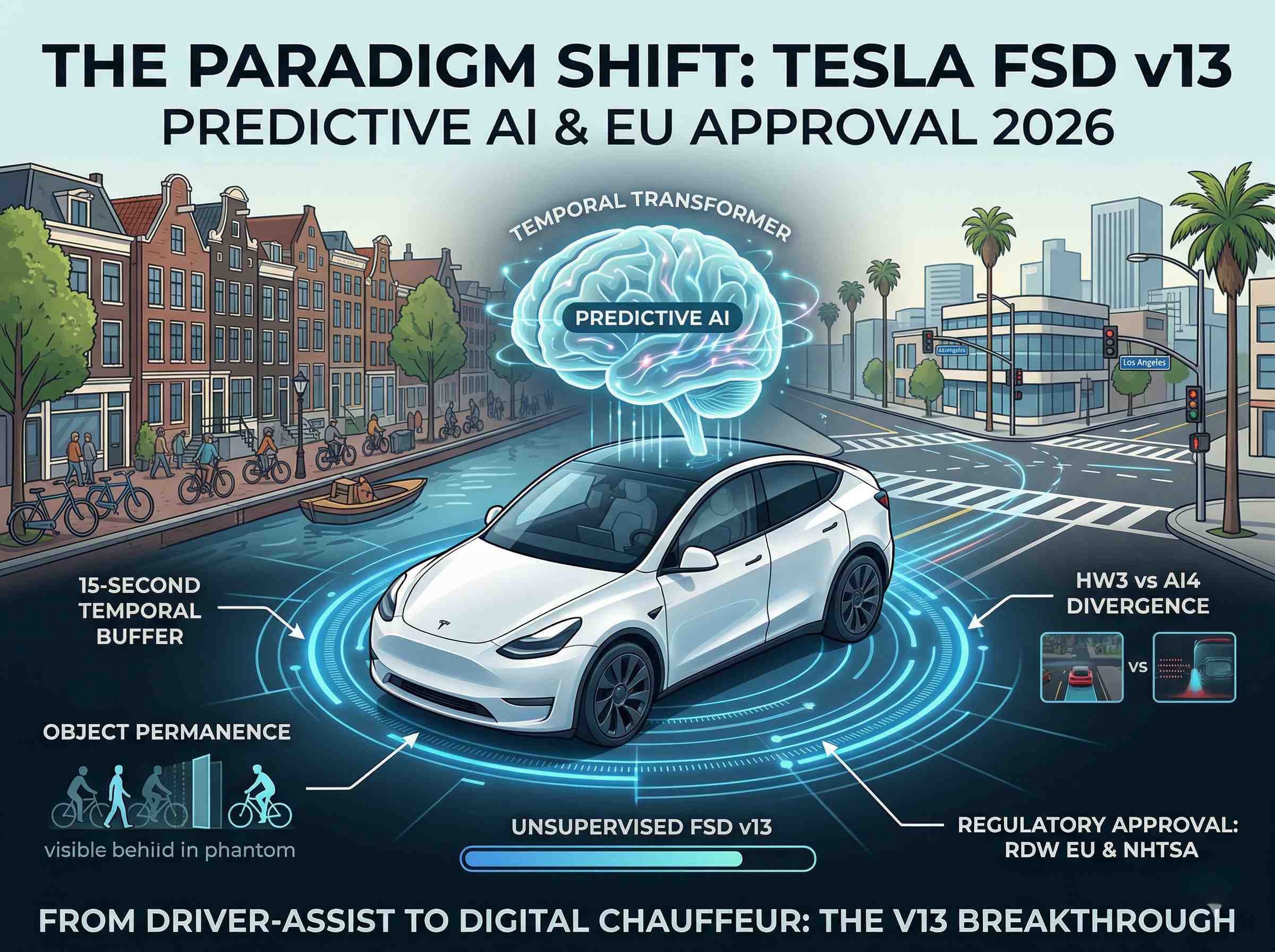
1. Introduction: The Paradigm Shift of March 2026
For years, Tesla’s Full Self-Driving (FSD) was categorized as a "highly advanced driver-assist system." However, as of March 2026, we are witnessing a fundamental transition. The release of FSD v13 (and the early developer builds of v14) has moved Tesla away from a "reactive" AI—one that simply responds to what it sees in the current frame—to a "predictive" AI.
The cornerstone of this shift is the implementation of Temporal Transformers. While previous versions like v12 introduced "End-to-End" neural networks, v13 adds the dimension of time and memory. For North American owners, this means fewer disengagements in complex urban environments. For European owners, today marks a historic milestone as the Dutch vehicle authority (RDW) nears the final approval for a summer 2026 EU-wide rollout.
2. The Core Innovation: 15-Second Temporal Buffering
The most significant technical leap in v13 is the 15-second Temporal Buffer. In the past, if a pedestrian was momentarily hidden by a parked van, the system’s "occupancy network" would occasionally lose track of them, leading to hesitant restarts or jerky braking.
Understanding "Object Permanence"
V13 utilizes a Transformer-based architecture—the same underlying logic as Large Language Models (LLMs) like GPT-4—to maintain Object Permanence. The car now "remembers" the trajectory of every object it has seen in the last 15 seconds.
-
Persistent Pathing: If a cyclist enters a blind spot, the AI calculates their probable speed and position, ensuring the car doesn't turn into their path even if they aren't currently visible to the cameras.
-
Reduced Phantom Braking: By understanding the "flow" of traffic over time, the system can distinguish between a stationary hazard and a momentary visual glitch, such as steam from a manhole cover or lens flare.
3. The HW3 vs. AI4 (Hardware 4) Divergence
As a Tesla blogger, the most frequent question from your audience is likely: "Is my older car being left behind?" Today’s data suggests a growing structural performance gap.
Voxelization and Occupancy Network 3.0
The latest update introduces Occupancy Network 3.0, which discretizes the 3D world into "voxels" (volumetric pixels).
-
AI4 Superiority: On vehicles equipped with the AI4 computer, voxel resolution is 8x higher than on Hardware 3 (HW3). This allows the car to identify fine details—like a stray nail, a shallow pothole, or the subtle hand signals of a construction worker—at twice the distance.
-
Latency: The "Photon-to-Control" Metric: AI4 has successfully halved the latency between a camera capturing an image and the car executing a steering command. In v13, this response time is now officially faster than human neurological reflexes.
While HW3 remains supported via "v13 Lite" branches, 2026 is the year where the "Unsupervised" dream begins to look like an AI4-exclusive future.
4. Regulatory Hurdles: NHTSA and the EU RDW
The software is ready, but the regulators are watching more closely than ever.
The European Breakthrough
As of March 20, 2026, Tesla Europe officially completed the final testing phase with the Dutch RDW. All documentation for UN Regulation No. 171 has been submitted.
-
The Timeline: Official approval in the Netherlands is expected by April 10, 2026.
-
Mutual Recognition: Under EU rules, once the RDW grants approval, other member states can recognize the homologation. This sets the stage for a "Staggered Rollout" in Germany, France, and Norway by June 2026.
The US "Degradation" Probe
In the United States, the NHTSA has escalated its probe into 3.2 million Tesla vehicles as of March 19, 2026. The investigation focuses on "Degradation Detection"—the system’s ability to recognize when visibility (due to glare or dust) is too poor for FSD to operate safely. Tesla’s response in v13 has been to introduce Neural Confidence Scores, which provide a 2-second proactive warning to the driver if environmental conditions deteriorate.
5. Conclusion: The End of the Beginning
We are no longer in the "Beta" era. With the integration of Grok AI for voice commands and the refinement of the Temporal Transformer architecture, Tesla has solved the primary logical hurdle of autonomy: understanding the world as a continuous sequence of events rather than a series of static photos.
For the owner in Los Angeles or the future user in Amsterdam, FSD v13 represents the transition from a "driver aid" to a "digital chauffeur." The journey toward the Cybercab launch in April 2026 is now fully paved with silicon and code.
FAQ: Frequently Asked Questions
Q: Will my 2022 Model 3 (HW3) get the full FSD v13 features? A: You will receive the core logic of v13, but certain high-resolution features like "Voxel-based Pothole Avoidance" and the ultra-low latency response times are optimized specifically for the AI4 processor.
Q: When will FSD (Supervised) be available in the UK and Germany? A: Following the expected Dutch approval on April 10, 2026, a wider European rollout is anticipated for Summer 2026. Note that UK right-hand-drive software may follow shortly after the initial EU launch.
Q: What is "Child Left Alone Detection" in the latest firmware? A: Part of the 2026.2.3 update, this uses the internal cabin camera and weight sensors to alert your phone if a child or pet is detected in a locked vehicle, flashing exterior lights as a secondary warning.
Q: Does v13 finally handle "Unprotected Left Turns" (ULTs)? A: Yes. Thanks to the 15-second temporal buffer, the car can now "wait" for a specific gap it identified seconds earlier, making ULTs significantly smoother and more "human-like" than in v12.