
Introduction
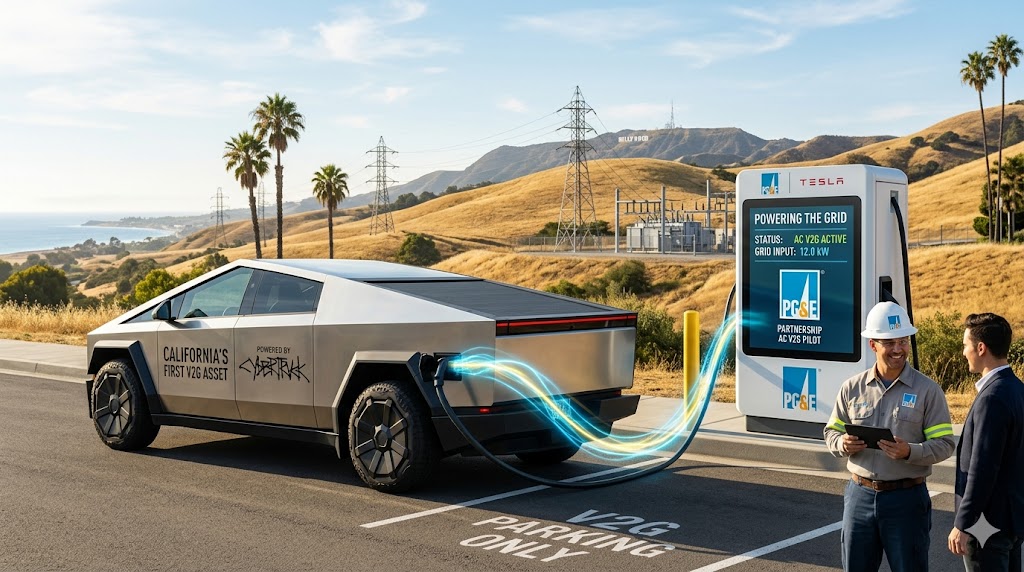
On April 20, 2026, Pacific Gas and Electric Company (PG&E) and Tesla announced a landmark development in the evolution of electric vehicles: the Tesla Cybertruck has been approved for participation in PG&E's residential Vehicle-to-Everything (V2X) pilot program. The announcement, made from Oakland, California, marks the first alternating current (AC) vehicle-to-grid application approved for customers in California, enabling Cybertruck owners to power their homes during outages and earn money by selling electricity back to the grid during high-demand events.
"Electric vehicles can do more than move people — they can help power homes and support the grid," said Jason Glickman, Executive Vice President of Strategy and Growth at PG&E. "By welcoming Tesla into our residential V2X program, we're expanding customer choice while making California's grid more flexible, resilient, and affordable."
Colby Hastings, Senior Director of Tesla's Residential Energy business, framed the announcement in competitive terms: "Our unique integrated architecture makes vehicle-to-grid dramatically cheaper than alternatives, and PG&E's V2X program will accelerate customer adoption."
This announcement transforms the Cybertruck ownership proposition. What was previously an electric pickup truck — albeit one with distinctive styling and impressive specifications — now becomes a mobile power plant capable of backing up a home during blackouts and generating revenue by supporting California's electricity grid. For owners in PG&E's service territory, which covers over sixteen million people across Northern and Central California, the Cybertruck now offers a tangible financial benefit that offsets ownership costs and enhances energy independence.
Chapter 1: How Cybertruck V2G Works — The Technical Breakdown
The Cybertruck's vehicle-to-grid capability relies on three core components: the Cybertruck itself with its built-in bidirectional charging hardware, the Tesla Powershare Gateway, and the Tesla Universal Wall Connector. Together, these components enable electricity to flow in both directions — from the grid to the vehicle for charging, and from the vehicle to the home or grid during discharge events.
What makes Tesla's approach distinctive is its use of alternating current (AC) power natively. In a conventional EV charging setup, the grid supplies AC power, which the vehicle's onboard charger converts to direct current (DC) to charge the battery. Bidirectional systems must reverse this process, converting the battery's DC power back to AC for home or grid use. Ford and General Motors, which already participate in PG&E's V2X pilot, rely on DC bidirectional chargers — specialized hardware that converts DC to AC externally and can cost between six thousand and ten thousand dollars for installation.
Tesla's Powershare system takes a fundamentally different approach. By handling the AC-DC conversion inside the vehicle and delivering AC power directly to the Powershare Gateway and Universal Wall Connector, the system uses conventional residential electrical equipment rather than specialized DC infrastructure. The result is lower hardware complexity, lower installation costs, and better interoperability with existing home electrical panels.
This AC distinction matters enormously for scaling vehicle-to-grid adoption. DC bidirectional chargers are expensive, require dedicated circuits, and often necessitate electrical panel upgrades — barriers that discourage homeowner participation. An AC-based system that works through standard residential service removes a major cost obstacle and positions Tesla's solution for broader deployment across California and beyond.
The Cybertruck operates in two distinct modes under the PG&E program. Powershare Home Backup automatically powers the home during grid outages, providing seamless backup electricity that can sustain a typical household for days. Powershare Grid Support exports energy to the grid during high-demand events, with compensation provided through PG&E's Emergency Load Reduction Program (ELRP).
The program runs on an opt-in, event-based model. Owners choose whether to participate in specific grid events and retain full control over how much energy they contribute. Discharge limits allow owners to reserve battery capacity for driving, ensuring that grid participation does not compromise mobility.
The Cybertruck's 123 kilowatt-hour battery pack — equivalent to roughly nine Tesla Powerwalls — makes it one of the largest mobile energy storage assets available to the grid. This capacity matters particularly during California's peak demand periods, typically summer evenings when solar generation drops and air conditioning loads surge. A single Cybertruck can store enough energy to power an average American home for several days, and when aggregated across hundreds or thousands of vehicles, the collective storage capacity becomes a meaningful grid resource.
Chapter 2: Why AC Matters — Tesla's Competitive Advantage
The technical distinction between AC and DC vehicle-to-grid systems may seem arcane, but it has profound implications for cost, scalability, and user adoption.
Ford's F-150 Lightning, the first vehicle approved for PG&E's V2X pilot, uses a DC-based system developed in partnership with Sunrun. The setup requires Ford's Charge Station Pro and Sunrun's Home Integration System — specialized hardware that converts the truck's DC battery power to AC for home use. Installation costs for this system typically range from six thousand to ten thousand dollars, depending on electrical panel requirements and labor complexity.
General Motors' Ultium-based vehicles — including the Chevrolet Silverado EV, Equinox EV, Blazer EV, Cadillac Lyriq, and GMC Sierra EV — use a similar DC bidirectional architecture. The GM Energy V2H Bundle includes a bidirectional charger and home hub, with installation costs comparable to Ford's solution.
Tesla's AC-based approach fundamentally changes the cost equation. Because the Cybertruck handles AC-DC conversion internally and delivers AC power directly to the Powershare Gateway, the system uses conventional residential electrical equipment rather than specialized DC infrastructure. This means lower hardware costs, simpler installation that often avoids panel upgrades, and better compatibility with existing home electrical systems.
The cost advantage is amplified by PG&E's incentive structure. Participants in the V2X pilot may receive up to four thousand five hundred dollars in incentives applied toward bidirectional-enabled equipment such as the Tesla Universal Wall Connector and Powershare Gateway, as well as utility interconnection costs. Additional incentives are available for participating in planned grid or backup power events and for staying enrolled through the end of the pilot program.
For a Cybertruck owner, the combination of lower equipment costs and substantial incentives means the out-of-pocket expense for enabling V2G capability may be minimal — potentially even net-positive once grid participation compensation is factored in. This economic advantage positions Tesla's solution for broader adoption than the more expensive DC-based alternatives.
Beyond cost, the AC approach offers interoperability benefits. A system that works through standard residential electrical service can more easily integrate with existing home infrastructure, including solar panels and Powerwall batteries. Tesla has indicated that Powershare with Powerwall integration — allowing Cybertruck energy to flow through a home battery system — is scheduled for mid-2026, though this feature has faced previous delays.
Chapter 3: Financial Incentives — How Cybertruck Owners Earn Money
The PG&E V2X program offers Cybertruck owners multiple pathways to financial benefit, structured across three categories of incentives.
First, participants receive up to four thousand five hundred dollars in incentives applied toward the cost of bidirectional-enabled equipment and utility interconnection. This incentive covers the Tesla Universal Wall Connector and Powershare Gateway — the two hardware components required to enable V2G capability — as well as any necessary electrical work to connect the system to the home and grid.
Second, owners earn additional compensation for participating in planned grid or backup power events. During periods of high electricity demand, enrolled vehicles may export power in response to grid signals, helping balance supply and demand while providing customer compensation. These events are coordinated through PG&E's Emergency Load Reduction Program (ELRP), which pays participants for reducing demand or supplying power during critical periods.
Third, bonus incentives are available for staying enrolled through the end of the pilot program. This retention incentive encourages continued participation and helps PG&E build a stable base of distributed energy resources.
The compensation structure follows a model already validated in Texas. In February 2026, Tesla launched the Powershare Grid Support program in Texas, where Cybertruck owners in CenterPoint Energy and Oncor service areas began earning bill credits for discharging to the grid during high-demand events. While exact compensation rates vary by grid event and utility territory, Texas participants have reported meaningful bill credits that offset electricity costs.
Tesla's experience with Powerwall virtual power plants provides additional context for what Cybertruck owners might expect. In 2024, Tesla paid Powerwall owners nine million nine hundred thousand dollars through its VPP programs. The company has been building its virtual power plant presence in Texas since 2022, starting with a two-hundred-Powerwall demonstration and eventually securing approval from the Public Utility Commission of Texas for two VPPs.
The Cybertruck's 123 kilowatt-hour battery capacity dwarfs the 13.5 kilowatt-hours in a single Powerwall, suggesting that Cybertruck owners could earn proportionally more — though actual earnings will depend on utility compensation rates, frequency of grid events, and individual participation levels.
Importantly, Tesla has stated that using Powershare Grid Support through Tesla Electric will not impact the Cybertruck warranty for early participants. This reassurance matters for owners who want to try the program without second-guessing long-term battery health or coverage implications.
Chapter 4: Expanding from Texas — Why California Represents a Much Bigger Opportunity
The California announcement follows Tesla's launch of the Powershare Grid Support program in Texas in February 2026, where Cybertruck owners in CenterPoint Energy and Oncor service areas covering Houston and Dallas began earning bill credits for grid participation.
The Texas program was Tesla's first V2G offering in the United States and represented a strategic choice. Texas operates its own isolated grid through ERCOT, which is notorious for volatility and has experienced several high-profile near-failures during extreme weather events. Tesla has been building its virtual power plant presence in Texas since 2022, and adding Cybertrucks to that distributed energy network made strategic sense — each truck packs 123 kilowatt-hours of capacity, vastly exceeding the 13.5 kilowatt-hours in a single Powerwall.
California represents a much larger opportunity. PG&E serves more electric vehicle drivers than any other utility in the United States, and California has the largest EV market in the country. The PG&E V2X pilot offers up to one thousand residential customer spots, and early enrollment is recommended given expected demand.
California's grid faces unique challenges that make distributed energy resources particularly valuable. The state's rapid adoption of solar power has created the "duck curve" — a phenomenon where net electricity demand drops sharply during midday solar production and rises steeply in the evening as the sun sets. This evening ramp requires flexible resources that can quickly respond to changing grid conditions. Vehicle-to-grid technology, which can discharge stored energy precisely when the grid needs it most, offers a compelling solution.
California also experiences frequent power outages due to wildfire risk, particularly in PG&E's service territory. The utility's Public Safety Power Shutoff program intentionally de-energizes power lines during high-fire-risk conditions to prevent catastrophic wildfires. For residents in affected areas, the ability to power their homes from their Cybertruck during these outages provides a level of energy security that no conventional vehicle can match.
Tesla has indicated that expansion beyond PG&E is planned, with Southern California Edison and San Diego Gas and Electric territories next in line for V2G availability. This phased rollout approach allows Tesla and the utilities to refine program parameters and operational procedures before broader deployment.
Chapter 5: What Cybertruck Owners Need to Know
For current and prospective Cybertruck owners in California, the PG&E program opens new possibilities for how their vehicle can serve their household.
Enrollment in the V2X pilot requires a Cybertruck with Powershare capability, the Tesla Powershare Gateway, and the Tesla Universal Wall Connector. These components must be professionally installed, and the system must pass utility interconnection approval before participation can begin. Owners can enroll through PG&E's V2X program portal at pge.com/V2X.
The program operates on an opt-in, event-based model. Owners choose whether to participate in specific grid events, which are typically announced in advance through the Tesla app. During an event, the Cybertruck automatically discharges energy to the grid up to the owner's specified discharge limit, and compensation is credited to the owner's account.
Owners should understand several important considerations. First, participation requires the vehicle to be plugged in at home when grid events occur — events that may occur with little notice. Tesla encourages participants to keep their Cybertrucks plugged in when at home to maximize grid support availability.
Second, owners retain full control over discharge limits, allowing them to reserve battery capacity for driving. If a grid event occurs and the owner needs to drive somewhere, the vehicle's battery will have whatever charge remains based on the discharge limit setting.
Third, the program's pilot status means that parameters and compensation rates may evolve over time. PG&E and Tesla will use data from the pilot to refine program design and potentially expand to a permanent offering.
Fourth, while Tesla has stated that participation will not impact the Cybertruck warranty for early adopters, owners should review their warranty documentation and consult Tesla for specific guidance regarding their individual circumstances.
Finally, the availability of up to four thousand five hundred dollars in incentives makes the hardware installation financially accessible for most owners. Combined with ongoing compensation for grid participation, the program can meaningfully offset Cybertruck ownership costs.
Conclusion
The PG&E and Tesla announcement transforms the Cybertruck from an electric pickup into a mobile power plant capable of backing up homes during outages and earning money by supporting California's electricity grid. The first AC vehicle-to-grid application approved in California establishes Tesla's Powershare system as a technically simpler, lower-cost alternative to the DC-based solutions from Ford and General Motors.
For Cybertruck owners in PG&E's service territory, the program offers tangible financial benefits: up to four thousand five hundred dollars in equipment incentives, ongoing compensation for grid participation, and bonus incentives for continued enrollment. The ability to power a home during outages — a capability that proved valuable during Texas grid events and California wildfire-related shutoffs — provides energy security that no conventional vehicle can match.
The expansion from Texas to California signals Tesla's broader ambitions for vehicle-to-grid technology. With PG&E serving more EV drivers than any other U.S. utility, the California program represents a significant scaling of Tesla's distributed energy vision. Southern California Edison and San Diego Gas and Electric territories are expected to follow.
Perhaps most importantly, Tesla's AC-based approach to V2G removes a major cost barrier to homeowner adoption. By eliminating the need for expensive DC bidirectional chargers and specialized installation, Tesla has positioned vehicle-to-grid technology for mainstream deployment. As more utilities across the United States launch V2G programs, the Cybertruck's unique bidirectional capability may become a significant differentiator and resale value driver.
The convergence of electric vehicles and home energy systems represents one of the most promising frontiers in the clean energy transition. With the Cybertruck now approved as California's first AC vehicle-to-grid asset, Tesla has taken a meaningful step toward a future where millions of EVs serve not just as transportation but as distributed energy resources that strengthen grid resilience and accelerate decarbonization.
FAQ
Q: How much money can I realistically earn from V2G?
A: Exact compensation rates vary by grid event and utility territory. Texas participants have reported meaningful bill credits. California incentives include up to four thousand five hundred dollars toward equipment, plus per-event payments.
Q: Does participating in V2G affect my Cybertruck's battery warranty?
A: Tesla has stated that using Powershare Grid Support through Tesla Electric will not impact the Cybertruck warranty for early participants. Owners should review their warranty documentation and consult Tesla for specific guidance.
Q: Can I use V2G with other Tesla models?
A: Currently, only Cybertruck supports bidirectional charging. Tesla has not announced V2G plans for Model 3, Model Y, Model S, or Model X.
Q: What happens during a power outage?
A: Powershare Home Backup automatically switches your home to Cybertruck battery power, providing seamless backup electricity for as long as the battery has charge.
Q: How long can Cybertruck power my home?
A: With a 123-kilowatt-hour battery pack, a Cybertruck can power an average American home for several days, depending on energy usage. A typical home consumes approximately thirty kilowatt-hours per day.
Q: Will other utilities offer similar V2G programs?
A: Likely yes. PG&E's program is a pilot that, if successful, will likely be replicated by other major utilities. Tesla plans to expand to Southern California Edison and San Diego Gas and Electric territories.
Q: What equipment do I need to participate?
A: You need a Cybertruck with Powershare capability, the Tesla Powershare Gateway, and the Tesla Universal Wall Connector. Professional installation is required.
Q: How do I enroll?
A: Cybertruck owners in PG&E's service territory can enroll at pge.com/V2X. The program offers up to one thousand residential customer spots, so early enrollment is recommended.
Q: Do I have to participate in every grid event?
A: No. Participation is opt-in and event-based. You choose whether to participate in specific grid events and retain full control over discharge limits.
Q: What is the difference between Powershare Home Backup and Powershare Grid Support?
A: Home Backup powers your home during outages. Grid Support exports energy to the grid during high-demand events in exchange for compensation.
Q: Why is AC-based V2G better than DC-based systems?
A: AC-based V2G uses conventional residential electrical equipment rather than specialized DC infrastructure, resulting in lower hardware complexity, lower installation costs, and better compatibility with existing home electrical panels.