
I. Introduction
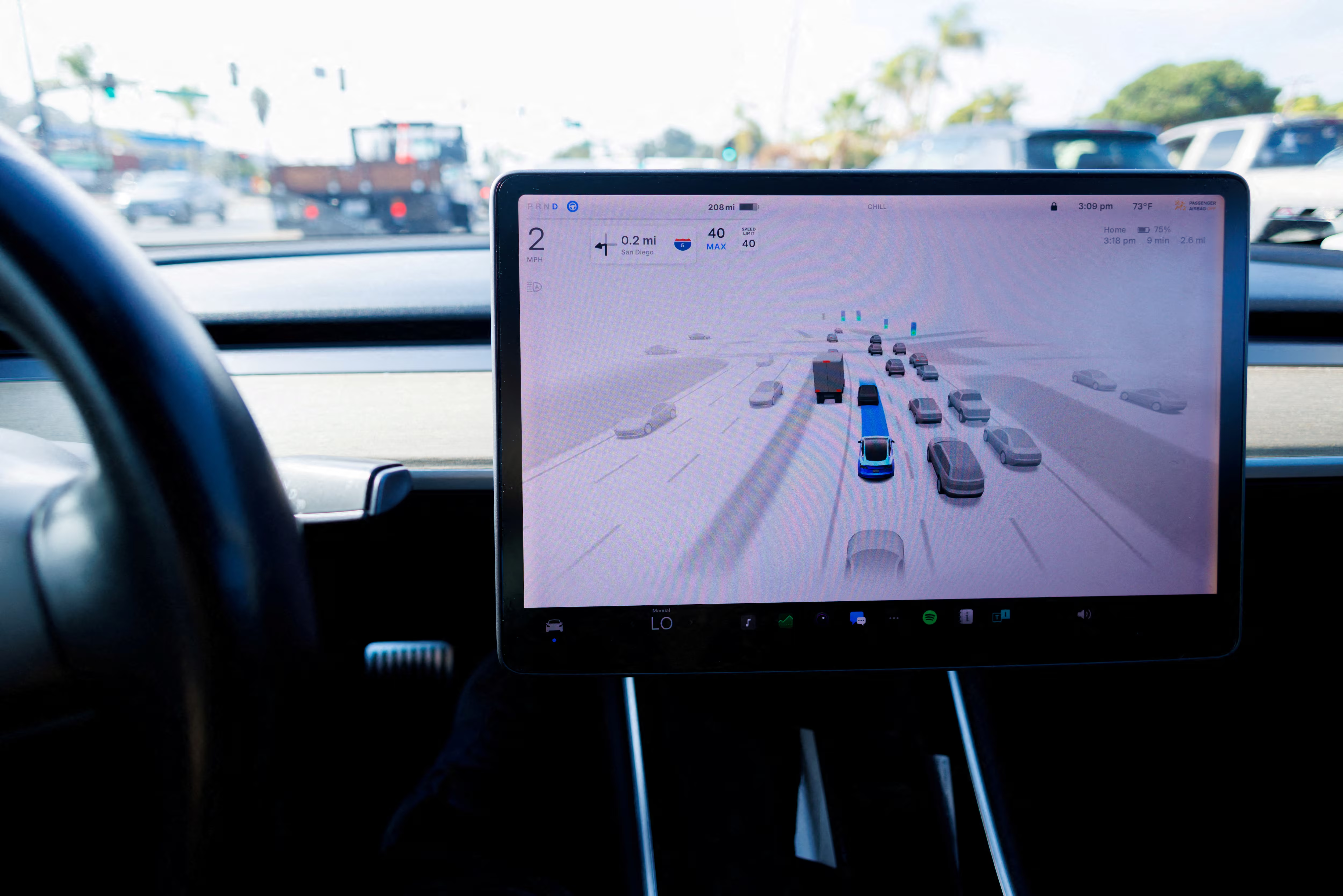
The U.S. National Highway Traffic Safety Administration (NHTSA) has launched a new investigation into Tesla’s Full Self-Driving (FSD) system, targeting over 2.9 million vehicles sold in the United States.
At the heart of the inquiry is whether Tesla’s FSD software—marketed as a driver-assistance system—encourages unsafe behavior or systematic traffic law violations.
While Tesla maintains that FSD requires active supervision and is “safer than human drivers,” federal regulators are now probing whether the software’s behavior may be non-compliant with U.S. traffic regulations, particularly in cases involving stop signs, speed limits, and lane discipline.
This marks one of the most comprehensive safety reviews Tesla has faced in years—one that could shape the legal and technological trajectory of autonomous driving in the U.S.
II. Background: Tesla’s History with U.S. Regulators
Tesla’s relationship with U.S. safety regulators has long been complicated.
-
In 2021–2023, NHTSA opened multiple probes into Autopilot-related collisions.
-
In 2024, Tesla issued a limited recall involving driver-assistance “visual cues.”
-
Now, in 2025, NHTSA is focusing squarely on the behavioral outputs of FSD, not just its hardware or driver-monitoring systems.
According to internal NHTSA documents, the agency’s current review centers on whether FSD “fails to adhere to traffic control devices and posted speed limits under certain conditions.”
In other words, regulators are no longer just testing if FSD avoids crashes—they are testing if it obeys the law.
III. Scope and Objectives of the Investigation
NHTSA’s Office of Defects Investigation (ODI) confirmed that the probe affects nearly every Tesla sold in the U.S. equipped with FSD or Autopilot hardware:
-
Model S (2016–2025)
-
Model X (2016–2025)
-
Model 3 (2017–2025)
-
Model Y (2020–2025)
The agency will examine:
-
Traffic control compliance: Does FSD consistently stop at red lights and stop signs?
-
Speed adaptation: How accurately does the system interpret and respond to changing speed limits?
-
Lane discipline: Does the system remain centered within lanes or improperly cross markings during automated maneuvers?
-
Driver supervision effectiveness: How well does Tesla ensure that users remain attentive during FSD engagement?
According to an NHTSA spokesperson, “The investigation will determine whether the system’s operational behavior may constitute an unreasonable risk to motor vehicle safety.”
IV. Tesla’s Response
Tesla has not issued an official press release, but Elon Musk responded on X (formerly Twitter), calling the probe “routine” and stating that FSD “strictly follows traffic laws unless overridden by human drivers.”
He added:
“Our data shows FSD Beta users experience far fewer accidents per mile than average human drivers. Regulators will find that FSD enhances, not endangers, road safety.”
Internally, Tesla engineers reportedly believe the issue stems from contextual interpretation, where FSD occasionally misjudges temporary road signs or fails to adapt quickly to construction zones—issues common among AI-based perception systems.
Still, the company faces pressure to demonstrate verifiable compliance, not just statistical safety.
V. Key Technical Concerns
1. Stop Sign Roll-Through
Videos posted by users have shown FSD occasionally performing a “rolling stop” at intersections—a behavior that mimics human habits but violates most state traffic laws.
Tesla removed this feature in 2022 after NHTSA intervention, but testers claim similar edge-case behaviors persist in some builds.
2. Speed Limit Confusion
In rural areas, Tesla’s camera-based sign detection sometimes misreads school zone or temporary speed limits, causing momentary overspeeding.
Such lapses may technically violate traffic regulations, even if they pose no immediate safety hazard.
3. Lane Selection Bias
Analysts have observed FSD occasionally drifting toward the inner lane on multi-lane highways—a subtle preference that may confuse nearby drivers or violate state lane discipline rules.
Each of these issues reflects the broader challenge of encoding legal nuance into machine learning models.
Where humans rely on context and social expectation, neural networks rely on training data—and that data may not fully capture the diversity of U.S. road conditions.
VI. The Legal and Regulatory Implications
This investigation could have far-reaching implications for both Tesla and the broader autonomous vehicle industry.
If NHTSA finds evidence of systematic violations, Tesla could face:
-
Mandatory software revisions or recalls,
-
Monetary penalties, and
-
Public transparency requirements regarding FSD testing data.
Furthermore, the probe could establish a legal precedent for how regulators evaluate “intelligent” driving systems—not just for safety outcomes, but for lawful conformance.
Automotive legal scholars note that the case may force U.S. regulators to define what it means for an AI driver to be “compliant.”
As Stanford Law Professor Carla Gomez explains:
“Tesla has blurred the line between driver assistance and automation. NHTSA’s investigation could finally compel the government to articulate where that line legally sits.”
VII. Industry and Public Reactions
The reaction from the EV community has been polarized.
-
Tesla supporters argue that regulators are overreaching, citing millions of FSD miles without serious incidents.
-
Critics counter that “obeying the law” is a non-negotiable baseline for any vehicle operating on public roads.
Competitors like Waymo and Cruise, both operating fully driverless fleets under stricter conditions, have remained publicly silent but are privately observing the case with interest—since any enforcement outcome will likely shape future AI driving regulations.
Meanwhile, Tesla owners report mixed feelings: many appreciate FSD’s convenience, but some worry that regulatory scrutiny could slow future feature rollouts or even restrict beta access.
VIII. Potential Outcomes and Timelines
NHTSA investigations typically follow three stages:
-
Preliminary Evaluation (PE) – Data gathering (currently underway).
-
Engineering Analysis (EA) – Technical verification of defects.
-
Recall or closure – Based on findings.
Analysts estimate this process may take 6 to 12 months, depending on Tesla’s cooperation and the complexity of the data.
If the findings point to noncompliance, Tesla may issue a software-based recall, similar to the 2023 Autosteer fix, which was deployed entirely over-the-air.
IX. Broader Context: Trust and Transparency
Beyond the legal dimension, the NHTSA probe reflects a broader cultural question:
Can consumers trust software-driven autonomy to obey laws as reliably as humans?
Tesla’s approach—releasing beta versions directly to consumers—has accelerated real-world learning but also blurred accountability lines.
Unlike traditional automakers, Tesla collects massive datasets in real time, enabling fast iteration but limited external oversight.
As the public grows more aware of AI’s limitations, trust may hinge not on performance metrics, but on ethical transparency—how Tesla communicates its systems’ boundaries, risks, and trade-offs.
X. Conclusion
NHTSA’s new investigation into Tesla’s FSD system signals a critical inflection point for both the company and the future of road autonomy.
It challenges not only Tesla’s technology, but also the regulatory frameworks that govern machine-driven behavior on public roads.
If Tesla successfully demonstrates that FSD adheres to legal standards while maintaining its safety edge, the company could solidify its leadership in supervised autonomy.
If not, it may face the first major regulatory roadblock to its long-promised vision of full autonomy.
Either way, this probe represents a necessary step in answering one of the most pressing questions of the decade:
Can an algorithm truly follow the law?
FAQ
1. Which Tesla models are affected?
All models equipped with FSD or Autopilot hardware from 2016 to 2025.
2. Does this mean Tesla cars are unsafe?
Not necessarily—the focus is on legal compliance, not crash rates.
3. What could happen next?
Tesla may need to modify software behavior or provide compliance reports.
4. How long will the investigation take?
Likely 6–12 months, depending on data and cooperation.
5. Will this affect European markets?
Indirectly. EU regulators often align with U.S. safety findings, especially if legal behavior patterns are questioned.