
Chapter 1: Introduction – A Network Transformed
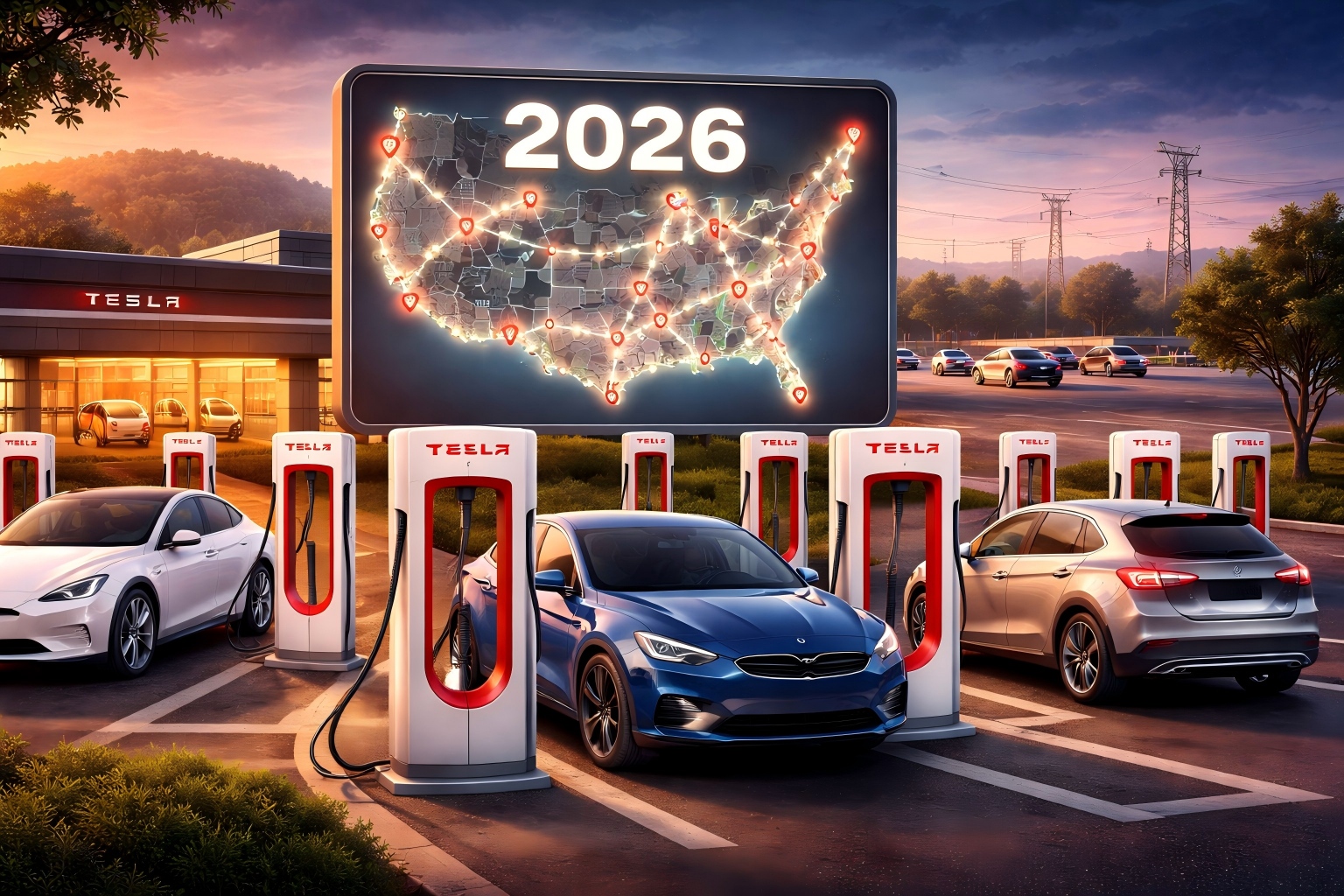
When Tesla began building its Supercharger network in 2012, it was a competitive advantage exclusive to Tesla owners. Fast-forward to 2026, and the network has evolved into something far more complex: a public charging utility that serves Ford, Rivian, GM, Hyundai, and Stellantis vehicles alongside Tesla’s own fleet. Meanwhile, the hardware powering this network is undergoing its most significant transformation since the original Supercharger debuted.
On March 16, 2026, Tesla Charging made a quiet but momentous announcement: Gigafactory New York had produced its final V3 Supercharger cabinet, marking the end of a seven-year, 15,000-cabinet production run. The V4 cabinet line is now ramping up, bringing 500kW charging capability, support for 800-volt vehicles, and a simplified installation process that promises faster network expansion .
Chapter 2: The V4 Revolution – Hardware That Changes Everything
The transition from V3 to V4 is not merely an incremental upgrade. It represents a fundamental rethinking of how Supercharger sites are designed, deployed, and operated.
Technical Specifications
The V4 cabinet, which powers the dispensers visible at charging sites, operates at 400 to 1,000 volts—a critical upgrade that enables full-speed charging for 800-volt vehicles from Hyundai, Kia, Porsche, and Tesla’s own Cybertruck. For compatible passenger vehicles, output reaches 500 kW per stall, effectively doubling the maximum speed of the V3 system. For the Tesla Semi, the same cabinets can deliver up to 1.2 MW per stall, supporting the company’s entry into electric trucking.
Perhaps more significant than peak power is the cabinet’s architectural efficiency. Each V4 cabinet supports up to eight charging stalls, double the four stalls per cabinet of the V3 system. This reduces the physical footprint required for power cabinets at each site, simplifying permitting and deployment. As Max de Zegher, director of Tesla Charging in North America, explained when the V4 system was announced: “Posts can peak up to 500kW for cars, but we need less than 1MW across 8 posts to deliver maximum power to cars 99% of the time” .
The Folding V4 Innovation
In a development that underscores Tesla’s focus on deployment velocity, the company introduced a folding V4 Supercharger design in March 2026. The engineering change allows 33% more units to fit on a single delivery truck, cuts deployment time in half, and reduces overall installation cost by roughly 20%.
This innovation addresses one of the least glamorous but most consequential bottlenecks in charging infrastructure: getting hardware from factory floor to job site efficiently. By collapsing the form factor for transit and unfolding into an operational configuration on arrival, the folding design dramatically reduces logistics overhead—particularly at large or remote sites where multiple units are needed simultaneously.
For Tesla owners, the folding V4 translates into faster rollout of new stations, particularly in underserved regions, and lower capital costs that help keep Supercharger pricing competitive.
Chapter 3: 2026 Expansion Roadmap – Where New Sites Are Coming
The network’s growth in early 2026 has been substantial. In the first quarter alone, Tesla added 2,500 new Supercharger stalls globally, representing a 19% increase year-over-year. Total network capacity reached 1.8 TWh of energy delivered during the quarter, with 53 million individual charging sessions completed.
The 400-Stall Megasite
Perhaps the most ambitious project on the horizon is a planned 400-stall Supercharger site in Yermo, California. To be developed in six phases, this site will feature exclusively V4 500kW cabinets and will be located at a commercial development known as Eddie World 2. Solar canopies are planned for many of the charging bays, integrating energy generation with distribution.
This site, once completed, will be the largest Supercharger station in the world—a testament to Tesla’s confidence in continued EV adoption and the network’s role as a critical infrastructure asset.
US and Europe Focus
In the United States, Tesla opened the first true 500kW V4 Supercharger on the East Coast in Kissimmee, Florida, in March 2026, followed closely by a new site in Nashville, Tennessee . Meanwhile, a public Megacharger for the Tesla Semi launched in Ontario, California, with 37 additional Megacharger sites targeted for completion by the end of 2026.
In Europe, the V4 rollout continues across multiple markets, with new sites opening in France, Italy, and Poland. The network’s density in Western Europe now approaches that of the US, making coast-to-coast road trips increasingly feasible.
Chapter 4: Non-Tesla Access – The Open Network Era
Perhaps the most significant policy shift in the Supercharger network’s history is the opening of stations to non-Tesla EVs. As of March 2026, more than 27,500 Supercharger stalls globally are accessible to vehicles from Ford, GM, Rivian, Hyundai, and most recently Stellantis brands including Dodge, Jeep, Ram, Fiat, and Maserati .
The Regulatory Driver
This openness is not purely strategic; it is also regulatory. In markets like Malaysia, Tesla’s approval under the BEV Global Leaders program required that at least 30% of its chargers be open to other brands . Similar pressures exist in Europe, where public funding for charging infrastructure often comes with open-access requirements.
The Congestion Question
For Tesla owners, the primary concern with open access is congestion. Will you now wait in line behind a Ford F-150 Lightning or a Hyundai Ioniq 6?
The answer varies by site. Tesla has implemented a tiered pricing structure that encourages non-Tesla owners to use specific stations. In markets with open access, non-Tesla rates are typically higher than member rates, and congestion fees (idle fees) apply when stations are busy. These pricing mechanisms help balance utilization while ensuring Tesla owners retain a preferential experience.
However, there are legitimate concerns about compatibility. Early reports from open-access deployments reveal that 800-volt EVs like the Hyundai Ioniq 6 charge significantly slower at V3 Superchargers than at 800-volt-optimized competitors. Due to the Tesla network’s 400-volt architecture and the Ioniq 6’s built-in DC-DC converter limitations, real-world charging speeds at V3 stations can be limited to around 100 kW—far below the vehicle’s 235 kW capability. V4 cabinets, with their 1,000-volt capability, will address this limitation, but the transition to V4 will take time.
Chapter 5: What V4 Means for Your Charging Experience
For Tesla owners, the V4 transition brings both immediate benefits and a more complex charging landscape.
Faster Charging for Cybertruck and Future Vehicles
If you own a Cybertruck or plan to purchase one, V4 is essential. The Cybertruck’s 800-volt architecture requires V4 cabinets to achieve its maximum charging speed. At V3 stations, charging speeds are capped significantly.
Compatibility with Future Tesla Models
As Tesla transitions future vehicle lines to higher-voltage architectures, V4 will become increasingly necessary. The company’s focus on V4 production signals that higher-voltage vehicles are part of the long-term roadmap.
Simplified Site Layouts
The eight-stall-per-cabinet architecture of V4 means fewer physical cabinets cluttering charging sites. This results in cleaner, more intuitive layouts with shorter cable runs and less equipment visible. The folding V4 design further accelerates deployment, meaning sites go from planning to operation faster.
Chapter 6: Pricing and Membership – The Economics of Charging
Supercharger pricing in 2026 reflects both the network’s expansion and its open-access model. Tesla owners continue to enjoy preferential rates, while non-Tesla owners pay a premium.
Current Pricing Structure
While per-kWh rates vary by region and time of use, the general structure is consistent: Tesla owners pay the lowest rates, typically matching or undercutting competitors like Electrify America. Non-Tesla owners pay a premium—often 20-30% higher—and may be subject to congestion fees at busy locations .
The Membership Option
In some markets, Tesla offers a subscription model that reduces per-kWh rates for frequent chargers. For owners who take regular road trips, the subscription can pay for itself within a few sessions.
Idle Fees
Idle fees remain a critical tool for managing congestion. At busy sites, fees apply once a vehicle’s state of charge exceeds 80%, incentivizing owners to move their vehicles promptly after charging. Non-Tesla owners may face idle fees even at sites where Tesla owners are exempt, depending on local policies.
Chapter 7: Implications for Tesla Owners – Navigating the New Landscape
For existing Tesla owners, the Supercharger network’s evolution offers several considerations:
1. Road Trip Planning
With non-Tesla vehicles now using the network, peak travel periods may see increased congestion. The Tesla app’s real-time stall availability feature is more important than ever. Planning charging stops during off-peak hours or at V4 sites (which are more likely to have ample capacity) can minimize wait times.
2. V3 Support and Service
With V3 production ended, owners of vehicles that rely exclusively on V3-level speeds (most Model 3 and Model Y vehicles) should understand that V3 stations will continue to operate and be maintained for the foreseeable future. Tesla’s service network will support V3 equipment for years to come.
3. The Charging Experience
As non-Tesla vehicles become more common at Superchargers, the experience may change. V4 sites with longer cables accommodate vehicles with charging ports in various locations, reducing the awkward parking situations sometimes seen at V3 sites with short cables . Over time, the network will standardize around V4, creating a more uniform experience for all users.
Chapter 8: Conclusion – The Network as Moats and Bridges
The Supercharger network has always been one of Tesla’s most formidable competitive advantages. In 2026, it remains so—but its role is evolving. No longer exclusively a moat protecting Tesla’s vehicle business, it is now also a bridge connecting Tesla to other automakers’ customers and to a broader energy ecosystem.
For Tesla owners, this evolution is largely positive. The revenue from non-Tesla charging supports network expansion that benefits everyone. V4 technology brings faster speeds and better site designs. And the network’s growth—2,500 new stalls in Q1 alone—demonstrates Tesla’s commitment to infrastructure even during periods of automotive delivery fluctuations.
The next time you pull into a Supercharger and see a Rivian or a Ford charging beside you, remember: that electron they’re buying helps fund the stall you’re using. In the long run, a bigger, more robust network serves everyone.
FAQ
Q: Will non-Tesla EVs cause longer wait times at Superchargers?
A: It depends on the site. Tesla’s pricing structure and congestion fees are designed to balance utilization. V4 sites with ample capacity are less likely to experience significant waits. Using the Tesla app to check stall availability before arriving is recommended.
Q: Can my older Tesla (Model S/X with legacy charging hardware) use V4 Superchargers?
A: Yes. V4 dispensers are backward-compatible with all Tesla vehicles. However, your vehicle’s maximum charging speed is determined by its onboard hardware, not the cabinet.
Q: How do I know if a Supercharger site has V4 cabinets?
A: The Tesla app and in-car navigation indicate stall type when you select a Supercharger location. V4 sites are increasingly marked with a “500kW capable” indicator.
Q: Will Tesla continue to maintain V3 stations now that production has ended?
A: Yes. Tesla has a long-standing commitment to supporting existing infrastructure. V3 stations will remain operational and maintained for the foreseeable future.
Q: Does charging a non-Tesla at a Supercharger affect my charging speed?
A: Not directly. V4 cabinets use load balancing across all connected stalls. In practice, the difference is usually negligible, especially at sites with sufficient capacity.