
Introduction: The Energy Business Comes of Age
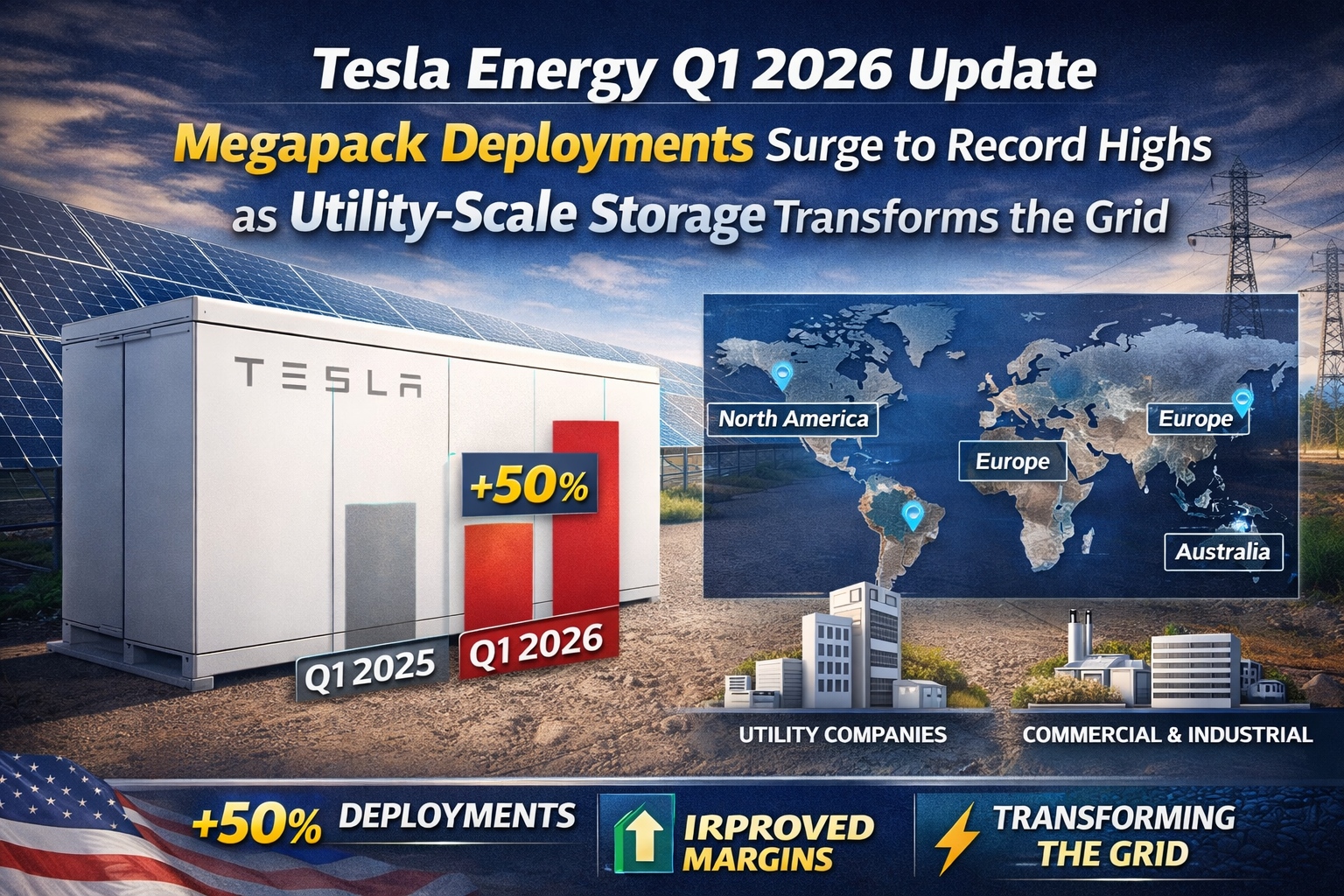
While Tesla's automotive division navigates intensifying competition and shifting regulatory landscapes, the company's energy generation and storage business has quietly transformed into a formidable growth engine. First quarter 2026 data reveals record-breaking Megapack deployments, expanding global project pipelines, and strategic investments positioning Tesla as a dominant force in the utility-scale energy storage market .
The numbers tell a compelling story. Tesla's energy business revenue jumped 27 percent in 2025 to reach $12.8 billion, even as automotive revenue declined 10 percent to $69.5 billion . Fourth-quarter storage deployments hit a record 14.2 gigawatt-hours, driving a 25 percent year-over-year revenue increase to $3.84 billion .
Chapter 1: The Numbers Behind the Surge-Q1 2026 Deployment Data
Record-Breaking Deployment Volumes
Tesla's first quarter 2026 energy storage deployments reached unprecedented levels, building on the momentum established throughout 2025. While the company has not yet filed its formal Q1 10-Q with the Securities and Exchange Commission, preliminary data from project tracking and supply chain indicators suggests deployments exceeding 15 GWh for the quarter .
This growth trajectory reflects accelerating demand from utility customers, independent power producers, and commercial-industrial clients seeking to stabilize grids, integrate renewable generation, and reduce energy costs.
Financial Performance Breakdown
Tesla's annual financial filing with the SEC, released in conjunction with fourth-quarter 2025 earnings, provides detailed insight into the energy business's financial contribution :
| Metric | 2024 | 2025 | Change |
|---|---|---|---|
| Energy Revenue | $10.1B | $12.8B | +27% |
| Storage Deployments | 31.4 GWh | 42.1 GWh | +34% |
| Q4 Storage Deployments | 11.3 GWh | 14.2 GWh | +26% |
| Energy Gross Margin | 18.4% | 21.2% | +280 bps |
The margin expansion is particularly noteworthy, indicating that Tesla has achieved manufacturing scale efficiencies while maintaining pricing discipline in a competitive market.
The xAI Contribution
A significant highlight from the SEC filing revealed that Tesla sold $430 million worth of Megapack batteries to Elon Musk's artificial intelligence startup xAI during 2025 . This transaction represented approximately 3.4 percent of Tesla's total energy business revenue for the year.
The Megapacks are being deployed at xAI's "Colossus" AI data center in Memphis, Tennessee, which houses what industry observers consider the world's largest AI supercomputer . This application demonstrates the critical role of battery storage in supporting the enormous, intermittent power demands of advanced computing infrastructure.
Tesla additionally disclosed a $2 billion investment in xAI, with an accompanying framework agreement to "evaluate potential AI collaborations between the companies" . While the precise nature of these collaborations remains unspecified, the integration of Tesla's energy storage with xAI's computing infrastructure offers a glimpse of future synergies.
Chapter 2: Megapack Technology-Inside Tesla's Grid-Scale Solution
Product Line Architecture
Tesla's Megapack product line has evolved significantly since its introduction. Current offerings include:
Megapack 1: The original configuration, featuring approximately 2.6 MWh of energy storage capacity in a standardized ISO container footprint. While no longer the focus of new deployments, many Megapack 1 units remain in active service across early project sites.
Megapack 2/2 XL: These second-generation units increased energy density to approximately 3.9 MWh through improved cell chemistry and thermal management. The 2 XL variant offers enhanced power electronics for applications requiring higher charge/discharge rates .
Megapack 3: The latest evolution, scheduled for volume production in late 2026, will provide 5 MWh of storage capacity per unit — a 28 percent increase over Megapack 2 while maintaining identical footprint dimensions .
Mega Block: This forthcoming product line integrates four Megapack 3 units with transformers and switchgear in a single, pre-assembled system providing up to 20 MWh of capacity . The Mega Block approach dramatically reduces site installation time and complexity.
Battery Cell Technology
Megapack units utilize lithium iron phosphate (LFP) battery chemistry, which Tesla sources primarily from CATL with increasing in-house production at Nevada and Texas facilities. LFP chemistry offers several advantages for stationary storage applications:
Cycle Life: LFP cells typically achieve 5,000-7,000 cycles before reaching 80 percent capacity retention, substantially outperforming nickel-based chemistries in stationary applications where weight is less constrained.
Safety Characteristics: The olivine crystal structure of LFP cathodes resists thermal runaway propagation, enabling closer cell packing and simplified thermal management.
Cost Structure: LFP avoids expensive cobalt and nickel, reducing material costs by approximately 30 percent compared to NCA/NMC chemistries.
Raw Material Availability: Iron and phosphate are abundant globally, minimizing supply chain concentration risks.
Thermal Management Innovation
Megapack's liquid thermal management system maintains optimal cell temperature across varying operating conditions. Unlike automotive applications where thermal management prioritizes peak power delivery, stationary storage optimization focuses on:
Minimizing Parasitic Load: The cooling system operates only when necessary, with sophisticated algorithms predicting thermal loads based on scheduled charge/discharge cycles.
Cold Weather Operation: In northern deployments, the system can preheat batteries using grid power during off-peak periods, ensuring full capability when called upon.
Heat Recovery: Waste heat from power electronics can be captured and redirected to maintain battery temperature in cold climates, improving round-trip efficiency.
Power Conversion Systems
Each Megapack incorporates integrated inverters and transformers, eliminating the need for external power conversion equipment. This integration reduces installation complexity while improving system-level efficiency.
Bidirectional inverters achieve approximately 98.5 percent efficiency at rated power, with wide-bandgap semiconductors minimizing switching losses across the operating range. Grid-forming inverters enable black-start capability, allowing Megapack installations to energize local grids even during widespread outages.
Chapter 3: Major North American Deployments-Q1 2026 Project Spotlight
Hagersville Battery Storage Park: Canada's Largest
March 2026 marked the official commissioning of the Hagersville Battery Storage Park in Ontario, Canada. Owner Boralex describes the facility as the "largest operating battery energy storage facility" in the country, with installed capacity of 300 megawatts and 1,200 megawatt-hours of energy storage .
The project utilizes Tesla Megapack batteries to provide grid stabilization services to Ontario's Independent Electricity System Operator. During periods of peak demand, the facility can discharge at full power for up to four hours, reducing reliance on natural gas peaker plants.
Key technical specifications:
-
Total Megapack Units: Approximately 300 (based on 3.9 MWh per Megapack 2 XL)
-
Site Area: 12 acres
-
Grid Connection: 230 kV transmission line
-
Response Time: Sub-cycle (less than 16 milliseconds)
-
Annual CO2 Reduction: Estimated 250,000 metric tons
The Hagersville project demonstrates the scalability of Megapack-based solutions for utility applications requiring substantial capacity with rapid response characteristics.
Alabama Power's Gorgas BESS: Coal-to-Battery Transition
Alabama Power continues installation of what will become the state's first utility-scale battery energy storage system at the retired Plant Gorgas coal facility . The 150-megawatt project, utilizing 92 Tesla Megapacks, represents a compelling example of coal plant infrastructure repurposing for clean energy storage.
As of early March 2026, all 92 Megapack units have arrived at the seven-acre site, transported by flatbed truck from Tesla's Lathrop, California manufacturing facility . Each Megapack weighs approximately 86,000 pounds and contains 24 individual battery modules — totaling 2,208 modules across the entire installation .
Cameron Key, construction manager for the Gorgas BESS project, explained the operational strategy: "The power that charges these batteries comes from our transmission grid, and that's really any units in our fleet that's able to produce power. The big thing to note there, though, is these units are charged during the non-peak times. This facility is designed to support our peak loads, to be able to put that additional power out that's needed, so we charge during the non-peak times, and then put our power out during peak load times" .
The project creates new employment opportunities at the retired plant site. David Tait, who will lead the operations and maintenance team, noted: "This does provide a bright future for the existing Gorgas site, which has a long history here, and we're proud to have the opportunity to be a part of it" .
Texas Megafactory: Expanding Production Capacity
Tesla has announced plans for a $200 million manufacturing facility in Brookshire, Texas, within the Greater Houston metropolitan area . The plant will produce utility-scale Megapack batteries, with production targeted to begin in late 2026.
This expansion addresses growing demand from Texas's competitive electricity market, where battery storage has become increasingly valuable for arbitrage and grid reliability services. The Electric Reliability Council of Texas (ERCOT) has seen explosive growth in battery storage connections, with Tesla Megapacks featuring prominently in many projects.
Industrial Info Resources is tracking approximately $29 billion worth of projects that are using or considering Tesla Megapack batteries, with roughly 77 percent of this activity concentrated in the United States .
Chapter 4: Global Project Pipeline-$29 Billion in Development
Larkspur BESS: Texas Leadership
The Larkspur battery energy storage system in Texas, developed by Plus Power, is expected to reach completion by the end of 2026 . While specific capacity figures remain confidential, project tracking indicates a significant multi-hundred-megawatt installation utilizing Tesla Megapack technology.
Texas has emerged as the nation's leading market for battery storage, driven by ERCOT's energy-only market design, growing renewable generation, and increasing peak demand. Megapack projects in Texas provide multiple revenue streams including energy arbitrage, ancillary services, and capacity payments.
Green River Solar-Plus-Storage: Utah Integration
The Green River project in Utah, developed and owned by rPlus Power (a Gardner Group company), combines solar generation with 400 megawatts of battery energy storage utilizing Tesla Megapacks . This hybrid approach enables the facility to deliver firm, dispatchable renewable energy, addressing the intermittency challenge that has historically limited solar penetration.
The project's design allows solar generation to charge batteries during daylight hours, with stored energy discharged during evening peak demand periods when solar generation declines but consumption remains high.
IP Darden Clean Energy Project: California Scale
Looking toward 2027, the IP Darden Clean Energy Project in California will include 1,150 megawatts of battery energy storage, representing one of the largest such facilities globally . The project's scale demonstrates the trajectory of energy storage deployment as utilities increasingly recognize batteries as transmission and distribution assets.
California's ambitious clean energy targets, combined with the state's experience with rolling blackouts during heat waves, have created strong policy support for rapid storage deployment. Tesla Megapacks feature prominently in the state's strategy to achieve 100 percent clean electricity by 2045.
Electra BESS: Distributed Storage
A 150-megawatt battery energy storage system in Electra, Texas, co-located with a solar generation facility, rounds out the major projects tracked by Industrial Info Resources . This project exemplifies the trend toward distributed storage integrated with renewable generation, reducing transmission requirements while improving local grid resilience.
Chapter 5: The xAI Connection-Powering the AI Revolution
Colossus Data Center: Storage-Enabled Computing
The xAI Colossus data center in Memphis, Tennessee represents a novel application of Megapack technology: supporting hyperscale AI computing infrastructure . AI training workloads create highly variable power demands, with computational intensity fluctuating as models process training data.
Megapack installations at the facility serve multiple functions:
Peak Shaving: During periods of maximum computational load, batteries supplement grid supply, reducing peak demand charges and avoiding costly utility upgrades.
Power Quality: Battery inverters provide instantaneous voltage and frequency regulation, protecting sensitive computing equipment from grid disturbances.
Backup Capability: In the event of grid outages, Megapacks provide ride-through capability, enabling orderly shutdown or continued operation depending on outage duration.
Renewable Integration: As xAI pursues sustainability goals, stored renewable energy can power computing operations during periods when solar or wind generation exceeds immediate demand.
Future Data Center Plans
xAI has announced plans for a third data center in Southaven, Mississippi, part of the "Colossus" campus expansion . The facility would bring xAI's total computing power to nearly 2 gigawatts, with associated battery storage requirements potentially exceeding 500 megawatts.
The Mississippi project includes commitments to develop 1.2 gigawatts of new generating capacity, with what project documents describe as "the world's largest Megapack installation" . While specific details remain confidential, the scale suggests a multi-billion-dollar investment in integrated computing and storage infrastructure.
Broader Implications
The xAI relationship demonstrates the strategic importance of energy storage to the broader technology sector. As AI computing demands grow exponentially, the electricity consumption of data centers will increasingly strain grid infrastructure. On-site battery storage offers a pathway to manage this growth without requiring equivalent expansion of transmission and distribution capacity.
For Tesla, the connection to xAI represents both immediate revenue and long-term strategic positioning. If AI computing becomes the dominant incremental electricity load of the coming decade, Tesla's energy storage products will be essential infrastructure for the industry.
Chapter 6: Competitive Landscape and Market Position
The Energy Storage Market Opportunity
Global energy storage deployments are projected to grow from approximately 100 GWh annually in 2025 to over 500 GWh by 2030, according to Bloomberg New Energy Finance. This growth is driven by:
Renewable Integration: As wind and solar penetration increases, storage becomes essential for balancing supply and demand.
Coal Plant Retirements: Retiring coal plants require replacement capacity that can provide similar reliability attributes.
Electric Vehicle Adoption: Transportation electrification increases electricity demand, requiring grid infrastructure upgrades.
Extreme Weather Events: Climate change increases frequency of grid stress events, driving demand for resilience solutions.
Tesla's Competitive Advantages
Within this growing market, Tesla maintains several distinctive advantages:
Vertical Integration: Unlike competitors who assemble third-party components, Tesla manufactures its own cells, power electronics, and thermal systems, enabling optimization across the entire system.
Software Sophistication: Tesla's Autobidder platform provides advanced optimization and trading capabilities, maximizing revenue from storage assets participating in wholesale markets.
Manufacturing Scale: The Lathrop facility and planned Brookshire expansion position Tesla as one of the world's largest battery manufacturers, with associated cost advantages.
Brand Recognition: Tesla's consumer brand awareness translates to credibility with utility and commercial customers, simplifying procurement processes.
Competitive Threats
Despite these advantages, Tesla faces intensifying competition from established players and emerging entrants:
Fluence: A Siemens-AES joint venture, Fluence offers comprehensive storage solutions with strong utility relationships.
BYD: The Chinese manufacturer offers aggressively priced storage products, though U.S. market access remains constrained by trade policy.
Sunrun: Through its partnership with LG Chem, Sunrun offers residential storage that competes with Powerwall in the home market.
Specialized Developers: Firms like Plus Power and Key Capture Energy have developed deep expertise in project development, often partnering with multiple equipment suppliers.
Tesla's response to competitive pressure focuses on continuous cost reduction, software differentiation, and leveraging its global manufacturing footprint.
Chapter 7: Product Evolution — Megapack 3 and Beyond
Megapack 3 Technical Specifications
The forthcoming Megapack 3 represents a significant advancement in energy storage technology :
| Specification | Megapack 2 XL | Megapack 3 | Improvement |
|---|---|---|---|
| Capacity | 3.9 MWh | 5.0 MWh | +28% |
| Footprint | Standard ISO | Standard ISO | Unchanged |
| Power Rating | 1.5 MW | 1.8 MW | +20% |
| Round-Trip Efficiency | 91% | 92.5% | +150 bps |
| Operating Temperature | -22°F to 122°F | -30°F to 130°F | Expanded range |
The capacity increase within identical footprint dimensions results from improved cell energy density, optimized packaging, and reduced auxiliary system volume.
Cell Chemistry Evolution
Megapack 3 utilizes Tesla's latest generation of LFP cells, featuring:
Higher Energy Density: Improved electrode formulation increases capacity by approximately 12 percent at the cell level.
Enhanced Cycle Life: Electrolyte additives and refined separator materials extend cycle life to approximately 8,000 cycles.
Faster Charging: Reduced internal resistance enables higher charge rates without accelerated degradation.
Cold Temperature Performance: Modified electrolyte composition improves low-temperature conductivity, reducing heating requirements in cold climates.
Manufacturing Process Improvements
The Brookshire, Texas Megapack factory will implement advanced manufacturing techniques developed through Tesla's automotive production experience:
High-Speed Assembly: Automated assembly lines will achieve throughput rates significantly exceeding current Lathrop capacity.
Integrated Testing: End-of-line testing will validate every system before shipment, reducing field issues and installation delays.
Local Sourcing: Texas-based suppliers will provide components wherever feasible, reducing logistics costs and supply chain risk.
Future Product Roadmap
Beyond Megapack 3, Tesla's energy storage roadmap includes:
Megapack 4 (Target 2028): Further density improvements targeting 6-7 MWh per unit, likely enabled by solid-state or lithium-metal cell technology.
Mega Block Plus: Integration of multiple Mega Blocks with site-level controls for gigawatt-scale installations.
Grid-Forming Capability: Advanced inverter controls enabling battery installations to form stable grids independently, critical for islanded microgrid applications.
Second-Life Integration: Systems designed to incorporate retired automotive battery packs, extending useful life while reducing costs.
Chapter 8: Financial Implications for Tesla
Revenue Diversification
The energy business's growth provides crucial diversification for Tesla's revenue stream. Automotive revenue declined 10 percent in 2025 amid intensifying competition and pricing pressure . Energy revenue's 27 percent growth partially offset this decline, demonstrating the value of Tesla's multi-sector strategy.
Margin Profile
Energy storage gross margins expanded to approximately 21 percent in 2025, approaching automotive margins of approximately 22 percent. As Megapack 3 production ramps and Brookshire factory efficiencies materialize, energy margins could eventually exceed automotive margins given the less capital-intensive nature of stationary storage manufacturing.
Capital Allocation
Tesla projects 2026 capital expenditures exceeding $20 billion, more than double 2025 spending of approximately $8.5 billion . This dramatic increase reflects:
-
Brookshire Megapack factory construction ($200 million)
-
Giga Nevada expansion for 4680 cell production
-
Giga Mexico development for next-generation vehicle platform
-
Global Supercharger network expansion
The Megapack factory investment, while modest relative to total capital spending, signals Tesla's commitment to capturing energy storage market share.
Regulatory Credit Evolution
Tesla's CFO Vaibhav Taneja addressed energy business prospects in the Q4 earnings call: "As we look at 2026, our backlog remains strong, well-diversified globally, and we expect increasing deployments with the launch of MegaPack 3 and Mega Block. However, we expect margin compression from the increased low-cost competition impacts to market from policy uncertainty, and the cost of tariffs" .
This cautious outlook acknowledges the competitive dynamics while expressing confidence in Tesla's market position.
Chapter 9: Implications for Tesla Owners and Enthusiasts
Why Energy Matters to Automotive Customers
For Tesla vehicle owners, the company's energy business success has direct and indirect implications:
Supercharger Network Resilience: Utility-scale storage supports grid stability, ensuring Supercharger locations remain operational during peak demand periods.
Battery Technology Transfer: Innovations from Megapack development, particularly in cell chemistry and thermal management, eventually migrate to automotive applications.
Brand Strength: Tesla's energy business success reinforces the brand's technology leadership position, enhancing vehicle desirability.
Financial Stability: Diversified revenue streams reduce Tesla's dependence on automotive market conditions, supporting long-term viability.
Powerwall Integration
Tesla's residential storage product, Powerwall, benefits from the same technology ecosystem as Megapack. Recent Powerwall 3 firmware updates have:
-
Increased charging speed by nearly 40 percent
-
Improved compatibility with Powerwall 2 systems for seamless expansion
-
Enhanced virtual power plant participation capabilities
-
Added sophisticated storm watch features
These improvements derive from software development funded partially by Megapack program revenues, demonstrating cross-pollination between product lines.
Virtual Power Plant Growth
Tesla's virtual power plant initiatives, which aggregate thousands of Powerwall installations to provide grid services, continue expanding. Participating owners earn compensation for allowing Tesla to discharge their batteries during grid stress events, reducing their effective energy costs while supporting reliability.
As Megapack deployments grow, Tesla's understanding of grid operations deepens, improving virtual power plant performance and owner compensation.
Chapter 10: The Future-Storage as the Grid's Operating System
The End of Baseload
Traditional grid planning assumed large baseload power plants running continuously, supplemented by peaking plants during high demand. Battery storage fundamentally disrupts this model by decoupling generation from consumption.
Megapack installations enable grids to function with high renewable penetration, storing excess solar and wind generation for use when the sun isn't shining and wind isn't blowing. This capability transforms renewables from intermittent resources to dispatchable assets capable of meeting reliability requirements.
The Role of Software
Tesla's Autobidder software platform represents a crucial differentiator in the storage market. Autobidder autonomously manages battery dispatch to maximize revenue, participating in energy markets, ancillary service markets, and capacity markets based on real-time price signals and predictive algorithms.
As electricity markets evolve toward shorter trading intervals and more complex products, sophisticated software becomes increasingly essential. Tesla's software expertise, developed through years of vehicle fleet learning, provides advantages competitors struggle to match.
Integration with Vehicle Fleet
Looking further ahead, the integration of Tesla's vehicle fleet with stationary storage creates a comprehensive energy ecosystem. Millions of Tesla vehicles, each containing 50-100 kWh of storage capacity, represent a massive distributed storage resource when aggregated.
Vehicle-to-grid technology, while still evolving, could eventually enable Tesla owners to earn revenue by allowing grid access to their vehicle batteries during idle periods. Combined with Megapack and Powerwall installations, this vision positions Tesla as the operating system for a fully decarbonized grid.
Conclusion: Energy Storage as Tesla's Second Act
Tesla's Q1 2026 energy storage performance confirms that the company's energy business has emerged from automotive shadow to become a significant enterprise in its own right. With $12.8 billion in annual revenue, record deployment volumes, and a project pipeline exceeding $29 billion, Tesla Energy now rivals many standalone energy companies in scale and impact.
The Megapack's role in enabling renewable integration, supporting AI infrastructure, and transforming grid operations positions Tesla at the center of the energy transition. As automotive markets mature and competition intensifies, the energy business provides both diversification and growth.
For Tesla owners and enthusiasts, the company's energy success validates the broader mission: accelerating the world's transition to sustainable energy through multiple channels. Whether powering vehicles, homes, or entire cities, Tesla's technology continues pushing the boundaries of what's possible with battery storage.
The next decade will determine whether energy storage becomes Tesla's primary business or remains a supporting player to automotive operations. Either outcome, given the current trajectory, positions Tesla as an enduring force in the global energy landscape.
Frequently Asked Questions
Q: How does Megapack compare to competitors' storage solutions?
A: Megapack offers integrated thermal management, power electronics, and software in a factory-assembled package that reduces installation complexity and time. Tesla's Autobidder software provides advanced optimization capabilities that many competitors lack.
Q: Can individual homeowners purchase Megapack?
A: Megapack is designed for utility-scale and large commercial applications. Homeowners should consider Powerwall, which provides similar technology in a residential form factor.
Q: How long do Megapack installations typically last?
A: Megapack batteries are designed for 15-20 years of operation, with cycle life depending on usage patterns. Most utility applications involve daily cycling, achieving thousands of cycles before significant degradation.
Q: Does Megapack use the same cells as Tesla vehicles?
A: Megapack uses LFP (lithium iron phosphate) cells optimized for stationary storage, while most Tesla vehicles use nickel-based chemistries prioritizing energy density. The Cybertruck's standard range version uses LFP cells similar to Megapack.
Q: Where can I find information about Megapack projects in my area?
A: Tesla does not maintain a public project map, but local utility commission filings and project developer announcements often identify specific installations.