
1. Introduction: The 2026 Paradigm Shift in Autonomy
As of March 12, 2026, the automotive world is no longer debating whether a vision-only system can drive; instead, the conversation has shifted toward how a system can think. The wide rollout of Tesla’s Full Self-Driving (FSD) v13, delivered via the 2026.2.3 firmware package, represents the most significant architectural overhaul in the company’s history.
For years, FSD was characterized by "behavioral cloning"—mimicking millions of hours of human driving data. While effective, this approach often struggled with "edge cases" where the environment didn't match the training set. V13 changes the game by introducing End-to-End Temporal Transformers. This move from spatial optimization to temporal intelligence is not just a software update; it is a fundamental shift in how the vehicle perceives the flow of time and the permanence of objects.
2. The Technical Leap: End-to-End Temporal Transformers
The core innovation of v13 lies in its ability to process sequences rather than snapshots.
2.1 Understanding "Object Permanence"
In previous versions (v11 and early v12), the AI’s memory was relatively shallow. If a pedestrian walked behind a parked truck, the occupancy network would occasionally "forget" the pedestrian for a fraction of a second until they reappeared. This led to jerky braking or hesitant acceleration.
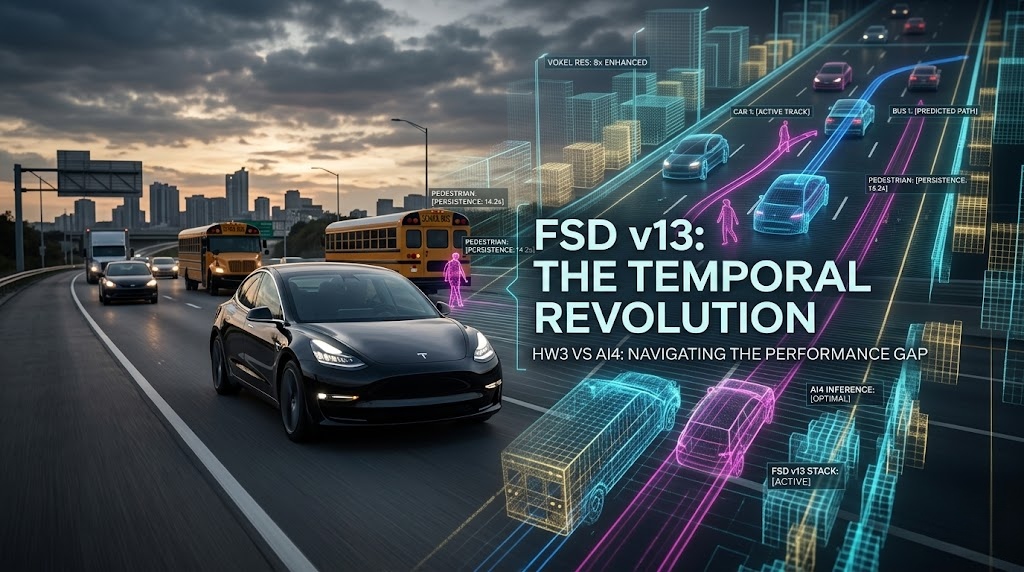
V13 introduces a 15-second Temporal Buffer. By using Transformer architectures—the same technology that powers Large Language Models like GPT-4—Tesla’s AI now maintains a persistent internal representation of the environment. If a cyclist disappears into a blind spot, the AI "knows" the cyclist is still there and calculates their likely trajectory based on the last 15 seconds of motion data.
2.2 Voxelization and Occupancy Network 3.0
To support this temporal understanding, Tesla has upgraded its Occupancy Network to version 3.0. The system now discretizes the 3D world into high-resolution voxels (volumetric pixels).
-
Resolution Boost: V13 features an 8x increase in voxel resolution for front-facing cameras.
-
Physics-Based Inference: Instead of just identifying "car" or "curb," the system evaluates the density and solidity of every cubic decimeter of space. This allows the car to navigate through extremely tight construction zones in Europe or narrow suburban streets in California with a confidence that mirrors a professional human driver.
3. The Hardware Bottleneck: The HW3 vs. AI4 Divide
While v13 is a triumph of software engineering, it has exposed a growing hardware divide that is becoming a primary concern for the Tesla community.
3.1 The "FP16 vs. INT8" Battle
The AI4 (Hardware 4) computer, utilizing Tesla’s proprietary silicon, is designed to run these massive neural networks at native precision (FP16). AI4 provides nearly 3x the inference power of the legacy Hardware 3 (HW3) suite.
On HW3 vehicles, Tesla engineers have had to employ aggressive "pruning" and quantization to INT8 (lower precision) to get v13 to run. The results are telling:
-
AI4 Performance: Near-zero latency, 36Hz full-resolution video input, and "Photon-to-Control" response times that exceed human reflexes.
-
HW3 Performance: Statistically safer than v12, yet prone to "micro-hesitations" as the aging processor struggles to compute the massive temporal buffer and high-res occupancy grids simultaneously.
3.2 The Reality of "Supervised" Autonomy
For owners of older Model 3 and Model Y vehicles, v13 marks the "glass ceiling" of HW3. While Elon Musk has repeatedly stated that HW3 remains capable of supervised autonomy, the gap in smoothness and confidence between the two hardware generations is now large enough to affect resale values and user satisfaction.
4. Safety & Compliance: The Texas Lawsuit Milestone
Every technological leap brings new scrutiny. On March 11-12, 2026, a $1 million lawsuit was filed in a Houston, Texas court by Justine Saint Amour. This case has sent ripples through the industry.
4.1 The Incident on the 69 Eastex Freeway
The lawsuit alleges that a Cybertruck, running FSD (Supervised), failed to navigate a Y-shaped overpass split. While the car should have followed the curve to the right, it allegedly attempted to drive straight into a concrete barrier. The plaintiff’s legal team argues that Tesla’s "dangerous design choices"—specifically the exclusion of LiDAR—and Musk’s "irresponsible marketing" are at fault.
4.2 Engineering Concerns vs. Corporate Vision
Interestingly, the lawsuit cites internal Tesla engineering concerns. It alleges that some engineers advocated for a hybrid LiDAR/Vision approach to handle high-speed geometry splits (like Y-junctions) more reliably. This case will be a landmark trial for the "Vision-Only" philosophy, testing whether Tesla’s software improvements can legally and practically replace active depth sensors.
5. Global Implementation: US vs. European Road Logic
Tesla has faced significant regulatory hurdles in Europe due to the UNECE regulations. However, v13’s improved "Human-Like" behavior is finally meeting the criteria for more expansive testing in the EU.
5.1 Navigating European Complexity
Unlike the wide, grid-like streets of the US, European driving requires a high degree of "negotiation." V13’s new Redesigned Control System excels here. It allows for smoother nudging in traffic and better interaction with cyclists—a critical requirement for the Dutch and German markets.
6. Conclusion: The Road to Unsupervised FSD
FSD v13 is the "End of the Beginning." By solving the temporal dimension of AI perception, Tesla has removed the final logical hurdle to achieving a system that truly understands the world. However, the hardware limitations of HW3 and the mounting legal pressure in the US suggest that the transition to "Unsupervised" FSD will be a hardware-gated and legally-contested journey.
For the Tesla blogger and owner, the message is clear: The software has matured, but the hardware in your car—and the laws in your country—are the new frontier of the autonomy race.
FAQ: What You Need to Know About FSD v13
Q: Can I upgrade my HW3 Tesla to AI4 to get the better v13 performance? A: No. Tesla has officially stated that the wiring harnesses and power requirements for AI4 are incompatible with HW3 vehicles. However, they continue to optimize v13 to ensure it remains a safe, supervised experience for all owners.
Q: Does v13 require an active internet connection to "think"? A: No. All inference happens locally on the vehicle’s FSD computer. The internet is only used for downloading map updates and uploading "disengagement" data to Tesla’s training clusters.
Q: Is v13 better in heavy rain? A: Yes. The "Improved Camera Cleaning" logic and Occupancy Network 3.0 allow the system to better filter out visual noise from raindrops and spray, using the temporal buffer to "fill in the blanks."
Q: What is the "Child Left Alone Detection" mentioned in the update? A: This is a safety feature bundled with the 2026.2.3 firmware. It uses the cabin camera and weight sensors to provide persistent alerts to the owner's phone if a child or pet is detected in a locked vehicle.