
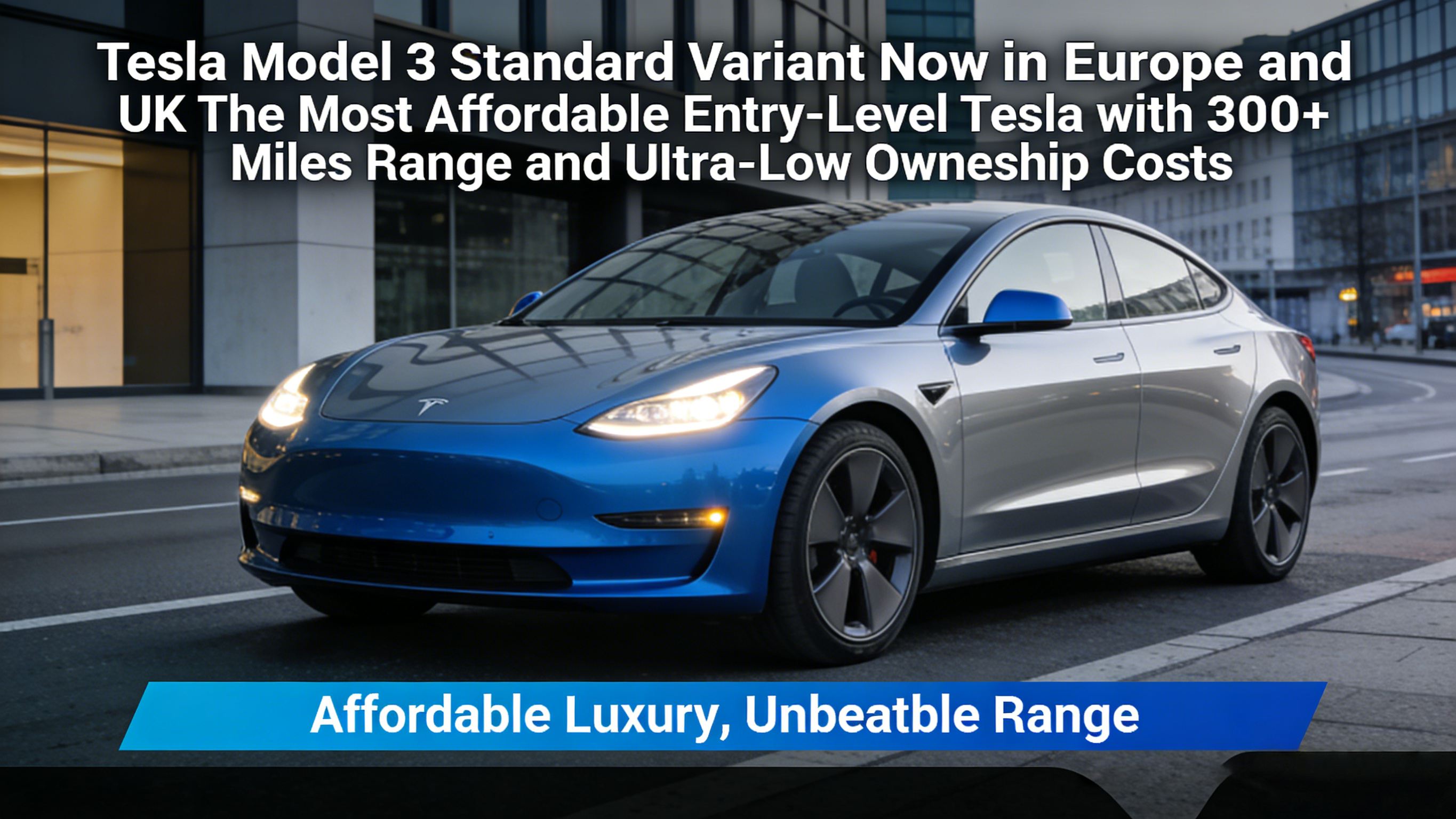
As a Tesla owner or prospective buyer in Europe or the UK, you have probably felt the pinch of high EV prices over the past few years. Premium features and advanced technology come at a cost, and many families or first-time EV drivers have hesitated to make the switch. That changed dramatically in late 2025 when Tesla quietly rolled out the Model 3 Standard variant across Europe and the UK. Priced from just €37,970 in Germany (or equivalent in other markets) and £37,990 in the UK, this is the most accessible way yet to own a genuine Tesla. Deliveries began rolling out in February 2026, and as of March 2026, thousands of owners across the continent are already taking delivery or placing orders.
This is not a watered-down compromise. The Model 3 Standard still delivers an official WLTP range of 332 miles (534 km), single-motor rear-wheel-drive efficiency that sips just 13.0 kWh per 100 km, and the same sleek Highland styling that turned heads when the refreshed Model 3 launched. What Tesla did was smart: they removed a handful of premium touches that most daily drivers never notice while keeping the core Tesla experience intact — instant torque, over-the-air updates, a massive 15.4-inch touchscreen, and access to the world’s best Supercharger network. The result is a car that undercuts the previous entry-level Model 3 by roughly €8,000 / £7,000 and undercuts many rival EVs while still feeling every bit a Tesla.
Compare that to the US market, where the equivalent Standard variant launched a couple of months earlier at $36,990. European and UK pricing reflects local taxes, shipping from Berlin Gigafactory, and right-hand-drive engineering for the UK, yet the value proposition remains identical. For American Tesla owners reading this (many of whom travel to Europe or have friends and family there), this variant opens the door for relatives to join the Tesla family without breaking the bank. In a year when EV adoption in Europe has slowed due to higher interest rates and range anxiety concerns, the Model 3 Standard arrives like a breath of fresh air.
This article is written specifically for Tesla owners and enthusiasts in the US, Europe, and UK who want deep, practical insight before configuring their next car. We will walk through every specification, crunch the real ownership numbers, guide you step-by-step through ordering, share what early owners are saying in 2026, and place the Standard in the broader European EV market context. By the end, you will understand exactly why March 2026 is the perfect moment to consider this vehicle — whether you are upgrading from an older Model 3, switching from a diesel, or simply entering the EV world for the first time.
Chapter 1: Specifications and Configuration Details
At its heart, the Model 3 Standard is a rear-wheel-drive sedan powered by a single electric motor producing enough torque to hit 0-100 km/h (0-62 mph) in 6.2 seconds — plenty quick for merging onto the Autobahn or overtaking on UK motorways. Tesla has not published the exact battery capacity, but independent testing and owner reports point to approximately 63 kWh usable energy, which is more than enough for the rated 534 km WLTP range.
Real-world efficiency shines in European conditions. Early owners in Germany and the Netherlands are reporting 13.0–14.5 kWh/100 km in mixed winter driving, translating to 280–300 miles of usable range even in cold weather with cabin heating on. That is significantly better than many competitors because Tesla’s heat pump and software optimizations continue to improve via over-the-air updates. The 18-inch Photon wheels (standard fitment) strike the perfect balance between comfort and efficiency; upgrading to 19-inch would shave about 25–30 km off the official range but many owners keep the 18s for daily use.
Step inside and you immediately notice the cost-saving choices that make the €37,970 price possible. The seats are high-quality textile fabric rather than the vegan leather found on Premium models. They are still heated in the front row, supportive for long drives, and covered in a durable, easy-to-clean material that many owners actually prefer in families with children or pets. The panoramic glass roof remains — Tesla kept this signature feature because it costs little to produce yet dramatically improves the sense of space. However, the rear passenger touchscreen is gone; rear passengers control climate and media through the front 15.4-inch display or the Tesla app. Ambient lighting is simplified, and the premium audio system is replaced with a capable seven-speaker setup that still sounds crisp for podcasts and navigation voice prompts.
Trunk space is unchanged at 682 liters with seats up (including the frunk), making weekend trips or airport runs effortless. The car rides on the same refined suspension as the Highland refresh, delivering a supple ride over European cobblestones and potholed UK B-roads. Ground clearance sits at 138 mm — adequate for most city and highway use without scraping.
Safety equipment is identical to higher trims: full Autopilot hardware, eight cameras, and the latest structural battery pack that earned top Euro NCAP ratings. Standard connectivity is included, but Premium Connectivity (real-time traffic, satellite-view maps, music streaming) remains a €9.99/month subscription — exactly the same as every other Tesla.
Compared with the Premium Long Range Rear-Wheel Drive variant (which starts around €45,970 in Germany), the Standard sacrifices the rear screen, slightly larger battery (offering up to 466 miles on 18-inch wheels), faster 250 kW Supercharging capability (the Standard maxes at 175 kW), and a few cosmetic touches. Yet for 80% of daily drivers who commute under 150 miles and charge at home or work, those differences are academic. The Standard still charges from 10–80% in about 25–30 minutes at V3 Superchargers, and home charging on a 7 kW wallbox is complete overnight.
Early configurator data shows most buyers stick with the base 18-inch wheels, white or black exterior paint, and no additional options. That keeps the on-the-road price under €40,000 in most European countries after registration fees — a psychological barrier that many rivals still cannot break.
Chapter 2: Pricing and Ultra-Low Ownership Costs
The headline price is €37,970 in Germany and £37,990 in the UK (including destination but before any local incentives). That is roughly €8,000 / £7,000 less than the next Model 3 trim. Over a typical five-year ownership period, the savings compound dramatically.
Let us run the numbers for a typical European owner driving 12,000 miles (19,000 km) per year. At an average electricity rate of €0.28/kWh (Germany 2026 average) or £0.24/kWh (UK), the Model 3 Standard consumes roughly 2,470 kWh annually. Total electricity cost: about €692 or £593 per year. Compare that with a comparable petrol car (e.g., a 1.5-liter Golf doing 45 mpg) that would burn roughly €1,800–2,200 in fuel annually at current prices. The Tesla saves €1,100–1,500 per year on energy alone.
Maintenance is another Tesla strength. No oil changes, no spark plugs, no timing belts. Tesla quotes average annual service costs under €300 after the initial years, mainly tire replacements and cabin filter changes. Brake pads last far longer thanks to regenerative braking. Over five years, total maintenance might run €1,200–1,500 versus €3,000+ for a comparable ICE car.
Insurance is lower too. UK owners report the Standard variant landing in insurance group 32 (versus 38–40 for Premium models) because of the simpler specification and lower value. That can save £150–300 per year on comprehensive policies.
Add it up: energy + maintenance + insurance savings versus a diesel or petrol equivalent easily exceed €2,000–3,000 per year. Over five years, the total cost of ownership advantage versus a €35,000–40,000 combustion car can reach €12,000–15,000. Versus the Premium Model 3, the Standard saves you the upfront €8,000 plus slightly lower insurance and the same running costs.
Now stack that against direct European rivals in early 2026:
- Volkswagen ID.3 base (around €35,000–38,000): similar price but only 250–280 miles real-world range in winter, slower charging (135 kW max), and a less refined drive. Many owners report software glitches that Tesla solved years ago.
- BMW i4 eDrive35 (around €50,000+): premium badge but €12,000 more expensive with comparable range.
- BYD Seal or MG4: cheaper on paper (€32,000–35,000) but lack Tesla’s charging network, over-the-air capability, and resale strength. European owners consistently report Tesla’s Supercharger access and app ecosystem as worth the small premium.
Resale value remains Tesla’s secret weapon. Even the Standard variant is holding 70–75% of value after three years in early data from similar US Standard models. That is far better than most mass-market EVs.
For US Tesla owners considering a European trip or helping family buy one, the math is even sweeter: the car qualifies for many country-specific incentives. In Germany, the 2026 environmental bonus (if still active) or company-car tax breaks can shave another €2,000–3,000. In the Netherlands, the MRB road tax exemption for EVs lasts until at least 2028. In the UK, Benefit-in-Kind tax for company cars is just 2% — one of the lowest in Europe.
Chapter 3: Delivery and Configuration Guide
Ordering could not be simpler. Head to tesla.com (select your country: en_eu or en_gb), click Model 3, and the Standard / Rear-Wheel Drive variant appears as the lowest-priced option. The configurator defaults to it.
Step-by-step:
- Choose exterior color (Solid Black or Pearl White recommended for lowest cost and heat reflection in southern Europe).
- Select 18-inch wheels (do not upgrade unless you want the sportier look).
- Interior: the textile seats are the only choice at this trim.
- Add Full Self-Driving (Supervised) if you want it (€7,500–8,000 one-time or subscription).
- Skip Premium Connectivity for the first year if you are budget-conscious; you can always add it later.
- For UK buyers: the configurator automatically shows right-hand drive and UK-specific plates.
Delivery estimates as of mid-March 2026 are 2–8 weeks depending on country and configuration. Berlin Gigafactory is producing these at scale, and inventory units are already appearing in Germany, Netherlands, and the UK. Tesla’s app will notify you the moment your VIN is assigned and provide tracking.
Right-hand-drive markets (UK, Ireland, Cyprus) receive dedicated builds with no waiting penalty. Owners in Norway, Sweden, and France report deliveries as quick as 10 days for in-stock cars.
Incentives are handled automatically in the configurator where applicable. In countries with purchase grants, Tesla deducts them at order time so you see the final price upfront. Always double-check local EV subsidy rules because they evolve quickly in 2026.
Pro tip from early owners: order before the end of Q1 2026 to lock in current pricing. Tesla has a history of adjusting prices monthly based on demand and battery costs.
Chapter 4: Real-World Owner Experiences in Europe and the UK
Early 2026 owners are overwhelmingly positive. A Berlin commuter who previously drove a 2018 Model 3 says the new Standard feels “lighter and more nimble” in city traffic while delivering noticeably quieter cabin noise thanks to updated Highland insulation. Winter range in Scandinavia has held at 260–280 miles even at –10°C with preconditioning — far better than many predicted.
Long-distance travel is effortless. A family in Manchester drove to the south of France (1,200 miles round trip) using only Superchargers. With the 175 kW capability, they spent about 25 minutes per stop and arrived relaxed. The lack of a rear screen was barely noticed; kids used tablets or the front display.
Efficiency data shared in European Tesla owner forums shows consistent 13.2–13.8 kWh/100 km across mixed driving. That translates to real cost per mile of about 4–5 pence in the UK or 5–6 euro cents in Germany at home rates. One owner in Amsterdam calculated that his monthly charging bill dropped from €180 (previous petrol car) to €45.
Daily commute owners love the textile seats for their breathability in summer and the fact that they do not show wear as quickly as some vegan leathers. The simplified interior actually feels more modern and less cluttered.
For American Tesla owners visiting Europe, the Standard variant is the perfect rental or loaner choice for friends. The car feels instantly familiar — same app, same software experience — yet costs less to run locally.
2026 efficiency trends favor the Standard even more. New software updates rolling out this quarter are further optimizing preconditioning and regenerative braking, pushing real-world range closer to 340 miles in mild conditions. Tesla’s vertical integration means these improvements arrive free to every owner.
Chapter 5: Market Positioning and European EV Trends
Tesla’s decision to launch the Standard variant is a direct response to softening EV demand in Europe. Sales growth slowed in 2025 due to higher financing costs and range anxiety. By bringing a sub-€38,000 Tesla to market, the company undercuts almost every premium and mass-market rival while maintaining superior technology and network advantages.
Competitors are scrambling. The Volkswagen ID.3 and Cupra Born now look expensive for the range they deliver. Polestar 2 starts £10,000 higher. Chinese brands like BYD and MG offer tempting sticker prices but cannot match Tesla’s charging ecosystem or software maturity. BMW and Mercedes still position their EVs as luxury first, leaving a huge gap in the affordable premium segment that the Model 3 Standard now owns.
Longer-term, this variant supports Tesla’s volume strategy ahead of the rumored next-generation “Redwood” model expected in 2027. By proving that a stripped-yet-capable Tesla can sell in high volumes in Europe, the company is building the data and production experience needed for even cheaper cars ahead.
Resale strength, Supercharger access, and the ability to add features later via software or subscription make the Standard a low-risk entry point. European Tesla clubs report that many Standard buyers plan to upgrade to Performance or Long Range in three years, knowing they will recover most of their investment.
Conclusion: Why Now Is the Best Time to Buy
The Model 3 Standard is not just the cheapest Tesla ever offered in Europe and the UK — it is one of the smartest EV purchases available anywhere in 2026. It delivers genuine 300+ mile range, class-leading efficiency, legendary build quality, and a driving experience that still feels special, all at a price that finally competes head-on with mainstream cars.
Whether you are a European or UK resident ready to ditch your petrol car, an American Tesla owner helping family overseas, or simply someone who has been waiting for the right moment to join the Tesla ecosystem, the timing is perfect. Deliveries are happening now, pricing is stable, and the car continues to improve every month through free software updates.
Head to the Tesla website today, configure your Standard variant, and take the first step into affordable electric mobility that does not compromise on joy or future-proof technology. Your wallet — and the planet — will thank you.
FAQ
- Does the Model 3 Standard include free Supercharging? No, Supercharging is pay-per-use at all speeds up to 175 kW. However, many owners find home charging far cheaper.
- Is there a rear passenger screen? No — that feature is reserved for Premium variants. Rear passengers use the front screen or the Tesla app.
- What is the real-world range in winter? Owners report 260–290 miles in cold European conditions with preconditioning. Summer easily exceeds 320 miles.
- Does it qualify for government incentives in 2026? Yes in most countries. Check the Tesla configurator for automatic deductions or visit your local EV grant website.
- How does insurance compare with the Premium model? Typically one or two groups lower, saving £150–300 annually in the UK.
- Can I add Full Self-Driving later? Yes, at any time via the app or website for a one-time fee or subscription.
- Is the glass roof included? Yes — the panoramic glass roof is standard even on the base model.
- What is the difference between “Standard” and “Rear-Wheel Drive” on the website? They are the same car. Media and early announcements used “Standard”; the official site uses “Rear-Wheel Drive” for the entry trim.
- How long does delivery take right now? 2–8 weeks for most configurations. Inventory cars can be collected in days.
- Is the Standard version being produced in Berlin? Yes, alongside other Model 3 variants. This keeps lead times short for European customers.