
Introduction
On paper, Tesla has always been in the business of selling electric vehicles. But for the past several years, one of its most profitable products has had nothing to do with cars rolling off assembly lines. It has been a financial instrument, a compliance tool, a line item on quarterly reports that investors have come to call "free money." Regulatory credit revenue—payments from competing automakers who cannot meet government emissions targets on their own—has padded Tesla's bottom line with billions of dollars in pure profit, requiring no engineering investment, no material costs, and no delivery logistics.
That era is ending faster than many anticipated.
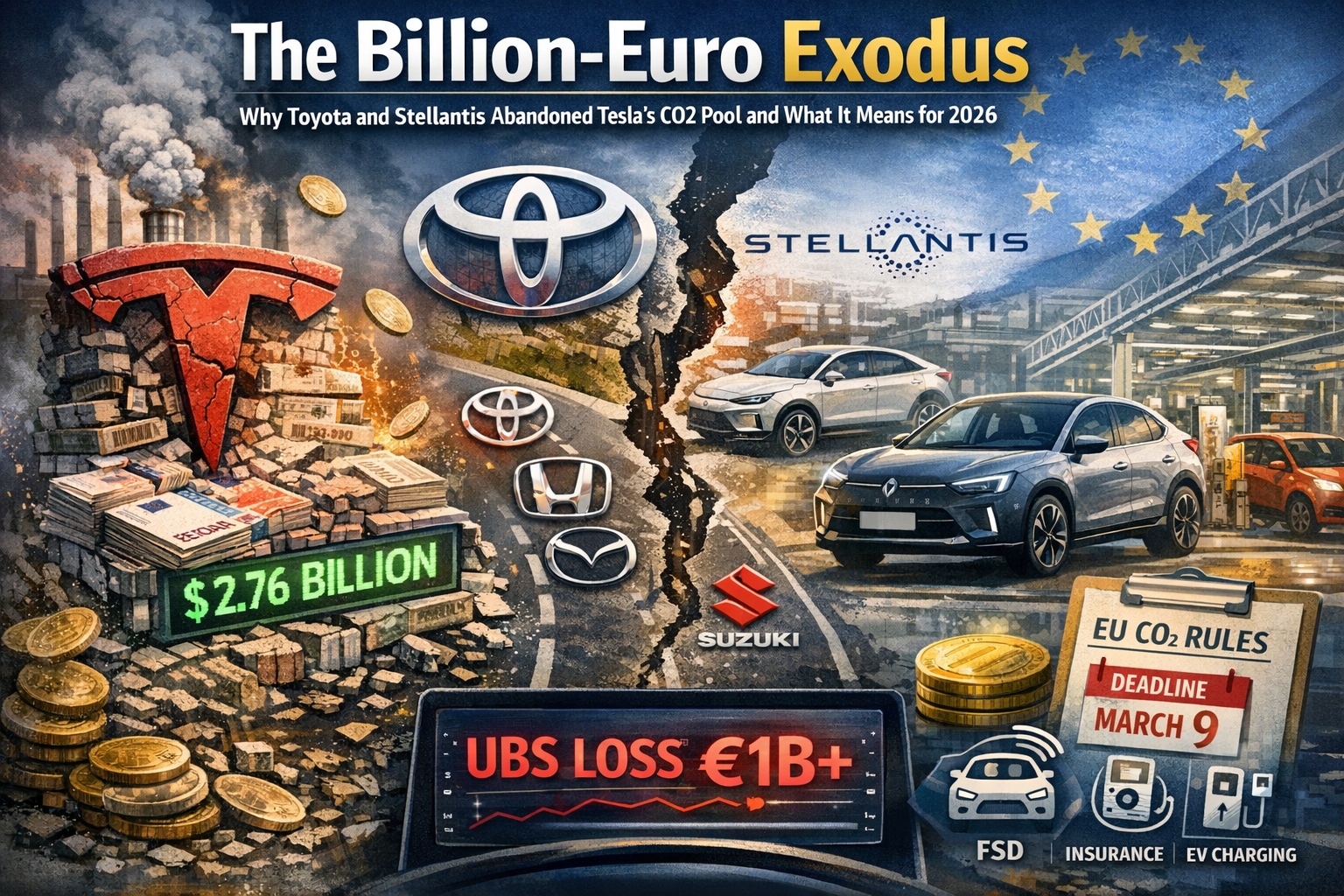
On March 3, 2026, EU filings confirmed what industry observers had suspected for months: Toyota and Stellantis, two of the largest contributors to Tesla's European CO2 emissions pool, will not be returning for the 2026 compliance year. The departure strips Tesla of its most significant paying partners in a program that UBS analysts estimated generated over €1 billion for the company in Europe during 2025. Ford, Honda, Mazda, and Suzuki remain in the pool for now, but the departure of Toyota and Stellantis signals a fundamental shift in the regulatory landscape.
This is not merely a story about corporate accounting or European bureaucracy. It is a story about how the auto industry is evolving faster than Tesla's most reliable profit center can sustain. It is about Toyota finally finding its electric footing after years of skepticism. It is about Stellantis using its acquisition of Chinese EV maker Leapmotor to build its own compliance ecosystem. And it is about what happens when the "free money" faucet begins to drip rather than flow.
For Tesla owners and investors, the implications are profound. The regulatory credit business has funded research and development, supported pricing strategies, and provided a cushion during production ramps. As that cushion deflates, Tesla must rely on what every other automaker relies on: selling cars and software at a profit.
The Mechanics of the EU CO2 Pool
How Pooling Works Under EU Regulations
To understand why Toyota and Stellantis's departure matters, one must first understand the byzantine world of European emissions compliance.
The European Union sets fleet-wide CO2 emissions targets that automakers must meet each year. For 2025, the target was 96.3 grams of CO2 per kilometer averaged across each manufacturer's entire new vehicle fleet sold in Europe. Automakers that exceed this threshold face substantial fines—penalties that can run into hundreds of millions of euros for large manufacturers with significant sales volumes.
The challenge is that not all automakers sell the same mix of vehicles. Companies like Tesla, which sells only battery-electric vehicles with zero tailpipe emissions, generate a massive surplus of compliance headroom. Their fleets are so clean that they effectively have "extra" emissions credits they cannot use themselves.
Enter the pooling mechanism. EU regulations allow manufacturers to form "pools" for compliance purposes. Within a pool, the fleets of multiple manufacturers are combined, and the average emissions are calculated across the entire group. A high-emissions manufacturer like Stellantis, which still sells significant volumes of internal combustion vehicles, can join a pool with a zero-emissions manufacturer like Tesla. The combined average comes down, and both manufacturers meet their targets—provided the high-emissions manufacturer pays the clean manufacturer for the privilege.
This is not charity. It is a market-based mechanism designed by regulators to create financial incentives for electrification while giving lagging automakers breathing room to transition. And for Tesla, it has been extraordinarily lucrative.
The Evolution of Tesla's European Pool
Tesla's dominance as a pool anchor did not happen overnight. It began in 2019, when Fiat Chrysler Automobiles (FCA), now part of Stellantis, signed a groundbreaking deal worth up to $2 billion to pool its European fleet with Tesla. At the time, FCA was desperately behind on electrification and faced massive fines. Tesla had surplus credits and no competitors willing to pay for them. The deal was a lifeline for FCA and a windfall for Tesla.
In subsequent years, the pool expanded dramatically. By 2025, the coalition included Toyota, Stellantis, Leapmotor, Ford, Honda, Mazda, Subaru, and Suzuki. It was a who's who of the global auto industry, all paying Tesla to offset their emissions deficits. UBS analysts estimated that this arrangement generated over €1 billion for Tesla in Europe alone during 2025.
The financial mechanics were simple: Tesla collected payments from pool members, reported the revenue as regulatory credit sales, and added it directly to its bottom line. Unlike vehicle sales, which carry manufacturing costs, logistics expenses, and warranty liabilities, regulatory credits carried virtually no cost of goods sold. Every dollar of credit revenue was a dollar of pure profit.
But the arrangement was always temporary. It existed because legacy automakers were slow to electrify. As they accelerate their own transitions, the need to pay Tesla diminishes.
Why Toyota Left: The Path to Self-Sufficiency
Toyota's Gradual Embrace of Electrification
Toyota has long been the subject of criticism from environmental advocates for its perceived reluctance to embrace battery-electric vehicles. The company bet heavily on hybrids and hydrogen fuel cells, arguing that a mix of technologies was necessary for global markets with varying infrastructure readiness.
That skepticism has not entirely vanished, but it has evolved. For the 2025 compliance year, Toyota's European CO2 target was 96.3 grams per kilometer, and the company is currently expected to hit that target almost exactly without pooling assistance. This is a remarkable achievement for a manufacturer that, just a few years ago, was widely seen as an electrification laggard.
How did Toyota get there? The answer lies in a combination of sustained hybrid dominance and a rapidly expanding pure-electric lineup.
Toyota has maintained an exceptionally high proportion of hybrid vehicles in its European fleet for years. Models like the Corolla Hybrid, Yaris Hybrid, and C-HR Hybrid sell in significant volumes and deliver substantially lower emissions than their conventional counterparts. The company also has relatively few high-emission vehicles remaining in its European portfolio.
But hybrids alone would not be enough to meet the 2025 target. Toyota needed pure-electric vehicles, and in 2025 and early 2026, those vehicles finally arrived in force.
The bZ4X Breakthrough
The Toyota bZ4X, the company's first dedicated battery-electric vehicle built on the e-TNGA platform, had a slow start. Early reviews were mixed, and initial sales were modest. But in February 2026, the bZ4X achieved something remarkable: it became the best-selling electric vehicle in Denmark.
Denmark is not the largest European market, but its EV adoption rates are among the highest on the continent. Winning there signals that Toyota's electric strategy is finally gaining traction. The bZ4X is now supplemented by the new Urban Cruiser, which is hitting European showrooms and expanding Toyota's electric footprint.
For Toyota, the decision to leave Tesla's pool reflects a simple calculation: why pay Tesla for credits when we can generate our own? The company's European fleet is now clean enough to stand alone, and the trajectory suggests it will only get cleaner.
The Strategic Message
There is also a symbolic dimension to Toyota's departure. For years, the company was criticized for its slow EV transition. Remaining in Tesla's pool would signal continued dependence on another manufacturer's compliance surplus. Leaving signals self-sufficiency.
As one industry analyst noted, Toyota's exit arguably reflects its trajectory toward self-sufficiency and gradual efforts to embrace electrification. The company is not just meeting targets; it is positioning itself as a credible competitor in the European EV market. Paying Tesla for credits undermines that positioning.
Why Stellantis Left: The Leapmotor Card
The FCA Legacy and the 2019 Deal
Stellantis's relationship with Tesla's credit pool has deeper roots than most. In 2019, Fiat Chrysler Automobiles signed a landmark agreement with Tesla worth up to $2 billion to pool its European fleet. At the time, FCA was arguably the automaker most exposed to European emissions fines. Its fleet was heavy with high-emission vehicles, and it had virtually no electric vehicles in the pipeline.
That deal was controversial within the industry. Critics argued that FCA was simply buying compliance rather than investing in its own electrification. But from a business perspective, it was rational: paying Tesla was cheaper than developing an entire EV lineup from scratch.
Now, seven years later, the calculus has changed. Stellantis missed its 2025 CO2 target by approximately six grams per kilometer. That might suggest continued dependence on pooling. But Stellantis has something it did not have in 2019: Leapmotor.
The Leapmotor Strategy
In 2023, Stellantis acquired a 51% majority stake in Leapmotor, a Chinese electric vehicle manufacturer. The deal was initially viewed as a way for Stellantis to gain access to Chinese EV technology and potentially use Leapmotor as a low-cost platform for global markets. But its implications for European compliance are now coming into focus.
Leapmotor delivered over 17,000 vehicles in Europe during the fourth quarter of 2025 alone. The company has expanded to over 800 dealer locations across the continent and is rapidly scaling its presence. More importantly, Leapmotor will begin production at a Stellantis facility in Zaragoza, Spain, in the final quarter of 2026. That facility is being adapted to produce up to 200,000 Leapmotor vehicles annually.
This changes everything for Stellantis's compliance strategy. By forming its own pool exclusively with Leapmotor, Stellantis can use those zero-emission vehicle sales to offset its fleet average without paying Tesla a cent. The Chinese automaker's growing European volume provides exactly the compliance cushion that Stellantis needs.
It is a vertically integrated solution that bypasses Tesla entirely. And it reflects a broader trend: automakers are increasingly finding ways to generate their own compliance surplus rather than buying it from competitors.
The Financial Impact on Tesla
The Credit Revenue Trajectory
To understand what Toyota and Stellantis's departure means for Tesla, one must examine the company's regulatory credit revenue history.
In 2024, Tesla earned a record $2.76 billion globally from regulatory credit sales. This was pure profit, representing approximately 10% of the company's total net income for the year. Investors had grown accustomed to this line item, even as Tesla repeatedly warned that it would decline over time.
By 2025, the decline was well underway. Global credit income fell 28% to approximately $2 billion. The primary driver was the elimination of the US emissions credit market, which cost Tesla an estimated $1.4 billion in revenue over nine months. The US market had been a significant source of credit sales, particularly to manufacturers like Honda and General Motors. When that market disappeared, Tesla lost a substantial revenue stream.
Europe was supposed to partially offset those losses. The EU's CO2 targets were tightening, and demand for credits was expected to remain strong. But the European Commission granted automakers three extra years to meet new targets, reducing the urgency to pool with Tesla. Now, with Toyota and Stellantis departing, the European revenue stream is also under pressure.
The 2026 Outlook
What does this mean for 2026? The remaining pool members—Ford, Honda, Mazda, and Suzuki—will continue to generate some credit revenue. But they are smaller contributors than Toyota and Stellantis, both of which were widely considered Tesla's largest financial partners in the pool.
The full financial impact will depend on how much these remaining members pay and whether any new members join. EU pool decisions can be revised until December 1 of each year, leaving a theoretical window for Toyota or Stellantis to rejoin if their emissions positions deteriorate mid-year. But industry observers consider this unlikely. The direction of travel is clear: automakers are increasingly able to comply on their own.
Tesla has acknowledged this trajectory in its financial filings. The company has consistently warned that regulatory credit revenue is declining and will continue to do so. But acknowledging a trend and managing its financial impact are different matters. Replacing billions in pure-profit credit revenue requires selling a lot more vehicles—or developing new high-margin revenue streams like Full Self-Driving subscriptions.
The "Free Money" Problem
The challenge for Tesla is that regulatory credits were not just any revenue. They were the highest-margin revenue in the entire automotive industry. Every dollar from credit sales dropped straight to the bottom line with virtually zero cost attached.
Vehicle sales, by contrast, carry substantial costs. Manufacturing, materials, labor, logistics, warranty reserves—all of these eat into margins. Even with Tesla's industry-leading efficiency, automotive gross margins rarely exceed 20-25%. Software revenue, like FSD subscriptions, carries higher margins but requires ongoing development investment and faces adoption hurdles.
The credit revenue decline forces Tesla to compete on the same terms as every other automaker: by selling products that customers want at prices that generate profit. That competition is intensifying across Europe, where established manufacturers are finally bringing competitive EVs to market.
The Broader Industry Context
The European EV Market in 2026
Toyota and Stellantis' departures from Tesla's pool reflect broader changes in the European EV market. For years, Tesla enjoyed a first-mover advantage that translated into compliance dominance. No other manufacturer had enough EV volume to anchor a pool, so Tesla effectively held a monopoly on compliance surplus.
That monopoly is eroding. Traditional automakers now have substantial EV volume of their own. Volkswagen's ID family, BMW's i-series, Mercedes's EQ brand—all are generating significant sales and creating their own compliance headroom. The need to pay Tesla diminishes as in-house EV volume grows.
This is precisely what regulators intended. The pooling mechanism was designed as a bridge, not a permanent arrangement. It gave lagging automakers time to develop their own electric offerings. Now that those offerings are arriving, the bridge is no longer needed.
The US Market Precedent
The European situation echoes what happened in the United States in 2025. When the US emissions credit market was eliminated, Tesla lost a substantial revenue stream virtually overnight. The company had no control over the policy change and no ability to replace that revenue except through vehicle sales.
Europe is different. The EU has not eliminated its credit market, and the remaining pool members will continue to generate some revenue. But the departure of Toyota and Stellantis demonstrates that regulatory credit income is not a stable, predictable line item. It is a function of competitors' weakness, and as competitors strengthen, the income declines.
The December 1 Window
One caveat bears mention: EU pool decisions are not final until December 1. If Toyota or Stellantis finds itself in a worse emissions position than expected mid-year—perhaps due to shifting sales mix or supply chain disruptions—they could theoretically rejoin the pool. Stellantis has explicitly stated it is not in the pool "for now," leaving the door open to later entry.
But the probability of rejoining appears low. Both companies have made strategic commitments that reduce their dependence on Tesla. Toyota is confident in its hybrid and EV lineup. Stellantis is building its own compliance ecosystem around Leapmotor. Rejoining Tesla's pool would signal failure in those strategies.
What This Means for Tesla Owners
Indirect Implications
For Tesla owners, the credit revenue decline has indirect but meaningful implications. Regulatory credits have historically subsidized Tesla's pricing strategy, allowing the company to invest in Supercharger expansion, software development, and manufacturing efficiency without relying entirely on vehicle margins. As credit revenue shrinks, those investments must be funded elsewhere.
This could manifest in several ways. Pricing pressure may increase as Tesla seeks to maintain margins. FSD subscription pricing could rise. Features that were previously included may move behind paywalls. None of these is certain, but the financial pressure created by declining credit revenue is real.
The European Market Position
For European Tesla owners specifically, the departure of Toyota and Stellantis from the pool signals something encouraging: the market is maturing. More competitors mean more charging infrastructure investment, more consumer awareness, and more political support for electrification. Tesla no longer carries the entire weight of the European EV transition on its shoulders.
This maturity also means more choice for consumers. When Toyota and Stellantis were paying Tesla for compliance, they were effectively acknowledging that they could not compete on their own. Now they are competing directly. For Tesla, that means pressure to innovate faster. For Tesla owners, that means a healthier, more dynamic market with more options and better infrastructure.
Conclusion
The departure of Toyota and Stellantis from Tesla's EU CO2 pool marks the end of an era. For years, regulatory credits have provided Tesla with billions in pure-profit revenue, funding the company's growth while competitors paid for their own slow transitions. That era is ending not with a regulatory change, but with competitors finally learning to stand on their own.
Toyota's exit reflects a successful transition from hybrid dominance to electric competence. The bZ4X's strong performance in markets like Denmark demonstrates that Toyota can compete in EVs when it chooses to. Stellantis's exit reflects a different strategy: using its Leapmotor acquisition to build a vertically integrated compliance ecosystem that bypasses Tesla entirely.
For Tesla, the financial impact is manageable but significant. The company has already absorbed the loss of the US credit market. It can absorb the partial loss of European credit revenue. But doing so requires replacing billions in high-margin income with actual vehicle and software sales. That is a challenge, not a crisis.
For the broader industry, the message is clear: the training wheels are off. Automakers can no longer pay their way to compliance. They must build competitive EVs, develop charging infrastructure, and convince consumers to make the switch. Tesla's credit revenue was always a symptom of competitors' weakness. As competitors strengthen, the symptom fades.
The question now is whether Tesla can maintain its momentum without that crutch. The answer will determine not just the company's stock price, but its position in the European market for years to come.
Frequently Asked Questions
Q: Will Toyota or Stellantis rejoin Tesla's pool later in 2026?
A: It is possible but unlikely. EU pool decisions can be revised until December 1, 2026. If either company's emissions position deteriorates significantly mid-year, they could theoretically rejoin. However, both have made strategic commitments that suggest they expect to comply independently. Toyota is confident in its hybrid and EV lineup, and Stellantis is building its own compliance ecosystem around Leapmotor.
Q: How much money will Tesla lose from these departures?
A: The exact figure is difficult to calculate because payment terms are private. However, UBS analysts estimated that Tesla's European pool generated over €1 billion in 2025, with Toyota and Stellantis as the largest contributors. Even partial loss of that revenue is significant, though Tesla has already absorbed the $1.4 billion loss from the US credit market elimination.
Q: Does this affect Tesla vehicle prices in Europe?
A: Indirectly, yes. Regulatory credit revenue has historically subsidized Tesla's pricing and investment strategy. As credit revenue declines, Tesla must rely more heavily on vehicle margins. This could create pricing pressure, though the effect is unlikely to be immediate or dramatic.
Q: What is Leapmotor, and why does it matter?
A: Leapmotor is a Chinese electric vehicle manufacturer in which Stellantis holds a 51% majority stake. The company delivered over 17,000 vehicles in Europe in Q4 2025 and will begin production at a Stellantis facility in Spain in late 2026. By forming its own pool with Leapmotor, Stellantis can use those zero-emission vehicle sales to offset its fleet average without paying Tesla.
Q: Are other automakers leaving the pool?
A: Ford, Honda, Mazda, and Suzuki remain in the pool for now. Subaru is also not currently listed in the 2026 pool filing. The remaining members are smaller contributors than Toyota and Stellantis, so their continued participation only partially offsets the departures.
Q: How does the US credit market compare to Europe?
A: The US emissions credit market was eliminated in 2025, costing Tesla an estimated $1.4 billion in revenue. Europe still has an active credit market, but the European Commission granted automakers three extra years to meet new CO2 targets, reducing the urgency to pool with Tesla.