
Introduction
On July 1, 2026, Tesla’s Charging team published a set of numbers that should make every EV owner — and every legacy automaker — sit up and take notice. In the second quarter of 2026, the Tesla Supercharger network delivered 2.0 terawatt-hours of energy to electric vehicles worldwide. That is enough electricity to power more than 180,000 American homes for an entire year. It represents a 30% year-over-year increase in energy throughput, alongside 60 million charging sessions — a 32% jump from Q2 2025.
These are not merely incremental gains. They are evidence of a network operating at a level of scale and efficiency that no other charging provider on the planet can match. And they arrive at a pivotal moment: Tesla’s core vehicle delivery numbers are forecast to show little growth. The contrast is the story. Tesla’s charging arm is posting record throughput at the same moment its car-sales machine is hitting a plateau. The Supercharger network, once a supporting player in the Tesla ecosystem, is increasingly becoming the company’s most formidable competitive moat.
For Tesla owners in the United States and Europe — the two regions where the network is densest and most heavily utilized — these Q2 2026 numbers are not abstract statistics. They translate into shorter wait times, more available stalls, faster charging speeds, and a growing sense that the EV charging experience has finally, decisively, caught up with the vehicle capability.
1: The Q2 2026 Scorecard — A Record-Breaking Quarter by Every Measure
1.1 Energy Delivered: 2.0 TWh and Climbing
The headline number from Tesla’s Q2 2026 Supercharger scorecard is 2.0 terawatt-hours of energy delivered. To put that figure in perspective: Tesla delivered close to 7 TWh across all of 2025. Through the first half of 2026 alone, the network has already banked roughly 3.8 TWh — 1.8 TWh in Q1 and 2.0 TWh in Q2. The company is on track to significantly surpass its 2025 annual total.
The year-over-year growth rate tells an even more compelling story. In Q1 2026, energy delivery grew 22% year-over-year. In Q2, that growth accelerated to 30%. The network is not just expanding — it is accelerating. Each quarter is building on the last with increasing momentum.
1.2 Charging Sessions: 60 Million and Counting
Alongside the energy figure, Tesla reported 60 million charging sessions in Q2 2026. That is up from 53 million sessions in Q1 2026 and represents a 32% year-over-year increase. The session growth rate also accelerated from Q1’s 26% year-over-year increase.
What makes this particularly noteworthy is that session volume is growing at nearly twice the pace of the hardware expansion. The network added roughly 2,700 new stalls in Q2, a 17% year-over-year increase. Yet sessions grew at 32% — meaning each individual stall is working significantly harder than it did a year ago. This is the hallmark of a network that is not just growing in footprint but deepening in utilization.
1.3 Hardware Expansion: 2,700 New Stalls, 5,000 Locations Mapped
Tesla opened approximately 2,700 new Supercharger stalls globally in Q2 2026. The company also added 5,000 Supercharger locations to its official map, covering more than 58,000 mapped stalls. This mapping effort is a new addition to the quarterly scorecard, reflecting Tesla’s growing emphasis on transparency and user experience.
As of Q2 2026, Tesla operates more than 75,000 Superchargers worldwide across roughly 7,900 stations. The network’s scale is unmatched. In the United States alone, Tesla operates more than 2,500 station locations with approximately 30,000 individual stalls. The company’s share of all DC fast charging ports in the U.S. stands at approximately 52%, though that share is gradually declining as other providers expand.
1.4 Environmental Impact: 934 Million Liters of Gasoline Saved
The environmental math from Q2 2026 is staggering. Tesla estimates that the Supercharger network saved 934 million liters of gasoline from being burned during the quarter, avoiding 3.8 billion kilograms of CO2 equivalent emissions. In Q1 2026, the network saved 823 million liters of gasoline and avoided 3.4 billion kilograms of CO2. The improvement quarter-over-quarter reflects both higher utilization and the growing share of renewable energy feeding into the grid.
2: The Utilization Paradox — More Usage, Less Waiting
2.1 Average Sessions Per Stall: From 3–4 to 8 Per Day
Perhaps the most remarkable claim in Tesla’s Q2 scorecard concerns how hard the network is working. Tesla’s utilization curve shows average sessions per stall per day rising from around 3 to 4 in 2019 to roughly 8 by 2026. Each Supercharger stall is now being used approximately 9 times per day on average.
This means each stall is actively dispensing energy for approximately 4.5 to 6.75 hours every day. For a network of 75,000 stalls, that translates into an extraordinary level of capital efficiency. Tesla is extracting maximum value from every piece of hardware it deploys.
2.2 Wait Times at a Record Low
The counterintuitive piece of this story is that wait times have fallen even as utilization has soared. The share of drivers who have to wait for an open stall has dropped from peaks near 2 to 2.5% down to about 0.5 to 1% today. Some reports put the global wait rate at an even lower 0.4–0.5%.
Running a network harder while congestion falls is difficult to achieve. It requires sophisticated demand management, predictive analytics, and a hardware architecture that can handle high throughput without breaking down. Tesla has achieved this combination through a multi-pronged strategy: expanding capacity in high-demand areas, deploying faster charging hardware that reduces dwell time, and using software to balance load across the network.
2.3 The AI Behind the Scenes
Tesla is not just building more stalls; it is building smarter networks. In April 2026, the company trained a new machine-learning model to predict Supercharger queues before drivers arrive. The model monitors real-time traffic within a geofenced area around Superchargers and predicts how many vehicles — including those from third-party brands — intend to charge there. This predictive capability allows Tesla to surface real-time availability information to drivers, reducing the uncertainty that has historically plagued public EV charging.
The company is also expanding forecasted Supercharger availability in Google Maps globally and bringing live Supercharging updates to the Android lock screen. These software improvements are as important as the hardware expansion in delivering a seamless charging experience.
3: The V4 Revolution — Faster, Smarter, More Scalable
3.1 V4 Cabinets: 500 kW for Passenger Vehicles, 1.2 MW for Semi
The Q2 2026 performance is built on the back of Tesla’s V4 Supercharger hardware, which represents a generational leap over the V3 system. The V4 cabinet delivers up to 500 kW per stall for passenger vehicles and up to 1.2 MW for the Tesla Semi. This compares to the V3’s maximum of 250 kW, effectively doubling the peak charging speed.
The V4 cabinets cover voltages between 400 and 1,000 V, making them compatible with 800V platforms from manufacturers like Hyundai, Kia, Porsche, and of course Tesla’s own Cybertruck. This voltage flexibility is critical as the industry moves toward higher-voltage architectures that enable faster charging and reduced weight.
3.2 The Folding Unit Supercharger: Deployment at Scale
Tesla’s ability to add 2,700 stalls in a single quarter is partly attributable to its new Folding Unit (FU) Supercharger design. Unveiled in March 2026, the FU is a pre-assembled, foldable V4 system that can be transported compactly and unfolded on site.
The efficiency gains are substantial. Tesla’s charging business senior director has stated that the FU solution improves transport efficiency by 33% compared to previous prefabricated Supercharger units, cuts installation time in half, and reduces overall costs by approximately 20%. Each Folding Unit contains a 1.2 MW power electronics cabinet supporting eight charging stalls.
3.3 European Rollout Accelerates
Europe is a key battleground for the V4 rollout. Tesla has already begun a large-scale modernization of its European network in 2026. The company opened its first 500 kW V4 Supercharger site outside the United States in late June 2026, featuring 28 V4 stalls. This site is ideal for 800V EVs from Hyundai, Kia, Xpeng, Zeekr and others that can make the most of the new chargers.
The FU Superchargers are also crossing the Atlantic. Tesla has confirmed that wide-scale European rollout will accelerate in Q3 2026, targeting key rest areas along major motorways. The Tilburg pilot in the Netherlands signals that FU units are already being adapted to local grid and permitting requirements.
3.4 Megacharger Infrastructure for the Tesla Semi
While the passenger vehicle network gets most of the attention, Tesla is also building out Megacharger infrastructure for the Tesla Semi. The company has added 64 Megacharger locations to its map, revealing Semi truck charging routes. Tesla aims to deploy 46 Megacharger stations by early 2027, with about 37 sites planned for 2026 specifically. The Megacharger system uses the same V4 cabinet technology but at 1.2 MW output, enabling rapid charging for commercial vehicles.
4: The Open Network Strategy — Turning Competitors into Customers
4.1 From Walled Garden to Shared Infrastructure
Perhaps the most consequential strategic shift in Tesla’s charging business over the past two years has been the opening of the Supercharger network to non-Tesla vehicles. What was once a closed ecosystem — a competitive advantage reserved exclusively for Tesla owners — has become shared infrastructure accessible to drivers of Rivian, General Motors, Ford, Mercedes-Benz, Lucid, and others.
The Q2 2026 numbers demonstrate that this opening has not degraded the experience for Tesla owners. On the contrary, the network is handling more sessions than ever while wait times are at record lows. The broadening base of users helps explain how session volume can outrun stall growth, since each connector now serves a far larger pool of vehicles.
4.2 Volvo Integration: 20,000 Superchargers in 29 European Countries
A major development in Q2 2026 was Volvo’s announcement that it will integrate Tesla Supercharger access directly into its own smartphone app. Starting in the fourth quarter of 2026, Volvo drivers in Europe will be able to use more than 20,000 Tesla Superchargers in 29 countries without needing the Tesla app.
This is a significant departure from the previous model, where non-Tesla drivers had to use the Tesla app to initiate charging sessions. Direct app integration reduces friction and makes the Supercharger network feel like a native part of the Volvo ownership experience. As Alejandro Castro Pérez of Volvo noted, “Adding Tesla Superchargers in Europe means they now have even easier access to one of the most recognised fast charging networks”.
4.3 The North American Charging Standard (NACS) Ecosystem
In North America, the Supercharger network has become the de facto standard for DC fast charging. Stellantis adopted Tesla’s North American Charging Standard in late 2025, giving customers access to more than 28,000 Tesla Superchargers across five countries. General Motors opened access to more than 17,800 Superchargers for its EV owners. The NACS ecosystem now extends to Japan and South Korea, with further expansion planned for 2027.
4.4 Financial Implications: New Revenue Streams
Opening the network is not just a strategic move — it is a financial necessity. Retrofitting legacy infrastructure and expanding at scale demands significant capital. By opening the gates to over 27,500 non-Tesla vehicles, Tesla has unlocked fresh revenue streams and federal subsidies to buffer the financial burn of rapid expansion.
However, the open network also brings operational challenges. The platform now has to accommodate a wide array of third-party cars with different charge-port locations, communication protocols, and voltage architectures. Tesla has managed these challenges through a combination of hardware flexibility (the V4 cabinet’s wide voltage range) and software sophistication (the predictive queue model and real-time availability features).
5: The Grid Challenge — Powering the Future Without Breaking the Present
5.1 The Strain on Local Distribution Grids
The rapid deployment of ultra-fast V4 cabinets capable of throwing 500 kW at passenger vehicles and 1.2 MW at commercial trucks places immense strain on local distribution grids. Sucking megawatts out of the grid instantaneously forces a heavy reliance on on-site battery storage systems just to keep local substations from melting under peak-demand surges.
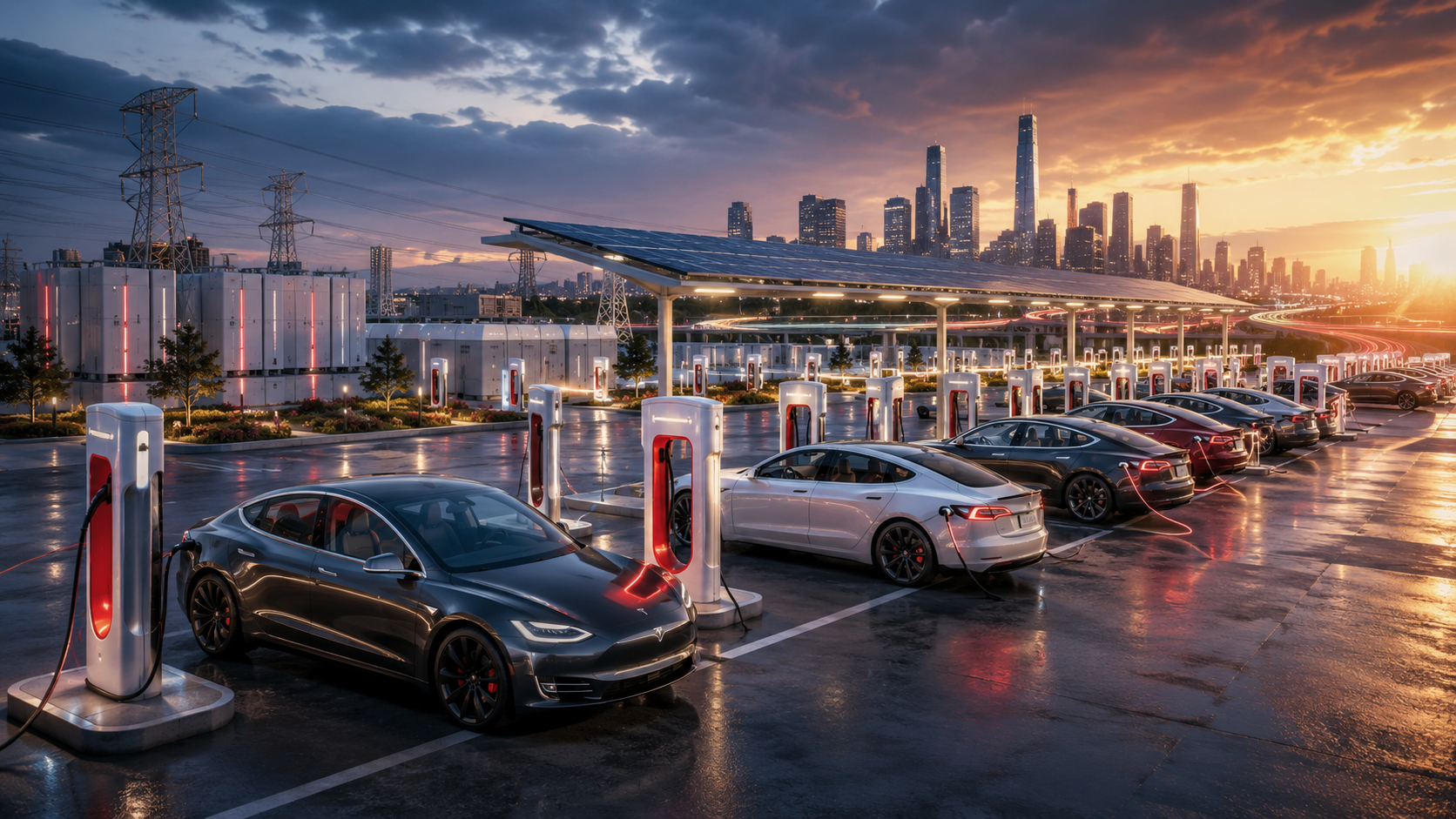
Tesla has anticipated this challenge. The company is increasingly pairing new Supercharger sites with Megapack energy storage systems and solar canopies. The 96-stall site planned for Willows, California, for example, will feature 2 solar canopies and a Megapack system. The massive 400+ stall expansion at Eddie World in Yermo, California, is also expected to include significant on-site storage.
5.2 Renewable Integration and Off-Grid Solutions
Tesla has been moving toward integrating solar and battery storage at existing stations for years. The company analyzes Supercharger usage patterns, solar irradiance data, and grid reliability to identify prime candidates for off-grid installations. In some cases, the solar Supercharger actually becomes more reliable than a grid-dependent one.
Tesla also actively prioritizes Supercharger locations where renewable energy is readily available or can be cost-effectively integrated. This proactive stance ensures that as the network expands, its environmental impact remains a core consideration. The Q2 2026 environmental savings of 3.8 billion kg of CO2 avoided would be even larger if a greater share of the energy came from renewable sources.
5.3 The Megapack Opportunity
The grid challenge also represents a business opportunity. Tesla’s energy storage deployments reached an all-time high in Q2 2026, contributing significantly to the company’s profits. The company reported positive free cash flow of $1.3 billion in Q2, underscoring Tesla’s strong financial health. The Megapack systems deployed at Supercharger sites are not just enabling faster charging — they are becoming a profitable business line in their own right.
6: What This Means for Tesla Owners in the US and Europe
6.1 The US Experience: More Stalls, Shorter Waits, Faster Charging
For Tesla owners in the United States, the Q2 2026 numbers translate into tangible improvements. The network is denser than ever, with 30,000 stalls across 2,500 locations. Major new sites are coming online, including a planned 96-stall hub in Willows, California and a massive 400+ stall expansion in Yermo, California. These mega-hubs are transforming road trips from a logistical challenge into a seamless experience.
The V4 rollout is also accelerating in the U.S. The first true 500 kW V4 Supercharger on the East Coast opened in Kissimmee, Florida, in March 2026, followed closely by a new site in Nashville, Tennessee. For owners of 800V-capable vehicles like the Cybertruck, these sites deliver charging speeds that were unimaginable just a few years ago.
6.2 The European Experience: Catching Up and Pulling Ahead
Europe has historically lagged behind the U.S. in Supercharger density, but that gap is closing rapidly. The Q2 2026 scorecard shows the network expanding aggressively across the continent. The first 500 kW V4 site outside the U.S. opened in late June, and FU Superchargers are being deployed at key motorway rest areas.
The Volvo integration, which will bring 20,000 Superchargers into the Volvo app across 29 European countries, signals a new phase of openness that benefits Tesla owners by increasing utilization and justifying further expansion. More users mean more revenue, which means more investment in the network. The virtuous cycle is well underway.
European Tesla owners also benefit from the network’s reliability. Tesla Supercharger uptime consistently tops industry rankings, with owners reporting very high uptime and alert-free sessions across the U.S. and Europe. The network’s 99.95% availability rate is a standard that no other charging provider has been able to match.
6.3 The Competitive Moat Widens
For Tesla owners, the Supercharger network is more than a convenience — it is a competitive advantage that no other EV brand can replicate. The network’s scale, reliability, and integration with Tesla vehicles create an ownership experience that is simply superior to what any other automaker can offer. This is reflected in surveys: Tesla owners consistently praise how easy the Supercharger network makes life with an electric vehicle, whether for local journeys or longer ones. The Supercharger network has been named the Best Public Charging Point in 2026 by Autotrader, ahead of competitors like Ionity.
7: The Road Ahead — What to Expect in the Second Half of 2026
7.1 10,000 Stalls by Year-End?
Tesla added approximately 2,500 stalls in Q1 and 2,700 in Q2, bringing the first-half total to roughly 5,200 stalls. If this pace continues, Tesla could add more than 10,000 stalls in 2026, pushing the global total well beyond 80,000. The company’s stated target is to exceed 100,000 Superchargers globally by the end of 2026, a goal that now appears achievable.
7.2 The V5 Horizon
While the V4 rollout is still in its early stages, Tesla is already looking ahead to V5. The V5 Supercharger is expected to utilize a native 1000V DC bus architecture, compared to the V4’s 400–1000V range. This will enable even faster charging for next-generation EVs with 1000V architectures. Most legacy EVs, including the early Model 3 and Model Y, operate on a 400V system, but the industry is moving toward higher voltages, and Tesla is positioning itself to lead that transition.
7.3 Continued Open Network Expansion
The open network strategy will continue to expand in the second half of 2026. Volvo’s direct app integration will go live in Q4. More automakers are expected to adopt NACS, further broadening the base of users and increasing utilization. The financial benefits of this open strategy will become increasingly apparent as non-Tesla sessions contribute a growing share of revenue.
7.4 Software and AI Innovations
Tesla’s software advantage will continue to deepen. The predictive queue model will become more accurate as it gathers more data. The real-time availability features in Google Maps and on Android lock screens will become more widely available. The in-app experience will continue to improve, making the already seamless Supercharger experience even more polished.
Conclusion
The Q2 2026 Supercharger scorecard is not just a set of impressive numbers — it is a statement of intent. Tesla delivered 2.0 TWh of energy, hosted 60 million charging sessions, added 2,700 new stalls, and saved nearly a billion liters of gasoline, all while reducing wait times to near-record lows. This is a network operating at a level of scale, efficiency, and reliability that no competitor can match.
The numbers also tell a deeper story. The network is growing faster than the fleet, utilization is rising faster than hardware expansion, and the open network strategy is expanding the user base without degrading the experience. Tesla is no longer just an automaker with a charging network — it is an energy infrastructure company that happens to build some of the world’s most advanced electric vehicles.
For Tesla owners in the United States and Europe, this is excellent news. The network that supports your vehicle is stronger, faster, and more reliable than ever. It is also more open, which means more revenue for Tesla and more investment in future expansion. The virtuous cycle is spinning faster with each passing quarter.
The road ahead is clear. The V4 rollout will continue, bringing 500 kW charging to more locations. The V5 horizon promises even faster speeds. The Megacharger network will support the Tesla Semi’s commercial ambitions. And the software that powers it all will become smarter and more seamless.
Tesla’s Supercharger network was once a differentiator. Today, it is a competitive moat. Tomorrow, it may be the company’s most valuable asset. For Tesla owners, that means one thing: the best charging experience in the world is about to get even better.
Frequently Asked Questions
Q: How much energy did the Supercharger network deliver in Q2 2026?
A: Tesla’s Supercharger network delivered 2.0 terawatt-hours (TWh) of energy in Q2 2026, a 30% increase year-over-year. That is enough to power more than 180,000 American homes for a full year.
Q: How many charging sessions occurred in Q2 2026?
A: The network hosted 60 million charging sessions in Q2 2026, up 32% from Q2 2025.
Q: How many new Supercharger stalls were added in Q2 2026?
A: Tesla added approximately 2,700 new Supercharger stalls globally in Q2 2026, a 17% year-over-year increase.
Q: Is the Supercharger network open to non-Tesla vehicles?
A: Yes. Tesla has opened the network to vehicles from Rivian, General Motors, Ford, Mercedes-Benz, Lucid, Volvo, and others. In Europe, Volvo drivers will be able to access more than 20,000 Superchargers through the Volvo app starting in Q4 2026.
Q: Are wait times increasing because of the open network?
A: No. Despite higher utilization, wait times have fallen to near-record lows of approximately 0.4–0.5% globally. Tesla has managed to run the network harder while reducing congestion.
Q: What is the V4 Supercharger, and how is it different from V3?
A: The V4 Supercharger delivers up to 500 kW per stall for passenger vehicles (compared to V3’s 250 kW) and up to 1.2 MW for the Tesla Semi. It covers voltages between 400 and 1,000 V, making it compatible with 800V EVs from multiple manufacturers.
Q: What is the Folding Unit Supercharger?
A: Unveiled in March 2026, the Folding Unit is a pre-assembled, foldable V4 system that can be transported compactly and unfolded on site. It improves transport efficiency by 33%, cuts installation time in half, and reduces costs by approximately 20%.
Q: How much gasoline did the Supercharger network save in Q2 2026?
A: Tesla estimates the network saved 934 million liters of gasoline and avoided 3.8 billion kilograms of CO2 emissions in Q2 2026.