
Introduction: The Continental Divide in Autonomy
For over half a decade, a digital "iron curtain" has separated the Tesla driving experience in North America from that in Europe. While drivers in California have been traversing complex city streets using "End-to-End" neural networks, European owners have remained tethered to a legacy version of Autopilot—a system governed by rigid, decades-old international standards that prioritized mechanical simplicity over artificial intelligence.
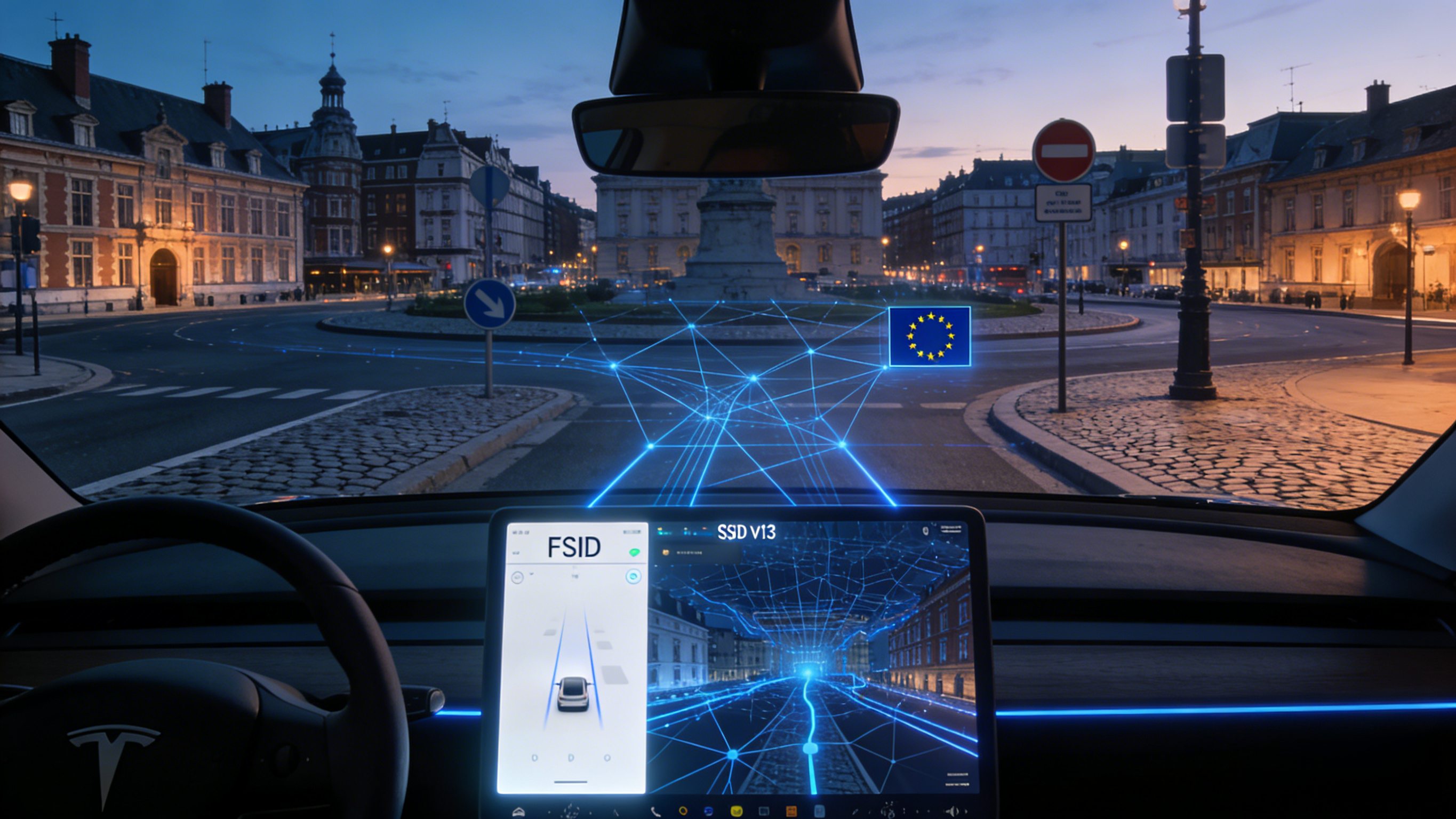
However, as of February 11, 2026, the narrative has fundamentally shifted. Following a series of landmark negotiations between Tesla’s policy team and the Netherlands’ RDW (Rijksdienst voor het Wegverkeer), the first real-world validation of FSD v13 (Supervised) on European soil has officially commenced. This development is not merely a software update; it represents the most complex regulatory "handshake" in the history of the automotive industry.
This article provides an exhaustive analysis of the technical architecture of v13, the specific European regulations being bypassed or adapted, and the roadmap for every Model 3, Y, S, and X owner from London to Berlin.
Chapter 1: The Dutch Gateway and the "Article 39" Strategy
The Role of the RDW
In Europe, vehicle type approval is decentralized. A manufacturer can seek approval in one member state, which then serves as a "passport" to the rest of the European Union. Tesla has long chosen the Netherlands as its primary gateway due to the RDW’s history of tech-forward thinking.
Decoding the Article 39 Exemption
The core of today’s breakthrough is Article 39 of the EU Framework Regulation 2018/858. This provision allows for the "market admission of new technologies or concepts which are incompatible with one or more regulatory acts."
Tesla has successfully argued that the traditional UNECE R79 rules—which limit steering lateral acceleration and mandate specific "hands-on" intervals—are fundamentally incompatible with a neural-network-based system like FSD v13. By using Article 39, Tesla has secured a "Sandbox" status in the Netherlands. This allows a fleet of specially designated "Early Access" vehicles to operate FSD (Supervised) without the restrictive steering torque limits previously imposed on European cars.
The Significance of Cross-Border Testing
Today’s leak of "Cross-Border Logic" testing is particularly vital. Unlike the United States, where state lines offer minimal environmental variation, European borders involve changes in:
-
Signage Typography: Transitioning from German "StVO" signs to French "Code de la Route."
-
Lane Marking Colors: Managing the yellow temporary markings common in the Netherlands versus the white markings in Belgium.
-
Default Speed Rules: FSD v13 must now instantly adjust its "confidence buffers" when crossing from a country with a 130 km/h limit to one with a 100 km/h daytime limit (like the Netherlands).
Chapter 2: Technical Deep Dive – The v13 "End-to-End" Architecture
The Death of the Heuristic Stack
Previous versions of European Autopilot relied on a "C++ Heuristic Stack"—thousands of lines of manually written code that told the car: "If you see a sign with a red circle, then slow down." FSD v13.3, which is the version currently being validated by the RDW, has completely retired this approach. It uses a Unified Vector Field perception system. Instead of "identifying" a curb, a car, and a pedestrian as separate objects and then running a logic check, the car perceives the entire environment as a probability map of "occupancy" and "intent."
36Hz Full-Resolution Vision
One of the most significant upgrades in v13 for the 2026 fleet is the processing frequency. Running on the latest AI4 (Hardware 4) and the newly shipping AI5 (Hardware 5/AI5), the system now processes video at 36 frames per second.
-
Latency-to-Action: For a European driver, this is critical. At Autobahn speeds (150 km/h+), a delay of 100 milliseconds is the difference between a smooth lane change and a dangerous jerk. v13 has reduced this latency to approximately 28 milliseconds, effectively reacting faster than a human fighter pilot.
The Roundabout Solution
Europe is the land of the roundabout—from the simple mini-roundabouts of the UK to the chaotic "Magic Roundabout" in Swindon. v13 features a specific training set derived from over 500 million miles of European driving data collected in "Shadow Mode" since 2024. The system now understands "spiral entries," where the car must choose a lane before entering the circle based on the eventual exit.
Chapter 3: Compliance with UNECE DCAS (Driver Control Assistance Systems)
While Article 39 provides a temporary "Sandbox," the long-term goal for Tesla is compliance with the DCAS Phase 2/3 regulations adopted in Geneva in January 2026.
Hands-On vs. Eyes-On
The greatest friction point has always been the "Hands-On" requirement. European regulators have been wary of "Hands-Free" systems like Ford’s BlueCruise or GM’s Super Cruise. Tesla’s solution in v13 for Europe is a hybrid:
-
Vision-Based Monitoring: The cabin camera tracks eye gaze and head tilt with sub-millimeter precision.
-
Adaptive Torque: On local European roads, the car will still require a light "capacitive touch" on the steering wheel every 60 seconds (or upon a system-initiated maneuver), satisfying the DCAS mandate for "continuous driver involvement."
The "System-Initiated Maneuver" (SIM) Breakthrough
Until recently, European cars were forbidden from initiating a lane change without the driver manually toggling the turn signal. v13.3 includes a "Negotiated SIM" feature. The car will suggest a lane change via the UI and wait for a "micro-torque" nudge from the driver to execute. This is a compromise that allows the AI to plan the path while keeping the human as the "legal commander."
Chapter 4: Regional Implementation – Spain, Finland, and Beyond
The Spanish Heat and Urban Density
Tesla’s expansion into Madrid for FSD testing is strategic. Spanish cities are characterized by extremely narrow streets and "scooter chaos." FSD v13 introduces a new "Vulnerable Road User" (VRU) Buffer. By training on Madrid’s data, the system has learned to predict the "filtering" behavior of motorcyclists, a behavior almost non-existent in North American training sets.
The Finnish Winter Challenge
In Helsinki, Tesla is testing v13’s Visual Inference in "zero-visibility" lane marking scenarios. When snow covers the road, v13 uses "Map-Agnostic Spatial Reasoning"—it looks at the tracks left by previous cars and the position of telephone poles/curbs to infer where the lane should be. This is a massive leap over the GPS-dependent "High-Definition Maps" used by competitors like Waymo.
Chapter 5: Impact on Ownership and Resale Value
For European owners, the activation of FSD v13 isn't just a luxury; it’s a financial catalyst.
-
Resale Premium: In the UK and Germany, "FSD-enabled" used Teslas currently trade at a mere €2,000 premium over base models because the software was largely non-functional. With the 2026 rollout, analysts expect the "Software Equity" of these vehicles to jump by €5,000–€8,000 overnight.
-
The Hardware 3 Dilemma: While v13 is being ported to HW3, the RDW validation is currently focused on HW4. Owners of 2019–2021 vehicles may face a longer wait as Tesla optimizes the neural network weights to fit within the older car's smaller memory buffer.
Conclusion: A New Era for the European Tesla Experience
The events of February 11, 2026, mark the end of the "Dark Ages" for European Tesla owners. By navigating the delicate balance between the RDW’s safety requirements and the raw power of End-to-End AI, Tesla has proven that its Vision-Only approach is globally scalable.
The roadmap for the remainder of 2026 involves moving from "Exemption-based testing" to "Type-approval deployment." For the owner in London, Paris, or Rome, the message is clear: your car is finally about to become as smart as the ones you’ve been watching on YouTube for years.
FAQ: Everything You Need to Know Today
Q: Does my car need a hardware upgrade to run FSD v13 in Europe? A: If you have a vehicle produced after mid-2023 (HW4/AI4), you are ready for the initial rollout. HW3 owners will receive a "Performance Optimized" version later in Q3 2026.
Q: Can I take my hands off the wheel in Germany yet? A: No. Under the current DCAS Phase 2 rules, you must maintain "hands-on" or "touch-sensitive" contact. However, the car will handle 99% of the steering and braking logic.
Q: Will FSD v13 recognize the different speed limit signs across EU borders? A: Yes. The v13 perception engine has been trained on the full library of UNECE-standard signage, including electronic overhead gantries on the Autobahn.
Q: Is the Dutch approval valid in the UK? A: Post-Brexit, the UK has its own "Automated Vehicles Act." However, the UK Department for Transport (DfT) is closely shadowing the RDW’s data, and a reciprocal agreement is expected by summer 2026.