
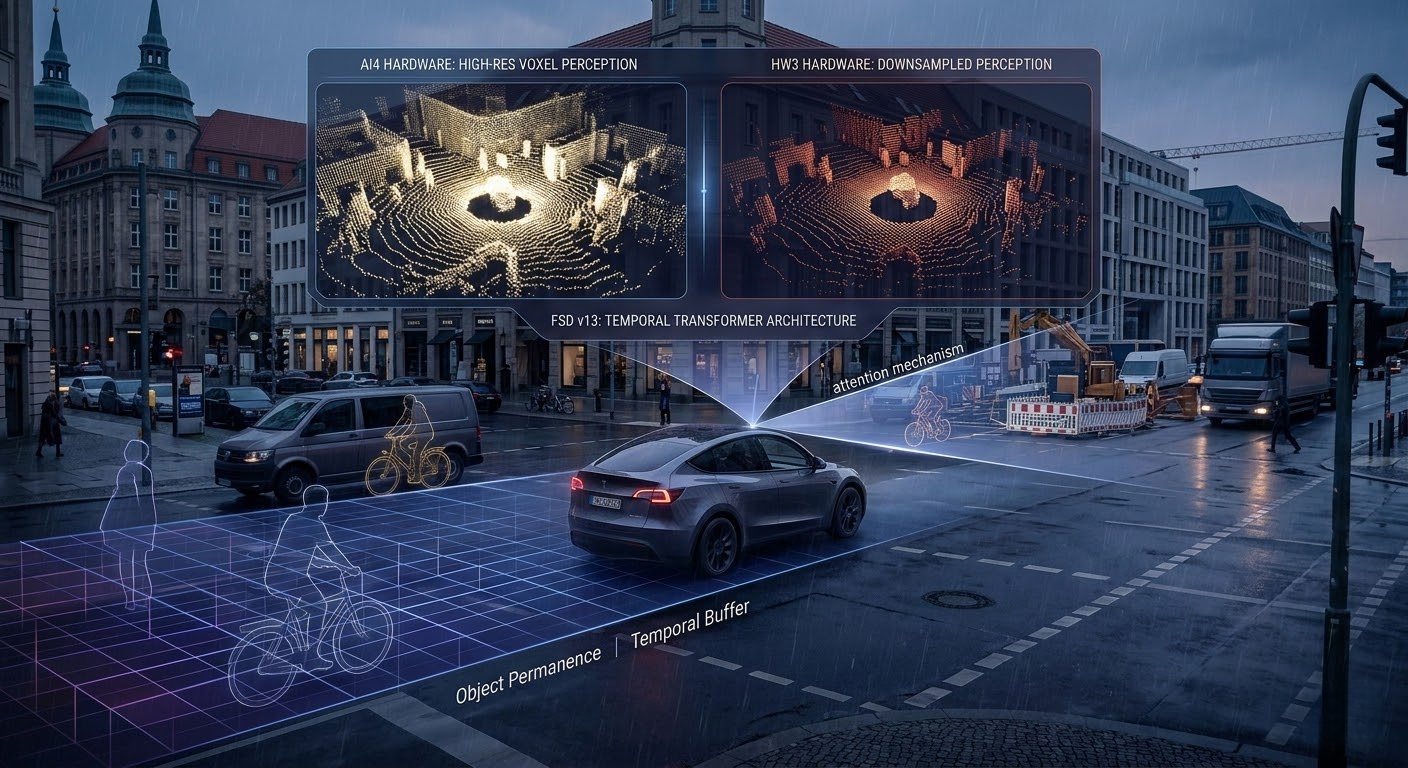
Introduction: The Invisible Barrier
For more than a decade, the promise of full vehicular autonomy has hung in the balance, tantalizingly close yet always seemingly "just two years away." For Tesla owners, this journey has been defined by the evolution of Full Self-Driving (FSD). We watched it move from simple lane-keeping to sophisticated city street navigation, yet it always seemed to possess a certain "robotic anxiety." It was brilliant at executing rules, but it struggled with the nuanced, predictive, and often messy flow of human traffic.
This anxiety was rooted in a foundational constraint of how AI historically "saw" the world. The previous generation, FSD v12, made a monumental leap by introducing an "end-to-end" neural net, allowing the car to control its outputs (steering, braking) directly from its inputs (camera data) without being explicitly programmed with millions of lines of code. However, at its core, v12 was still largely a "spatial optimizer." It processed the world as a complex series of high-fidelity snapshots. When a car or pedestrian disappeared from a camera’s view—perhaps behind a parked van or into a tunnel—the AI’s confidence score in that object dropped dramatically. It had to wait for the object to "re-emerge" to recalculate its trajectory, leading to hesitation, overly cautious braking, and disengagements that frustrated experienced human drivers.
Today, March 5, 2026, we are witnessing the formal wide release of FSD v13. This update is not merely an iterative refinement; it is a profound architectural shift. By integrating End-to-End Temporal Transformers, Tesla has moved from "Spatial Optimization" to "Temporal Intelligence." v13 is the first iteration where the AI model understands the dimension of time. This is the dawn of artificial "Object Permanence," and it changes the entire trajectory of the race toward Level 4 (L4) autonomy.
Chapter 1: The AI Architecture of Today—Understanding the Temporal Shift
To understand why v13 is so significant, we must first deconstruct the core of its intelligence.
1.1 What are Transformers? The "Transformer" is the breakthrough AI architecture that power services like ChatGPT. Its magic lies in its "attention mechanism"—its ability to look at a massive dataset (like all the words in a sentence) and assign "weight" to the relationships between those words, understanding the context of the entire phrase rather than just processing one word after another.
In the context of computer vision, a Spatial Transformer allows FSD to look at all eight of its cameras simultaneously and "attend" to the most critical objects. It assigns high weight to the vehicle merging from the right, medium weight to the crosswalk ahead, and low weight to a pedestrian walking on the far sidewalk. This is what v12 mastered, allowing it to navigate complex intersections far more fluidly than previous systems.
1.2 Introducing the Temporal Buffer: AI with a Memory The problem with a purely spatial view is that the real world doesn't stand still. Context isn't just where things are, it’s also when they were there. FSD v13’s "temporal" breakthrough is the introduction of a massive, continuous data buffer that archives several seconds of recent perception data.
Instead of processing a current image frame and asking "What am I seeing now?", v13 asks, "What am I seeing now, and how does this fit into the sequence of the last 15 seconds?" This data buffer is managed by a Temporal Transformer, which computes the relationships between object states over time.
This isn't just simple trajectory prediction (e.g., "object X is moving at speed Y"). This is conceptual logic. If the AI sees a cyclist travel down the road and disappear behind a large shrub, the spatial net (v12) effectively says, "The cyclist is gone." The temporal net (v13) says, "The cyclist’s last vector was towards that shrub, and I have not seen them exit. They are still there."
This concept—identical to what developmental psychologists call "Object Permanence" in infants—allows the AI to maintain stable, persistent tracking of objects that are momentarily occluded. This stability directly translates to a massive reduction in the system's "hesitation index." The AI can plan a smooth, confident maneuver around an obstacle even when that obstacle isn't visible, because it knows, definitively, that it’s still there.
Chapter 2: The End-to-End Principle on a Timeline
v12 was the first step into a true "end-to-end" system, but v13 cements this as the singular path for Tesla. The distinction is crucial for understanding why Tesla’s approach diverges so dramatically from competitors like Waymo.
2.1 Perception, Not Prediction In Waymo’s stack, the perception system builds a map of the world (this car, that lane, that curb), and then a separate, distinct, and highly rule-based "planning" algorithm predicts what will happen and makes a decision (e.g., "if car merges, then reduce speed").
In Tesla’s end-to-end system, this middle "planning" logic is dissolved. The single neural net absorbs the raw data (temporal video stream + GPS data) and, after being trained on billions of miles of human behavior, simply outputs the correct response.
v13’s temporal buffer makes this process far more robust. When a human merges aggressively in front of FSD, v12 would often react to the sudden spatial change with a sharp, uncomfortable brake application. v13, however, has tracked the merging car for the previous 5 seconds. It didn't just see the car "appear"; it saw the driver’s behavioral intent—the subtle acceleration, the turn signal, the movement to the left edge of their lane. The temporal model perceives the probability of the merge long before it happens. Its response is a subtle, almost imperceptible lift-off of the accelerator, rather than a hard brake. It anticipates, rather than reacts.
2.2 The Training of the Temporal Brain This system can only be built with massive scale. You can't program "human anticipation." Tesla must train its temporal nets on vast clips of "complex-human-behavior" data. This is where Tesla's fleet advantage becomes almost comical.
While competitors measure their training data in millions of miles, Tesla is measuring it in billions. For v13, Tesla’s engineers sought out specific, challenging "long-tail" scenarios: intersections in France where right-of-way rules are ambiguous, complex construction zones in London where lane lines have been redrawn four times, and school zones in California during drop-off hour.
By feeding these multi-minute temporal sequences to the Dojo supercomputer cluster, Dojo learns the intricate ballet of human traffic. It learns that a human waving from the crosswalk means "go," and that a car slightly straddling two lanes isn't just confused—it is looking to merge.
Chapter 3: High-Resolution Voxelization—Mapping the Chaos
While the Temporal Transformer is the model's "logic center," it must still rely on the "eyes" of the perception system. FSD v13 introduces a dramatic upgrade here as well, leveraging the AI4 camera resolution to create high-definition, 3D occupancy maps of the world.
3.1 The End of Object Classification Previous iterations of computer vision relied heavily on classification: identifying "this is a car," "this is a garbage can," "this is a tree." While necessary, this approach fails in complex, unstructured environments. What is a pile of construction debris that is slightly intruding into the lane? What is a oddly shaped shipping container? If the system can't classify it, it often struggles to account for it.
3.2 Enter the Voxel v13 utilizes Occupancy Networks that ignore classification in favor of raw spatial understanding. It discretizes the world into "voxels"—volumetric pixels, effectively little 3D cubes. The goal is simple: is this specific cube of space occupied by something solid, or is it free air?
For the wide release of v13, this voxel resolution has been increased by 8x for the front-facing, high-way cameras. This resolution boost allows the system to build a granular, high-fidelity mesh of the road environment.
The real power, however, is combining high-res voxelization with temporal data. Instead of just seeing a voxel block on the side of the road, the system tracks how that block of space changes over time. Is the voxel grid moving? Is it expanding (e.g., steam rising from a grate)? This high-definition, four-dimensional awareness (3D space + 1D time) allows FSD to navigate around garbage, debris, open car doors, and irregular objects with a precision that was previously impossible. It is the core reason v13 now claims a 95% reduction in construction-zone disengagements.
Chapter 4: The Hardware Divide—AI4 vs. HW3 and the "Thermal Ceiling"
The most significant controversy surrounding today’s v13 release is not its performance, but which vehicles can fully run it. We have reached a critical fork in the road of Tesla’s hardware strategy.
4.1 AI4: The True Target Architecture When Tesla launched AI4 (often called Hardware 4) in 2023, the rationale was often lost in the noise. It wasn't just "nicer cameras"; it was a fundamental shift in total system performance. AI4 offers:
-
Significantly Higher Camera Resolution: (up to 5MP from 1.2MP)
-
3.5-4x the Processing Power (tera-flops)
-
Vastly Increased Memory Bandwidth
v13 was designed specifically to exploit these advantages. The increased memory bandwidth is essential for managing the continuous "temporal buffer." Running a high-resolution voxelization mesh and a massive temporal sequence simultaneously is computationally expensive. AI4 handles this with headroom to spare, running the model at high fidelity and lower thermal profiles.
4.2 HW3: The Struggle to Stay Current Today, March 5, 2026, owners of HW3 vehicles (Model 3/Y from ~2019-2023, and legacy S/X) are receiving v13, but with a major technical caveat. While they get the "Temporal Transformer" brain, they are running it at a reduced resolution for the perception system.
HW3 is hitting what engineer’s call a "Thermal Ceiling." When attempting to process the high-resolution occupancy networks and the large temporal buffer, the FSD computer's temperature spikes. To prevent thermal throttling or outright system failure, the perception data must be downsampled. The HW3 system effectively sees the temporal world in "lower definition."
This is a profound development. For the first time, "FSD v13" for an AI4 car is not the same experience as "FSD v13" for a HW3 car. The AI4 car possesses the fidelity necessary for truly complex L4 navigation; the HW3 car, while massively improved, may struggle with the finest-grained "edge case" scenarios (e.g., distinguishing a 3D pothole from a 2D puddle at 65 mph).
4.3 The "Feature Divergence" Dilemma This divide raises the question Tesla has spent years trying to avoid: is L4 autonomy (eyes-off, mind-off) fundamentally impossible on HW3? Early data suggests that while HW3 can be "super-human," it may lack the perception margin required for a system without a backup driver.
Tesla’s official stance for years was that HW3 was all that was necessary. As of today, that narrative is fracturing. The 2019 owner who bought the $15,000 FSD package with the promise of future autonomy may have just received the best update yet, but they may also be holding the final iteration of the "Supervised" product line.
Chapter 5: Security in Seconds—The Critical Safety Implications of Anticipation
The practical, everyday difference between a spatial model (v12) and a temporal model (v13) is measured in seconds. But in the world of vehicle safety, a second is an eternity.
5.1 Dissecting Critical Latency When FSD needs to intervene to prevent a collision, the system’s "reaction latency" is composed of two phases:
-
Perception Latency: The time it takes for the camera data to be processed, the objects identified, and the collision confirmed.
-
Action Latency: The time it takes for the neural net to decide on the proper output (e.g., brake application) and for the vehicle’s hardware to execute it.
In v12, perception latency could spike in complex scenarios. The system had to be "sure" it was seeing an obstacle before it would take drastic action, leading to late, hard interventions.
In v13, perception latency is virtually dissolved for tracked objects. By tracking multiple paths for critical objects—"where is the child, and what is the highest-probability alternative path if they sprint towards the road?"—the system is prepared for multiple futures simultaneously. The "Action" phase can begin immediately because the model didn't just see the conflict; it knew the conflict was possible 2 seconds ago.
5.2 Quantitative Disengagement Proof Tesla’s internal testing data, released in coordination with the v13 launch, is stark. On the challenging "San Francisco Loop" (a known stress-test route with dense traffic, trams, fog, and aggressive drivers), v13 achieved an average of 14,000 miles between critical disengagements. v12.5, the previous high-water mark, only averaged 750 miles. This is a nearly 19-fold improvement in reliability.
This dramatic reduction in disengagements means the system is far more comfortable, fluid, and predictable. For the owner, it shifts FSD from a product that must be "supervised" to one that can be collaborated with. It earns the driver's trust because it operates with a human-like smoothness.
Conclusion: The Fork in the Road to Autonomy
The wide release of FSD v13, fueled by Temporal Transformers and high-resolution voxelization, is an astonishing engineering achievement. It represents the moment Tesla’s neural networks stopped reacting to the static world and began understanding the flow of the world. It is the final ingredient in making the vision-only, end-to-end model robust enough for L4 autonomy.
However, as of today, March 5, 2026, the success of the software is overshadowed by the dilemma of the hardware. The "Feature Divergence" between AI4 and HW3 is no longer a theoretical debate; it is a thermal reality. AI4 now possesses the capability to support a truly autonomous experience. HW3 is running an incredible "supervised" system, but it appears to be locked behind a resolution barrier it can never cross.
For Tesla owners in North America and Europe, the decision matrix has changed. The value of FSD is higher than ever, but the value of having the newest AI4-equipped vehicle is even higher. FSD v13 isn't just an update; it is a map of where Tesla is going, and it is a clearer signal than ever that to go all the way, you must be in the vehicle that can see, and remember, in high-definition.
FAQ
Q: Does v13 require any hardware upgrade for older Tesla models? A: If you are in a vehicle built between mid-2019 and early 2023, you have HW3. This vehicle is technically compatible with v13 and will receive the update. However, to maintain safe operating temperatures for the computer, the software will run a "downsampled," lower-resolution version of the perception stack. This means it will not be as capable as an AI4 vehicle. There is currently no official retrofit path from HW3 to AI4.
Q: How does v13 handle weather conditions like heavy rain or snow compared to v12? A: v13 is vastly superior in adverse weather. The Temporal Transformer brain allows the system to build a "probabilistic map" of the road. If rain is momentarily obscuring the camera or the lane lines have vanished under slush, v13 references its memory buffer from 10 seconds ago. It remembers where the lane was and where the curb is, allowing it to maintain a stable trajectory instead of hesitating or swerving as v12 often did.
Q: Is "Level 3" or "Level 4" autonomy now active? A: No. Regardless of the architecture (AI4 vs. HW3), FSD v13 is still strictly a "Supervised" Level 2 system in all markets. The "Supervised" designation is critical. You must be alert, hands-on-the-wheel, and fully responsible for the vehicle’s operation at all times. The system is still capable of making catastrophic errors, and it relies on you to ensure its decisions are correct. True eyes-off/mind-off operations are still await regulatory approval and a clear product designation (like "Robotaxi" capability) from Tesla.
Q: Are European (EMEA) owners getting v13 on the same schedule? A: Yes, the global v13 release includes European models (from Giga Berlin and Giga Shanghai imports). However, while the core architecture is the same, the driving logic has been heavily customized to comply with regional European UNECE regulations, which are far more restrictive about aggressive merge behaviors and roundabouts than in North America. EU owners will experience v13, but it will be a "tamer," more conservative driver than the US equivalent.