
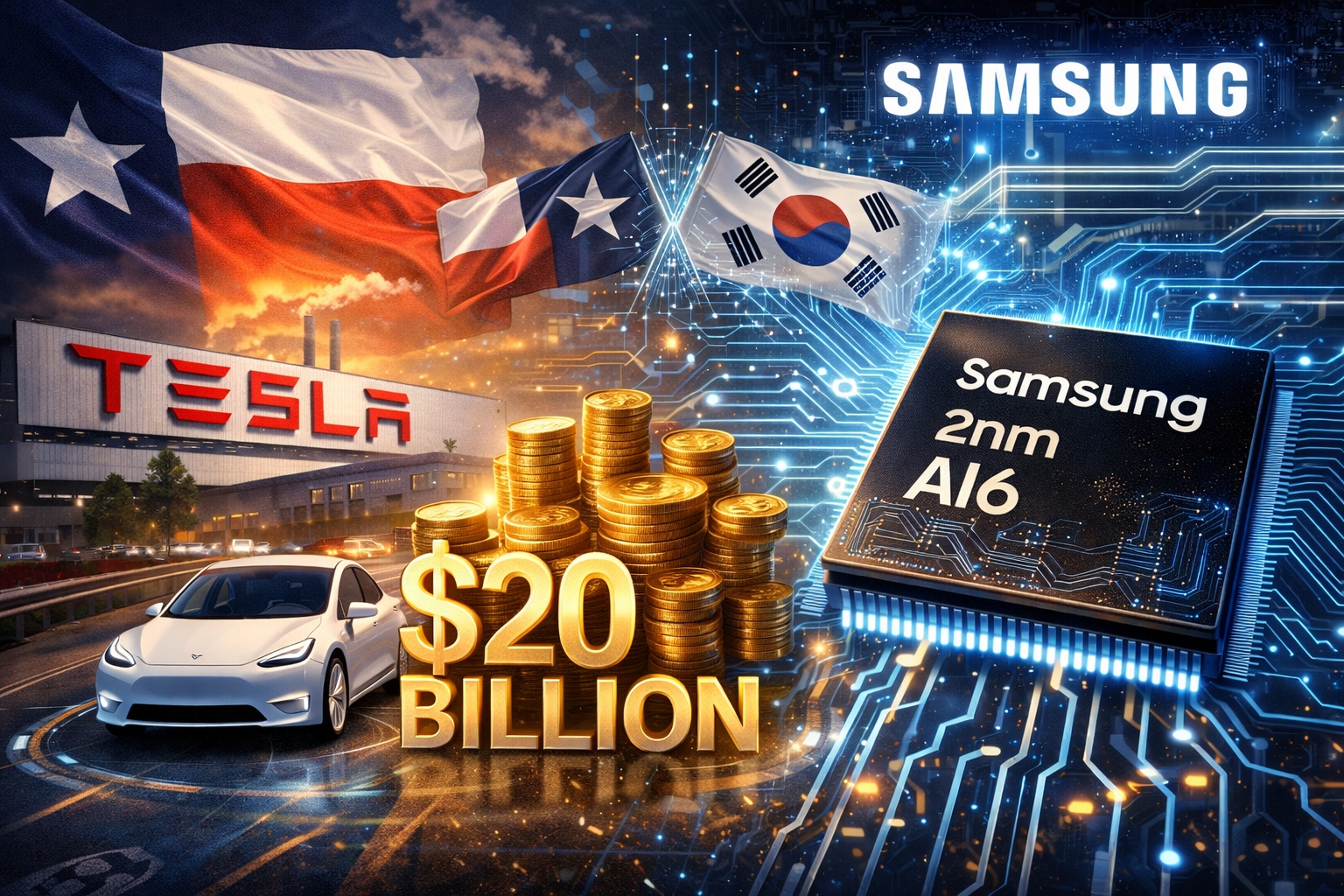
Introduction: The $50 Billion Handshake
In the first week of March 2026, a team of Tesla's senior procurement executives boarded flights to South Korea. Their mission was not to negotiate a discount on display screens or battery cells. Their mission was to secure the future of artificial intelligence at Tesla. According to multiple industry reports, Tesla is in the final stages of negotiating a massive expansion of its existing contract with Samsung Electronics, aiming to more than double the supply of AI6 wafers .
The numbers are staggering. Currently, Samsung produces approximately 16,000 wafers per month for Tesla using its advanced 2nm process. The new demand could add an additional 24,000 wafers, bringing the total to 40,000 wafers per month . At current market rates for advanced silicon, this could push Tesla's annual payments to Samsung from an estimated $20 billion to nearly $50 billion by the time the deal is fully ramped .
This is not a simple supply contract. It is a strategic alliance that analysts are calling the "Texas Compact" . It binds Tesla's hardware roadmap to Samsung's new foundry in Taylor, Texas, creating a domestic supply chain for the most critical component of the 21st century: the AI chip.
For the Tesla owner in Europe or the U.S., this deal is the invisible hand that will shape their driving experience for the next decade. It determines whether the FSD in their car improves, whether the Optimus robot in their local factory becomes a reality, and whether Tesla can maintain its lead in the autonomous race.
Section 1: Decoding the AI6—Beyond the 2nm Node
To understand why Tesla is willing to spend tens of billions of dollars, one must understand what the AI6 chip actually is.
The Architectural Leap from AI4 to AI6
The current generation of Tesla vehicles, including the 2026 Model Y "Juniper" refresh, utilize the AI4 chip, which is manufactured on a 5nm process node . The AI4 is incredibly capable; it powers the current FSD (Supervised) stack and handles the vision-based processing for over 9 million vehicles on the road.
The AI6, however, represents a generational quantum leap. Built on Samsung's 2nm gate-all-around (GAA) process, the AI6 chip is not merely an incremental upgrade . The move from 5nm to 2nm is expected to deliver a massive improvement in both performance and power efficiency. For an electric vehicle, efficiency is everything. A chip that performs twice the computation for half the energy means more range left for driving and less heat generated in the cabin.
A General-Purpose AI Workhorse
Crucially, the AI6 is described by industry insiders as a "generalist" AI chip . This is a significant distinction. The HW3 and HW4 (AI4) chips were primarily designed for the specific task of driving a car. They are application-specific integrated circuits (ASICs) optimized for Tesla's vision neural networks.
The AI6 is designed for a broader mandate. Its architecture is intended to handle the real-time decision-making required for:
-
Full Self-Driving (Unsupervised): Running the massive neural network models necessary for L4 autonomy without a human supervisor.
-
Optimus Humanoid Robot: Providing the "brain" for the robot to navigate unstructured environments, understand voice commands, and manipulate objects.
-
Dojo Training Nodes: Some variants of the AI6 are expected to be deployed in Tesla's data centers, acting as the compute nodes for the Dojo supercomputer, which trains the neural networks for the entire fleet .
The 5G Modem Integration
Another critical component of the AI6 package is the integrated 5G modem. Samsung has reportedly developed a custom 5G modem specifically for Tesla, which will be supplied alongside the AI6 chips starting later in 2026 . This modem is essential for the Robotaxi network. It enables the high-bandwidth, low-latency communication required for a driverless car to stream data, receive over-the-air updates in real-time, and communicate with fleet control centers. The modem ensures that the "AI Computer" (formerly FSD Computer) is constantly connected .
Section 2: The Texas Compact—Why Samsung and Why Now?
The choice of Samsung as the primary partner, and the insistence on manufacturing in Texas, is a story of geopolitics and vertical integration.
The Geopolitical Imperative
During Tesla's Q1 2026 earnings call, Elon Musk was uncharacteristically direct about the risks of relying on Asian semiconductor fabs. "I think people may underestimate some geopolitical risks that are going to be major factors in a few years," Musk warned . He elaborated that the current global concentration of advanced chip manufacturing in Taiwan (TSMC) and South Korea presents a strategic vulnerability.
If tensions escalate in the Taiwan Strait, the entire Western automotive industry could grind to a halt. By committing to Samsung's Taylor, Texas, fab, Tesla is effectively buying insurance. The $16.5 billion initial investment—and now the expanded deal—helps Samsung scale its U.S. operations, creating a "backup" source of supply outside of East Asia .
Why Samsung Over TSMC?
TSMC is the dominant player in the foundry business, but Samsung offered two critical advantages:
-
Capacity Alignment: Samsung was aggressively seeking a "anchor tenant" for its expensive new Taylor fab. Tesla's massive order fills that fab and helps Samsung recoup its capital investment.
-
Vertical Integration Synergy: Unlike TSMC, which is a pure-play foundry, Samsung has its own vast electronics division. This allows for closer collaboration on components like the custom 5G modem, which can be co-developed and optimized alongside the main AI chip .
The "TeraFab" Contingency
It is important to note that this Samsung deal does not negate Tesla's own chipmaking ambitions. Musk has confirmed the initiation of the "TeraFab" project—a Tesla-owned chip factory that would combine logic, memory, and packaging under one roof . However, building a leading-edge fab takes years and hundreds of billions of dollars. The Samsung deal is the bridge that provides Tesla with the necessary compute power today while the TeraFab project slowly comes online later this decade.
Section 3: The $20 Billion AI Investment Spree (and the Trade-Offs)
The expanded Samsung partnership is the centerpiece of a much larger financial commitment. Tesla has signaled that it plans to spend over $20 billion in 2026 on AI-heavy ventures .
Where the Money Goes
This $20 billion is not just for chips. It encompasses:
-
Cybercab Production: Tooling up the factories to produce the dedicated robotaxi vehicle.
-
Dojo Supercomputer Expansion: Purchasing the cooling, power, and networking infrastructure to house the tens of thousands of AI6 chips used for training.
-
Optimus Pilot Lines: Initial production tooling for deploying Optimus robots in Tesla's own factories for internal use.
-
Samsung Wafer Purchases: The down payments and long-term capacity reservations for the AI6 wafers.
The Investor Trade-Off
For investors and analysts, this level of capital expenditure presents a classic trade-off. Tesla's automotive business is facing margin compression due to price cuts and slowing demand in the U.S. and Europe . Traditional automakers would hunker down and preserve cash in such an environment.
Tesla is doing the opposite. It is doubling down on spending, betting that the future margins from software (FSD subscriptions, Robotaxi network fees) will dwarf the cyclical profits from car sales. As Simply Wall St notes, "Heavier fixed investment in custom AI hardware... [needs to] pay off through higher software and services revenue" . If the robotaxi or Optimus adoption is slower than hoped, this spending could pressure free cash flow significantly.
Section 4: The Product Roadmap Implications for Owners
For the Tesla enthusiast, the AI6 chip is not an abstract concept. It dictates the timeline and capability of the features they care about most.
FSD Performance and Availability
The AI6 chip is not expected to appear in consumer vehicles until at least 2028 . The current AI4 hardware is still vastly underutilized relative to its potential. However, the existence of the AI6 roadmap provides confidence to current owners that their investment in FSD will eventually translate into a vehicle capable of unsupervised driving. The neural networks trained on Dojo (powered by AI6 chips) will improve the performance of AI4 vehicles via over-the-air updates, even if the owners never buy a new car.
The Robotaxi Launch Timeline
The most immediate beneficiary of the AI6 ramp is the Cybercab. The robotaxi requires the AI6's 2nm efficiency and the integrated 5G modem to function profitably. The expanded Samsung deal, therefore, is a positive signal that Tesla is serious about launching the service in Austin and expanding to other cities. If Samsung can deliver the chips on time, it removes a major supply chain bottleneck for the Cybercab program.
The Optimus Reality Check
For those following the robotics narrative, the AI6 is the "brain" that makes Optimus useful. The humanoid robot market is littered with impressive demos that fail in the real world because they lack the on-board compute to react instantly. The AI6, combined with the advanced AI models being developed by xAI (which Tesla has invested $20 billion in), could provide the "soul" to match Optimus's mechanical "body" .
Conclusion: The Silicon-Powered Future
Tesla's decision to lock in a multi-billion dollar, multi-year supply of 2nm AI6 chips from Samsung is the single most important strategic move the company has made since the construction of Gigafactory Shanghai. It confirms that Tesla views itself not as an automaker that uses chips, but as an AI company that builds hardware.
The "Texas Compact" with Samsung provides Tesla with three critical assets:
-
Geopolitical Resilience: A U.S.-based supply chain for its most vital component.
-
Computational Superiority: Access to cutting-edge 2nm silicon that will power its autonomous and robotic fleets.
-
Vertical Integration: A partner willing to co-develop custom solutions like the 5G modem.
For the Tesla owner, this means that the gap between the promise of "Full Self-Driving" and the reality of "Unsupervised Autonomy" is being filled with silicon and software, not just hype. The $20 billion question is whether the execution on the product side can keep pace with the hardware procurement. If it can, 2026 will be looked back upon as the year Tesla secured the compute to dominate the next decade.
FAQ
Q: When will the AI6 chip be available in a Tesla I can buy?
A: According to current industry reports and semiconductor roadmaps, the AI6 processor is not expected to enter Tesla vehicles or robots until at least 2028. The AI4 (5nm) hardware in current models will continue to receive updates and improvements for the foreseeable future .
Q: Does the AI6 chip make my current Tesla obsolete?
A: No. Your current vehicle's hardware (AI3 or AI4) was designed for its specific capabilities. While the AI6 will enable new features in future cars, Tesla continues to support and improve the performance of existing hardware through software optimizations and neural network advancements trained on more powerful computers .
Q: Why is Tesla spending $20 billion on chips when car sales are slowing?
A: Tesla is making a strategic bet that the future value of the company lies in high-margin software and services (like the Robotaxi network and FSD subscriptions) rather than just selling cars. The chip investment is necessary to build the infrastructure for that future, even if it pressures short-term finances .
Q: Will the Samsung-made chips affect the quality of my Tesla?
A: The chip is a component, not a determinant of assembly quality. The AI6 chip is designed to be more powerful and efficient, which will improve the performance of future software features. It is manufactured to Samsung's highest quality standards for the automotive and data center markets .
Q: Is the "TeraFab" project replacing the Samsung deal?
A: No, the two are complementary. The Samsung deal provides the "bird in hand"—immediate, massive-scale supply of advanced chips. The TeraFab project is Tesla's long-term ambition to gain total independence. It will likely take years to build and will initially supplement, rather than replace, the Samsung supply .