
Introduction
The modern automotive industry faces rising labor costs, intricate assembly constraints, and complex manufacturing supply chains. While traditional original equipment manufacturers (OEMs) treat vehicle production and industrial robotics as entirely separate disciplines, Tesla is executing a unified hardware and software strategy. By building the Optimus Gen 3 humanoid robot on the exact same artificial intelligence framework, compute silicon, and spatial vision systems that power its autonomous vehicles, Tesla is radically transforming manufacturing operations at Giga Texas and the Fremont factory.
2. Hardware & AI Convergence
The foundational strength of Tesla’s robotics initiative lies in technological cross-pollination.
Shared Silicon Architecture
Rather than developing a standalone computer chip for Optimus, Tesla integrates its proprietary AI5 silicon across both vehicle platforms and humanoid robotics. The same low-latency neural processing unit that evaluates high-speed road conditions inside a Model Y or Cybercab processes real-time sensor feedback from Optimus’s dexterous hands and balance actuators.
Vision Processing Pipelines
Optimus relies exclusively on optical vision feeds from head-mounted cameras, running the same occupancy network spatial engines developed for FSD. This shared vision architecture enables the robot to navigate dynamic factory floors, recognize obstacles, map 3D physical spaces, and adjust to moving machinery without requiring specialized ambient beacons or physical guide rails.
3. Deployment of Optimus Gen 3 in Gigafactories
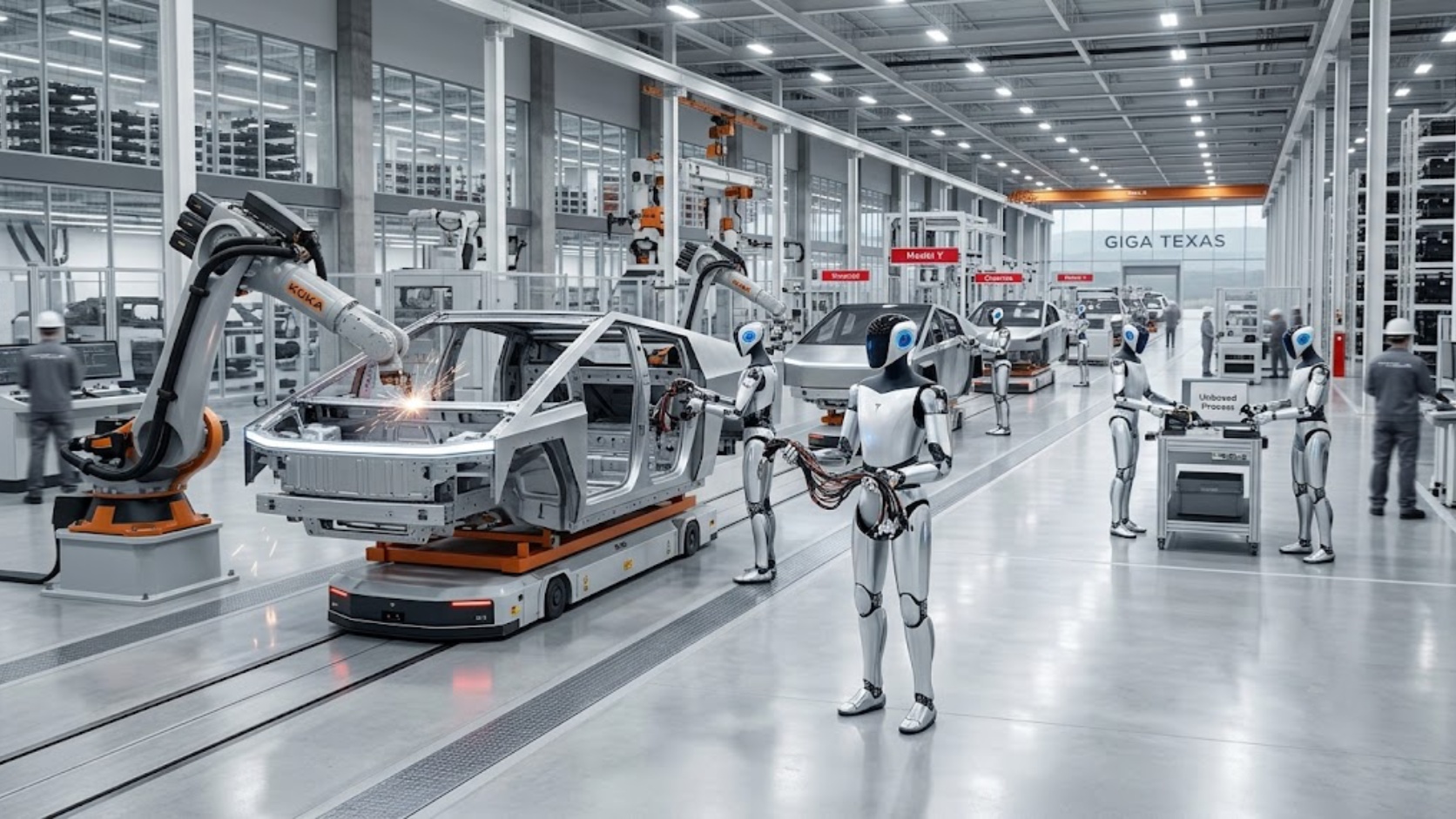
In 2026, Optimus Gen 3 transitioned from laboratory prototype testing to active operational roles within Tesla manufacturing plants.
High-Precision Ergonomic Operations
Optimus units handle repetitive, ergonomically stressful tasks that typically cause worker fatigue or strain injuries. Featuring tactile sensor arrays embedded across all fingertips, Optimus Gen 3 delicate battery cells, inserts wiring harnesses into tight door panels and sorts hardware fasteners with human-like dexterity.
Continuous Deep-Learning Improvement
Every hour an Optimus robot spends operating inside a Gigafactory generates telemetry and movement data. Using teleoperation data streams and reinforcement learning, algorithms refine motor actuation parameters, accelerating the robot's speed and operational accuracy across every successive manufacturing shift.
4. Unbox Process & Next-Gen Vehicle Platforms
The integration of humanoid robotics is essential to realizing Tesla’s "Unboxed" vehicle manufacturing methodology.
Unlike traditional linear assembly lines where a painted body shell moves continuously along a single path, the Unboxed process constructs distinct vehicle sub-assemblies simultaneously in parallel dedicated pods. Once completed, these sub-assemblies are joined together in a single final assembly step. Optimus robots seamlessly bridge the gaps between these parallel production cells, moving components autonomously and performing joining operations without requiring massive reconfigurations of rigid industrial automation machinery.
5. Long-Term Commercialization Outer Limits
While internal Gigafactory deployment serves as the proving ground, the commercial potential of Optimus reaches far beyond automotive assembly. Offering third-party industrial manufacturers a versatile humanoid robot capable of operating existing human tools and adapting to unformatted workspaces addresses severe global labor shortages in logistics, warehousing, and heavy industrial sectors.
Conclusion
By leveraging shared AI silicon, unified vision networks, and advanced manufacturing platforms, Tesla has built an unmatched technological ecosystem. The integration of Optimus Gen 3 into Gigafactory operations lowers vehicle production costs, accelerates assembly timelines, and establishes a blueprint for the future of industrial automation.
Frequently Asked Questions (FAQ)
Q1: How does Optimus Gen 3 learn complex assembly tasks inside the factory?
Optimus learns tasks through a combination of human teleoperation recording and neural network reinforcement learning. Human operators perform the assembly task wearing motion-capture gear, allowing the neural network to map movement trajectories and refine them for autonomous execution.
Q2: What is the direct financial benefit of shared AI development between Cybercab and Optimus?
Shared AI development eliminates redundant research and development costs. Capital spent optimizing the AI5 chip, training supercomputers, or developing vision networks directly benefits both the automotive software division and the humanoid robotics division simultaneously.
Q3: Will Optimus robots be made commercially available to third-party manufacturers?
Yes. After fully validating operational efficiency, safety protocols, and component reliability within its own manufacturing facilities, Tesla plans to roll out commercial Optimus units to external enterprise customers in manufacturing and logistics sectors.