
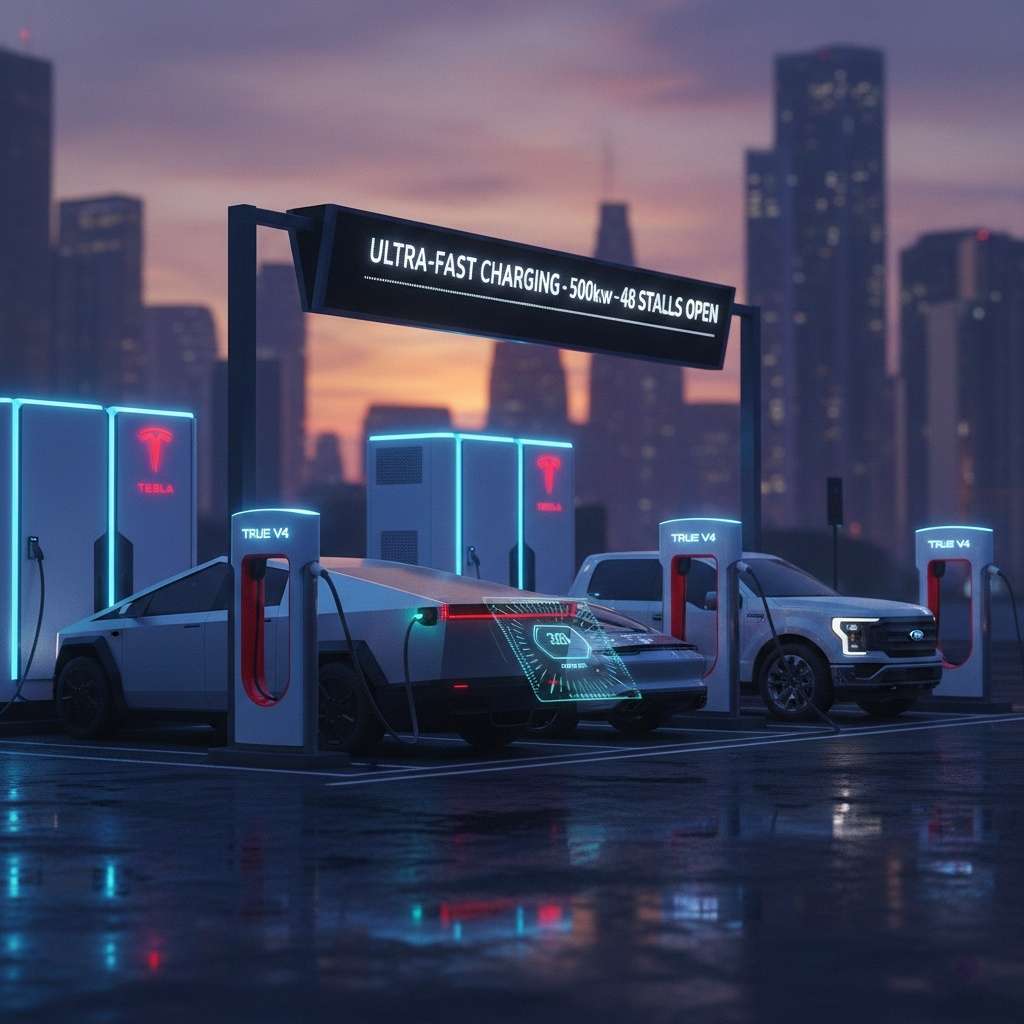
1. Introduction: The 500kW Milestone
As of late January 2026, the global electric vehicle landscape has reached a pivotal tipping point. While the "range anxiety" of the early 2010s has largely been relegated to the history books, a new challenge emerged in the mid-2020s: throughput efficiency. With millions of non-Tesla EVs now carrying NACS (North American Charging Standard) ports or utilizing Magic Dock adapters, the demand on the Supercharger network has never been higher.
Yesterday's release of Tesla's 2025 year-end infrastructure report confirms that the network has surpassed 75,000 global stalls. However, the headline isn't the quantity—it's the quality. The "True V4" revolution, characterized by the 1000V architecture and the long-awaited 500kW peak output for passenger vehicles, has officially moved from pilot testing in California to a wide-scale rollout across North America and Europe.
2. The Anatomy of "True V4": 1000V and the V4 Cabinet
To understand the 2026 infrastructure, one must distinguish between a "V4 Dispenser" and a "True V4 Site."
2.1 The Bottleneck of the V3 Cabinet
For the past year, many "V4" sites were actually hybrids: new, taller V4 posts connected to older V3 power cabinets. These sites were limited to 250kW and 500V, meaning 800V vehicles like the Porsche Taycan or Hyundai IONIQ 6 couldn't hit their peak speeds.
2.2 The V4 Cabinet Revolution
The hardware deployed in early 2026 changes everything. The new V4 Power Electronics Cabinet is a 1.2MW monster.
-
Voltage Range: 180V to 1,000V DC.
-
Current Density: 615 Amps.
-
Power Density: 3x higher than V3, meaning less physical footprint for more electrical "oomph."
For the first time, Tesla’s infrastructure is natively supporting the next generation of high-voltage batteries. The Cybertruck, which has long teased faster charging, is now seeing its 800V architecture fully utilized at these "True V4" sites, cutting 10-80% charge times by nearly 30%.
3. The European Expansion: Bridging the "Old World"
Europe presents a unique challenge: a fragmented grid, dense urban corridors, and the universal CCS2 standard. Despite these hurdles, Tesla has successfully converted over 42% of its European stalls to V4 as of January 2026.
3.1 Germany: The High-Speed Arteries
In Germany, Tesla has focused on the Autobahn network. Major hubs in Düsseldorf and Bensheim have been upgraded to V4 Cabinets this month. These sites are essential for German luxury EV owners (Porsche, Audi, Mercedes) who have largely abandoned proprietary charging networks in favor of Tesla’s superior uptime, which remains above 99%.
3.2 The UK: Beating the Grid Constraints
The United Kingdom has seen a surge in "Super-Hubs"—sites with 40 or more stalls. By integrating Megapacks (Tesla’s utility-scale batteries) into these sites, Tesla can provide 500kW bursts even when the local National Grid connection is limited. This "Energy Flywheel" approach has allowed sites like Tottenham and Manchester to stay operational and fast during peak evening hours.
4. The NACS Tsunami: Managing the Crowd
In the US, 2026 marks the "Year of the Open Gate." Nearly every major automaker (Ford, GM, Rivian, Volvo, Mercedes) has now fully integrated NACS ports into their new models.
4.1 Congestion Management via AI
With an influx of "non-native" EVs, wait times were a major concern for Tesla purists. Tesla’s solution in 2026 is Live Occupancy Pricing. The Tesla app now uses real-time AI to predict station arrival times and dynamically adjusts pricing for non-Tesla owners to "nudge" them toward underutilized nearby stalls.
4.2 The "Magic Dock 2.0"
For older CCS vehicles, Tesla has begun installing the Magic Dock 2.0 at V4 sites. This revised adapter is more robust and supports the higher 1000V throughput, ensuring that even a 2022 Kia EV6 can benefit from the V4 Cabinet's power.
5. Charging Economics: The New Profit Engine
Tesla Charging is no longer a cost center; it is a massive revenue generator.
-
Operational Costs: By reducing the cost per stall to under $40,000, Tesla can recoup its capital investment in just over 12 months in high-traffic areas.
-
The Membership Model: The $12.99/month Supercharger membership has become the "Amazon Prime" of the EV world, with millions of non-Tesla owners subscribing to access lower rates.
6. Conclusion: The "Moat" Widens
As we look at the state of charging in 2026, it is clear that Tesla’s primary advantage is no longer just the cars—it is the fueling station of the 21st century. By mastering 1000V electronics and 500kW speeds before its competitors could even stabilize their 150kW networks, Tesla has secured its position as the backbone of global electric transport. For the owner in London or Los Angeles, the experience remains the same: pull up, plug in, and walk away. Only now, you’re back on the road in half the time.
7. FAQ: Frequently Asked Questions
Q: Does my 2021 Model 3 benefit from the new 500kW V4 chargers? A: Not in terms of peak speed. Your car is limited by its 400V architecture and battery chemistry to ~250kW. However, you benefit from better "power sharing" at V4 sites, meaning your speed won't drop as much when the stall next to you is occupied.
Q: Can a Porsche Taycan really hit 500kW at these sites? A: While the V4 cabinet can output 500kW, the 2025/2026 Porsche Taycan is currently capped at roughly 320kW. The "overhead" provided by Tesla ensures the charger is never the bottleneck.
Q: Are V4 chargers more expensive to use? A: Base rates are similar to V3, but Tesla has introduced "Peak Hour Surcharges" at high-traffic urban sites to encourage off-peak charging.
Q: How do I find a "True V4" site (1000V) vs. a standard V4 post? A: In the Tesla App (Version 5.x), look for the "Ultra-Fast" icon or sites labeled with "Up to 500kW."