
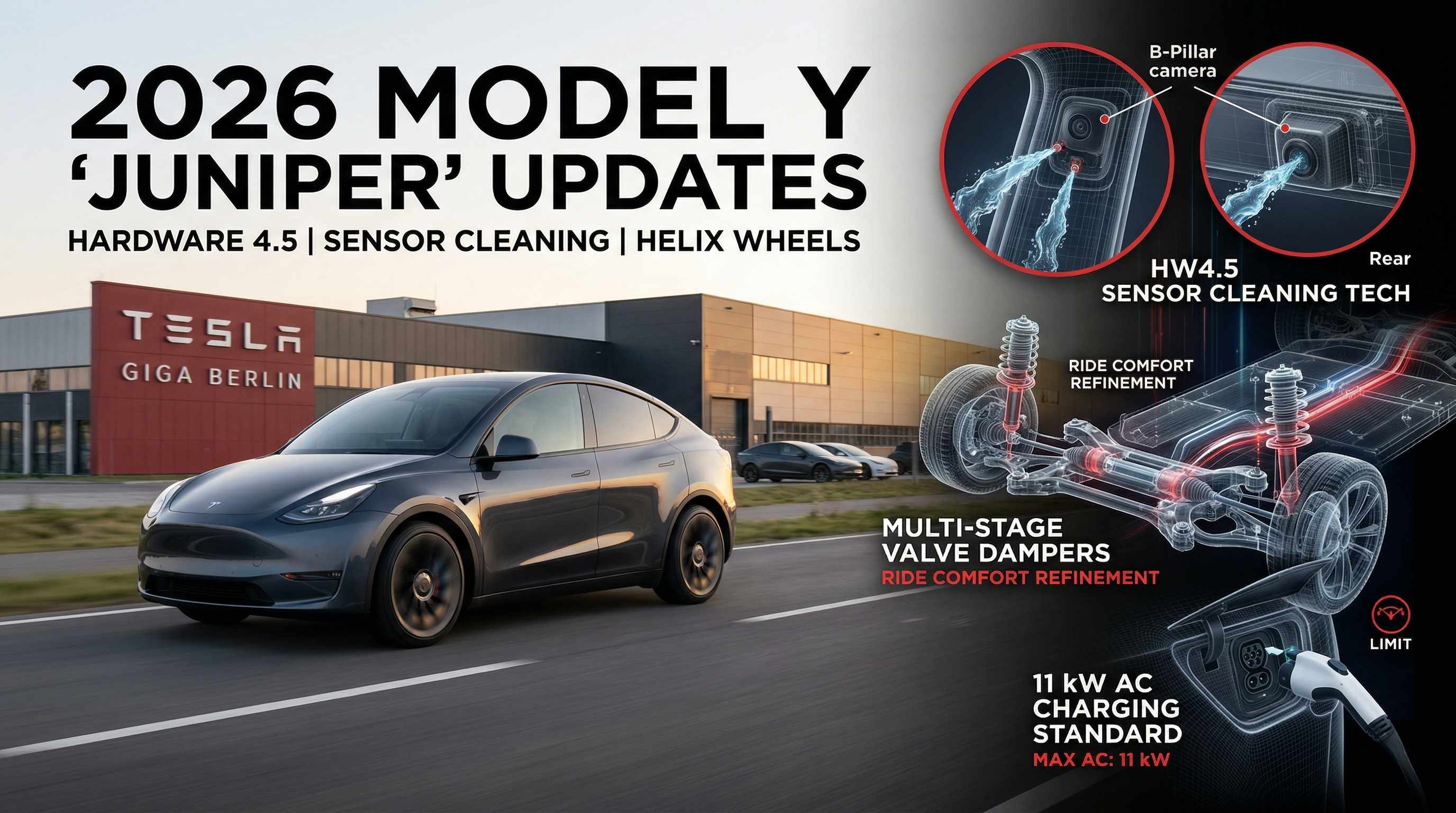
Chapter 1: The HW4.5 Advantage and the Quest for All-Weather Autonomy
The most significant, yet least visible, upgrade to the 2026 Model Y is the transition from the standard Hardware 4 (AI Computer) to a revised architecture unofficially designated by the engineering community as Hardware 4.5 (HW4.5). While the core processing unit—the silicon brains behind the Full Self-Driving (FSD) neural network—remains largely identical to the HW4 suite introduced in 2023, the peripheral sensor hardware has received a massive, highly pragmatic overhaul.
The Sensor Cleaning Revolution For years, Tesla owners in colder climates and regions prone to heavy rainfall have shared a common frustration: "Autopilot cameras blocked or blinded." The reliance on a purely vision-based system means that a single splash of muddy water, a buildup of winter road salt, or a layer of morning frost can immediately disable advanced driver-assistance features.
With the 2026 Juniper rollout, Tesla has finally addressed this Achilles' heel. HW4.5 introduces integrated, micro-fluidic cleaning nozzles housed directly within the exterior camera assemblies. Specifically, the rear tailgate camera and the critical B-pillar side-repeater cameras now feature a high-pressure, low-volume washer system.
How does it work? The system is tied directly into the windshield washer fluid reservoir. When the vehicle's neural net detects occlusion or a drop in optical clarity on a specific lens—or when the driver manually triggers the windshield washers—a micro-pulse of fluid is blasted across the camera glass, followed by a burst of forced air to clear the droplets. This ensures the 5-megapixel, high-dynamic-range lenses maintain uncompromised vision, drastically reducing the disengagement rate of FSD during inclement weather in places like the Pacific Northwest or the snowy autobahns of Germany.
Thermal Mitigation and Anti-Fogging Beyond the physical washing system, the HW4.5 camera housings feature upgraded internal heating elements. Previous iterations relied on ambient heat from the processing boards to keep the glass clear, which often proved insufficient during rapid temperature drops. The new active heating elements can defrost a frozen camera lens in under 90 seconds, ensuring the vehicle is ready to navigate autonomously almost as soon as you step inside.
For the average driver, HW4.5 transforms FSD from a "fair-weather friend" into a reliable co-pilot, fundamentally increasing the utility and safety of the vehicle in suboptimal driving conditions.
Chapter 2: Premium Trim Exclusives: Helix Wheels and Kinematic Tweaks
While the computing hardware dictates the vehicle's brain, the physical connection to the road defines the soul of the driving experience. The 2026 Model Y updates bring a refined aesthetic and mechanical maturity to the vehicle's stance, most notably through the introduction of new premium configurations.
The 20-inch Dark Gray Helix Wheels Aerodynamics and aesthetics often find themselves at war in EV design. The 2026 Model Y Long Range and Performance trims seek to bridge this divide with the introduction of the new 20-inch Dark Gray Helix wheels, replacing the aging Induction wheel design.
The Helix wheels are a masterclass in airflow management. Cast from a lightweight aluminum alloy, their asymmetrical, turbine-inspired spoke pattern is engineered to channel turbulent air away from the wheel wells, reducing aerodynamic drag at highway speeds. Despite their larger size, the unsprung mass has been reduced by approximately 1.5 kilograms per corner compared to the previous generation. This reduction in rotating mass translates to sharper steering response and a marginal but measurable improvement in overall energy efficiency, yielding an extra 3 to 5 miles of highway range.
Aesthetically, the darker, matte-metallic finish pairs aggressively with the deletion of chrome trims, giving the vehicle a wider, more planted visual presence that resonates well with the premium European market.
Suspension Geometry and Dampening Refinement Early Model Ys were frequently criticized for their harsh, unforgiving ride quality, particularly over broken urban pavement. Tesla has been iterating on its suspension design continuously, and the 2026 builds feature the most sophisticated mechanical setup to date.
Without moving to a highly complex and expensive air suspension system, Tesla engineers have completely revised the damping rates and bushing compliance on the Juniper updates. The dual-tube shock absorbers now feature multi-stage valving. During low-speed, high-amplitude impacts (like potholes or speed bumps), a secondary valve opens to quickly dissipate the energy, resulting in a plush, compliant ride. During high-speed cornering, the valving restricts fluid flow, stiffening the suspension to minimize body roll and maintain the Model Y's signature sports-car-like agility.
Furthermore, the rear subframe bushings have been redesigned with a softer durometer polyurethane, drastically reducing the transmission of low-frequency road noise and high-frequency vibrations into the cabin. The result is a whisper-quiet interior and a ride quality that finally rivals established luxury marques like BMW and Audi.
Chapter 3: The AC Charging Debate: Efficiency vs. Limitation
Not all hardware updates in the 2026 Model Y have been universally praised. A significant point of contention within the enthusiast community revolves around Tesla's decision regarding the vehicle's onboard AC charging architecture.
The 11 kW Ceiling In earlier iterations of the Model S and X, and even some early Long Range Model 3s, buyers could opt for high-capacity onboard chargers capable of drawing up to 22 kW of alternating current (AC) from a compatible wall connector. This allowed for incredibly fast home charging.
With the 2026 Model Y, Tesla has firmly standardized the onboard AC charger across all trims to a maximum capacity of 11 kW (approximately 48 amps on a 240V circuit). For owners who previously invested heavily in 22 kW or high-amperage home charging infrastructure, this hardware limitation feels like a downgrade.
The Engineering and Economic Justification To understand this decision, we must look at the data driving Tesla's engineering choices. Telemetry from millions of vehicles revealed that less than 2% of the global fleet regularly utilized AC charging speeds above 11 kW. The vast majority of owners plug in their vehicles overnight, where an 11 kW charger easily replenishes a battery from 20% to 80% in roughly 5 to 6 hours—well within the standard sleeping window.
By eliminating the heavier, more expensive 22 kW onboard inverters, Tesla achieves several goals:
-
Cost Reduction: Simplifying the manufacturing process and reducing component costs.
-
Weight Savings: Shedding unnecessary weight to further optimize the vehicle's miles-per-kWh efficiency.
-
Space Utilization: Freeing up physical space within the battery management array for more advanced thermal routing.
Tesla’s underlying philosophy is shifting. AC charging is viewed strictly as a "destination" or "overnight" solution, where extreme speed is unnecessary. For rapid energy replenishment, Tesla is aggressively expanding its V4 Supercharger network (DC fast charging), capable of delivering upwards of 250 kW. The 11 kW AC limit is a calculated compromise, sacrificing a niche luxury for broader fleet efficiency and cost optimization.
Chapter 4: Transatlantic Differences: US vs. European Specs
A fascinating aspect of tracking Tesla's hardware updates is observing how regional manufacturing hubs—Giga Texas and Fremont in the US, versus Giga Berlin in Europe—diverge in their production specifications. As of April 2026, a Model Y ordered in California is not entirely identical to one ordered in Munich.
Structural Battery Packs and Cell Chemistry In the United States, Giga Texas is heavily focused on the integration of the 4680 structural battery pack. This design utilizes the battery pack itself as a load-bearing component of the vehicle's chassis, significantly increasing torsional rigidity and simplifying assembly. The 2026 Standard Range models emerging from Texas utilize these 4680 cells, prioritizing manufacturing scale.
Conversely, Giga Berlin has deeply integrated BYD's advanced structural "Blade" battery technology (using Lithium Iron Phosphate, or LFP chemistry) for its entry-level rear-wheel-drive configurations. European owners benefit from this LFP chemistry, which allows for regular charging to 100% without significant degradation, a massive plus for daily commuters in dense urban environments.
Paint Technology and Manufacturing Precision Giga Berlin continues to boast the most advanced paint shop in Tesla's global network. Exclusive colors like Quicksilver and Midnight Cherry Red utilize a highly complex, multi-layered application process that creates a deep, liquid-metal appearance, dynamically shifting based on the curvature of the vehicle and ambient lighting.
While the US factories have introduced Stealth Grey and Ultra Red to close the gap, the European models generally exhibit a slightly higher micron thickness in their clear coats, providing better resistance to stone chips—a necessity for high-speed Autobahn driving.
Regulatory Hardware Finally, European Model Ys feature specific hardware adaptations to comply with stringent EU regulations. This includes active matrix LED headlights that are fully enabled for adaptive glare-free high beams (a feature still heavily regulated and only partially enabled in the US market), as well as physical structural reinforcements in the front crumple zones to satisfy Euro NCAP's aggressive pedestrian safety protocols.
Conclusion: The Buyer's Dilemma—Is it Time to Upgrade?
The 2026 "Juniper" updates to the Tesla Model Y represent a massive maturation of an already class-leading vehicle. Tesla has systematically targeted the car's few remaining weaknesses. The introduction of HW4.5 with active sensor cleaning effectively neutralizes the weather-related limitations of vision-only autonomy. The revised suspension geometry and the striking 20-inch Helix wheels elevate the driving dynamics from utilitarian to genuinely premium.
If you are currently driving a 2020 or 2021 Model Y, the difference in ride comfort, cabin noise isolation, and technological capability in the 2026 model is night and day. The leap in the FSD hardware alone justifies the transition for tech enthusiasts.
However, if you own a late 2023 or 2024 model equipped with the standard HW4, the lines are blurrier. Unless you live in a climate where snow and heavy rain constantly cripple your Autopilot cameras, the core performance of the vehicle remains quite similar. The 2026 Model Y is a testament to Tesla's philosophy of continuous iteration—it is unquestionably the best version of the car ever built, refined not by radical reinvention, but by relentless, data-driven optimization.
Frequently Asked Questions (FAQs)
Q1: How can I guarantee my new Model Y order includes Hardware 4.5? Tesla does not officially list HW4.5 on the configuration menu. However, as of late March 2026, nearly all Long Range and Performance models rolling off the Fremont and Giga Berlin lines feature the new camera cleaning system. When you receive your VIN, you can consult community tracking spreadsheets or physically inspect the vehicle prior to accepting delivery by checking the side-repeater cameras for the integrated fluid nozzle.
Q2: Can the HW4.5 camera cleaning system be retrofitted to older HW3 or HW4 vehicles? Unfortunately, no. The new system requires dedicated fluid lines routed from the main washer reservoir through the vehicle's structural pillars, as well as a completely different wiring harness to power the active heating elements. It is a factory-only integration.
Q3: Is the 7-seater configuration expanding to Europe with the 2026 updates? Yes. While historically limited mostly to the North American market, Giga Berlin has recently retooled a portion of its assembly line to accommodate the third-row seating option for the Long Range All-Wheel Drive variant. European customers should see this option become widely available in the configuration studio by Q3 2026.
Q4: Does the 11 kW AC charging limit mean I can't use my older 22 kW Tesla Wall Connector? You can absolutely still use your older, high-capacity Wall Connector. The charging station will simply communicate with the 2026 Model Y and automatically limit the power delivery to the vehicle's maximum intake threshold of 11 kW. It is perfectly safe and requires no modifications to your home electrical setup.
Q5: Are the new 20-inch Helix wheels prone to curb rash like the old Uberturbines? Tesla has slightly redesigned the tire profile provided with the Helix wheels. The rubber now features a marginally wider sidewall protector flange that extends past the aluminum rim edge. While you still need to be careful parallel parking, this small design tweak provides a much-needed buffer against minor curb impacts compared to previous wheel iterations.