
Introduction: The Inflection Point of 2026
In the history of sustainable transport, 2026 will be remembered as the year the "charging barrier" finally crumbled. While the early 2020s were defined by range anxiety and fragmented networks, today—February 2, 2026—the narrative has shifted toward seamless, ultra-high-speed integration. Tesla’s global rollout of the V5 Supercharger cabinet is the catalyst for this change.
The V5 is more than a faster plug; it is the central nervous system of a new energy economy. With a staggering peak output of 500kW and native support for up to 1000V DC, it addresses the technical requirements of a new generation of heavy-duty and performance EVs. In the US and Europe, the V5 is not just fueling Teslas; it is fueling the entire electric transition through standardized interoperability and AI-driven grid management.
Chapter 1: Engineering the 500kW Frontier
1.1 The Architecture of Speed
The leap from V3 (250kW) to V5 (500kW) required a fundamental rethinking of thermal management and power electronics. Traditional charging cables are limited by the heat generated at high currents ($P = I^2R$). To double the power output without doubling the cable thickness, Tesla engineered a next-generation liquid-cooled cable using a proprietary coolant with 40% higher thermal conductivity than previous iterations.
This allows the V5 to deliver up to 400 kilometers of range in just 5 minutes for compatible vehicles. For the first time, the "refueling" time of an EV is nearing parity with internal combustion engines, removing the primary psychological hurdle for long-distance travel in markets like the American Midwest or the European motorways.
1.2 High-Voltage Dominance
The 2026 automotive landscape is increasingly dominated by 800V and 1000V architectures. While older 400V chargers struggle to provide peak rates to these vehicles, the V5 cabinet is designed for a 0–1000V VDC range. This makes it the premier destination not just for the Tesla Cybertruck, but for high-end competitors like the Lucid Air, Porsche Taycan, and the upcoming 2026 BMW "Neue Klasse" models.
Chapter 2: Magic Dock 2.0 and the "Universal Standard"
2.1 The NACS Global Victory
By early 2026, the North American Charging Standard (NACS) has moved beyond North America. In a series of landmark agreements, European automakers have begun adopting the NACS inlet for their 2026/2027 model years to tap into Tesla’s superior uptime (historically 99.9%).
The Magic Dock 2.0 is the bridge for this transition. Unlike the first iteration, which was a bulky retrofit, Magic Dock 2.0 is an integrated, motorized adapter within the V5 post. It automatically detects the vehicle type and deploys the appropriate connector—whether NACS or CCS2—ensuring that a Ford F-150 Lightning or a Volkswagen ID.4 can plug in as effortlessly as a Model Y.
2.2 Software-Defined Charging
The true innovation of 2026 is the cross-brand "Plug & Charge" protocol. Tesla has opened its API to major OEMs, allowing for a unified handshake. When a non-Tesla vehicle plugs into a V5, the billing and battery pre-conditioning are handled automatically via the vehicle’s native infotainment system. This eliminates the "App Fatigue" that plagued early EV adopters who had to maintain dozen of different charging accounts.
Chapter 3: The AI Economy—Congestion and Dynamic Pricing
3.1 Live Pricing and Market Equilibrium
With millions of non-Tesla vehicles now accessing the network, managing station throughput has become a data science problem. Tesla’s 2026 Live Pricing model utilizes neural networks to predict demand based on:
-
Real-time vehicle navigation data (number of EVs routed to a specific station).
-
Local grid utility rates.
-
Historical "rush hour" patterns at specific geographic coordinates.
Prices now fluctuate in 15-minute intervals. If a station in New Jersey is nearing 90% occupancy, the price per kWh might rise slightly to encourage drivers to seek the next available station 10 miles away. Conversely, during low-demand periods, rates may drop below local utility averages to incentivize "opportunity charging."
3.2 The High State-of-Charge (SoC) Fee
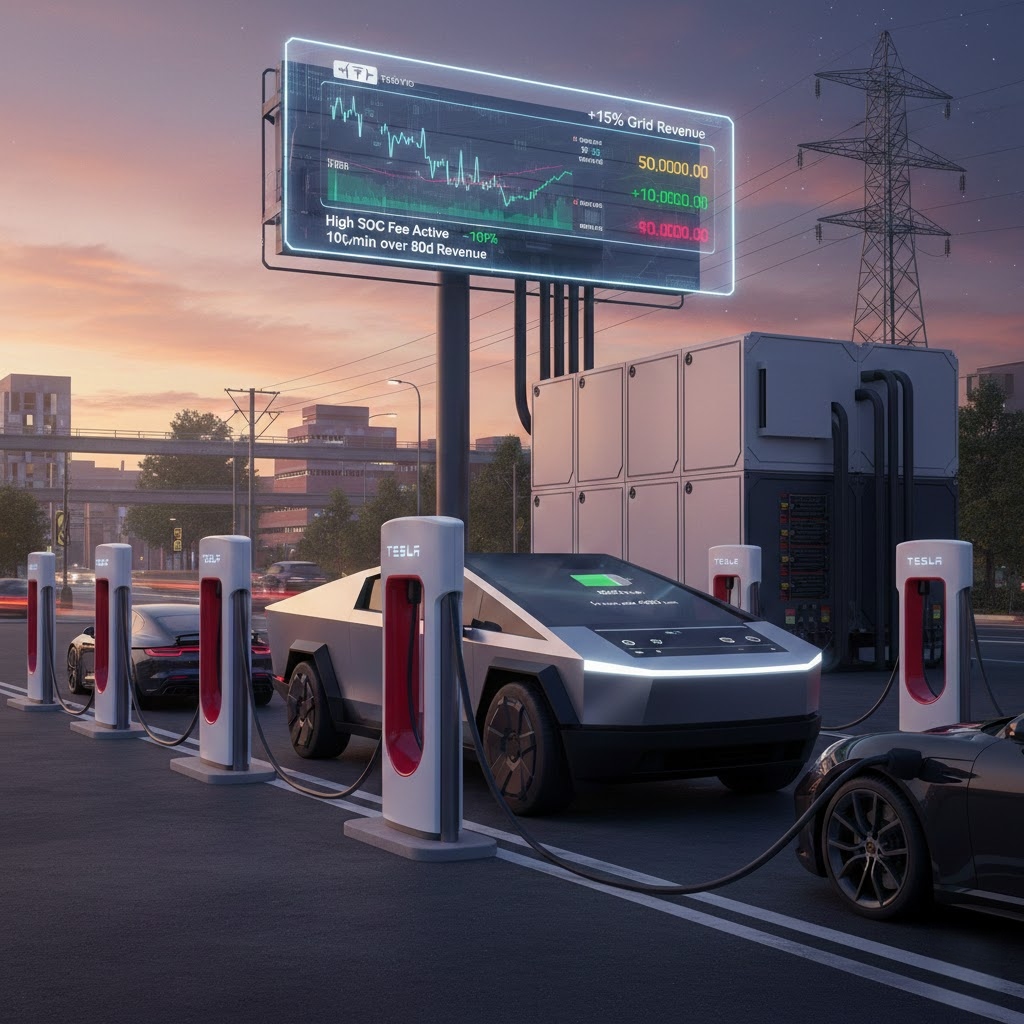
One of the most controversial yet effective tools in Tesla’s 2026 arsenal is the Congestion Fee for high SoC. Since charging speeds drop significantly after 80%, a vehicle occupying a V5 stall to reach 100% in a busy station is an efficiency bottleneck. In 2026, if a station is busy, Tesla implements a "Congestion Surcharge" for every minute a vehicle remains plugged in above 80% SoC, ensuring that stalls are available for those who truly need a fast splash-and-dash.
Chapter 4: The Virtual Power Plant (VPP) Integration
4.1 Megapack as the Buffer
The V5 rollout is rarely a standalone event. Most new V5 Supercharger "hubs" in 2026 are paired with Tesla Megapacks. This serves two critical roles:
-
Peak Shaving: Instead of drawing massive, expensive surges of power from the grid when five Cybertrucks plug in simultaneously, the station draws from the Megapack.
-
Grid Stability: During peak heatwaves in California or winter storms in Texas, these Supercharger hubs act as a Virtual Power Plant. Tesla can pause charging or push energy back into the grid, earning massive credits from utilities that offset the cost of the chargers themselves.
4.2 The "Energy Flywheel" Profit Model
By 2026, Tesla is essentially a digital utility. It buys electricity when it is cheap (mid-day solar surplus) and sells it via the V5 Superchargers at a premium. This "Energy Flywheel" makes the charging division a high-margin business, independent of vehicle sales cycles.
Conclusion: The New Infrastructure of Liberty
The Tesla V5 Supercharger is the final piece of the puzzle for the post-gasoline world. By combining 500kW technical supremacy with AI-driven economic efficiency, Tesla has created a network that is both a public utility and a private profit engine. In 2026, the question is no longer "Where can I charge?" but rather "Why would I charge anywhere else?"
FAQ
-
Q: Can a 2022 Model 3 take advantage of V5's 500kW?
-
A: Older 400V models will still be limited by their internal battery architecture (approx. 170kW–250kW), but they will benefit from more consistent speeds and less "neighbor sharing" slowdowns thanks to the V5 cabinet's 1.2MW total power capacity.
-
-
Q: Is Magic Dock 2.0 available in Europe?
-
A: Yes. While Europe primarily uses CCS2, Magic Dock 2.0 is being used to facilitate the transition for older vehicles and the small number of NACS-native imports.
-
-
Q: Does the "Congestion Fee" apply if the station is empty?
-
A: No. The fee is dynamically triggered only when the station occupancy exceeds a specific threshold (typically 50-80%).
-