
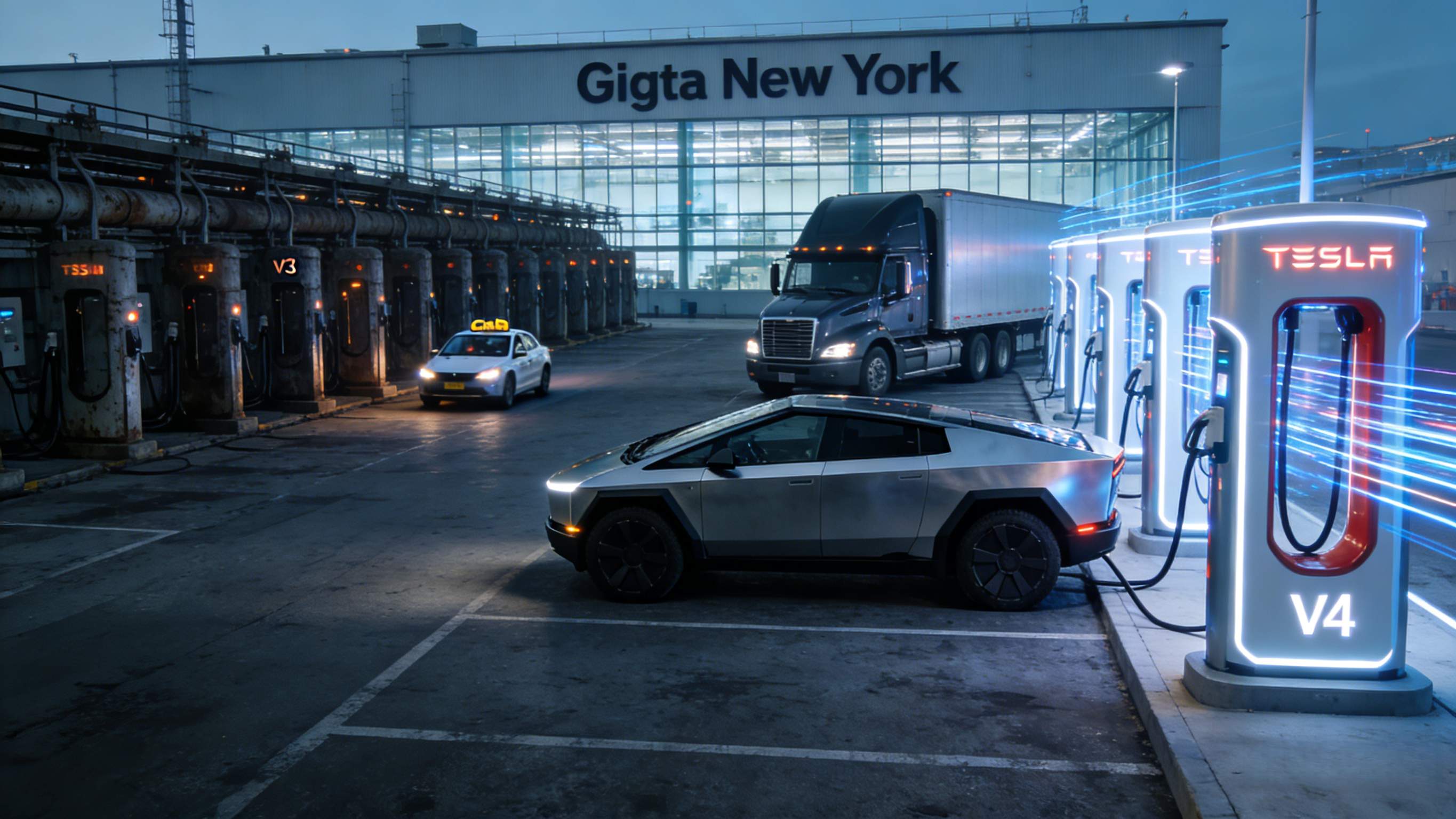
1. Introduction: The End of a Charging Era
On March 18, 2026, a quiet but monumental shift occurred at Giga New York. The final V3 Supercharger cabinet—the 15,482nd unit of its kind—rolled off the production line. With no fan-fare but immense strategic weight, Tesla officially retired the V3 architecture to transition the factory exclusively to V4 Supercharger production.
For the global Tesla community, particularly those in the high-density markets of the United States and the European Union, the V3 was the workhorse that made long-distance EV travel a mundane reality. However, as we enter the second half of the decade, the V3’s 250kW peak and 400V limitation have become the bottleneck for Tesla’s next generation of hardware. The "V4-Only" era is not just a hardware refresh; it is the activation of the 500kW ecosystem required for the Cybertruck, the Tesla Semi, and the upcoming "Cybercab."
2. Technical Superiority: V3 vs. V4 Architecture
To understand why Tesla is abandoning the V3, we must look under the "hood" of the charging cabinet. The V3 was designed in an era where the Model 3 and Model Y were the pinnacle of efficiency. The V4 is designed for a world of massive energy throughput.
2.1 The 1,000V High-Voltage Leap
The most significant limitation of the V3 was its 400-volt architecture. While sufficient for the current Model 3/Y fleet, it forces newer vehicles like the Cybertruck to use a "split-pack" charging method, which is efficient but adds complexity.
-
Native 800V/1000V Support: V4 cabinets are built with a native 1,000V architecture. This allows the Cybertruck and future 800V vehicles to pull maximum current without thermal throttling.
-
Peak Power: While V3 topped out at 250kW, the V4 cabinets are now rated for 500kW peak output per stall for passenger vehicles, and significantly higher for the Semi when using Megacharger-integrated V4 stacks.
2.2 Power Sharing and Busbar Efficiency
One of the common frustrations with V2 and early V3 stations was "power splitting"—when two cars charging next to each other would see their speeds drop.
-
The 1.2MW Cabinet: The new V4 "Super-Cabinets" produced at Giga New York feature a total power capacity of 1.2 Megawatts. This ensures that even if four Cybertrucks are plugged in simultaneously, each can pull a sustained high-rate charge without the "stall-sharing" slowdowns of the past.
3. The Global "Ubiquity" Strategy
Tesla’s move to V4-only production is heavily influenced by regulatory shifts in Europe and the United States (via the NEVI formula).
3.1 Longer Cables and Universal Access
European Tesla owners have long dealt with the "short cable" issue when non-Tesla EVs began using the network. The V4 solves this with a 3-meter (10-foot) cable, mounted on the outside of the stall.
-
Curb-Side Charging: This allows vehicles with charging ports on different corners (like the Porsche Taycan or Ford F-150 Lightning) to charge without taking up two parking spaces.
-
Integrated Payments: Compliance with the EU Alternative Fuels Infrastructure Regulation (AFIR) is now baked into the hardware. Every V4 unit rolling out of Giga New York now includes a built-in credit card reader and a small digital screen for price transparency, eliminating the "app-only" barrier for non-Tesla drivers.
4. Impact on the Existing Fleet: 400V vs. 800V
A common question among Model 3 and Model Y owners is: "Will my car charge faster on a V4?"
4.1 The Legacy Fleet (Model 3, Y, S, X)
For owners of the current 400V fleet, the V4 won't necessarily double your charging speed. Your car's internal Battery Management System (BMS) and the physical limits of its chemistry still cap out at roughly 250kW. However, the V4 offers better sustained curves. Because the V4 cables are liquid-cooled more efficiently and the cabinet has more "headroom," your car can stay at its 250kW peak for 5-10 minutes longer than it could on a V3, especially in high ambient temperatures.
4.2 The "Juniper" and "Highland" Factor
Rumors surrounding the 2026 Model Y Juniper refresh suggest a minor voltage bump. If Tesla moves the Model Y to a "mid-voltage" 500V system, the V4 infrastructure will be the only way to see the 30% reduction in "10%-to-80%" charging times that internal testers are currently reporting.
5. Conclusion: The Backbone of the Cyber-Economy
Tesla’s decision to retire V3 production marks the official transition from a "car company" charging network to a "global energy utility." By standardizing on V4, Tesla is preparing for a 2027-2030 roadmap where the Tesla Semi dominates short-haul logistics and the Cybercab operates 24/7.
The 500kW era isn't just about speed; it's about throughput. Higher speeds mean cars spend less time at the stall, which increases station turnover and, ultimately, Tesla's revenue per square foot of charging real estate. Giga New York is no longer just making chargers; it is building the fuel stations of the next century.
FAQ: What Every Owner Needs to Know
Q: Can I still use V3 stations if Tesla is only making V4 now?
-
A: Absolutely. Tesla will support the V3 network for at least another decade. The transition only affects new station installations and replacements.
Q: Does a V4 charger cost more to use?
-
A: Currently, Tesla maintains the same pricing per kWh across V3 and V4. However, some "Prime" V4 locations in Europe have introduced slightly higher "Peak Hour" fees due to their higher utility demand.
Q: When will my local V3 be upgraded to V4?
-
A: Tesla usually replaces cabinets only if they fail or if the site is being expanded. However, most new Supercharger sites permitted in 2026 will be V4 by default.