
Introduction
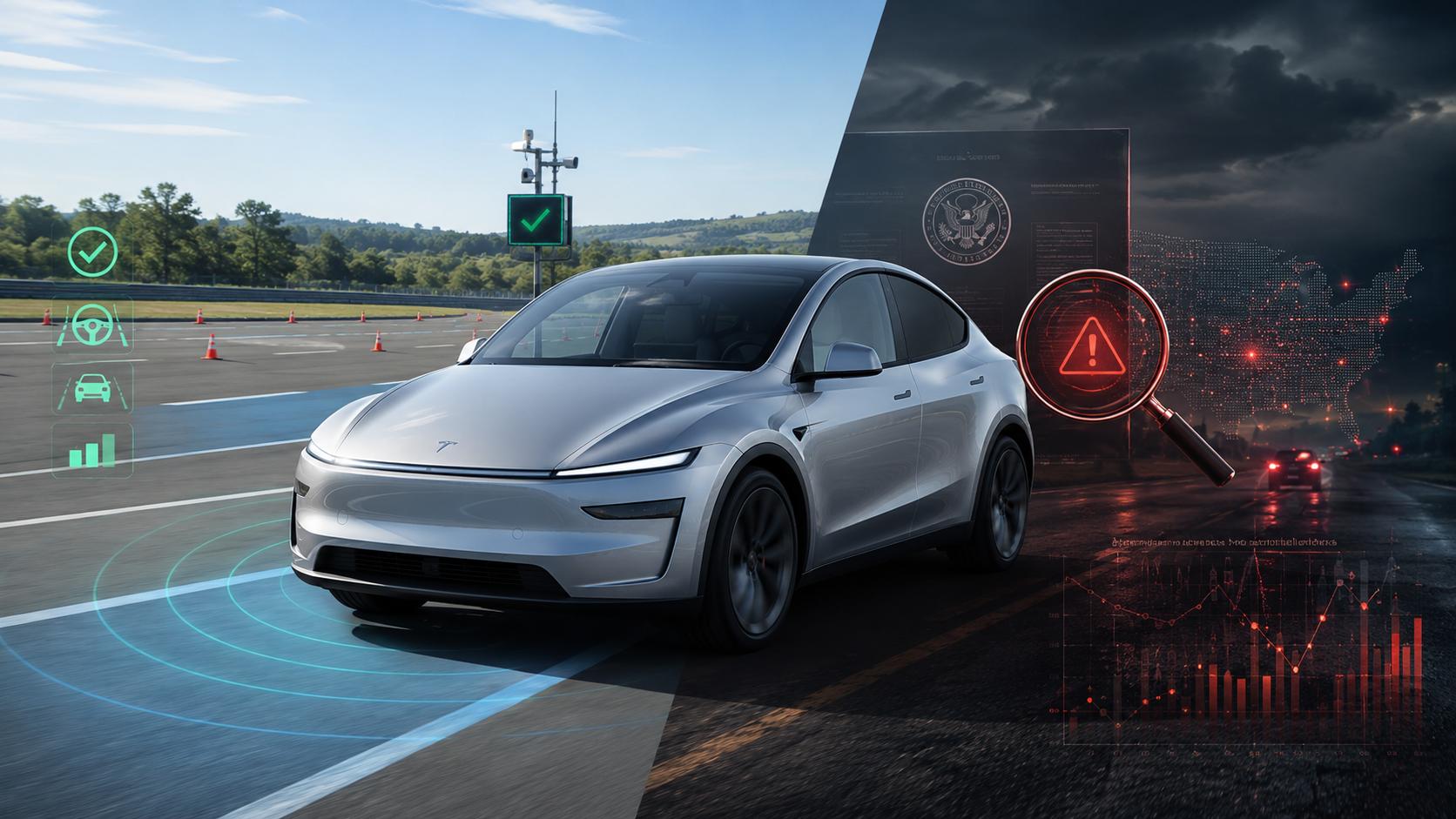
On May 7, 2026, the U.S. Department of Transportation‘s National Highway Traffic Safety Administration issued a press release that, on its surface, read like a straightforward victory for automotive safety. The 2026 Tesla Model Y, the agency announced, had become the first vehicle in the United States to pass NHTSA’s newly expanded Advanced Driver Assistance Systems benchmark under its New Car Assessment Program. The statement carried the weight of federal authority: “By successfully passing these new tests, the 2026 Tesla Model Y demonstrates the lifesaving potential of driver assistance technologies and sets a high bar for the industry,” declared NHTSA Administrator Jonathan Morrison.
But the press release‘s title — “Trump’s Transportation Department Announces Tesla Model Y Is the First Vehicle to Pass NHTSA‘s New ’Advanced Driver Assistance System‘ Tests” — hinted at something more complicated than a simple safety achievement. Government safety announcements rarely lead with a president’s name. The framing was unusual, and it invited scrutiny.
That scrutiny reveals a story far richer than the headline suggests. The Model Y‘s accomplishment is real: Tesla’s best-selling vehicle passed all eight ADAS evaluations — four legacy criteria and four newly added tests covering pedestrian automatic emergency braking, lane-keeping assistance, blind-spot warning, and blind-spot intervention. Yet the context surrounding this milestone complicates its meaning considerably. The tests evaluate foundational safety features that have been industry-standard equipment on dozens of vehicles for years. Tesla was the first to submit a vehicle for evaluation largely because the rest of the industry successfully lobbied to delay the testing deadline by a full year. And perhaps most strikingly, the same federal agency celebrating Tesla‘s basic ADAS capabilities is simultaneously conducting an engineering analysis — the final step before a potential mandatory recall — into the company’s Full Self-Driving system across approximately 3.2 million vehicles.
Section 1: What the Model Y Actually Passed — The Eight-Point ADAS Benchmark
To understand the significance of the Model Y‘s achievement, it is essential to understand precisely what NHTSA tested. The expanded New Car Assessment Program framework, finalized in late 2024 for model year 2026 vehicles, introduced four new pass/fail ADAS evaluations alongside the program’s four existing criteria. Together, these eight evaluations form what NHTSA describes as its new benchmark for vehicles equipped with advanced driver assistance systems.
The Four New ADAS Tests
Pedestrian Automatic Emergency Braking represents the most consequential addition to the testing regime. This system detects pedestrians in the vehicle‘s path and automatically applies emergency braking if the driver fails to react in time. Its inclusion reflects a grim statistical reality: pedestrian fatalities have risen sharply on American roadways in recent years, and the technology designed to prevent these tragedies has become a focal point for regulators. The U.S. government has already mandated automatic emergency braking as standard equipment on all new passenger vehicles starting in 2029, making this test a preview of coming compliance requirements.
Lane-Keeping Assistance evaluates the vehicle’s ability to actively steer itself to remain within lane markings, preventing unintentional drift — a critical safety net during highway driving and moments of driver inattention. The system must demonstrate that it can gently but effectively correct the vehicle‘s trajectory without overcorrecting or disengaging unexpectedly.
Blind-Spot Warning tests whether the vehicle alerts the driver through audio, visual, or haptic feedback when another vehicle occupies the driver’s blind spot during lane-change maneuvers. This addresses one of the most common accident scenarios on American highways: the unsignaled lane change into occupied space.
Blind-Spot Intervention goes a decisive step further. Rather than merely warning the driver, this system actively prevents the driver from steering into an occupied adjacent lane by applying gentle brake or steering corrections. It represents the cutting edge of ADAS capabilities — an interventionist safety net that overrides driver input when a collision is imminent. Until the updated NCAP framework, NHTSA had only recommended this technology; now it formally evaluates it.
The Four Legacy ADAS Criteria
The Model Y also passed NHTSA’s four original ADAS criteria: forward collision warning, which alerts drivers to impending frontal impacts; crash imminent braking, which automatically applies brakes when a collision is unavoidable; dynamic brake support, which supplements driver braking force during emergency stops; and lane departure warning, which alerts drivers when the vehicle drifts out of its lane without signaling. These tests have been part of the NCAP program for years and are widely considered the baseline for modern driver-assistance technology.
The Pass/Fail Framework
Critically, these tests operate on a binary pass/fail structure. They do not produce star ratings or percentage scores; they do not contribute to a vehicle‘s overall five-star safety rating, which remains based on traditional crashworthiness evaluations. A vehicle either meets the minimum performance benchmark, or it does not. This design is intentional — NHTSA wants to provide consumers with clear, unambiguous information about whether a vehicle’s safety systems function correctly. But it also means the tests establish a floor, not a ceiling. Passing them demonstrates competence, not excellence.
The Model Y vehicles that passed these tests were manufactured on or after November 12, 2025, and the results apply specifically to the 2026 model year. NHTSA confirmed that Tesla conducted its own testing and submitted the results to regulators for review — an arrangement the agency permitted for the 2026 model year, with plans to begin its own independent verification testing in the 2027 model year.
Section 2: The Industry Context — Why Tesla Was First
The fact that Tesla is the “first” automaker to pass these tests carries a significant qualifier that the press release did not emphasize. NHTSA finalized the updated NCAP criteria in late 2024 for implementation in model year 2026 vehicles. But in September 2025, the Trump administration delayed the full implementation by one year to model year 2027, after the Alliance for Automotive Innovation — the industry‘s main lobbying group, representing most major automakers — requested more time.
Tesla, notably, is not a member of the Alliance for Automotive Innovation. Neither are fellow pure-play electric vehicle manufacturers Rivian and Lucid. This meant that while the broader industry secured a regulatory reprieve, Tesla had no reason to wait. It submitted the Model Y voluntarily, ahead of the delayed timeline, and passed. It was, effectively, the only manufacturer to do so.
This context fundamentally reframes what “first” means. The Model Y being first to pass does not indicate that it is the only vehicle with these capabilities. Blind-spot warning, lane-keeping assistance, and pedestrian automatic emergency braking are standard or widely available on dozens of vehicles from Toyota, Hyundai, Honda, BMW, Volkswagen, and others. The difference is that those manufacturers have not yet submitted vehicles for evaluation under the new framework — not because they cannot pass, but because their own lobbying group successfully pushed the deadline back.
As Electrek noted in its coverage, Tesla‘s status as “first” is “largely a reflection of the fact they were the first to ask, rather than a strict verdict on their capabilities”. Automotive World framed the situation even more pointedly: the testing timeline was delayed at the request of the very industry group from which Tesla is excluded, creating a scenario where Tesla’s early submission was less a demonstration of superior technology than a function of regulatory timing.
This does not diminish the Model Y‘s accomplishment — it passed every test put before it, and that represents genuine engineering competence. But it does mean that consumers should not interpret “first to pass” as “only vehicle capable of passing.” The distinction matters because it speaks to how easily regulatory milestones can be misread as competitive advantages.
Section 3: The Political Framing — A Safety Announcement with Unusual Staging
The manner in which NHTSA made its announcement has drawn attention from automotive journalists and industry observers for reasons that extend beyond the test results themselves. The press release was headlined under Trump’s Transportation Department rather than NHTSA proper — a framing that is, in the words of one report, “highly atypical for a safety program communication”.
Government safety announcements typically focus on the safety program itself. The crash test results, the regulatory framework, the consumer information value — these are the standard elements of an NCAP communication. Leading with the president‘s name introduces a political dimension that is unusual for what is ostensibly a technical safety evaluation.
The political context surrounding this announcement is impossible to ignore. Tesla CEO Elon Musk held direct sway over federal government operations during his brief but consequential tenure as the de facto head of the Department of Government Efficiency, during which he conducted mass layoffs across the federal government. Many of the jobs lost were at NHTSA itself, and reporting at the time indicated that those overseeing autonomous driving were disproportionately affected by the cuts. Musk was relieved of his position several months into the second Trump administration, but the relationship between Tesla’s leadership and the regulatory apparatus remains a subject of intense public scrutiny.
NHTSA Administrator Jonathan Morrison‘s statement that the Model Y “sets a high bar for the industry” sits rather awkwardly against the fact that blind-spot warnings and pedestrian braking are industry-standard equipment on dozens of cars available today. Calling the bar “high” when the bar is literally blind-spot warnings — a feature that has been available on mainstream vehicles since the mid-2010s — struck many observers as generous framing. A Honda Civic priced at $25,000 includes lane-keeping assistance at no additional cost. These are not exotic technologies; they are table stakes for modern vehicle safety.
The political framing raises questions about whether this announcement was driven more by safety communication or by a desire to highlight Tesla — a company whose CEO’s relationship with the current administration has been well-documented and contentious in equal measure. For Tesla owners who care about the integrity of safety ratings, the staging of the announcement is a relevant piece of context. It does not invalidate the test results, but it does suggest that the storytelling around those results deserves careful examination.
Section 4: The Irony — Simultaneous FSD Investigation Across 3.2 Million Vehicles
Perhaps the most striking context surrounding the Model Y‘s ADAS milestone is what NHTSA is doing with its other hand. While the agency celebrates Tesla’s basic ADAS capabilities, it is simultaneously conducting an Engineering Analysis investigation into Tesla‘s Full Self-Driving system across approximately 3.2 million vehicles.
On March 18, 2026, NHTSA’s Office of Defects Investigation upgraded its probe into Tesla‘s FSD system to an engineering analysis — the final stage before the agency can pursue a mandatory recall. The investigation focuses on how the system performs in reduced-visibility conditions such as sun glare, fog, and dust. In multiple crashes reviewed by investigators, the agency found the system “did not detect common roadway conditions that impaired camera visibility and/or provide alerts when camera performance had deteriorated until immediately before the crash occurred”.
The scope of the investigation is vast. It covers an estimated 3,203,754 Tesla vehicles, including the 2016–2026 Model S and Model X, 2017–2026 Model 3, 2020–2026 Model Y, and 2023–2026 Cybertruck — essentially every Tesla equipped with Full Self-Driving capability.
The agency reported nine total incidents involving crashes or fires associated with visibility-related FSD performance, including one fatality and one injury. In each reviewed case, investigators found that the system either failed to detect a degraded state in time or did not issue alerts that would have allowed drivers to intervene. FSD also failed to detect or maintain tracking of lead vehicles in several of these incidents.
The investigation raises fundamental questions about Tesla‘s camera-only approach to autonomous driving, known as Tesla Vision, after the company removed radar sensors from its vehicles. NHTSA is evaluating whether that system, along with Tesla’s software designed to detect degraded camera performance, functions adequately under real-world conditions. The probe also examines whether Tesla‘s internal data and labeling limitations may have hindered consistent identification of crashes involving FSD visibility issues, potentially contributing to underreporting.
The coexistence of the ADAS celebration and the FSD investigation within the same agency, issued weeks apart, about the same company, creates an extraordinary paradox. As The Next Web observed, “The announcement celebrates Tesla for passing a test that measures whether a car can detect a pedestrian. The investigation examines whether Tesla’s cars can detect a pedestrian”. The distinction is the distance between what the tests measure and what the technology attempts.
This paradox is not merely rhetorical. It has real implications for how consumers, investors, and regulators should think about Tesla‘s safety narrative. The basic systems that earned the Model Y its “first to pass” designation — blind-spot warnings, lane-keeping assist, pedestrian automatic emergency braking — are not the systems at the center of the FSD investigation. Those basic systems are supplier-level technologies that have been refined across the industry for years. The investigation targets Tesla’s proprietary Full Self-Driving software, which operates at a level of autonomy that the ADAS tests do not assess.
This creates a situation where Tesla can legitimately claim to have passed the toughest ADAS tests ever applied by the federal government while simultaneously facing the most serious regulatory probe in its history for the very technology that defines its brand identity. Both realities are true, and both matter — but they tell very different stories about where Tesla‘s safety capabilities actually stand.
Section 5: The European Parallel — ADAS Acceptance and FSD Skepticism
The tension between basic ADAS competence and advanced autonomous ambition is not confined to the United States. In Europe, Tesla faces a regulatory landscape that mirrors the American situation in revealing ways — widespread acceptance of its driver-assistance fundamentals alongside deep skepticism about its Full Self-Driving aspirations.
European Safety Ratings: The Model Y’s Strong Foundation
The Model Y‘s safety credentials in Europe are well-established. Euro NCAP, the independent safety assessment program that serves as Europe’s equivalent to NHTSA‘s NCAP, has awarded the Model Y five-star overall ratings with strong percentage scores across all evaluation categories. The updated Model Y achieved a 91% score for Adult Occupant Protection, 93% for Child Occupant Protection, 86% for Vulnerable Road User Safety, and 92% for Safety Assist. These scores place the Model Y among the safest vehicles in its class and reflect genuinely strong performance in both crashworthiness and crash-avoidance categories.
The Euro NCAP Safety Assist score in the low 90% range reflects strong driver-assistance performance. This aligns with what NHTSA’s ADAS tests evaluated — the basic safety systems that help drivers avoid collisions in everyday driving scenarios. Across major crash-test programs worldwide, the Model Y earns top-tier scores, consistently ranking among the safest vehicles in its class.
The FSD European Approval Struggle
But while the Model Y‘s foundational safety systems earn praise from European regulators, Tesla’s more ambitious Full Self-Driving system faces substantial headwinds. On April 10, 2026, the Dutch vehicle authority RDW approved FSD (Supervised) for use on all Dutch roads, making the Netherlands the first European country to grant such approval. The approval followed 18 months of testing on both closed tracks and public roads and was intended to serve as a bridgehead for EU-wide authorization.
That bridgehead, however, has encountered serious resistance. According to email correspondence obtained by Reuters, officials in Sweden, Finland, Denmark, and Norway have raised substantive safety objections to FSD‘s approval. Swedish Transport Agency investigator Hans Nordin wrote that he was “quite surprised” to learn Tesla permitted FSD to exceed posted speed limits and said that should not be permitted. Finnish transport agency official Jukka Juhola asked pointedly whether Tesla was “really introducing a system that allows hands-free driving also on icy 80 km/h roads”.
These objections are rooted in a fundamental concern: FSD’s training data is heavily tilted toward Californian road conditions, not Nordic winter realities. The system‘s ability to handle speed limits, icy roads, and the kind of low-visibility conditions that NHTSA is simultaneously investigating remains unproven in the European context.
Regulators have also raised questions about branding. Several member states have questioned whether the “Full Self-Driving (Supervised)” name misleads drivers about the system’s actual capability levels. Tesla has been compelled to change its branding in multiple regions — most notably to “Intelligent Assisted Driving” in China — and recently dropped the “Autopilot” brand from its marketing materials in February 2026 to evade a 30-day sales and manufacturing ban in California.
The RDW‘s decision-making process has itself become a point of contention. The authority has not published the underlying research supporting its approval, and its General Manager publicly implored other regulators to “trust us on this, we tested it extensively” — a stance that sits poorly in a regulatory culture that expects technical determinations to be demonstrably reproducible. Several member states have indicated they will not move until documentation is available.
Dutch officials are presenting their case to the European Commission’s Technical Committee on Motor Vehicles, but an EU-wide vote — requiring approval from representatives of 55% of member states and 65% of the bloc‘s population — is not scheduled before July 2026 at the earliest. Tesla’s internal target of EU-wide approval in the second or third quarter of 2026 now rests on a committee outcome that leaked correspondence suggests is highly uncertain.
The European situation thus mirrors the American one with remarkable symmetry: Tesla‘s basic safety systems are widely respected and formally validated, while its autonomous ambitions face intensifying regulatory skepticism. The NHTSA ADAS milestone and the Euro NCAP five-star ratings tell one story; the FSD investigations on both continents tell another. Understanding Tesla’s safety position requires holding both narratives in view simultaneously.
Section 6: What This Milestone Actually Means for Tesla Owners
For current and prospective Tesla owners — particularly those in the United States and Europe who are the audience for this analysis — the Model Y‘s NHTSA ADAS milestone carries several practical implications that deserve careful consideration.
What the Milestone Confirms
The test results provide federal validation that the Model Y’s foundational safety systems function correctly under standardized testing conditions. For families shopping for the safest SUV on the market, this government-verified credential offers a data-backed point of comparison against competitors. It is not marketing hype; it is a regulatory determination backed by testing protocols.
The milestone also reinforces what independent safety assessments have consistently shown: the Model Y is a structurally safe vehicle with strong crash-avoidance fundamentals. The IIHS rates the Model Y‘s crashworthiness as Good — its highest rating — across multiple impact types. Euro NCAP gives it five stars with scores in the 90% range across occupant protection categories. The NHTSA ADAS tests add another layer of formal validation to this picture.
For insurance purposes, vehicles that pass these ADAS tests may qualify for lower premiums, as insurers increasingly factor verified crash-avoidance technology into their risk models. Owners who carry comprehensive coverage should inquire with their providers about whether the NHTSA ADAS designation affects their rates.
What the Milestone Does Not Confirm
Critically, the ADAS tests do not evaluate Tesla’s Autopilot or Full Self-Driving capabilities. They do not measure how the vehicle performs when operating with autonomous features engaged. They measure whether the vehicle‘s basic safety systems — the features that activate when a human is driving — function correctly.
The tests are also fundamentally limited in scope. They assess performance under controlled conditions, not the chaotic variability of real-world driving. A vehicle that passes pedestrian automatic emergency braking tests in a laboratory setting may perform differently at night, in rain, or when the pedestrian emerges from behind an obstruction. The tests establish baseline competence, not real-world reliability.
Furthermore, the pass/fail structure means that consumers have no way to distinguish between a vehicle that barely met the minimum standard and one that dramatically exceeded it. The Model Y achieved an NCAP score above 95% under the 6.0 program, which is genuinely strong — but the pass/fail format flattens this distinction in public-facing communications.
The FSD Reality Check
For owners who use or are considering subscribing to Full Self-Driving — which shifted to a $99/month subscription-only model in February 2026 — the simultaneous FSD investigation is directly relevant to their safety calculus. The engineering analysis focuses on precisely the kind of conditions that real drivers encounter: sun glare on morning commutes, fog on coastal highways, dust on rural roads. These are not edge cases; they are everyday driving scenarios.
NHTSA’s finding that the system “did not detect common roadway conditions that impaired camera visibility” in multiple crashes should give any FSD user pause. The system‘s limitations in reduced-visibility conditions are not theoretical — they have been documented in federal investigation reports linked to real crashes, real injuries, and a real fatality.
This does not mean FSD is unsafe to use. Tesla’s own safety data indicates that vehicles operating with Autopilot engaged experience fewer crashes per mile than the U.S. average — according to Tesla‘s reporting, one crash every 8.52 million kilometers with Autopilot engaged compared to the U.S. average of one crash every 1.0 million kilometers. But aggregate statistics can obscure specific failure modes, and the FSD investigation targets precisely those failure modes.
The Practical Takeaway for Owners
The responsible interpretation of the NHTSA milestone is this: the Model Y has demonstrated that its basic safety systems — the ones that protect you when you are driving — meet federal performance standards. This is genuinely good news, and it reinforces the vehicle’s position as one of the safest SUVs available. But it says nothing about the safety of the autonomous features that Tesla markets as its defining technological advantage. For those features, the regulatory story is still being written — and the current chapter is an engineering analysis, not a press release.
Section 7: The Bigger Picture — What NHTSA‘s ADAS Testing Signals for the Auto Industry
The Model Y’s milestone is not just about Tesla. It signals a broader shift in how vehicle safety is evaluated, regulated, and communicated to consumers — a shift that will affect every automaker and every car buyer in the years ahead.
The Regulatory Trajectory: From Crash Survival to Crash Prevention
For decades, vehicle safety regulation focused overwhelmingly on crashworthiness: how well a vehicle‘s structure, restraints, and airbags protect occupants when a collision occurs. Frontal-impact tests, side-impact tests, rollover evaluations — these formed the backbone of NCAP programs worldwide.
NHTSA’s expanded ADAS tests represent a decisive pivot toward crash prevention. The agency is now formally evaluating how well vehicles can avoid accidents altogether, not just how well they protect occupants when collisions happen. This shift reflects both technological progress — the systems exist now, whereas they did not twenty years ago — and a recognition that preventing crashes is inherently superior to surviving them.
NHTSA has indicated that this is just the beginning. The agency‘s 10-year roadmap for NCAP includes additional improvements currently under consideration, and next year two more tests will be added for automatic emergency braking and pedestrian versions of the same test at both day and night. The trajectory is clear: ADAS evaluation will become increasingly sophisticated, increasingly demanding, and increasingly central to how safety ratings are determined.
Competitive Pressure: The Bar Will Rise for Everyone
For other automakers, the Model Y’s “first to pass” designation — whatever its contextual caveats — creates competitive pressure. When the testing deadline arrives in model year 2027, every manufacturer will be expected to have vehicles capable of passing these evaluations. Those that do not will face the uncomfortable reality of marketing vehicles that failed government safety tests.
The list of vehicles NHTSA has selected for 2026 crash testing provides a window into the competitive landscape. Alongside the Tesla Model Y Long Range, the agency has selected the Rivian R1S, Hyundai Ioniq 5, Ford F-250, Toyota RAV4 Hybrid, Nissan Sentra, and several others for verification testing. These vehicles represent a cross-section of the market — electric and internal combustion, domestic and imported, trucks and sedans and SUVs. Their performance on these tests will establish the competitive baseline.
Expect a wave of ADAS-focused marketing from legacy brands as they seek to match Tesla‘s achievement. But expect also that many will clear the bar — because the bar, as noted, reflects technology that is already widely deployed. The real differentiation will come not from whether automakers can pass these tests, but from how their more advanced systems perform in the more demanding evaluations that NHTSA’s roadmap envisions.
The Software-Defined Safety Era
The NHTSA ADAS milestone reinforces a broader industry trend that extends well beyond any single automaker: safety is increasingly a software problem, not just a hardware one. The systems evaluated — pedestrian detection, lane-keeping, blind-spot intervention — are software-driven. They depend on sensor fusion, computer vision algorithms, and real-time decision-making code. Improvements to these systems can be deployed through over-the-air updates, meaning that a vehicle‘s safety capabilities can improve over time without physical modification.
Tesla’s over-the-air update capability gives it a structural advantage in this new paradigm. When NHTSA identifies a safety-relevant software issue, Tesla can deploy a fix to its entire fleet remotely — a capability that traditional automakers are still developing. But this advantage cuts both ways: the same OTA capability that enables rapid safety improvements also means that safety-relevant defects can be introduced to millions of vehicles simultaneously, which is precisely the scenario that NHTSA‘s FSD investigation is designed to address.
For consumers, the software-defined safety era means that safety ratings will need to be understood as dynamic rather than static. A vehicle that earns top marks today may perform differently after a software update — for better or for worse. This is unfamiliar territory for a regulatory system designed around physical crash tests that produce stable, enduring results.
Section 8: Conclusion — A Milestone Worth Acknowledging, Not Celebrating
The 2026 Tesla Model Y’s achievement as the first vehicle to pass NHTSA‘s expanded ADAS benchmark is real and merits acknowledgment. Tesla’s engineering teams have produced a vehicle whose foundational safety systems — the ones that activate in the critical milliseconds before a potential collision — meet federal performance standards under controlled testing conditions. For the families who rely on these vehicles for daily transportation, this is meaningful information.
But the milestone deserves acknowledgment rather than celebration, because the context surrounding it is too complex for triumphalism. Tesla was first to pass largely because the rest of the industry successfully lobbied for a delay that Tesla, as a non-member of the Alliance for Automotive Innovation, had no reason to observe. The tests evaluate features that are standard equipment on vehicles costing half as much. The press release announcing the achievement was staged with unusual political framing. And the same agency issuing the congratulations is simultaneously investigating whether Tesla‘s more ambitious autonomous technology can safely detect the very pedestrians its basic systems are now certified to protect.
The European situation adds a parallel dimension. The Model Y’s Euro NCAP five-star ratings confirm what NHTSA‘s ADAS tests suggest: Tesla builds fundamentally safe vehicles with strong crash-avoidance fundamentals. But the FSD approval struggle in Europe — with multiple member states raising substantive safety objections and the Dutch bridgehead proving far from sufficient — demonstrates that basic safety competence does not automatically translate into advanced autonomy readiness.
For Tesla owners in the United States and Europe, the responsible takeaway is nuanced. The vehicle you drive has passed safety tests that no other vehicle has yet been formally evaluated against. Its basic protective systems — the ones that work while you are driving — have been validated by the toughest regulators in the business. But the autonomous features that Tesla markets as the future of transportation remain under active federal investigation, and the outcome of that investigation will say far more about the company’s safety trajectory than any pass/fail test of blind-spot warnings.
The road to truly autonomous driving is paved with incremental milestones, and this is one of them — a real step forward on a journey whose destination remains uncertain. The Model Y has proven it can pass the tests that exist today. Whether Tesla‘s more ambitious systems can pass the tests that are still being written is a question that regulators on two continents are, quite appropriately, still working to answer.
FAQ
Q: What exactly did the Model Y pass?
A: The 2026 Tesla Model Y (vehicles manufactured on or after November 12, 2025) passed all eight ADAS evaluations under NHTSA’s updated New Car Assessment Program: four new tests (pedestrian automatic emergency braking, lane-keeping assistance, blind-spot warning, blind-spot intervention) and four legacy tests (forward collision warning, crash imminent braking, dynamic brake support, lane departure warning).
Q: Does this mean the Model Y is the safest car on the road?
A: The milestone confirms that the Model Y‘s basic driver-assistance systems meet federal performance standards. However, the tests evaluate foundational safety features that are standard on many vehicles. The Model Y is certainly among the safest vehicles available — supported by IIHS Good ratings and Euro NCAP five-star scores — but “first to pass” does not mean “only vehicle capable of passing.”
Q: Why was Tesla the first if these features are common?
A: The Alliance for Automotive Innovation successfully lobbied to delay the mandatory testing deadline from model year 2026 to model year 2027. Tesla, which is not a member of this lobbying group, submitted the Model Y voluntarily ahead of the delayed timeline. Most other automakers have not yet submitted vehicles because they were told they did not yet need to.
Q: Is NHTSA investigating Tesla’s Full Self-Driving system?
A: Yes. NHTSA upgraded its investigation into Tesla‘s FSD system to an Engineering Analysis on March 18, 2026 — the final stage before a potential mandatory recall. The probe covers approximately 3.2 million vehicles and focuses on FSD’s performance in reduced-visibility conditions such as sun glare, fog, and dust. Nine incidents have been identified, including one fatality.
Q: Does the ADAS milestone affect my vehicle‘s five-star safety rating?
A: No. The ADAS tests operate on a pass/fail basis and do not contribute to a vehicle’s overall five-star safety rating, which remains based on traditional crashworthiness evaluations. The pass/fail results appear as checkmarks on NHTSA‘s website.
Q: How does this relate to FSD approval in Europe?
A: The Model Y’s basic safety systems have been validated by Euro NCAP with five-star ratings and strong Safety Assist scores. However, Tesla‘s FSD system faces significant regulatory resistance in Europe. The Netherlands approved FSD in April 2026, but multiple Nordic countries have raised safety objections, and EU-wide approval is not expected before July 2026 at the earliest.
Q: Will these tests affect my insurance premiums?
A: Possibly. Vehicles with verified ADAS capabilities may qualify for lower insurance premiums, as insurers increasingly factor crash-avoidance technology into their risk models. Owners should check with their insurance providers about whether the NHTSA ADAS designation affects their rates.
Q: Are other automakers expected to pass these tests?
A: Yes. The features evaluated are widely deployed across the industry. When the mandatory testing timeline arrives in model year 2027, most major automakers are expected to have vehicles capable of passing. The real differentiation will come from how vehicles perform on more demanding evaluations that NHTSA plans to introduce in subsequent years.