
Introduction: The Forced Evolution of "Autopilot"
On March 6, 2026, Tesla owners across North America woke up to a subtle but profound transformation in their vehicle’s user interface. With the fleet-wide rollout of Software Version 2026.2.9, the term "Autopilot"—a brand name that has defined Tesla’s technological identity for over a decade—began to vanish.
This is not a mere marketing refresh. It is a calculated retreat and a strategic pivot forced by a multi-year legal battle with the California Department of Motor Vehicles (DMV). After facing a 30-day suspension of its manufacturing and dealer licenses in its most critical U.S. market, Tesla has officially begun purging "misleading" nomenclature from its vehicles. Today, we dive deep into why your car now says "Navigate on Autosteer" instead of "Navigate on Autopilot," and what this means for the future of Tesla’s autonomy.
Section 1: The Regulatory Battlefield—The California DMV vs. Tesla
The catalyst for this change was a definitive ruling by California's Office of Administrative Hearings in late 2025. Regulators argued that Tesla’s use of "Autopilot" and "Full Self-Driving" (FSD) violated state laws regarding false advertising.
The 60-Day Ultimatum
The DMV’s findings were blunt: the term "Autopilot" implies a level of autonomy (Level 3 or higher) that the car’s current hardware and software (Level 2) cannot legally or technically fulfill. Tesla was given a choice:
-
Face a 30-day sales ban in California, which would have shuttered showrooms from Palo Alto to Los Angeles.
-
Take "corrective action" to remove or qualify the branding to ensure drivers are not misled into thinking the car is autonomous.
Tesla chose the latter, but not without a fight. Even as the 2026.2.9 update rolls out, Tesla’s legal team filed a lawsuit on February 24, 2026, against the DMV, arguing that the agency "wrongfully and baselessly" labeled the company a false advertiser without proving actual consumer confusion.
Section 2: Technical Breakdown—The 2026.2.9 Terminology Shift
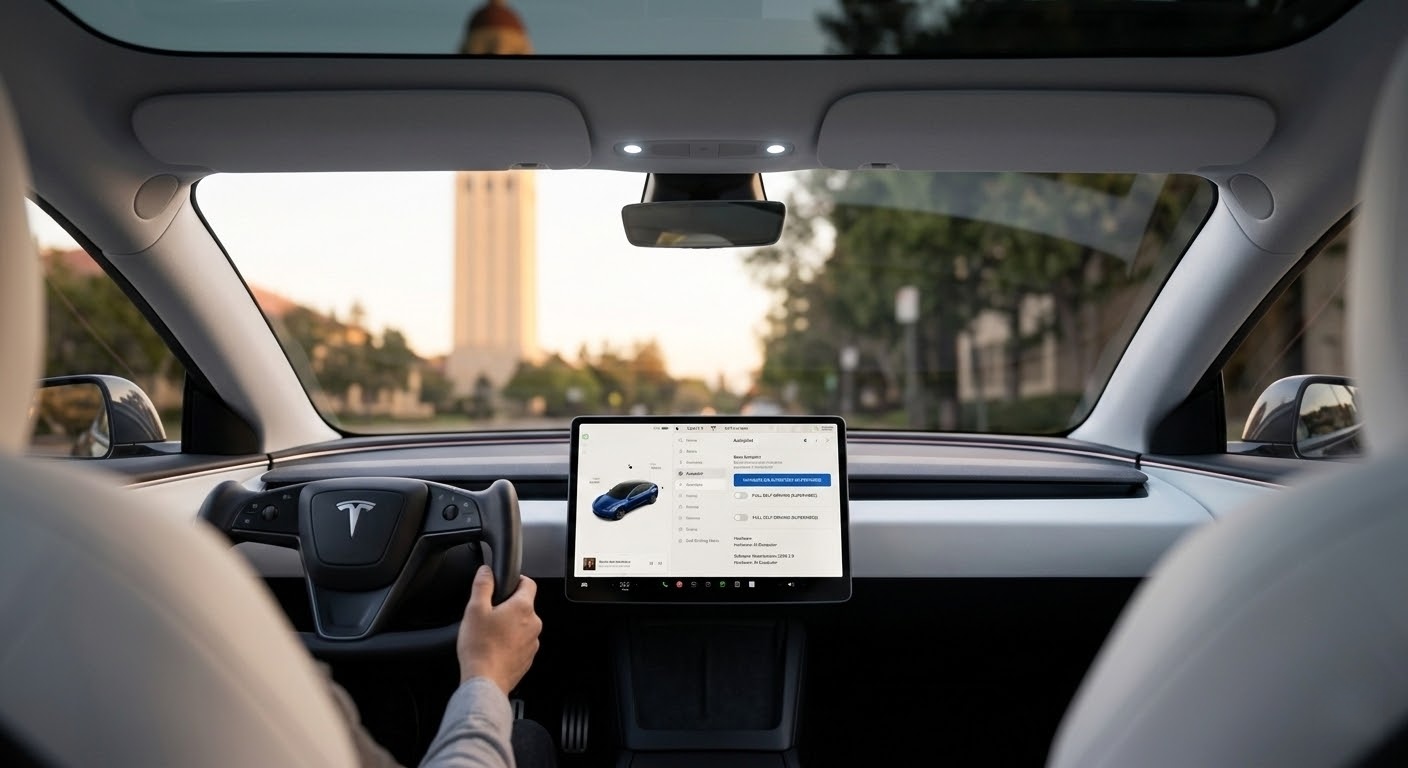
What actually changed inside your car? While the code governing the car’s neural networks remains untouched in this specific update, the Text and UI Strings have been systematically overhauled.
Key Nomenclature Changes
| Old Terminology | New Terminology (v2026.2.9) | Implications |
| Navigate on Autopilot | Navigate on Autosteer | Shifts focus from "piloting" to "steering assistance." |
| FSD Computer | AI Computer | Rebrands hardware as a general-purpose AI processor. |
| Autopilot Menu | Self-Driving Menu | Consolidates branding under the "Self-Driving" umbrella. |
| "Autopilot Disengaged" | "Self-Driving Disengaged" | Standardizes the voice/text prompt for takeovers. |
Does the behavior change?
Tesla’s official release notes state: "This change only updates the name of certain features and text in your vehicle, and does not change the way your features behave." The car still uses the same V14.2 end-to-end neural networks to change lanes and navigate interchanges. However, by removing the "Pilot" suffix, Tesla is shielding itself from liability by framing the system as a specialized steering tool rather than a surrogate driver.
Section 3: The Death of "Basic Autopilot" and the Subscription Push
Concurrent with the branding shift, Tesla has fundamentally restructured its ADAS (Advanced Driver Assistance Systems) business model in early 2026.
The End of the "Free" Tier
For years, every Tesla came with "Basic Autopilot" (Autosteer and TACC) for free. As of January 23, 2026, new Model 3 and Model Y orders only include Traffic-Aware Cruise Control (TACC).
-
The Nudge: If you want your Tesla to center itself in a lane—a feature now standard on a $20,000 Toyota—you must now subscribe to FSD (Supervised) for $99/month.
-
The SaaS Pivot: By removing "Autosteer" from the base package, Tesla is forcing a migration toward FSD. This ensures that every car on the road is running the same "Unified Stack," simplifying the data-collection process for their "10 billion mile" training goal.
Section 4: Consumer Perception and the "Mode Confusion" Risk
The core of the DMV's argument rests on Mode Confusion. This occurs when a driver overestimates a system's ability—for example, assuming that "Navigate on Autopilot" can handle a sudden construction zone or a faded lane marking without intervention.
The Psychology of "Autosteer"
By renaming the feature to "Navigate on Autosteer," Tesla is using a more literal and less evocative term. "Steering" is a physical action that most drivers understand requires monitoring. "Piloting" suggests an oversight role where the machine handles the complexity.
-
Safety Data: Early telemetry from 2026 suggests that drivers using the "Self-Driving (Supervised)" label are 12% more likely to keep their hands on the wheel compared to those using legacy "Autopilot" branding.
Section 5: Conclusion—The Path Toward Unsupervised Autonomy
Tesla’s decision to drop the "Autopilot" name is a strategic retreat to win the larger war. By complying with California’s DMV, Tesla avoids a catastrophic sales disruption and aligns its branding with the reality of Level 2 supervision.
However, the ultimate goal has not changed. The rebranding of the "FSD Computer" to the "AI Computer" hints at a future where the vehicle is not just a car, but a node in a global AI network. As Tesla reaches its target of 10 billion miles of training data later this year, the "Supervised" tag may eventually be dropped—but for now, the era of the "Pilot" is over, and the era of the "AI Steer" has begun.
FAQ
Q: If my car says "Navigate on Autosteer," did I lose any features?
A: No. Your car will still take highway exits, change lanes, and follow your GPS route exactly as it did before. Only the text on the screen has changed.
Q: I have an older Tesla with "Full Self-Driving Capability." Will my hardware name change?
A: Yes. Under the 'Software' tab in your car’s settings, the hardware previously listed as "Full Self-Driving Computer" will now be labeled as "AI Computer."
Q: Why is Tesla still suing the DMV if they already changed the names?
A: Tesla wants to clear its name of the "false advertiser" label. Being labeled as such by a government agency makes them vulnerable to class-action lawsuits and complicates their regulatory filings in Europe and China.
Q: Does this affect the $99/month subscription?
A: Indirectly. Tesla is focusing all its marketing on the "Self-Driving (Supervised)" subscription. The renaming is part of a move to make FSD the only available suite for advanced steering features.