
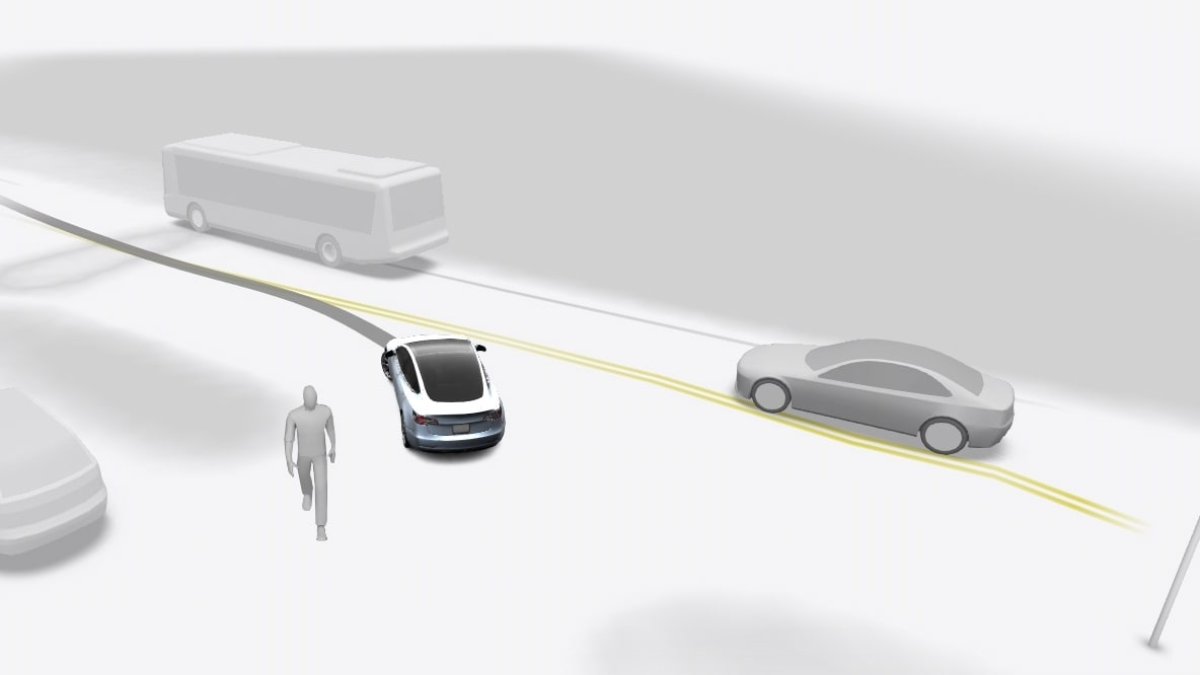
Today’s headlines around Tesla center on two tightly linked developments: a major step in Tesla’s Full Self-Driving (FSD) software evolution (marketed as a big parameter/architecture upgrade) and increasingly assertive timelines for the company’s Robotaxi service. Tesla has opened its Robotaxi app more broadly, piloted ride services in places such as Austin and parts of the Bay Area, and Elon Musk has publicly set an ambitious target to remove safety drivers from Robotaxi operations by the end of 2025. For owners — whether you’re in the US or Europe — these moves affect perceived vehicle value, insurance considerations, and how the company’s strategy might shift away from standalone car sales to mobility services.
1) What Tesla is claiming with FSD “V14” — breaking the jargon down
Tesla’s recent public messaging frames the latest FSD iteration as a step-change — described in headlines as a multi-fold increase in model parameters and an architectural upgrade intended to push the stack closer to unsupervised autonomy. In plain terms: Tesla is scaling the size and complexity of its neural networks (the internal mathematical models that map camera input to driving decisions) and increasing the compute and training resources behind them. The company argues this will produce better perception and planning in complex urban environments.
Why this matters for owners:
-
User experience: Improvements in perception (detecting pedestrians, signs, other vehicles) should directly reduce false alarms and sudden driver interventions — if the models live up to claims.
-
Software-defined features: Tesla historically delivers new capability via OTA updates; owners may see incremental improvements without hardware upgrades unless Tesla requires new compute modules.
-
Expectations vs. reality: Bigger models (more parameters) can capture more complex patterns but also require more extensive, cleaned training data and validation. “Bigger” is not a guarantee of safer operation; how the model performs in rare edge cases is the critical metric.
How to read vendor claims: marketers will highlight parameter counts and “10x” increases; the real proof is in field metrics — intervention rates per mile, disengagement studies, and peer-reviewed safety analyses.
2) Robotaxi today: pilots, the app, and the safety driver debate
Where Robotaxi operates now
Tesla’s Robotaxi pilot footprint has been limited but expanding. Public reporting shows pilot services live for limited rides in Austin and restricted tests in the Bay Area; the Robotaxi app has been pushed to more users (iOS initially), allowing signups and waitlists. However, the service in its public stage still operates with human supervision in different forms — either safety monitors in the passenger seat or drivers on certain routes.
Safety driver vs safety monitor
There is an important operational distinction: a “safety driver” typically sits in the driver’s seat ready to take manual control; a “safety monitor” may ride in the passenger seat monitoring system behavior and intervening less directly. Tesla’s stated plan — removing the safety driver altogether from Robotaxis — would be a major operational shift and requires overcoming regulatory, technical and insurance barriers. Elon Musk has publicly said the safety driver should be gone by year-end, reflecting an aggressive rollout ambition.
What ‘no safety driver’ practically implies
-
Full remote monitoring capabilities or redundant safety systems must be present.
-
Regulatory acceptance (state or national) of the system as safe to operate without a human on board.
-
Mature incident response and monitoring centers to handle edge cases and possible interventions.
Practical caveat: even if Tesla removes in-car safety drivers, many jurisdictions will still require formal approval. So for US and European owners, “no safety driver” does not mean immediate nationwide deployment.
3) Regulatory landscape: US states, federal oversight, and Europe
United States
-
Federal: NHTSA retains investigatory power and can demand data for crashes or systemic problems; federal scrutiny intensifies as robotaxi pilots expand.
-
State: US rollout is subject to state-level rules — Texas has enabled certain pilot permissions that made Austin an early Robotaxi hub; California and others currently have stricter frameworks and are more cautious. This patchwork will drive where Robotaxi scales quickly.
Europe
-
The EU and member states approach AVs cautiously, with rigorous processes for type-approval, occupant protection and liability frameworks. Any large-scale robotaxi rollouts in the EU would require significant regulatory coordination and likely incremental approvals country-by-country.
Liability & insurance
-
The transition from a human-in-the-loop to a software-responsible vehicle changes the legal picture. Initially, Tesla operates under an asset-operator model (the company or contractor provides the taxi service), which shifts liability to the operator for ride incidents. However, national laws and insurers will determine legal outcomes case by case.
4) Safety evidence, public trust and measurable metrics
To evaluate FSD and Robotaxi performance, stakeholders look for objective metrics:
-
Interventions per 1,000 miles (how often a human must intervene)
-
Incidents per vehicle-mile (crashes, near-misses)
-
False positive & false negative rates for perception (e.g., misclassifying a cyclist)
-
Edge-case performance (construction zones, unusual weather, complex city traffic)
Independent analysts and data aggregators (crowd-sourced and third-party) provide some evidence, but the most authoritative data would come from regulated disclosure and third-party audits. Tesla publishes selective safety claims, but independent validation remains crucial. In public discourse, videos and anecdotal reports shape perception strongly — and those can amplify rare failures even where overall metrics look good.
For owners: trust is built on demonstrable long-term reliability, not single demos. Watch for municipalities and regulators requiring black-box data transmissions or independent audits — those will be signals of maturing trust.
5) User & market impacts: resale values, FSD purchasing choices, and daily ownership
Resale & value
If Tesla’s unsupervised FSD arrives and achieves meaningful capability, vehicles with the feature (or that are eligible for it) could command higher resale prices — as FSD becomes an income-yielding capability (e.g., shared Robotaxi use or subscription income). Conversely, regulatory setbacks or a problematic rollout could depress perceived value. Investors already price in robotaxi potential; owners should monitor market signals, but avoid speculative purchases solely for future RBC (robotaxi business case).
Should owners buy FSD now? — guidance for readers:
-
If you value incremental driver-assist improvements now (adaptive lane changes, smoother city handling): buying/subscribing may make sense.
-
If your motivation is earning from Robotaxi fleet use: wait — the mechanics of enrolling private cars into fleets, compensation models, and insurance terms are still unresolved in many jurisdictions.
-
Subscription vs one-time purchase: evaluate cost over ownership horizon; Tesla has been promoting subscriptions that mitigate upfront cost.
Daily ownership changes
-
Expect more frequent OTA updates: owners should get comfortable with regular software maintenance and occasional behavior changes after updates.
-
Maintenance & warranties: higher autonomy may shift service patterns (e.g., sensor calibration, camera cleaning) and Tesla service policies.
6) Competitors & broader context: Waymo, Cruise and the race for driverless services
Tesla is not alone. Waymo and Cruise have taken more conservative, heavily instrumented and local-regulatory-friendly paths: Waymo operates driverless rides in multiple cities with a long safety-validation process; Cruise also runs services in limited geofenced areas. Tesla’s approach favors rapid fleet learning via scale and OTA model updates using vision-first sensors. The result: a strategic contrast — Tesla bets on scale and fast iteration; others emphasize redundant sensors and more conservative regulatory engagement. This difference has real implications for speed of deployment, the types of environments each system can handle, and how regulators treat them.
7) Practical checklist for owners (US & Europe)
-
Stay informed: follow NHTSA, local transport authority updates and Tesla’s own release notes.
-
Monitor insurance: ask your insurer how FSD and ride-hailing use affects premiums and coverage.
-
Audit OTA updates: keep logs of updates and any requested diagnostic uploads (useful for later warranty/regulatory evidence).
-
Community data: engage with owner forums and aggregated data projects to track intervention rates and real-world performance.
-
Decide on FSD purchase rationally: consider present value (driver assistance today) versus speculative future income.
8) Where to watch next (3–6 week signals)
-
Regulatory approvals/denials in major states or EU member states (legal decisions will set pace).
-
Independent safety audits or NHTSA requests for data (would indicate federal scrutiny).
-
Actual commercial rollouts expanding to new cities beyond Austin/Bay Area — that’s a scale signal.
-
Metrics disclosure (intervention rates broken down by geography and use case).
9) Conclusion
Tesla’s FSD and Robotaxi efforts are at a high-visibility inflection point. The company’s announcements and timelines are aggressive and potentially transformative — but they remain contingent on both technical performance in the real world and regulatory approvals in multiple jurisdictions. For US and European owners, the prudent approach is to stay informed, treat current FSD as an evolving driver-assist platform rather than guaranteed driverless autonomy, and be cautious about speculative purchases solely for future robotaxi revenue. When the objective metrics and regulatory frameworks converge, only then will the true user-facing benefits — and risks — be clear.
FAQ (short)
Q: Will Tesla owners be forced to enroll their cars in Robotaxi fleets?
A: No evidence of forced enrollment exists. Fleet participation is a commercial decision and will require explicit opt-in, with legal and insurance terms set by Tesla and local regulators.
Q: If I buy FSD now, will my car be eligible for Robotaxi use later?
A: Not automatically — eligibility and commercial use rules depend on region, Tesla’s fleet policies, and local laws.
Q: Should EU owners expect the same rollout speed as the US?
A: Unlikely; EU approvals and a more cautious regulatory stance mean slower rollout in many European countries.
Q: What should I do about insurance if I subscribe to FSD?
A: Contact your insurer immediately; some firms require disclosure of advanced driver-assist usage and may adjust premiums.